🦁 Macaw
🧾 Quick Facts
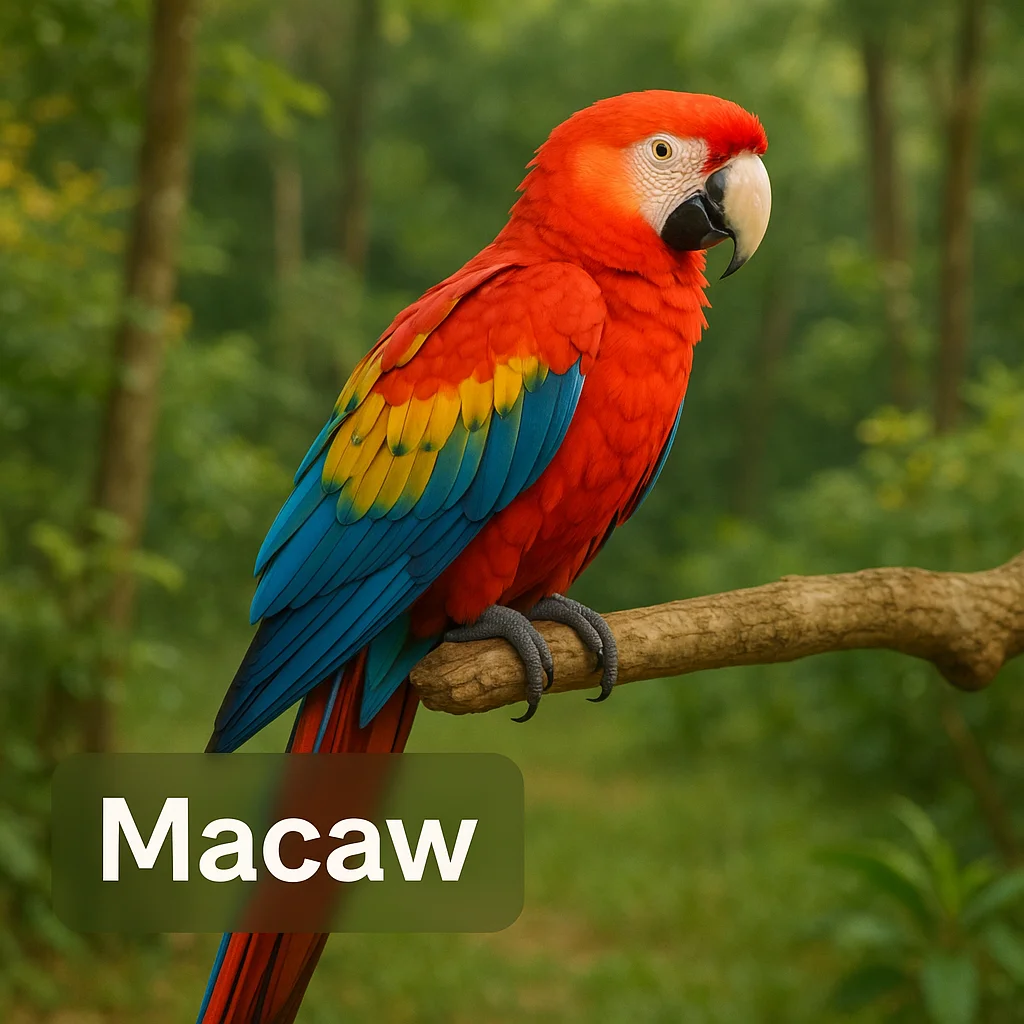
The macaw is a captivating member of the parrot family, known for its vibrant plumage and social behavior. These birds are often the centerpiece of many tropical forests, where they add splashes of color and excitement.
- Common name(s): Macaw
- Scientific name: Genus Ara, Anodorhynchus, Primolius, and others
- Animal type: Bird
- Typical adult size: Length 30–100 cm (12–39 inches), weight 300 g to 1.2 kg (0.66–2.65 lbs)
- Typical lifespan: 30–50 years in the wild, up to 80 years in captivity
- Diet type: Herbivore; fruits, nuts, seeds
- Activity pattern: Diurnal
- Social structure: Pairs or small groups
- Speed / movement highlights: Strong fliers, highly maneuverable in forested areas
- Intelligence/learning: Highly intelligent, known for problem-solving and mimicry
- Primary habitats: Tropical and subtropical forests
- Geographic range: Central and South America
- Predators/threats: Raptors, snakes, habitat loss, and the pet trade
- Conservation status: Varies by species; some are endangered
🔍 Identification & Appearance
Macaws are easily recognizable due to their large size and strikingly colorful feathers. They feature long tails and strong, curved beaks. Their plumage can be a spectrum of colors, including blue, red, green, and yellow. Most species have bare facial patches that help in differentiation.
- Body shape and silhouette: Large, with elongated tail and broad wings
- Key colors/patterns: Varies; often vibrant with combinations of primary colors
- Distinctive features: Large hooked beak, often bare face patches
- Tracks/scat: Rarely documented; cockatoo-like droppings
- Common look-alikes: Other large parrots; distinguish by size and bare facial skin
- Top ID Tips
- Look for vibrant plumage colors
- Notice the large size and long tail
- Check for bare facial patches
- Observe the strong, curved beak
- Listen for their loud, distinct calls
- Spot soaring flight in forest canopies
🧱 Body Structure & Physical Adaptations
Macaws boast a robust body structure tailored for life in the forest. They have strong beaks ideal for cracking nuts and seeds, and zygodactyl feet — two toes pointing forward and two backward — which are perfect for gripping branches. Their eyesight is excellent, adapted for bright sunlight environments.
- Build and proportions: Stocky with broad wings, elongated tail
- Teeth/beak/jaw: Powerful, hooked beak for cracking hard foods
- Claws/hooves/wings: Zygodactyl feet for climbing, flying
- Sensory strengths: Keen vision for spotting food and dangers
- Key Adaptations
- Strong beak for nuts and seeds
- Colorful feathers for species recognition
- Long tail for balance and flight stability
- Zygodactyl feet for arboreal life
- Loud vocal calls for communication
🌍 Range & Distribution
Macaws are indigenous to Central and South America, commonly inhabiting tropical rainforests, woodlands, and savannahs. Some species also thrive in coastal regions. They commonly reside at lower elevations, as their habitat preferences include dense, forested areas where food is abundant.
- Where You Might Find It
- Amazon Basin
- Eastern Panama
- Venezuelan forests
- Lowland rainforests
- Brazilian Atlantic Forest
🏞️ Habitat & Shelter
Macaws prefer tropical and subtropical forests where dense canopy offers food and protection. They nest in tree cavities, sometimes in cliffside crevices. Seasonal changes influence their movements within the forest to maximize food availability and minimize exposure to predators.
🧭 Behavior & Ecology
Macaws are highly social and interactive birds often found in pairs or small flocks. They maintain strong pair bonds, sharing mutual grooming and food. Communication is robust, with an array of calls, squawks, and screams used for alerts, social interaction, and territorial claims. Macaws play a critical role in seed dispersal, inadvertently assisting plant propagation through their feeding habits.
- Behavior Highlights
- Strong pair bonds
- Loud, communicative calls
- Playful and curious nature
- Cooperative grooming
- Seed dispersal through feeding
- Use of tools in some species
👥 Social Life & Group Dynamics
Macaws exhibit a highly social structure, often forming life-long pair bonds. Their group dynamics usually range from small family units to larger flocks. They cooperate in various ways, such as alerting each other to threats and sharing feeding grounds, which fortifies their social fabric.
- Social Structure Notes
- Monogamous pairs
- Small to moderate-sized flocks
- Cooperation in alert systems
- Hierarchical organization in larger groups
- Strong family bonds
🍽️ Diet, Prey & Predators
Macaws are primarily frugivores, relying on fruits, nuts, and seeds. They use their powerful beaks to crack open nuts that other species cannot access. Their natural predators include birds of prey and large snakes. To mitigate threats, macaws rely on vigilance and the alarm calls of their flockmates.
- Feeding Notes
- Diet primarily of fruits and nuts
- Known to eat clay, aiding in toxin neutralization
- Seasonal diet changes based on availability
- Powerful beaks aid in accessing tough nuts
- Foraging often happens in the early morning
- Team foraging increases efficiency
🦌 Hunting, Foraging & Movement
Macaws are acrobatic fliers, often seen gliding gracefully through forest canopies. They spend their days foraging for food, using their dexterous feet and strong beaks to access resources. Group foraging as a strategy helps minimize risk and maximize yield, illustrating complex navigation and spatial awareness.
- Movement & Strategy
- Strong, sustained flight
- Agile climbers within the canopy
- Early morning and late afternoon foraging
- Complex social foraging strategies
- Minimal seasonal migration
- Efficient resource exploration
🧠 Intelligence & Senses
Macaws are considered one of the most intelligent birds, displaying advanced problem-solving and learning capabilities. They have been observed using simple tools and imitating sounds, demonstrating their impressive cognitive versatility. Their acute senses, especially eyesight, play a crucial role in navigating complex habitats.
- Notable Abilities
- Advanced mimicry
- Tool use in some contexts
- Problem-solving skills
- Keen observational learning
- Acute color vision
🪺 Reproduction, Pregnancy & Parenting
Macaws typically breed in the wet season when food is plentiful. Most species are monogamous, with courtship involving mutual grooming and feeding. They nest in large tree cavities and both parents partake in rearing chicks. The chicks are altricial, requiring significant parental care before fledging.
- Reproduction Snapshot
- Monogamous pair bonds
- Nesting during the wet season
- 1-4 eggs per clutch
- Shared parental duties
- Juveniles fledging at 3 months
♀️♂️ Male vs Female Differences
Sexual dimorphism in macaws is often minimal, with males and females sharing similar sizes and coloration. Behaviorally, both sexes partake equally in parenting and territory defense. The slight size differences, when present, can usually aid in identifying the roles during mating rituals.
- Sex Differences at a Glance
- Minimal size difference
- Similar coloration
- Equal parenting roles
- Shared territory defense
🧬 Subspecies & Variation
Macaws encompass several species and subspecies, each exhibiting unique adaptations. Size, plumage colors, and habitat preferences vary across their range. For example, the Blue-and-Yellow Macaw is distinct for its vivid sapphire color, while the Scarlet Macaw is recognized by its crimson hue.
- Variation Notes
- Over 19 recognized species
- Size ranges significantly across species
- Coloration adapted to specific habitats
- Subspecies variation in geographical distribution
⚠️ Threats, Conservation & Human Interaction
Macaws face significant threats, including deforestation, illegal pet trade, and habitat fragmentation. Conservation efforts focus on habitat protection and legal protections to curb poaching. Responsible human interaction involves support for conservation programs and awareness of their ecological importance.
- Responsible Notes
- Ensure habitat preservation
- Combat illegal trade practices
- Support conservation initiatives
- Educate on ecological roles
- Promote legal protection frameworks
✨ Fun Facts & Unique Traits
- Macaws can live up to 80 years in captivity
- The Hyacinth Macaw is the largest parrot species
- They have a strong jaw that can crack a coconut
- Macaws use vocalizations to mimic their environment
- Pairs engage in mutual preening to strengthen bonds
- Clay licking helps detoxify and supplement their diet with minerals
📌 Summary
- Large, colorful birds with long tails and powerful beaks
- Inhabit tropical forests across Central and South America
- Primarily frugivores, rely on nuts and seeds
- Main threats include habitat loss and illegal pet trade
- Highly social, forming strong pair bonds
- Reproduce during wet season, both parents care for young
- Adaptations include strong beak, zygodactyl feet
- Crucial roles in seed dispersal and forest ecology