🦁 Ostrich
🧾 Quick Facts
The ostrich is a fascinating bird and stands out as the largest and heaviest bird in the world today. Here is a concise set of critical facts about this unique species:
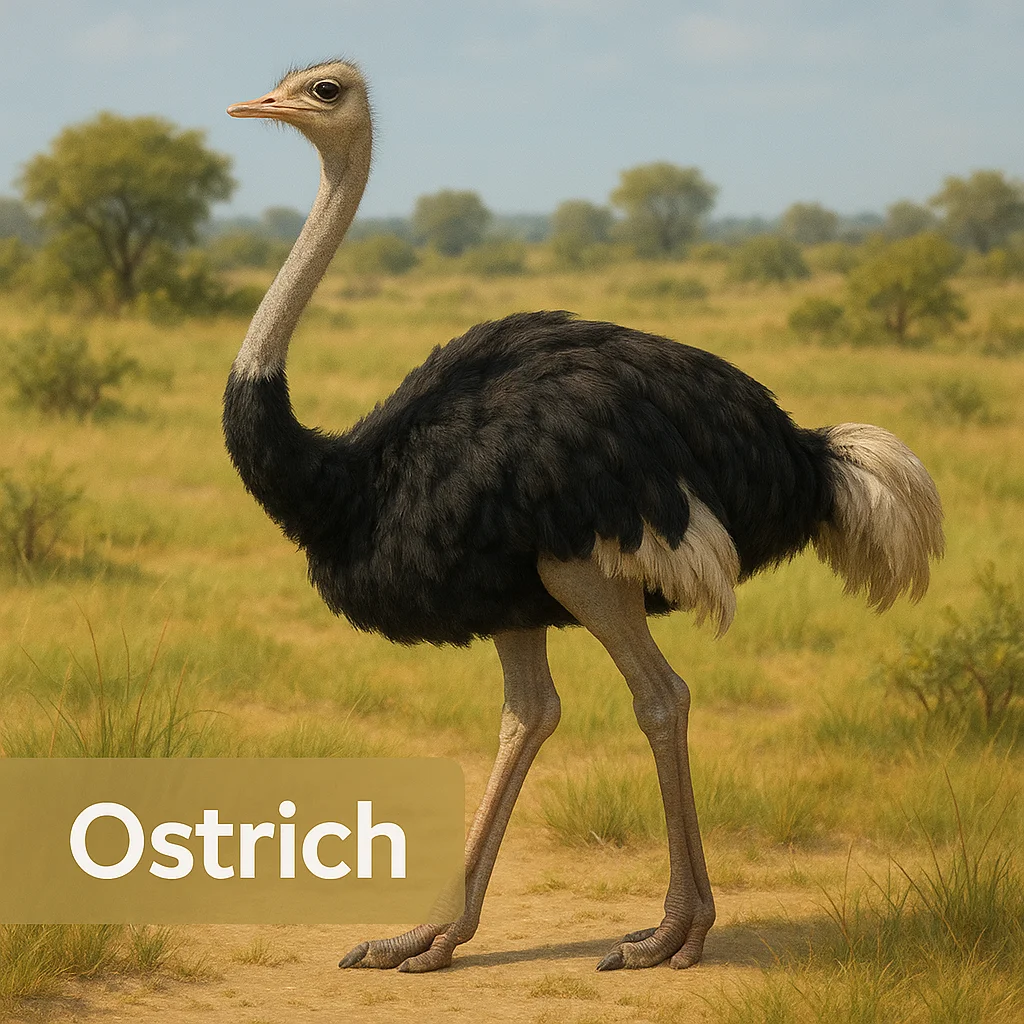
- Common name(s): Ostrich
- Scientific name: Struthio camelus
- Animal type: Bird
- Typical adult size: 2.1 to 2.7 meters (7 to 9 feet) tall, weighing 100 to 160 kilograms (220 to 350 pounds)
- Typical lifespan: 30 to 40 years in the wild
- Diet type: Omnivore, feeding on plants, seeds, and occasionally insects
- Activity pattern: Diurnal
- Social structure: Group (flocks)
- Speed / movement highlights: Capable of running at speeds up to 70 km/h (43 mph)
- Intelligence/learning: Known for their long-term memory and problem-solving skills
- Primary habitats: Savannas, semi-arid regions, and grasslands
- Geographic range: Africa
- Predators/threats: Natural predators include lions, cheetahs, and hyenas; human threats include hunting and habitat loss
- Conservation status: Varies by region, with some populations stable and others declining
🔍 Identification & Appearance
The ostrich is easily recognizable due to its towering height and robust build. Its long legs and neck give it a distinct silhouette that stands out in its natural habitat. Adult ostriches have a striking mix of black and white plumage, with males showcasing darker colors than females, who are generally brownish-gray.
- Body shape and silhouette: Tall, with a long neck and legs, and a compact, robust body.
- Key colors/patterns: Males have black and white feathers; females and young are brown and gray.
- Distinctive features: Large eyes adapted for spotting predators, and two-toed feet for running.
- Tracks, scat, or other field signs: Large, notable two-toed tracks that distinguish them from other species.
- Common look-alikes: Generally unique, but large flightless birds like emus and rheas could cause confusion.
- "Top ID Tips"
- Look for long, bare legs and neck.
- Black and white plumage for adult males.
- Size comparison: largest bird by height and weight.
- Two-toed large feet.
- Brownish-gray feathers in females.
- Prominent, big eyes designed for excellent vision.
- S-shaped neck posture.
🧱 Body Structure & Physical Adaptations
Ostriches are well adapted to their environment with their powerful legs and eyes that aid in survival. Their formidable physical attributes support their largely ground-dwelling lifestyle.
- Build and proportions: Stocky body with powerful legs suited for running and kicking.
- Teeth/beak/jaw adaptations: Lacks teeth, instead using a beak to aid in feeding.
- Claws/hooves/wings/fins: Flightless wings used for balance; legs end in two large toes optimized for speed.
- Sensory strengths: Exceptional vision and relatively good hearing, while smell is limited.
- "Key Adaptations"
- Fast-running legs capable of outrunning many predators.
- Large eyes for clear sight over long distances.
- Strong kick used for defense.
- Sparse wings provide balance during high-speed runs.
- Large lungs for efficient oxygen intake.
- Two-toed feet minimize ground contact, increasing speed efficiency.
🌍 Range & Distribution
The ostrich is found primarily in Africa, inhabiting a range of climates that extend from savannas to semi-desert regions. The bird tends to stay within areas that provide ample open space to accommodate their running and nesting behaviors.
- Continents/regions: Mostly sub-Saharan Africa.
- Typical countries/biomes: Open savannas and semi-arid plains in countries like Kenya, South Africa, and Namibia.
- Elevation range: Primarily lowland regions with flat terrains.
- Seasonal movements or migration: Minimal migration; primarily resident although they may move locally in search of food.
- "Where You Might Find It"
- Wide-open African savannas.
- Hot, dry semi-arid plains.
- Regions with sparse vegetation to facilitate running.
- Nature reserves and protected areas in Africa.
- Occasional overlap with areas inhabited by zebras and antelopes.
🏞️ Habitat & Shelter
Ostriches thrive in wide, open spaces, which facilitate their high-speed runs. These environments often include grasslands and semi-arid regions that offer an abundance of their dietary staples like seeds and grasses. Understanding the ostrich's habitat preferences is essential to comprehend its behaviors such as nesting and foraging.
- Preferred habitats: Grasslands, savannas, open woodland, and semi-desert regions.
- Microhabitats and shelter: No specific shelter utilized; nests are simple ground scrapes.
- Seasonal changes: Primarily influenced by food availability which can dictate movement patterns.
🧭 Behavior & Ecology
The behavior of ostriches is largely dictated by their environments and social structures. They are day-active birds with specific roles within the ecosystem, primarily focused on grazing and seed dispersal.
- Daily routine includes foraging, resting, and social interactions.
- Communication through varied vocalizations and visual displays.
- Interactions with other species occasionally include competitive grazing with other herbivores.
- Roles in the ecosystem include grazing and seed dispersal, significantly impacting vegetation growth.
- "Behavior Highlights"
- Tends to gather in groups for social interactions.
- Communicates with body postures and vocal sounds.
- Displays dust-bathing behaviors for grooming.
- Highly attentive to predators, often utilizing keen eyesight.
- Flocks may graze with zebras, creating mutual protection benefits.
- Egg-laying involves communal nests shared among several females.
👥 Social Life & Group Dynamics
Ostriches are social birds, usually found forming loose flocks that range from 5 to 50 members, enhancing protection against predators. Although primarily non-territorial, they have defined roles within groups, including cooperation in rearing young and defending against threats.
- Social tendencies vary, with groups sometimes forming loosely based social structures.
- Group types range from small kin groups to larger mixed flocks.
- Cooperation is evident in nesting and care of young, where dominant males and females often oversee nests.
- Dominance primarily observed in breeding scenarios where select males gather multiple females.
- "Social Structure Notes"
- Tendency to form flocks for foraging.
- Mixed-gender groups generally observed in non-breeding seasons.
- Prominent male plays a central role in nest building and defense.
- Adults collaboratively guard chicks, improving survival chances.
- Occasionally aggressive, especially during breeding season.
- Loose, flexible group dynamics change seasonally as resources and conditions fluctuate.
🍽️ Diet, Prey & Predators
As omnivores, ostriches have a varied diet that adjusts according to the season and available resources. They face numerous natural predators but employ a range of defenses to ensure their survival.
- Diet includes plants, seeds, insects, and occasional small vertebrates.
- Main eating tactics involve pecking at low-lying vegetation and searching for available resources.
- Predators include large carnivores such as lions and cheetahs; camouflage and speed offer primary defenses.
- Scavenging behaviors observed when resources are scarce.
- "Feeding Notes"
- Primarily feed on grasses, seeds, leaves, and fruits.
- Occasionally consume insects and small reptiles.
- May ingest small stones to aid digestion (gizzard stones).
- Flexible diet adapts with available resources.
- Predators present a constant threat, especially to eggs and young.
- Employ vigilance and speed to avoid predation.
🦌 Hunting, Foraging & Movement
Ostriches are renowned for their exceptional speed and agility, which serve as crucial survival tactics. They meticulously forage during daylight hours and benefit from their swift legs both in sourcing food and avoiding predators.
- Locomotion style: Primarily runners, adept at covering vast distances.
- Speed and endurance: Can sustain an impressive pace of 50 to 70 km/h (31 to 43 mph) over long distances.
- Foraging involves grazing on plant material and opportunistic consumption of insects.
- Emphasize wide-ranging movements with occasional shifts to access varied diets.
- "Movement & Strategy"
- Speed prevents most predators from catching them.
- Relies on long-distance travel to follow food resources.
- Young birds stay with family groups for added protection.
- Voids predators' notice with natural camouflage in pale, grassy landscapes.
- Adults employ zigzag patterns to escape threats.
- Able to overcome obstacles with long, powerful strides.
🧠 Intelligence & Senses
Ostriches exhibit considerable intelligence, particularly in social memory and problem-solving. They rely heavily on their acute vision to navigate their environment and avoid dangers.
- Problem-solving and learning capable, particularly in recognizing familiar individuals.
- Sophisticated social intelligence evidenced by group coordination.
- Senses: Excellent visual acuity, moderate hearing, limited olfactory sense.
- Limited research on wide variations in intelligence, indicating population-specific traits.
- "Notable Abilities"
- Visual acuity aids in detecting predators at great distances.
- Social learning observed within group dynamics.
- Remarkable memory for recognizing group members.
- Resilient against changing environments due to adaptable foraging behaviors.
- Possesses defensive instinct to kick accurately and powerfully.
🪺 Reproduction, Pregnancy & Parenting
Ostriches display unique reproductive traits, where breeding often involves synchronized communal nesting. Both genders partake in incubation, ensuring balanced sharing of parental duties.
- Breeding season: Generally spring and summer, varies by location.
- Mating system: Typically polygynous, with dominant males mating with multiple females.
- Incubation period: Approximately 42 days.
- Clutch size: Typically 12 to 16 eggs.
- Newborns are precocial, meaning young are relatively mature and mobile from birth.
- Parental roles divided, with males often incubating by night and females by day.
- "Reproduction Snapshot"
- Growth includes rapid plumage development for camouflage.
- Adults alternate duties in egg incubation, maximizing protection.
- Chick rearing is cooperative, increasing survival rates.
- Mature males establish and defend larger territories during breeding seasons.
- Incubation shared: Females during daylight hours, males by night.
♀️♂️ Male vs Female Differences
Ostriches exhibit a range of sex-based differences, from coloration to reproductive roles. While notable, these differences serve specific ecological purposes in mating displays and protective behaviors.
- Males are more vibrant, with black plumage accentuated by white wing feathers.
- Females showcase muted brown plumage which aids in nesting camouflage.
- Size difference: Males slightly larger and heavier than females.
- Males often take more aggressive roles in territorial defense.
- "Sex Differences at a Glance"
- Distinct plumage coloration: black in males, brown in females.
- Subtle size and weight variation favoring males.
- Males perform dramatic courtship displays.
- Females essential in role of selecting nesting locations.
- Both sexes share parental responsibilities, marking strong cooperation.
🧬 Subspecies & Variation
The ostrich is known to have several subspecies, each with subtle differences in size and habitat preference. While there are ongoing debates about classification, these subspecies illustrate the bird's adaptability to varied environments.
- Known subspecies include North African, Somali, and South African Ostriches, varying in geographic range.
- Subspecies distinctions include size and feather patterns.
- Adjustments to local environments such as desert adaptation or open plains tend to define subspecies categorization.
- The classification is subject to debate, focusing primarily on genetic distinctions.
- "Variation Notes"
- Subspecies adaptable across broad ecological zones.
- Each subspecies exhibits tailored adaptations to local conditions.
- Classification is evolving with genetics insights.
- Local adaptations influenced by habitat and climate.
- Variation mainly seen in size and behavior, especially across isolations.
⚠️ Threats, Conservation & Human Interaction
Ostriches face natural and anthropogenic pressures that threaten their survival. Major threats include habitat destruction and ongoing human encroachment. Steps toward conservation involve habitat protection and legal safeguards.
- Threats include habitat loss, hunting, and raising for commercial products.
- Conservation efforts focus on reserving areas and restricting hunting.
- Human-ostrich coexistence requires conscious balancing of resource use.
- In captivity: Ethical considerations emphasized, with zoos playing educational roles.
- "Responsible Notes"
- Conservation includes protection of natural breeding grounds.
- Prevention involves advancing economic alternatives to ostrich farming.
- Legal protections enforced to minimize hunting pressures.
- Perception management aids peaceful coexistence with nearby human communities.
- Conservation programs engage local communities in active protection roles.
✨ Fun Facts & Unique Traits
- Ostriches can live without water for days as they are well adapted to dry conditions by metabolizing water from their food.
- They have the largest eyes of all land mammals, enhancing their predator detection capabilities.
- Contrary to popular myth, ostriches do not bury their heads in the sand to avoid danger.
- The feathers of an ostrich, though not used for flight, insulate them from heat.
- Ostrich eggs are the largest of any bird species and can weigh up to 2 kilograms (4.4 pounds).
- Each ostrich eye is about the size of a billiard ball and provides a wide field of view.
- Ostriches can maintain their body temperature efficiently through a complex respiratory and circulatory system.
- Ostriches use complex dances as part of their courtship behavior.
📌 Summary
- Identified by height, long neck, and robust legs suited for speed.
- Found primarily across Africa's savannas, semi-arid areas.
- Diet: Omnivorous, varying with availability; includes flora and occasionally insects.
- Predominantly prey to large African carnivores like lions and hyenas.
- Social structures range from small groups to large flocks, important for protection.
- Reproductive strategies involve communal nests and shared incubation roles.
- Adaptations such as speed and sight are crucial for survival.
- Conservation remains essential as pressures from human encroachment persist.