🦁 Partridge
🧾 Quick Facts
Partridges are ground-dwelling birds known for their stout build and association with various habitats across Europe, Asia, and Africa. They are often characterized by their distinctive calls and intricate plumage patterns, which offer excellent camouflage.
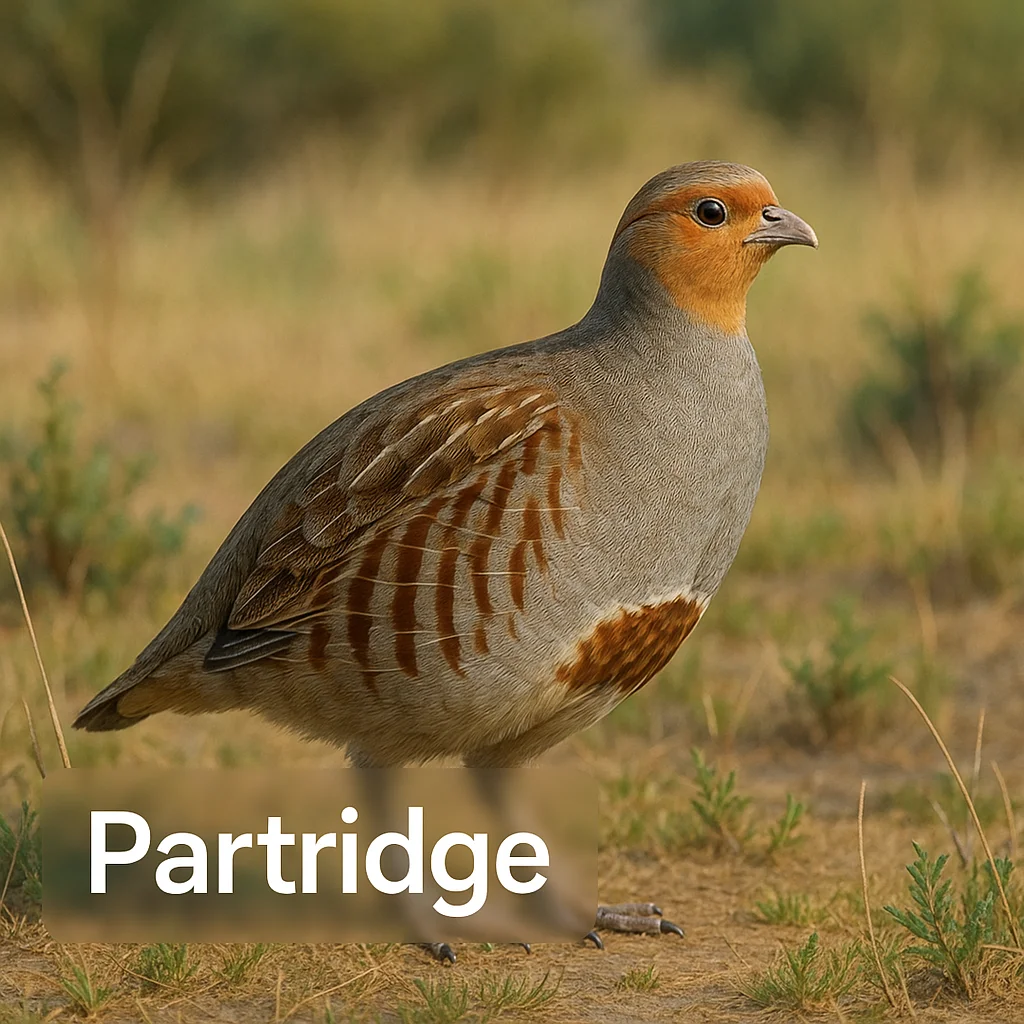
- Common name(s): Partridge
- Scientific name: Generally belongs to the genera Perdix, Alectoris, and others; varies
- Animal type: Bird
- Typical adult size: 25-34 cm in length; weighs around 300-400 grams
- Typical lifespan: 3-10 years in the wild
- Diet type: Omnivore; seeds, insects, and shoots
- Activity pattern: Primarily diurnal
- Social structure: Often found in small groups, especially during the breeding season
- Speed / movement highlights: Capable of short flights, strong runners
- Intelligence/learning: Capable of social learning; wary of predators
- Primary habitats: Grasslands, agricultural fields, woodland edges
- Geographic range: Europe, Asia, Africa
- Predators/threats: Foxes, birds of prey, humans
- Conservation status: Varies by region; some species are of concern
🔍 Identification & Appearance
Partridges are medium-sized birds with a compact, round body. Their plumage is typically brown, gray, or rust-colored, featuring intricate patterns that provide camouflage against predators. Broadly, they have sturdy legs, a short neck, and a short tail. While their appearance may vary slightly among species, they often possess a black line across the eye and barring on the underside.
- Top ID Tips:
- Compact, round body with short tail and legs
- Brown, gray, or rust-colored plumage
- Black stripe across the eyes
- Barred undersides
- Short, strong beak
- In-flight: rounded wings and fan-shaped tail
- Distinctive call sounds
- Reside mostly on the ground, rarely perch
- Usually seen in pairs or small groups
🧱 Body Structure & Physical Adaptations
Partridges are compact and stocky, built for life on the ground. They have powerful legs designed for running and scratching, which aids them in foraging through soil and leaf litter. Their beak is short and robust, ideal for breaking seeds and small insects.
- Key Adaptations:
- Strong, short beak for cracking seeds
- Robust legs for swift terrestrial movement
- Camouflage plumage to avoid detection
- Wide-set eyes for broad field of vision
- Dense, compact feathers for thermal regulation
- Ability to blend into surroundings with natural colors
- Strong flight muscles for rapid escape but limited long-distance flight
🌍 Range & Distribution
Partridges are widespread across Europe, Asia, and parts of Africa, adapting to a range of terrestrial environments. They can be found from lowland fields to upland plains. While some partridge species migrate short distances seasonally, many are resident in their local areas.
- Where You Might Find It:
- Western and Eastern Europe
- Across central and southern Asia
- Northern Africa
- In agricultural fields and pastures
- On grassy and open woodland margins
- In semi-arid scrublands
- Regions with moderate climates
- Occasionally in suburban areas near undeveloped land
- Often avoid dense forests and urban centers
🏞️ Habitat & Shelter
Partridges prefer diverse open habitats, from plains and grasslands to lightly wooded areas. They make use of dense grasses and low vegetation to build nests and conceal themselves from predators. Weather changes, such as a wet season, typically see them seeking sheltered spots to protect nests.
🧭 Behavior & Ecology
Partridges exhibit a variety of behaviors based on their environment and social structure. A typical day involves foraging for food, dust bathing, and staying alert for predators. Communication includes a range of vocalizations, particularly distinct calls between paired birds or when warning of danger. Partridges play an important ecological role as pest controllers and in seed dispersion.
- Behavior Highlights:
- Nocturnal roosting under cover
- Frequent foragers during daylight
- Distinctive alarm calls
- Engage in dust bathing
- Show site fidelity during the breeding season
- Role as herbivore and insectivore aids ecosystems
- Some engage in mutualistic relationships by serving as pest deterrents
- Typically avoid conflict with larger animals
👥 Social Life & Group Dynamics
Partridges are social birds, often found in pairs or small flocks. They may form larger groups during non-breeding seasons for enhanced vigilance. They engage in synchronized movements and cooperative feeding, emphasizing the importance of social structure in their life cycle.
- Social Structure Notes:
- Predominantly monogamous during breeding season
- Pairs or small family flocks commonly observed
- Strong pair bonding evident
- Protect territory from other pairs
- Variable group/flock sizes outside breeding season
- Alignment in flight and ground movements enhances group cohesion
- Occupational hierarchies occasionally seen in larger groups
- Social vocalizations enhance communication and cooperation
🍽️ Diet, Prey & Predators
Partridges are omnivores, largely dependent on a diet of seeds, grains, and insects, adjusting their diet as resources shift with seasons. In regions where natural predators like foxes and raptors are present, partridges rely on camouflage and vigilant behaviors to evade capture.
- Feeding Notes:
- Primarily consume seeds and grains
- Supplement diet with insects when available
- Adjust feeding habits with seasonal changes
- Prosper in agricultural areas with abundant feed
- Quick, agile runners to escape predators
- Employ cryptic plumage for protection
- Young are vulnerable; nestal closeness is protective
🦌 Hunting, Foraging & Movement
As primarily ground-dwelling birds, partridges are adept runners, using their strong legs to forage through underbrush and soil. They predominantly feed during daylight, maintaining energy efficiency by staying within familiar terrains. They rarely fly beyond short, rapid bursts when threatened.
- Movement & Strategy:
- Efficient runners for quick ground movement
- Short, powerful flight when startled
- Foraging strategy favors daylit hours
- Locate food sources using sight and local memory
- Navigation within a defined home range
- Minor seasonal position adjustments for optimal foraging
🧠 Intelligence & Senses
Partridges exhibit learning through social interactions and environmental awareness. This knowledge helps them adapt to changing conditions and potential threats. Their acute senses of vision and hearing aid in avoiding predators and locating food.
- Notable Abilities:
- Complex vocalization for communication
- Sharp eyesight for detailed environmental scanning
- Heightened auditory senses
- Problem-solving abilities evident in obstacle navigation
- Learning through social cues
🪺 Reproduction, Pregnancy & Parenting
Partridges show a strong tendency towards monogamous pairings during the breeding season, participating in coordinated courtship displays. Their incubation usually spans about 20-25 days, with the precocial young well developed at hatching, able to follow parents soon after birth.
- Reproduction Snapshot:
- Breeding season often starts in spring
- Monogamous pairing favored
- Clutch size typically 8-12 eggs
- Incubation period lasts approximately 3-4 weeks
- Young are precocial
- Both parents generally protect and guide the brood
- Nests built on ground in concealed spots
♀️♂️ Male vs Female Differences
While male and female partridges often look similar, subtle differences exist. Males might display slightly brighter plumage, especially during the breeding season. Behavioral differences are minimal, but roles can vary slightly in parenting and territory defense.
- Sex Differences at a Glance:
- Males may have slightly more vibrant plumage
- Both sexes participate in nesting and protection
- Roles in courtship displays typically led by males
- Subtle size difference; males marginally larger
- Females primarily responsible for incubation
🧬 Subspecies & Variation
The group commonly recognized as partridges includes several subspecies with varying characteristics. Differences can arise in plumage, size, and specific habitat preferences. Due to habitat pressures and isolation, certain subspecies are undergoing adjustments in response to environmental changes.
- Variation Notes:
- Variation in size among subspecies
- Plumage difference can indicate regional adaptation
- Specific habitat preferences among subspecies
- Debates on classification within birdwatching communities
- Inter-species contain unique call signatures
⚠️ Threats, Conservation & Human Interaction
Partridges face various human-related pressures including habitat loss, hunting, and agricultural pesticide exposure. Conservation efforts focus on habitat preservation and sustainable land use. Locally, community engagement promotes coexistence, ensuring partridges continue to thrive alongside development activities.
- Responsible Notes:
- Adapt to co-existence in agricultural regions
- Educational awareness on sustainable hunting practices
- Support conservation programs aimed at habitat protection
- Continued monitoring of population trends necessary
- Recognize the impact of pesticide use on food sources
- Encourage responsible human activities that respect natural habitats
✨ Fun Facts & Unique Traits
- Partridges have been celebrated in cultural lore, such as in "The Twelve Days of Christmas."
- Their ability to blend into their surroundings is a key survival tactic.
- Some species are known for their unique mating displays involving "drumming" sounds.
- Partridges can make quick, zigzag sprints to confuse predators.
- They have a peculiar habit of brooding to retain body heat.
- Youthful partridges are surprisingly independent soon after hatching.
- Varieties such as the Red-legged Partridge are introduced species in some regions.
- Partridge populations can serve as bioindicators for certain environmental health aspects.
📌 Summary
- Partridges are identifiable by their round body and camouflage plumage.
- They inhabit a range of open environments across Europe, Asia, and Africa.
- Omnivorous diet consists primarily of seeds and insects.
- Natural predators include foxes and various raptors.
- Typically social, forming bonds in pairs or small groups.
- Breeding results in precocial young that develop quickly.
- Adaptations include strong running legs and a compact body for ground dwelling.
- Notable for intricate vocalizations and their ecological role as seed dispersers.