🦁 Ring-necked Pheasant
🧾 Quick Facts
The Ring-necked Pheasant, known for its striking plumage and adaptability, is a common sight in agricultural and grassland regions across the globe. Originally native to Asia, this bird has been introduced to various parts of the world for hunting and conservation purposes.
- Common name(s): Ring-necked Pheasant
- Scientific name: Phasianus colchicus
- Animal type: Bird
- Typical adult size: 50-90 cm in length, 0.9-1.7 kg in weight
- Typical lifespan: 1-3 years in the wild; up to 18 years in captivity
- Diet type: Omnivore; seeds, grains, insects, small vertebrates
- Activity pattern: Diurnal
- Social structure: Solitary or in small groups, especially in winter
- Speed/movement highlights: Capable of quick bursts of running and short flights
- Intelligence/learning: Known for keen instincts and adaptability
- Primary habitats: Grasslands, farmlands, wetlands
- Geographic range: Native to Asia; introduced to North America, Europe, and Australia
- Predators/threats: Foxes, birds of prey, humans (hunting)
- Conservation status: Not currently at risk; varies by region
🔍 Identification & Appearance
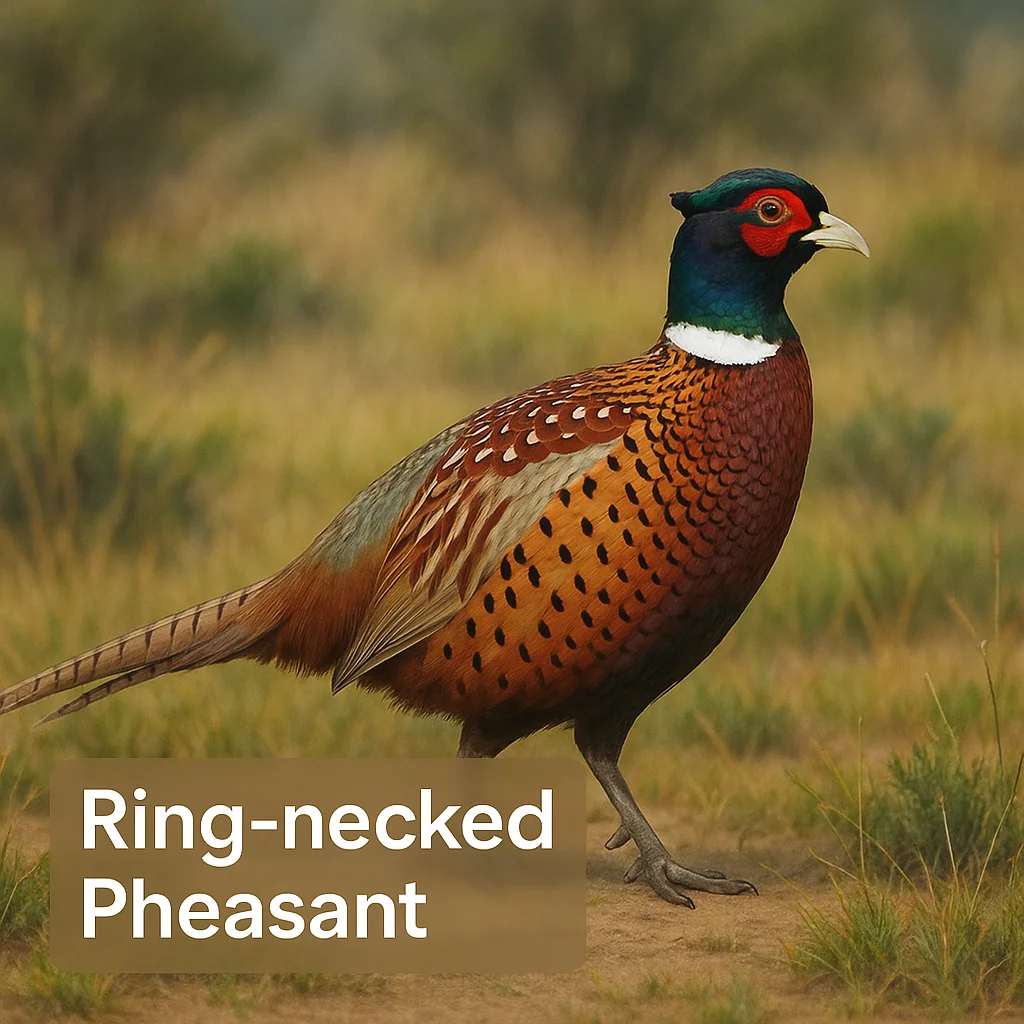
The Ring-necked Pheasant is easily recognized by its vibrant plumage and distinctive call. Males are typically more colorful than females, exhibiting bright red, orange, and green feathers, with a notable white ring around their neck. Females, in contrast, have more subdued brown shades for camouflage.
- Medium-sized, game bird with slender body and long tail
- Males have iridescent plumage with a white neck ring
- Females are mottled brown with a shorter tail
- Bright red wattles around the eyes in males
- Average wingspan ranges from 56 to 86 cm
- Tracks show three forward-pointing toes
- Scat is typically cylindrical and segmented
- Similar species include parrots and quails; pheasants are larger with longer tails
- Top ID Tips
- Look for the long, slender tail for easy ID
- Notice the distinctive rugged red wattle in males
- Spot the white ring on the neck of males
- Note the contrasting colors between males and females
- Listen for their loud, crowing call in spring
- Watch for quick, scuttling flight patterns
🧱 Body Structure & Physical Adaptations
The Ring-necked Pheasant has a compact body with powerful legs suited for running. Their beak is short and pointed for pecking at food. Adapted to their environments, they exhibit physical traits that aid in survival through camouflage and rapid escape from predators.
- Stocky build with robust leg muscles for swift running
- Short, robust beak ideal for cracking seeds
- Strong wings for short, powerful bursts of flight
- Eyes positioned for wide field of vision
- Feathers offer both display and camouflage functions
- Sharp eyesight aids in detecting movement
- Powerful chest muscles accommodate rapid flight take off
- Key Adaptations
- Distinct long tail improves in-flight stability
- Laminae in nostrils help filter dust in fields
- Feather colors provide camouflage against ground predators
- Strong legs support swift terrestrial movement
- Acute hearing enhances detection of threats
- Flight capability allows evasion over short distances
🌍 Range & Distribution
The Ring-necked Pheasant's range is extensive due to successful introductions outside its native range in Asia. Found predominantly in agricultural regions, these birds adapt well to various temperate environments.
- Originally native to East and Central Asia
- Introduced throughout Europe and North America
- Seen from lowlands to mid-elevations
- Thrive in mild, temperate climates
- Non-migratory; resident throughout the year
- Where You Might Find It
- Agricultural fields in the Midwest USA
- English countrysides and game reserves
- East Asian grasslands and woodlands
- European parks and natural habitats
- Cold, dry areas in the Northern Hemisphere
🏞️ Habitat & Shelter
Ring-necked Pheasants prefer open habitats with mixed vegetation such as grasslands and farmlands. They rely on grassy areas for feeding and nesting, using tall grasses and shrubs for shelter from predators.
- Favor open grasslands adjacent to agricultural lands
- Utilize hedgerows and forest edges for nesting
- Nest on the ground amidst dense, protective cover
- Adopt varied habitats including wetlands for feeding
- Adapt behaviorally to seasonal changes with migration patterns limited
🧭 Behavior & Ecology
The Ring-necked Pheasant is active during the day, with peak behaviors observed in the morning and late afternoon. Known for their melodic calls, these birds play a role as both seed dispersers and prey within their ecosystems.
- Engage in dust-bathing and preening regularly
- Emit a loud "Kok-Kok" noise for territory and mating
- Forage for seeds and insects during daylight
- Crucial seed dispersers enhancing plant eco-dynamics
- Display grounded, methodical flight patterns to avoid detection
- Behavior Highlights
- Known for characteristic vocal and visual displays in spring
- Participate in peckordering to resolve social hierarchies
- Form small flocks or coveys, especially in winter months
- Exhibit protective territorialism during breeding season
- Influence agricultural pest management positively
- Known for adaptability across diverse environments
👥 Social Life & Group Dynamics
Though Ring-necked Pheasants are often solitary, they can form loose groups called coveys, especially when foraging or overwintering. Their social interactions involve displays of aggression during mating seasons to establish dominance.
- Solitary during breeding season but social during colder months
- Form coveys of up to 50 individuals in harsh conditions
- Display intense rivalry among males during mating season
- Loose, flexible social groupings with minimal cooperative care
- Occasional mutual protection within coveys from predators
- Social Structure Notes
- Males establish a territory in the breeding season
- Female-led groups form protective clusters post-breeding
- Hierarchies can shift rapidly in response to environmental changes
- Flock behavior aids predator vigilance
- Covey dynamics provide warmth in freezing conditions
🍽️ Diet, Prey & Predators
As omnivores, Ring-necked Pheasants consume a diet rich in grains, seeds, and insects. Predation pressures come from mammals and birds of prey, influencing their feeding strategies and behaviors.
- Feed mainly on seeds, grains, and young shoots
- Supplements diet with insects and small vertebrates
- Forage by pecking and scratching throughout grasslands
- Employ techniques to avoid foxes, coyotes, and raptors
- Human hunting for sport adds additional pressure
- Feeding Notes
- Prefer freshly cut crop fields for feeding
- Consume protein-rich insect prey in breeding season
- Adapt diets based on seasonal availability
- Raid farmlands, thereby contributing to pest control
- Change feeding patterns with time of day to avoid predators
🦌 Hunting, Foraging & Movement
Pheasants are agile runners, traversing short distances swiftly to forage for food. Using their strong legs, they can quickly disappear into cover, taking flight when necessary to escape threats.
- Tend to run rather than fly unless startled
- Flight is short, fast bursts near the ground
- Nurture different foraging tactics across seasons
- Known for strategic fleeing patterns to evade predators
- Adjust movement habits in varied weather conditions
- Movement & Strategy
- Quick scuttering movements keep them safe from predators
- Short-distance flyers; take refuge on the ground
- Employ zig-zag runs to break line of sight for pursuers
- Move predominantly during early mornings and late afternoons
- Home ranges overlap but territorial disputes common
🧠 Intelligence & Senses
Through acute senses, the pheasant exhibits prowess in navigating its environment. While not known for tool use, these birds are adept at learning and adapting to surroundings, quickly recognizing threats and opportunities.
- Exhibit strong visual acuity crucial for daytime activity
- Hearing aids in detecting both mates and predators
- Limited olfactory senses but keen auditory abilities
- Show memory capabilities for spatial awareness and predator evasion
- Resourceful in adapting to new habitats and available food sources
- Notable Abilities
- Utilize a repertoire of visual signals to communicate
- Accomplished at layering camouflage and stealth
- Keen observation of predators leads to tactical concealment
- Rapid learners of safe and dangerous zones
- Memory aids in identifying favorable feeding locations
🪺 Reproduction, Pregnancy & Parenting
Ring-necked Pheasants engage in polygynous mating, with males often courting several females. The breeding season aligns with spring, where males exhibit colorful displays and calls to attract mates. Nests are shallow depressions on the ground, camouflaged by vegetation.
- Breeding season generally occurs from April to June
- Males perform elaborate courtship displays
- Mating is polygynous; males mate with multiple females
- Nests are minimalistic, with limited nesting material
- Incubation lasts approximately 23-28 days
- Reproduction Snapshot
- Females solely incubate and care for chicks
- Chicks are precocial, leaving the nest shortly after hatching
- Average clutch size ranges from 8-15 eggs
- Males defend territory rather than directly parent
- Chick survival rate varies with predation pressures
♀️♂️ Male vs Female Differences
Sexual dimorphism is prominent in Ring-necked Pheasants; males are larger, more vivid, and possess ornamental features lacking in females. These differences influence behavior, mating, and territory defense roles.
- Males are heavier and more colorful than females
- Distinct white neck band present in males only
- Red facial wattles are exclusive to males
- Females have demure brown plumage for better camouflage
- Behavior during breeding season emphasizes visual displays in males
- Sex Differences at a Glance
- Males decorated with vibrant plumage
- Females blend into landscapes for nesting
- Watch for extensive male competition 'lekking'
- Clear sexual dimorphism in size and behavior
🧬 Subspecies & Variation
Several subspecies of Ring-necked Pheasants display variation chiefly in size and coloration. These adaptations are products of long-standing geographical separation and differing environmental pressures.
- Subspecies include Phasianus colchicus torquatus and Phasianus colchicus mongolicus
- Variances in beak shape and wing span noted
- Some subspecies exhibit longer tail feathers
- Color intensities vary regionally across subspecies
- Variation Notes
- Asian populations tend to be more colorful
- Island subspecies may exhibit size reduction (island dwarfism)
- Cold-climate species possess thicker plumage
- Geographic coloring adaptations mitigate predation risk
⚠️ Threats, Conservation & Human Interaction
The challenges faced by Ring-necked Pheasants include habitat loss and hunting. While not currently at risk, their dependence on agricultural land presents a sustainability concern. Responsible practices can help balance conservation efforts with their role in human recreation.
- Habitat fragmentation is a significant concern
- Sport hunting impacts population dynamics
- Introduced populations may impact native species balance
- Intensive agriculture affects nesting spaces
- Contributions to pest control benefit farmers
- Responsible Notes
- Seasonal hunting to maintain healthy population levels
- Promote planting and preservation of cover crops
- Develop strategies for habitat connectivity
- Support research and monitoring efforts
- Acknowledge their role in agricultural systems
✨ Fun Facts & Unique Traits
- The Ring-necked Pheasant is the state bird of South Dakota
- Males are often referred to as roosters or cocks
- They were first introduced to North America in the 1880s
- Their stunning plumage is a result of selective breeding
- Pheasants were historically symbols of wealth and nobility
- They have been featured in numerous cultural artworks
- Can run at speeds of up to 48 km/h (30 mph)
- Capitalize on agricultural margins for feeding
📌 Summary
- Vibrant plumage and distinctive ringed neck identify them
- Adaptable, thriving in open grassland and farmland habitats
- Original Asian origins with global distribution
- Omnivore diet includes grains, seeds, insects
- Primary predators include foxes and birds of prey
- Exhibit both solitary and covey social structures
- Seasonal breeding with female-focused parenting
- Adaptations include strong running legs and iridescent feathers
- Pheasants balance agricultural impacts and habitat impact