🦁 Southern Cassowary
🧾 Quick Facts
The Southern Cassowary (Casuarius casuarius) is a large, flightless bird known for its striking appearance and secretive behavior. Native to the tropical rainforests of Papua New Guinea, Indonesia, and northeastern Australia, it plays a vital role as a seed disperser in these ecosystems.
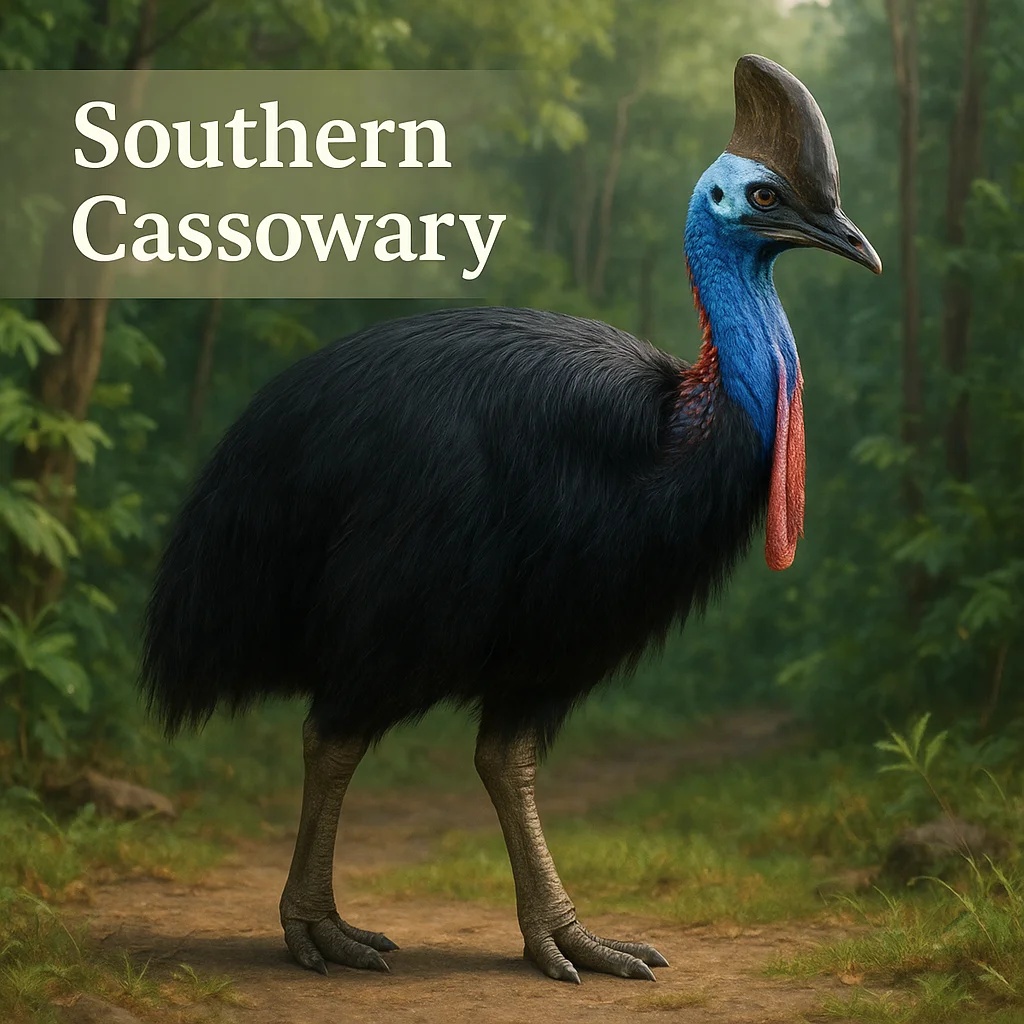
- Common name(s): Southern Cassowary, Double-wattled Cassowary
- Scientific name: Casuarius casuarius
- Animal type: Bird
- Typical adult size: 1.5 to 1.8 meters in height, up to 60 kg in weight
- Typical lifespan: 40 to 50 years in the wild
- Diet type: Omnivore; primarily fruits, small animals, and fungi
- Activity pattern: Diurnal but shy
- Social structure: Mostly solitary
- Speed / movement highlights: Capable of running at speeds up to 50 km/h
- Intelligence/learning: Capable of recognizing human interactions and navigating complex environments
- Primary habitats: Tropical and subtropical rainforests
- Geographic range: Papua New Guinea, Indonesia (Aru Islands), northeastern Australia
- Predators/threats: Predation by feral dogs and occasional threats from humans
- Conservation status: Considered Vulnerable due to habitat loss
🔍 Identification & Appearance
The Southern Cassowary is easily identifiable by its large size, black plumage, and the distinctive casque on its head. This helmet-like structure is used to push through dense forest vegetation. Its neck is adorned with vibrant blue skin, coupled with red wattles hanging down. Juveniles have brown plumage which darkens as they mature.
- Top ID Tips
- Large, rounded body with long, powerful legs
- Distinctive helmet-like casque on the head
- Bright blue neck with red wattles
- Black, shaggy feathers covering the body
- Sharp claws on strong feet
- Unique, booming call used for communication
🧱 Body Structure & Physical Adaptations
Southern Cassowaries have a robust build, optimized for movement in dense forest environments. The powerful legs allow them to sprint and kick effectively, and they possess dagger-like claws that provide defense against threats. Their beak is versatile, aiding in the consumption of various food types.
- Key Adaptations
- Strong, muscular legs for running and kicking
- Large, helmet-like casque for forest navigation
- Versatile beak for a varied diet
- Sharp claws for defense
- Vivid neck and wattles for sexual display
- Deep booming calls for long-range communication
🌍 Range & Distribution
The Southern Cassowary primarily inhabits the tropical regions of northeastern Australia, Papua New Guinea, and parts of Indonesia. It is most commonly found in lowland swamps and rainforests, where dense cover provides protection.
- Where You Might Find It
- Northeastern Australia (Queensland)
- Lowland rainforests
- Papua New Guinea rainforests
- Indonesian islands (Aru Islands)
- Forested areas up to 1,100 meters elevation
- Regions with dense understory vegetation
🏞️ Habitat & Shelter
Southern Cassowaries prefer the dense vegetation of tropical and subtropical rainforests, where they find ample food and shelter. They rely on thick undergrowth for protection against predators and harsh weather conditions. Understanding their habitat helps in consideration of conservation efforts to preserve these critical environments.
🧭 Behavior & Ecology
Southern Cassowaries are generally solitary, coming together only for breeding. They are territorial, using low-frequency calls to communicate and establish territory boundaries. They are vital seed dispersers, contributing to forest regeneration by facilitating the spread of plant species.
- Behavior Highlights
- Semi-solitary lifestyle
- Territorial; males fiercely defend their space
- Communicates with booming, low-frequency calls
- Vital role in seed dispersal
- Capable of aggressive defense behavior when threatened
👥 Social Life & Group Dynamics
Though mostly solitary, cassowaries form temporary bonds during the breeding season. Afterward, females may leave the males to incubate eggs and rear chicks alone. They are not known to form lasting familial groups or flocks.
- Social Structure Notes
- Primarily solitary
- Temporary pair-bonding during breeding
- Males take on incubation and chick rearing
- Territorial disputes are common
🍽️ Diet, Prey & Predators
The Southern Cassowary's diet consists largely of fallen fruit, which it collects from the forest floor, but it also eats small animals and fungi. Its capability to digest a wide range of food allows it to thrive in diverse environments. Natural predators are few due to its size, though juveniles are vulnerable to predation.
- Feeding Notes
- Primarily frugivorous, favoring fleshy fruits
- Opportunistic feeder; will eat insects and small vertebrates
- Important seed disperser for many tree species
🦌 Hunting, Foraging & Movement
Southern Cassowaries are agile foragers, capable of covering extensive areas in search of food. Using their casque, they can manipulate and push through vegetation. They typically forage alone during the day, relying on stealth and speed to avoid threats.
- Movement & Strategy
- Solitary foraging strategy
- Utilizes casque to navigate dense forest
- Capable of high-speed sprints
- Adapted to walking long distances in search of food
🧠 Intelligence & Senses
Southern Cassowaries possess keen senses, especially in terms of sight and hearing, enabling them to detect predators and other threats. Their intelligence is evident in their problem-solving abilities, such as navigating obstacles and remembering the locations of food sources.
- Notable Abilities
- Keen vision and hearing for detecting threats
- Ability to remember specific feeding locations
- Utilizes complex vocalizations for communication
🪺 Reproduction, Pregnancy & Parenting
During breeding season, Southern Cassowaries engage in elaborate displays, with females choosing their mates. The male constructs a nest on the forest floor where the female lays eggs. Afterward, the male incubates the eggs and rears the chicks alone.
- Reproduction Snapshot
- Breeding occurs in dry season
- Polygynous relationships
- Males incubate eggs and care for chicks
- Clutch size of 3-5 eggs
♀️♂️ Male vs Female Differences
Females are typically larger than males, with more vivid neck coloration and larger casques. This size difference aids in female mate-selection, where larger, brighter females are often more successful in attracting mates.
- Sex Differences at a Glance
- Females are larger and more colorful
- Males take on chick-rearing duties
- Larger casque in females
🧬 Subspecies & Variation
Though the classification of Southern Cassowary subspecies remains debated, variations exist primarily in size and coloration depending on geographical location. These differences probably represent adaptations to distinct microhabitats.
- Variation Notes
- Potential subspecies under scientific debate
- Size variation across geographical range
⚠️ Threats, Conservation & Human Interaction
Southern Cassowaries face threats from habitat destruction, vehicle collisions, dog attacks, and in some areas, hunting. Conservation efforts focus on habitat protection and public education about coexistence strategies, particularly in regions where human expansion interfaces with cassowary habitats.
- Responsible Notes
- Habitat preservation is critical
- Vehicle speed limits in cassowary areas
- Public awareness initiatives
✨ Fun Facts & Unique Traits
- Cassowaries are considered the world's most dangerous bird due to their powerful claws.
- They are known for their contribution to forest regeneration as essential seed dispersers.
- Their casque is not fully understood; hypotheses suggest it might be used for acoustic resonance or thermoregulation.
- Cassowaries can "moo" like cattle; these low-frequency sounds help in forest communication.
- They can swallow fruits larger than a billiard ball whole!
- The Southern Cassowary has inspired myths and stories in the regions it inhabits.
📌 Summary
- The Southern Cassowary is a large, flightless bird with a distinctive appearance.
- It inhabits tropical rainforests in Australia, Papua New Guinea, and Indonesia.
- This species is crucial for seed dispersal in its native ecosystems.
- Cassowaries are primarily solitary except during breeding.
- They are omnivorous, eating fruits, fungi, and small vertebrates.
- Known for their powerful leg kicks as an anti-predator defense.
- Males take a primary role in chick-rearing.
- Conservation efforts focus on habitat protection to mitigate population decline.