🦁 Sulphur-crested Cockatoo
🧾 Quick Facts
The Sulphur-crested Cockatoo is a charismatic and recognizable bird native to Australasia, known for its striking crest and playful demeanor. It is often admired for its intelligence and social behaviors, making it a popular subject in wildlife documentaries and as a companion bird.
- Common name(s): Sulphur-crested Cockatoo
- Scientific name: Cacatua galerita
- Animal type: Bird
- Typical adult size: 44–54 cm in length; 800–1000 grams in weight
- Typical lifespan: 40–70 years in the wild; up to 80 years in captivity
- Diet type: Herbivore; primarily seeds, nuts, fruits, and berries
- Activity pattern: Diurnal
- Social structure: Highly social; often seen in pairs or flocks
- Speed / movement highlights: Capable of agile and sustained flight
- Intelligence/learning: Highly intelligent with excellent problem-solving skills
- Primary habitats: Forests, woodlands, and urban areas
- Geographic range: Australia, New Guinea, some Indonesian islands
- Predators/threats: Birds of prey, habitat loss, illegal pet trade
- Conservation status: Least Concern; population stable but faces regional threats
🔍 Identification & Appearance
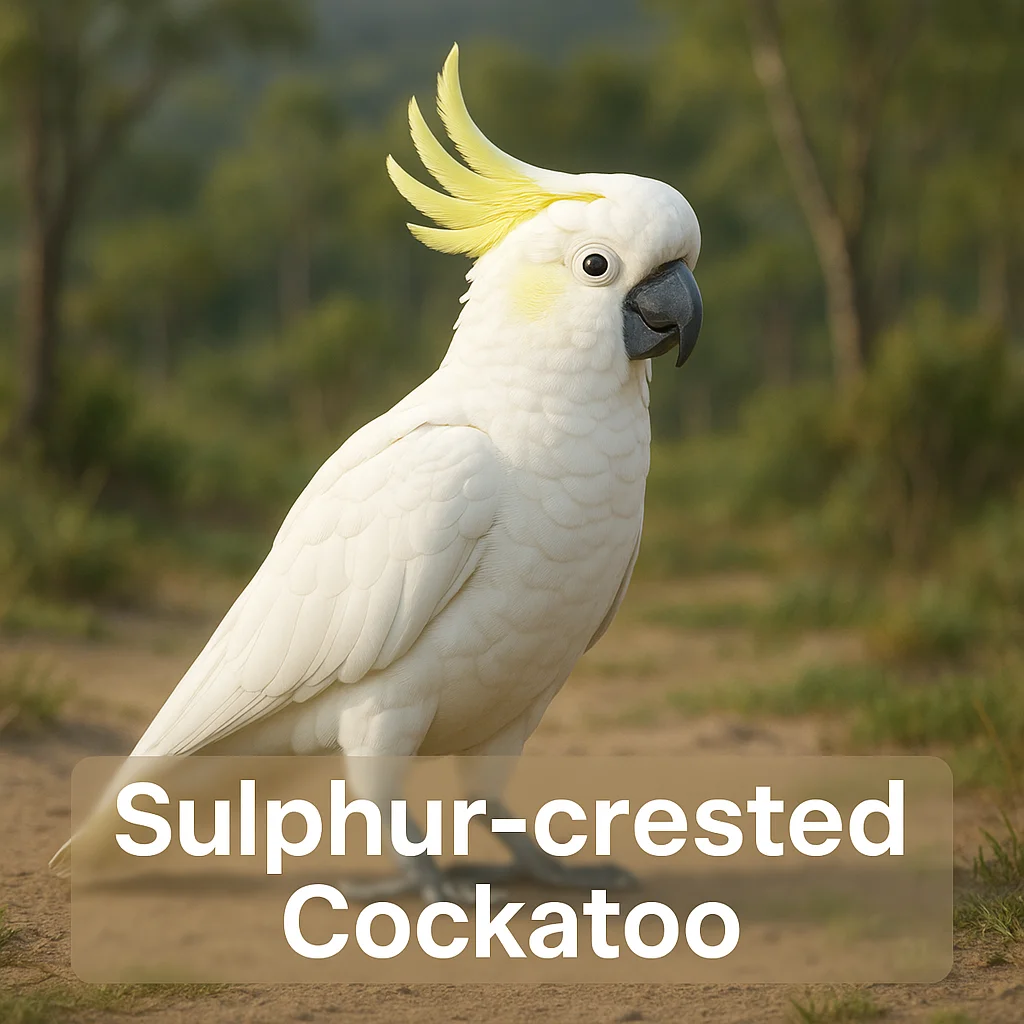
The Sulphur-crested Cockatoo is easily recognized by its large, white body and striking, lemon-yellow crest. It has a strong, curved beak and zygodactyl feet, which are well-adapted for climbing and manipulating objects. Its eyes are dark, giving it an expressive look.
- Large, robust body with predominantly white plumage
- Lemon-yellow crest that can be raised or lowered
- Dark beak and feet
- Zygodactyl feet (two toes forward, two backward)
- Short tail compared to body size
- Black eyes that stand out against white feathers
- Females and males appear similar, subtle size differences may be seen
- Juveniles have shorter crests and duller coloring
🧱 Body Structure & Physical Adaptations
The Sulphur-crested Cockatoo's physical form reflects its arboreal lifestyle and intelligence. Its beak is designed for cracking hard seeds, while its keen vision allows it to pick food from a distance. The bird's strong wings facilitate swift flight, crucial for escaping predators and traveling between feeding grounds.
- Strong, curved beak for seed cracking and manipulation
- Robust, muscular body for sustained flight
- Zygodactyl feet for a strong grip on branches
- Keen eyesight for locating food and detecting danger
- Agile flyers able to navigate through trees
- Sociable features suited for communication (crest, vocalizations)
🌍 Range & Distribution
The Sulphur-crested Cockatoo is widely distributed across Australia, New Guinea, and some parts of Indonesia. It thrives in a variety of habitats, from tropical rainforests to urban settings. Some populations may exhibit minor seasonal movements but are largely sedentary.
- Primarily found in eastern and northern Australia
- Also found in New Guinea and islands in Indonesia
- Prefers coastal and lowland regions
- Common in urban environments as free-ranging populations
- Mostly resident with minor local movements
🏞️ Habitat & Shelter
Sulphur-crested Cockatoos are adaptable birds that can live in a wide range of environments. They primarily reside in forests, woodlands, and savannas but have also made urban parks and gardens their homes. They often roost in large communal groups in trees and will use tree hollows for nesting.
🧭 Behavior & Ecology
Sulphur-crested Cockatoos are highly social and intelligent birds, displaying complex vocalizations and social interactions. They are known to be playful, often engaging in behaviors that seem exploratory or entertaining. These birds rely on vocalizations to communicate and establish territory within their flocks.
- Communicate with loud screeches and vocal mimicry
- Engage in playful and inquisitive behaviors
- Known for strong social bonds and group cohesion
- Role as seed dispersers, influencing plant regeneration
- Tend to be dominant in areas with ample food resources
👥 Social Life & Group Dynamics
Sulphur-crested Cockatoos are notably gregarious, often residing in flocks that can number several dozens to over a hundred individuals. These flocks are crucial for foraging, protection, and social interaction. Within these groups, they exhibit cooperative behaviors but also experience occasional conflicts, which are usually resolved with vocal displays and posturing rather than physical altercations.
- Flock sizes vary from small groups to large communities
- Strong pair bonds between mates within flocks
- Group cooperation in foraging and alertness to predators
- Vocal communication helps maintain group cohesion
- Dominance hierarchies exist but are fluid
🍽️ Diet, Prey & Predators
The diet of Sulphur-crested Cockatoos consists mainly of seeds, nuts, fruits, and berries. Occasionally, they may consume insects or small invertebrates. In urban areas, they are known to exploit human food sources. Natural predators include large birds of prey, while humans pose threats through habitat destruction and capture for the pet trade.
- Primarily seed and fruit eaters, adapted to a varied diet
- Diet includes roots, leaf buds, and flowers
- Utilize strong beaks to crack hard nut shells
- In urban areas, adapt to available anthropogenic food
- Avoid predators with rapid flight and loud alarms
🦌 Hunting, Foraging & Movement
As diurnal birds, Sulphur-crested Cockatoos typically forage during the day in flocks or pairs, using their strong beaks to access food. They are known for their ability to solve problems to reach difficult food sources. Their movement is dynamic, characterized by strong, sustained flight, which aids in evading predators and locating new food areas.
- Forage in flocks to efficiently find and exploit resources
- Often seen foraging on the ground as well as in trees
- Can cover large areas in search of food when necessary
- Use beaks not only for eating but also for exploration
- Highly adaptable in finding new food sources
🧠 Intelligence & Senses
They are highly intelligent, exhibiting advanced problem-solving skills and vocal mimicry. These attributes, combined with their social nature, make them particularly adept at learning and communicating. Their eyesight is crucial for foraging and detecting predators, while their hearing helps locate flock members and identify threats.
- Capable of complex problem-solving and tool use
- Demonstrate ability to mimic human speech and other sounds
- Use intelligence for cooperative behaviors
- Keen eyesight aids in foraging and predator detection
- Hearing is important for social interactions and alerts
🪺 Reproduction, Pregnancy & Parenting
The breeding season of Sulphur-crested Cockatoos varies depending on locale but often coincides with spring and summer. They generally form monogamous pair bonds, with both parents sharing responsibilities in incubating eggs and raising the chicks. Nesting sites in tree hollows need to be protected from competitors and predators.
- Breeding season generally falls in the austral spring and summer
- Monogamous pair bonds often last for life
- Both sexes share incubation duties over a 26–30 day period
- Clutch size is usually 2–3 eggs
- Chicks are altricial, requiring care and feeding by parents
♀️♂️ Male vs Female Differences
Male and female Sulphur-crested Cockatoos exhibit minimal sexual dimorphism, with both sexes appearing similar in size and coloration. However, females tend to be slightly smaller with less pronounced crests. Behavioral differences are subtle and generally revolve around their roles in nesting and parenting.
- Females may be marginally smaller in size
- Crest size and display similar between sexes
- Both sexes participate equally in parenting roles
- Coloration nearly identical between males and females
🧬 Subspecies & Variation
There are several recognized subspecies of the Sulphur-crested Cockatoo, with variations in size, plumage intensity, and geographic distribution. Some minor physical differences may occur depending on their environmental niches. Debate over specific subspecies continues among scientists, highlighting the complex nature of avian taxonomy.
- Cacatua galerita galerita (greater) - common in northern and eastern regions
- Cacatua galerita triton (Triton) - found in New Guinea and neighboring islands
- Subspecies can vary slightly in size and coloration
- Environmental variation influences minor physical differences
⚠️ Threats, Conservation & Human Interaction
Despite being classified as Least Concern, Sulphur-crested Cockatoos face challenges from habitat destruction, the illegal pet trade, and human-wildlife conflicts, particularly in urban areas. Conservation efforts focus on habitat protection and curbing illegal trafficking. In captivity, they are popular as pets, necessitating responsible ownership to ensure their well-being.
- Habitat loss due to land clearing for agriculture and urbanization
- Illegal capture and trade for the pet market
- Human-wildlife conflict in urban areas causing crop damage control
- Need for enforcement of protected status in some regions
- Ethical concerns around captive care practices
✨ Fun Facts & Unique Traits
- Sulphur-crested Cockatoos can live over 80 years in captivity with proper care
- They are highly social and require significant mental stimulation
- Capable of mimicking human speech and various environmental sounds
- Often perform aerial acrobatics in displays of play or social interaction
- Their loud calls can be heard over a kilometer away
- Known for being occasional troublemakers by chewing wood or cables
- Play significant roles in dispersing seeds in their native habitats
- Form part of folklore and cultural symbology in Australia
📌 Summary
- Large white bird with a striking yellow crest
- Found across Australasia in forests and urban settings
- Omnivorous diet includes seeds, fruits, and berries
- Faces threats from habitat destruction and pet trade
- Highly social and often seen in large, interactive flocks
- Exhibits monogamous breeding and extensive parenting roles
- Adaptable and intelligent, known for vocal mimicry
- Important ecological role as a seed disperser
- Long lifespan, with some individuals living up to 80 years in captivity