🦁 Toucan
🧾 Quick Facts
The toucan is a colorful and fascinating bird known for its distinctive large beak and vibrant plumage. Found mainly in tropical regions, these birds are a delight to both birdwatchers and wildlife enthusiasts. Here's a snapshot of what makes toucans unique:
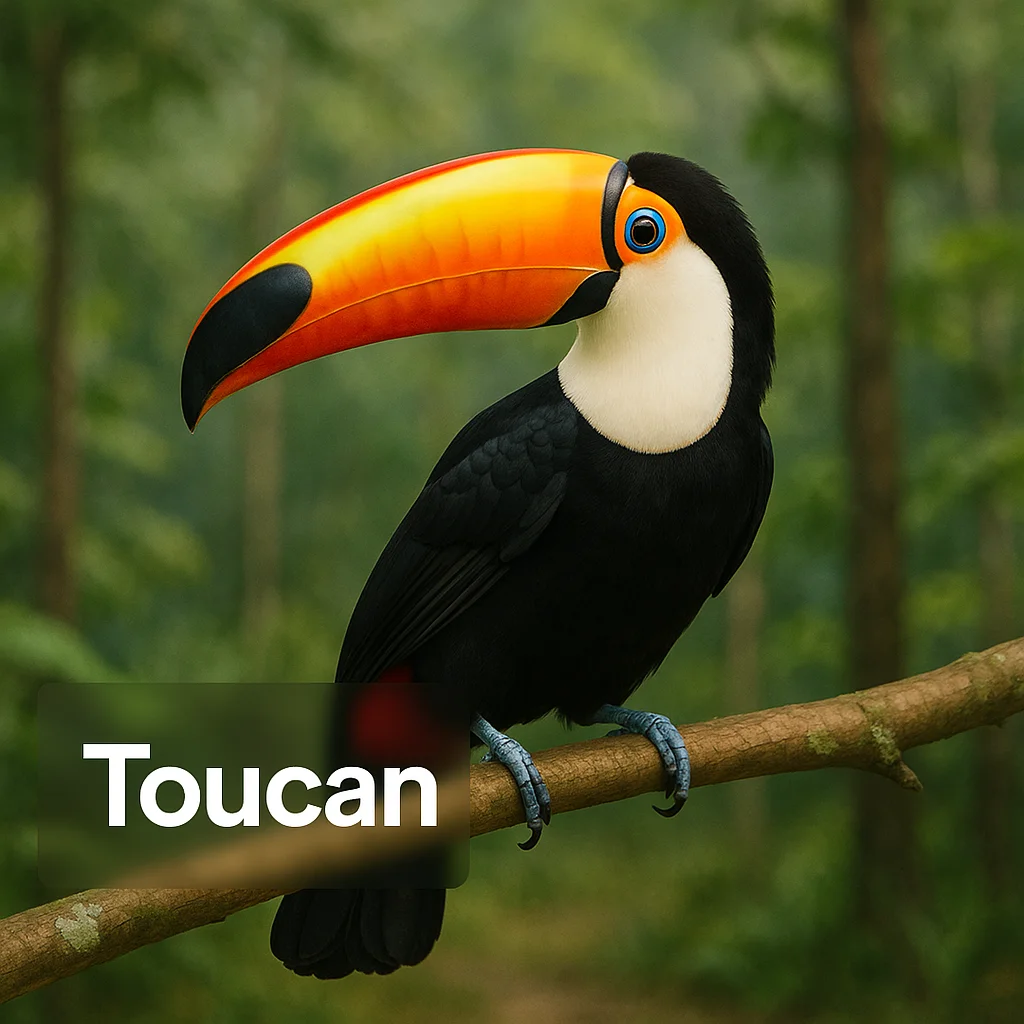
- Common name(s): Toucan
- Scientific name: Ramphastos (genus) – species varies
- Animal type: Bird
- Typical adult size: 18 to 24 inches long, 13 to 15 ounces
- Typical lifespan: 15 to 20 years in the wild
- Diet type: Omnivore – fruits, insects, small reptiles
- Activity pattern: Diurnal
- Social structure: Small groups
- Speed / movement highlights: Flies at moderate speeds, agile in trees
- Intelligence/learning: Medium intelligence, known for playful behavior
- Primary habitats: Dense rainforests
- Geographic range: Central and South America
- Predators/threats: Snakes, jaguars, human encroachment
- Conservation status: Varies by region; generally stable
🔍 Identification & Appearance
Toucans are unmissable with their large, colorful bills and striking plumage. Their body shape is robust yet streamlined, allowing them to navigate dense foliage easily. The most familiar toucan is the toco toucan, with black and white plumage and a vivid orange bill.
Seasonal or age-related changes in their appearance are minimal. Their beaks, while large, are surprisingly light and used for manipulating food and other objects.
- Top ID Tips:
- Large, brightly colored bill
- Predominantly black plumage with white, yellow, or orange accents
- Compact body with short, rounded wings
- Brightly colored skin around the eyes
- Distinctive croaking calls
- Short, squared tail
- Hop rather than walk along branches
- Different species show variations in color patterns
- Juveniles are duller in color
🧱 Body Structure & Physical Adaptations
The toucan's distinctive bill is not just for show; it serves multiple purposes including foraging, defense, and thermoregulation. Despite its size, the beak is composed of a honeycombed bone structure covered with keratin, making it extremely light. Toucans have a compact and stout build with relatively short legs and claws adapted for gripping branches.
Their sensory abilities are typical of most birds, with acute vision that helps them spot predators and search for food. Their sense of smell is less developed, as is common among avian species.
- Key Adaptations:
- Lightweight, large bill for foraging and display
- Prehensile feet for climbing and perching
- Layered plumage for protection and insulation
- Colorful plumage for mating and territory defense
- Moderate wingspan for fluttering flight in dense forests
- Strong, curved toes for grip and stability
- Beak acts as a balance counterweight
🌍 Range & Distribution
Toucans are primarily residents of tropical and subtropical rainforests across Central and South America. They thrive in the humid environments of these lush forests, often staying at lower elevations where the canopy is dense. Toucans are not known for long-distance migration; they typically remain within a defined territory close to food and nesting sites.
- Where You Might Find It:
- Amazon Basin
- Atlantic Forest of Brazil
- Costa Rican rainforests
- Panamanian jungles
- Lowland tropical forests
- Andean foothills
- Yungas regions
- Guianas' rainforests
🏞️ Habitat & Shelter
Preferring dense tropical forests, toucans often nest in tree cavities and spend much of their time among the canopy layer. These birds require plenty of foliage for cover and access to the fruits and small animals they feast on. Tropical climates with consistent warmth and rainfall create an ideal environment for their lifestyle.
Understanding a toucan’s habitat includes recognizing their reliance on forests for food sources and nesting options. Seasonal changes like the rainy season can increase fruit availability, thus influencing toucan movements and feeding behavior.
🧭 Behavior & Ecology
Toucans are diurnal, engaging in foraging and social activities during daylight. They exhibit territorial behavior, using their loud calls to communicate and assert dominance. Toucans form loose, small groups and partake in mutual preening and social interactions.
Though generally peaceful, they may exhibit aggressive behavior when defending their habitat. Ecologically, toucans play a vital role as seed dispersers, aiding the growth of their forested environments.
- Behavior Highlights:
- Loud vocalizations for communication
- Affectionate grooming among group members
- Solitary when foraging
- Defensive of nesting sites
- Active seed dispersers
- Occasional mid-story perchers
- Interaction with other bird species documented
- Limited defense tactics against predators
👥 Social Life & Group Dynamics
Toucans are social birds that often move and feed in small groups. They typically form loose flocks that break up into pairs during breeding season. While not highly cooperative, they do exhibit social bonding through grooming and communicating vocally to maintain group cohesion.
Dominance hierarchies may exist within groups, but these are not strongly pronounced. Toucan interactions are generally peaceful unless mating or territory is at stake.
- Social Structure Notes:
- Small flocks outside breeding season
- Pair bonding during breeding season
- Group grooming behaviors
- Mild conflicts over territory
- Loose hierarchical structure within flocks
- Pairs exhibit protective instincts over nests
🍽️ Diet, Prey & Predators
Toucans are primarily frugivorous, consuming a wide variety of fruits available in their forest habitats. However, they are opportunistic feeders and will also consume insects, small reptiles, and bird eggs. This varied diet provides essential nutrients for their survival.
Main predators include birds of prey, snakes, and larger mammals like jaguars. Toucans use their agility and tree-hopping abilities to escape potential threats.
- Feeding Notes:
- Diet predominantly fruit-based
- Occasional consumption of small vertebrates
- Opportunistic feeding on eggs
- Foraging behaviors vary with seasonal fruit availability
- Limited interaction with human agriculture
- Predators include certain snakes and raptors
🦌 Hunting, Foraging & Movement
As agile fliers, toucans navigate through the forest canopy using a combination of flight and hopping. Their versatile beaks allow them to reach fruit on branches and catch insects mid-air. Toucans exhibit a form of resource tracking, moving locally based on food availability.
They typically forage during the day, exploring their home range for suitable feeding sites, while their movement is notably short-range, focusing on forest inter-canopy sectors.
- Movement & Strategy:
- Arboreal foraging and movement
- Skillful maneuvering in dense forests
- Uses beak to pluck and manipulate food
- Locally nomadic, moving for food access
- Efficient and fast flight between trees
- Hop-style movement along branches
🧠 Intelligence & Senses
Toucans are known for their playful curiosity and moderate intelligence among bird species. They use visual cues and vocal signals for communication and are capable of problem-solving in their environment. Their interaction with objects and use of tools is minimal; however, they exhibit good spatial memory for navigation.
Their keen sight aids in detecting ripe fruits and spotting predators, while their ability to judge distances in a three-dimensional forest environment is noteworthy.
- Notable Abilities:
- Moderate problem-solving skills
- Effective use of vocalizations for communication
- Good spatial awareness in forest habitats
- Playfulness observed with objects and fellow toucans
- Visual acuity for predator and prey detection
- Slight tool use in food extraction documented
🪺 Reproduction, Pregnancy & Parenting
Breeding for toucans occurs during the spring and early summer months. They are typically monogamous, forming pair bonds that last through the breeding season. Toucans lay a clutch of two to four eggs in tree cavities, which both parents help incubate and rear.
Chicks are altricial, requiring care and feeding from both parents until they fledge. Outside the breeding season, toucans divide their time between group socializing and individual foraging.
- Reproduction Snapshot:
- Monogamous pair bonds during breeding
- Breeding seasonality varies by region
- Two to four eggs per clutch
- Both parents share incubation duties
- Chicks are initially helpless and require feeding
- Nesting sites are reused if effective
- Nesting in natural or excavated tree cavities
♀️♂️ Male vs Female Differences
During breeding season, toucans do not exhibit dramatic size differences between genders. However, slight variations in plumage color intensity or bill markings may occur and be more discernible to other toucans than to human observers.
Behaviorally, males may exhibit more vocal and protective behaviors, especially during the nesting period.
- Sex Differences at a Glance:
- Similar sizes in males and females
- May show varied bill patterns
- Males slightly more territorial
- Subtle differences in call patterns
- Equal participation in chick rearing
- Plumage coloration intensity varies slightly
🧬 Subspecies & Variation
Several species of toucans have been identified, each with adaptations to various environmental niches across their range. The toco toucan and keel-billed toucan, among others, display different beak shapes and coloration.
Classification of subspecies can sometimes be debated due to overlapping characteristics and hybridization events in some regions.
- Variation Notes:
- Diverse species under Ramphastos genus
- Geographic variations in size and plumage
- Environmental adaptations evident in beak size
- Potential hybrid zones noted
- Subspecies differing slightly by altitude
⚠️ Threats, Conservation & Human Interaction
Natural challenges for toucans include predation by larger animals and competition for nesting sites. Human-related pressures encompass habitat destruction due to deforestation, as well as the illegal pet trade in some areas.
Conservation efforts focus on habitat preservation and legal protection in their native regions. Toucans are popular in aviculture, which necessitates ethical considerations to maintain adequate living conditions.
- Responsible Notes:
- Habitat loss due to deforestation
- Regulations essential for pet trade
- No direct threats to humans
- Role in ecotourism highlights need for habitat protection
- Species conservation status varies widely
- Participation in local conservation efforts encouraged
✨ Fun Facts & Unique Traits
- Toucans’ bills are not only for feeding; they also help regulate body temperature.
- The sound of a toucan's call can be heard almost a half-mile away in dense forest.
- The toucan’s appearance was featured significantly in indigenous folklore.
- Toucans’ colorful bills are primarily a mating signal.
- They are among the few birds that can toss food into the air and catch it.
- They have zygodactyl feet with two toes facing forward and two backward for better grip.
- Toucans are known to be playful, often engaging in beak fencing.
- Despite their size, toucan beaks are light due to a sparse skeleton.
📌 Summary
- Toucans are easily identified by their large, colorful beaks and vibrant plumage.
- They thrive in tropical rainforests, primarily in Central and South America.
- Toucans are social birds, living in small groups and exhibiting curious behavior.
- Their diet is primarily fruit-based, though they are opportunistic feeders.
- Natural predators include snakes and birds of prey.
- Reproduction involves monogamous pairing and shared parental duties.
- Toucans play a critical role as seed dispersers in their ecosystems.
- While not endangered, habitat destruction poses a threat to certain populations.