🦁 Wild Turkey
🧾 Quick Facts
The wild turkey is a native bird of North America, recognized not only for its significance during Thanksgiving celebrations but also for its interesting behaviors and adaptability across diverse habitats.
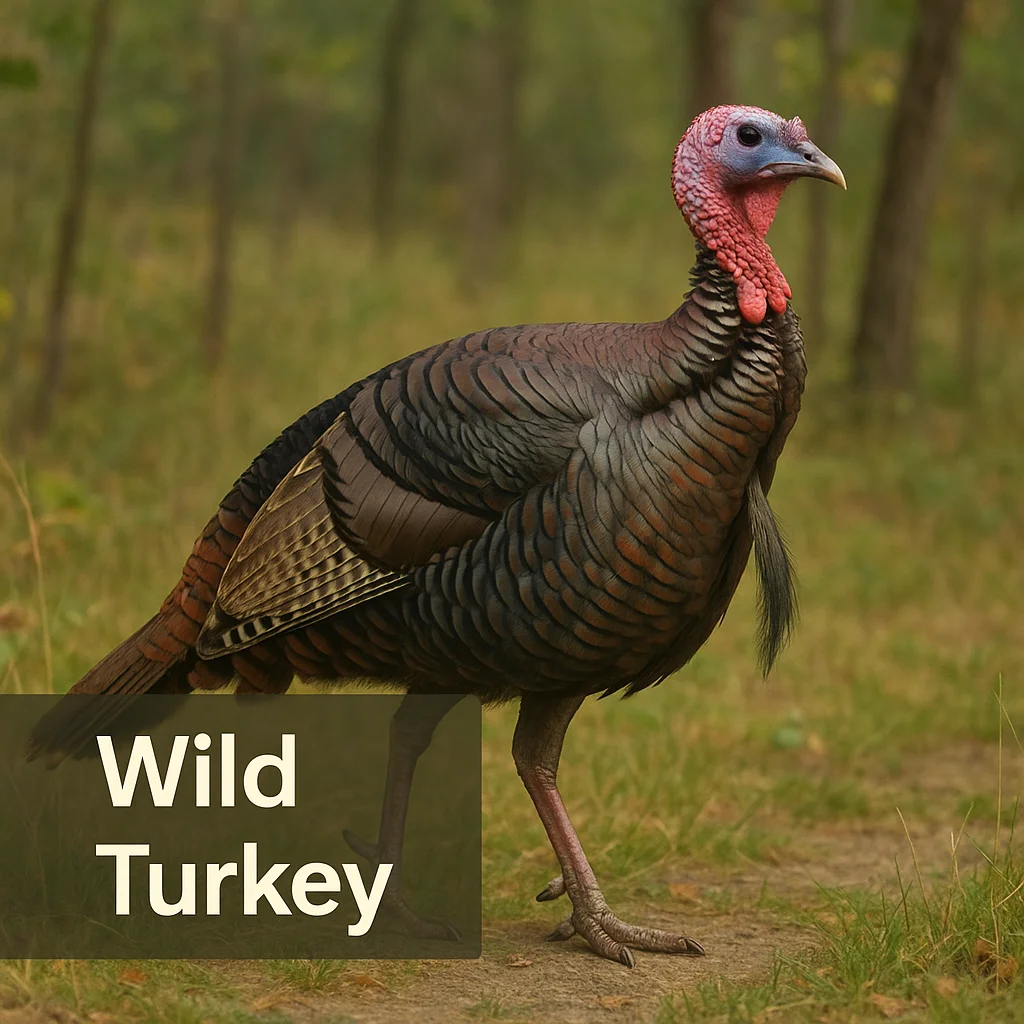
- Common name(s): Wild Turkey
- Scientific name: Meleagris gallopavo
- Animal type: Bird
- Typical adult size: 3.5 to 4 feet (height), 8 to 24 pounds (weight)
- Typical lifespan: 3 to 5 years in the wild, up to 10 years in captivity
- Diet type: Omnivore; includes seeds, insects, and small reptiles
- Activity pattern: Diurnal
- Social structure: Groups called rafters or flocks
- Speed / movement highlights: Can fly short distances at 55 mph; running speed around 20 mph
- Intelligence/learning: Known for diverse vocalizations and problem-solving skills
- Primary habitats: Woodlands, grasslands, wetlands
- Geographic range: Across North America
- Predators/threats: Coyotes, foxes, birds of prey, humans
- Conservation status: Least Concern, but varies by region
🔍 Identification & Appearance
Wild turkeys are large birds with a distinct appearance that makes them relatively easy to identify in their natural habitat.
- Body shape is plump with a long, fan-like tail
- Feathers are iridescent bronze and green
- Adult males (gobblers) feature red wattles, a snood, and a beard
- Females have more subdued coloration and lack prominent beards
- Legs are strong and spurred, aiding in swift movement
- Tracks show three forward-facing toes and one backward-facing toe
- Scat is often spiral-shaped and can vary in size
- Common look-alikes include domestic turkeys; wild turkeys appear leaner and more agile
- Top ID Tips:
- Look for the distinctive fan-like tail
- Identify the gobblers by their bright red and blue head markings
- Check for the iridescent sheen on the feathers in sunlight
- Females have a more mottled and camouflaged appearance
- Listen for their loud "gobble" calls, particularly during breeding season
- Spot their large tracks in softer ground or snow
🧱 Body Structure & Physical Adaptations
Wild turkeys have evolved various physical features that help them thrive in their environments, from foraging on the ground to perching safely at night.
- Stocky and robust build for strength and stability
- Powerful wings enable brief but rapid flights to escape predators
- Long, sturdy legs are excellent for running
- Snood and wattle help in thermoregulation and display
- Strong beak for pecking and eating a variety of foods
- Acute vision for detecting predators
- Average hearing abilities, used for recognizing calls and alarm signals
- Key Adaptations:
- Strong legs for extended periods of walking and quick bursts of speed
- Iridescent plumage aids in breeding displays
- Adaptable diet allows survival in varied habitats
- Ability to fly up to roosting sites for safety
- Seasonal color changes in the head for mating
🌍 Range & Distribution
The wild turkey's range spans a vast portion of North America, showcasing its adaptability to different environments and climates.
- Found in the eastern and central United States, parts of Mexico
- Introduced to western United States and southern Canada
- Prefer broadleaf forests, but also adapt to open grasslands and agricultural lands
- Reside at elevations from sea level to around 10,000 feet
- Mostly reside in one region, with some seasonal range shifts for food
- Where You Might Find It:
- Deciduous and mixed woodlands
- Grassland-adjacent forests
- Rural farmland areas
- Wooded river valleys
- Suburban and semi-urban parks
- Oak and hickory forests
- Roosting on tree branches
- Foraging in open fields
🏞️ Habitat & Shelter
Wild turkeys show remarkable adaptability in their choice of habitat and can often be found in a variety of settings, combining forest cover and open spaces.
- They prefer areas with mature forests for roosting and open fields for foraging
- May use understory vegetation as shelter from weather
- Seasonal changes lead them to seek different food sources, altering their habitat use
- Nesting is typically done in concealed locations on the ground
🧭 Behavior & Ecology
The behavior of wild turkeys plays an important role in their survival and interactions within their ecosystems.
- Active during the day, foraging for food
- Communication through gobbling, clucking, and purring
- Engage in dust bathing and preening as grooming methods
- Play a role in seed dispersal and controlling insect populations
- Display group hierarchies, with a dominant male leading the flock
- Sometimes form protective alliances with other birds like deer
- Behavior Highlights:
- Loud gobbling used to communicate over distances
- Complex social structures within flocks
- Strong territorial instincts among males during mating season
- Adaptable foraging behaviors, shifting with the seasons
👥 Social Life & Group Dynamics
Wild turkeys have intricate social dynamics, influenced by both gender and season.
- Form flocks that vary in size with the season, often more extensive in the winter
- Groups often consist of males or females with their young
- Rank and pecking order defined by displays and vocalizations
- Females protect young and teach them essential survival skills
- Males establish territories and display to attract mates
- Social Structure Notes:
- Males often group together when not breeding
- Females lead smaller groupings especially with offspring
- Cooperative behavior observed in raising young
- Turkeys exhibit a clear hierarchy within groups
🍽️ Diet, Prey & Predators
Wild turkeys are omnivorous and feed on a diverse diet, while they also face various natural threats.
- Diet includes nuts, berries, insects, and small vertebrates
- In fall, acorns and beechnuts are vital food sources
- Predators include wolves, eagles, and bobcats
- Defensive strategies involve flight or running to trees
- Feeding Notes:
- Opportunistic foragers that adapt to available foods
- Diet changes seasonally and regionally
- Prefer seeds and fruits when available
- Young turkeys, or poults, initially feed on insects for protein
- Anti-predator strategy includes keen vigilance
🦌 Hunting, Foraging & Movement
Wild turkeys are adept movers, whether on the ground or in the air for short flights.
- Primarily walkers and runners, foraging mostly on the ground
- Capable of short bursts of flight when escaping threats
- Foraging often occurs during the cooler parts of the day
- Strong navigational skills, using memory and visual landmarks
- Movement & Strategy:
- Combine walking and short flights to access food and evade danger
- Roost in trees at night for safety
- Use landmarks and learned routes for foraging
- Foraging in flocks for increased vigilance
🧠 Intelligence & Senses
Wild turkeys are known for their acute senses and intelligence, factors that aid their survival in the wild.
- Good memory for foraging locations
- Vocal complexity for varied communication
- Strong eyesight used for spotting predators
- Limited sense of smell but effective use of hearing for warnings
- Sensitive to changes in their environment, leading to adaptable behavior
- Notable Abilities:
- Complex social learning and hierarchy
- Recognition of individual calls in the flock
- Adaptation to a wide range of food sources
🪺 Reproduction, Pregnancy & Parenting
Reproductive behavior in wild turkeys varies seasonally and involves unique courtship rituals.
- Breeding season starts in early spring
- Polygamous mating system with males courting multiple females
- Females lay about 10 to 12 eggs per clutch on average
- Incubation period lasts about 28 days
- Poults are precocial, meaning they are relatively mature and mobile shortly after hatching
- Females alone incubate the eggs and care for the young
- Reproduction Snapshot:
- Males display by fanning tail feathers
- Courtship involves gobbling and strutting performances
- Chicks learn survival skills from their mother
♀️♂️ Male vs Female Differences
Sexual dimorphism is notable in wild turkeys, impacting both their physical characteristics and roles.
- Males are larger, more colorful, and have a more prominent snood and beard
- Males perform elaborate displays during mating season
- Females are more secretive in nesting habits
- Males more prone to aggressive territorial behavior
- Sex Differences at a Glance:
- Size and color variances are easily noticeable
- Distinctive behaviors during courting
- Flock and social behaviors differ significantly
🧬 Subspecies & Variation
There are several recognized subspecies of wild turkey, each adapted to its specific environment.
- The Eastern wild turkey is the most prevalent subspecies
- The Merriam's turkey is adapted to higher elevations in the West
- The Rio Grande turkey inhabits the southern plains
- Notable variations occur in plumage coloration and size
- Variation Notes:
- Subspecies exhibit unique feather patterns and colors
- Geographical location heavily influences behavioral patterns
⚠️ Threats, Conservation & Human Interaction
Wild turkeys face multiple challenges, both natural and those influenced by human activities.
- Habitat destruction and fragmentation reduce suitable living areas
- Hunting regulated legally, with sustainable management programs
- Conflict arises from agriculture when turkeys feed on crops
- Conservation efforts focus on habitat restoration and population monitoring
- Responsible Notes:
- Engage in ethical hunting practices
- Support conservation programs for habitat protection
- Awareness about maintaining distance during breeding season
✨ Fun Facts & Unique Traits
- Wild turkeys can run at speeds of up to 20 mph
- Their "gobble" can be heard over a mile away
- They hold cultural significance, particularly in the United States
- Feathers possess a unique iridescence, changing colors with light angles
- Wild turkeys have excellent panoramic vision
📌 Summary
- Identifiable by their iridescent plumage and fan-like tails
- Natural habitats include woodlands and open grasslands
- Distributed across North America with several subspecies
- Omnivorous diet varies seasonally
- Natural predators include foxes and birds of prey
- Strong social structure within flocks
- Unique breeding displays by males
- Adaptations include strong legs for running and defensive flight