🦁 Blue Whale
🧾 Quick Facts
The Blue Whale, often referred to as the largest animal ever to have lived on Earth, is a truly remarkable marine mammal. Known for their immense size and distinctive blue-gray coloration, these gentle giants are found in oceans around the world and are known for their powerful swimming abilities and complex vocalizations.
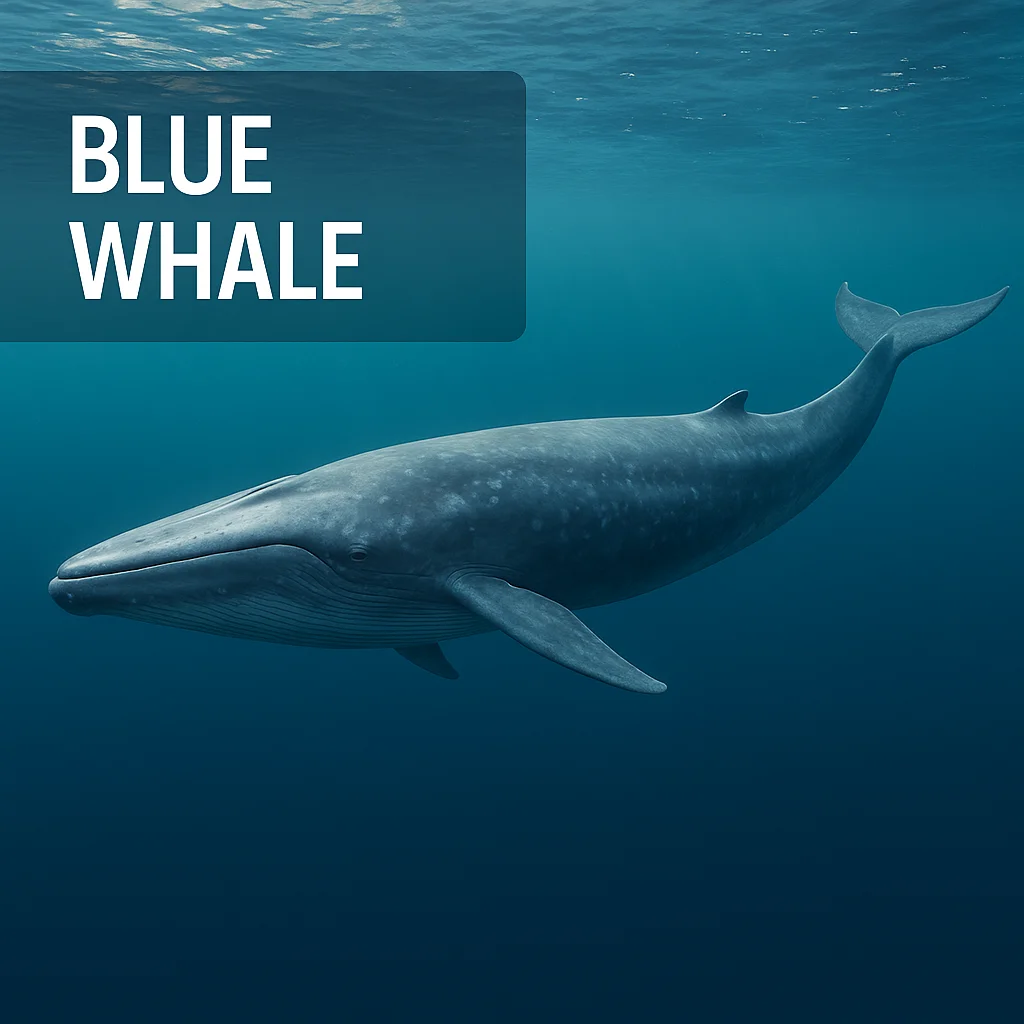
- Common name(s): Blue Whale
- Scientific name: Balaenoptera musculus
- Animal type: Mammal
- Typical adult size: 70-100 feet in length; 100-150 tons in weight
- Typical lifespan: 70-90 years
- Diet type: Carnivore; primarily krill
- Activity pattern: Varies; largely determined by feeding opportunities
- Social structure: Solitary or small groups
- Speed / movement highlights: Can reach speeds of up to 20 miles per hour
- Intelligence/learning: High, with complex vocalizations and learning behavior
- Primary habitats: Open ocean, deep waters
- Geographic range: Worldwide, primarily in polar and temperate oceans
- Predators/threats: Orcas, human-related threats
- Conservation status: Endangered
🔍 Identification & Appearance
The Blue Whale is characterized by its immense size and streamlined body. They sport a blue-gray color that can appear mottled with lighter spots. The head of a Blue Whale is flat and U-shaped, and they have a series of baleen plates in their mouths for filtering food. Notably, their dorsal fin is relatively small compared to their overall body size. When breathing, they produce a distinct vertical spout of water.
- Long, slender body with small dorsal fin
- Blue-gray coloration, possibly mottled appearance
- Heads feature broad, U-shaped structure
- Baleen plates instead of teeth for filtering krill
- Produces a tall, vertical water spout when exhaling
- Presence of ventral pleats allowing for expanded throat during feeding
- Rorqual family member characterized by deeply grooved throats
- Fins are slender and pointed
- Unique tail fluke identification in some research programs
- Large blowholes visible on the top of the head
🧱 Body Structure & Physical Adaptations
Blue Whales have evolved several physical adaptations that enable them to thrive in marine environments. Their large bodies are streamlined to reduce water resistance, enhancing their swimming efficiency. They utilize baleen plates to filter massive swarms of krill, their primary diet. As rorquals, their expandable throat pleats aid in significant water intake during feeding. Furthermore, they possess excellent underwater hearing vital for communication and navigation.
- Streamlined body for efficient swimming
- Baleen plates for filtering krill
- Expandable throat thanks to ventral pleats
- Powerful tail fluke propels them forward
- Adapted for deep ocean navigation
- Strong sense of hearing to detect vocalizations
- Thick blubber layer provides insulation
- Relatively small eyes contribute to streamlined shape
- Large heart to circulate blood throughout their massive bodies
- Broad flippers for steering and maneuvering
🌍 Range & Distribution
Blue Whales have a cosmopolitan distribution, residing across the world's oceans from the polar to tropical regions. However, they are more commonly found in the southern hemisphere. They often undertake seasonal migrations from higher latitudes in summer to warmer waters during winter.
- Primarily found in the Antarctic and North Atlantic Oceans
- Inhabit pelagic zones of the South Pacific and Indian Oceans
- Occasionally spotted off the coast of California
- Migrate to warmer waters in tropical regions during winter
- Seen in deeper oceanic waters rather than coastal areas
- Observed feeding near the polar ice edge
- Largely absent from land-locked seas
- Non-breeding in the Arctic Circle
- Documented sightings near the Azorean Islands
🏞️ Habitat & Shelter
Blue Whales prefer the open ocean and are typically associated with deep waters rather than coastal zones. Their habitat choice is heavily influenced by the availability of krill, their food source. During the warmer months, they can be found in colder regions where krill populations are abundant. In winter, they move to more temperate waters for breeding and calving.
🧭 Behavior & Ecology
As solitary swimmers or small groups, Blue Whales are known for their distinctive vocalizations that can travel long distances underwater, serving as communication signals. Their role in the ecosystem includes controlling plankton populations and influencing krill distribution via their feeding habits. In addition, they participate in nutrient cycling through their waste, benefiting marine life.
- Long-distance vocalization capabilities for communication
- Krill specialist feeding habits
- Solitary or small group behaviors
- Reputation for deep ocean dives to locate food
- Migratory with predictable seasonal patterns
- Contribute to nutrient cycles via fecal plumes
- Feeding dives dictated by krill swarms
- Avoidance of predator-rich regions
- Behavior influenced by environmental conditions
- Use echolocation to navigate and detect prey
👥 Social Life & Group Dynamics
Blue Whales are predominantly solitary creatures, though they occasionally form small groups, especially in areas abundant in food. These groupings are typically loose and transient, dictated more by feeding opportunities than social bonds. Mother and calf pairs present the strongest social bond within Blue Whales.
- Mainly solitary
- Occasionally form transient groups
- Mother-calf pairs are commonly observed
- No established dominance hierarchies
- Feeding aggregations common in high krill zones
- Lack strong long-term group bonding
- Interaction largely based on feeding needs
- Calves depend on mothers for extended periods
- Separation from groups after breeding season
🍽️ Diet, Prey & Predators
Blue Whales are filter feeders, primarily consuming krill, tiny crustaceans that form massive swarms in the ocean. They can consume several tons of krill daily during feeding seasons. As adults, they have very few natural predators, with only Orcas occasionally preying on vulnerable individuals such as the young or ill. Human activities, however, pose significant threats.
- Krill make up the primary diet
- May consume up to 4 tons of krill daily
- Occasional consumption of small fish
- Feeding primarily occurs in krill-rich waters
- Use baleen plates for effective filtering
- Naturally low predation due to size
- Human-related threats include ship strikes and entanglement
- Occasional Orca predation on young or weak
- Feeding behavior alters based on krill availability
- Feeding in swarms optimizes energy efficiency
🦌 Hunting, Foraging & Movement
As proficient swimmers, Blue Whales cover large distances when searching for food and shelter. They typically engage in lunge-feeding, where they accelerate towards krill swarms, engulfing vast quantities of water and prey in one go. With impressive endurance, these giants manage extensive migratory routes marked by predictable seasonal changes.
- Efficient open-ocean swimmers
- Lunge-feeding as a primary food acquisition method
- Migrate seasonally between feeding and breeding grounds
- Highly reliant on krill swarm locations
- Flexible home ranges dictated by food supply
- Endurance allows crossing oceanic expanses
- Adapted for deep dives in search of prey
- Swims at speed variations depending on purpose
- Occasional interaction with human vessels
- Adaptable to different marine conditions
🧠 Intelligence & Senses
While detailed studies on Blue Whale intelligence are limited, their vocalizations hint at complex communication capabilities potentially indicative of cognitive sophistication. They have keen auditory senses used for locating prey and navigating the vast oceans. Their sensory adaptations play a critical role in their detection of environmental cues associated with feeding and movement.
- Advanced vocal communication
- Keen hearing aids in navigation and hunting
- Limited but evolving understanding of intelligence
- Auditory senses play a vital role in locating krill
- Likely possess strong associative learning
- Use sound to maintain social contact over distances
- Perceptive to subtle changes in ocean temperature
- Potential problem-solving abilities under observation
🪺 Reproduction, Pregnancy & Parenting
Blue Whales have a prominent breeding season, typically in winter, in warmer waters. The courtship involves vocalizations and physical displays. Once mating occurs, females experience a gestation period of approximately 11-12 months, leading to the birth of a single, precocial calf. Calves are reliant on their mothers for milk and protection until weaning occurs at around 6-7 months.
- Breeding typically occurs during winter
- Gestation lasts about 11-12 months
- Birth of one calf at a time
- Calves are precocial and capable of swimming shortly after birth
- Strong maternal bond persists for months
- Calves rely on mothers' milk during early months
- Weaning occurs around 6-7 months of age
- Limited male involvement in calf rearing
- Breeding responsive to optimal environmental conditions
- Calving generally occurs in established warm-breeding areas
♀️♂️ Male vs Female Differences
In Blue Whales, sexual dimorphism is relatively subtle, with females generally growing slightly larger than the males, though coloration and behavior are largely similar across sexes. Males do not display horns, crests, or any extravagant features typical in other species for mate attraction.
- Females are slightly larger than males
- Similar color patterns in both sexes
- Lack of prominent sexual display adaptations
- Physical structures do not vary significantly between sexes
- Behavioral roles during breeding are similar
- Both sexes participate in vocal displays
- Maternal roles lead to stronger bonds with offspring
- Male group interactions are minimal
- Environmental detection and response similar across sexes
🧬 Subspecies & Variation
Blue Whales exhibit some geographical and subspecies variation. Notable subspecies include the Northern Hemisphere's Balaenoptera musculus musculus and the Antarctic's Balaenoptera musculus intermedia. These variations can reflect differences in size, migratory patterns, and feeding habits, influenced by regional ecology.
- Northern Hemisphere populations typically smaller
- Antarctic subspecies tend to be larger
- Feeding behavior varies depending on krill availability
- Migratory patterns reflect environmental cues
- Patches of regional populations remain distinct
- Genetic data indicates distinct population structuring
- Some disputed classifications remain debated
- Adaptive behaviors vary by habitat
- Regional vocalization patterns observed
⚠️ Threats, Conservation & Human Interaction
Blue Whales face several human-related threats, including ship strikes, entanglement in fishing gear, and noise pollution from vessels. Conservation efforts focus on reducing these threats and mitigating climate change impacts. Whale watching offers economic and educational benefits but requires regulation to avoid stress on animals.
- Threatened by ship strikes and vessel noise
- Migratory routes intersect fishing lanes, causing entanglement
- Climate change affects food supply distribution
- Protected under international conservation agreements
- Efforts to regulate whale-watching practices are ongoing
- Education focuses on reducing human-animal conflicts
- Marine protected areas aid in habitat preservation
- Reducing ocean pollution benefits whole food web
- Continued research into population dynamics is critical
✨ Fun Facts & Unique Traits
- Blue Whale hearts can weigh as much as a small car
- These whales can produce sounds up to 188 decibels
- Their tongues can weigh as much as an elephant
- Blue Whales have a lifespan approaching 90 years
- They possess among the longest migratory routes of any mammal
- Despite their size, they feed on some of the smallest marine life
- A Blue Whale can travel at speeds of up to 20 mph when threatened
- The uniquely long vocalizations help them communicate over vast distances
- Blue Whale calves gain about 200 pounds per day when nursing
📌 Summary
- Blue Whales are the largest animals on Earth, dwelling in oceans worldwide
- Recognizable by their blue-gray coloration and streamlined shapes
- Habitat preference for open ocean and deep water ecosystems
- Diet primarily consists of krill, using baleen plates for feeding
- Few natural predators; human threats are the main concern
- Migrate seasonally for feeding and breeding purposes
- Reproduction involves a long gestation period and maternal care
- Notable for long-distance vocal communication
- Subtle differences between males and females
- Facing conservation challenges; protected internationally