🦁 Gray Whale
🧾 Quick Facts
The Gray Whale, known for its impressive migratory journey, is a baleen whale that captivates with its unique characteristics and fascinating life cycle. This marine mammal has adapted to a life in the ocean, showcasing resilience and adaptability across diverse environments.
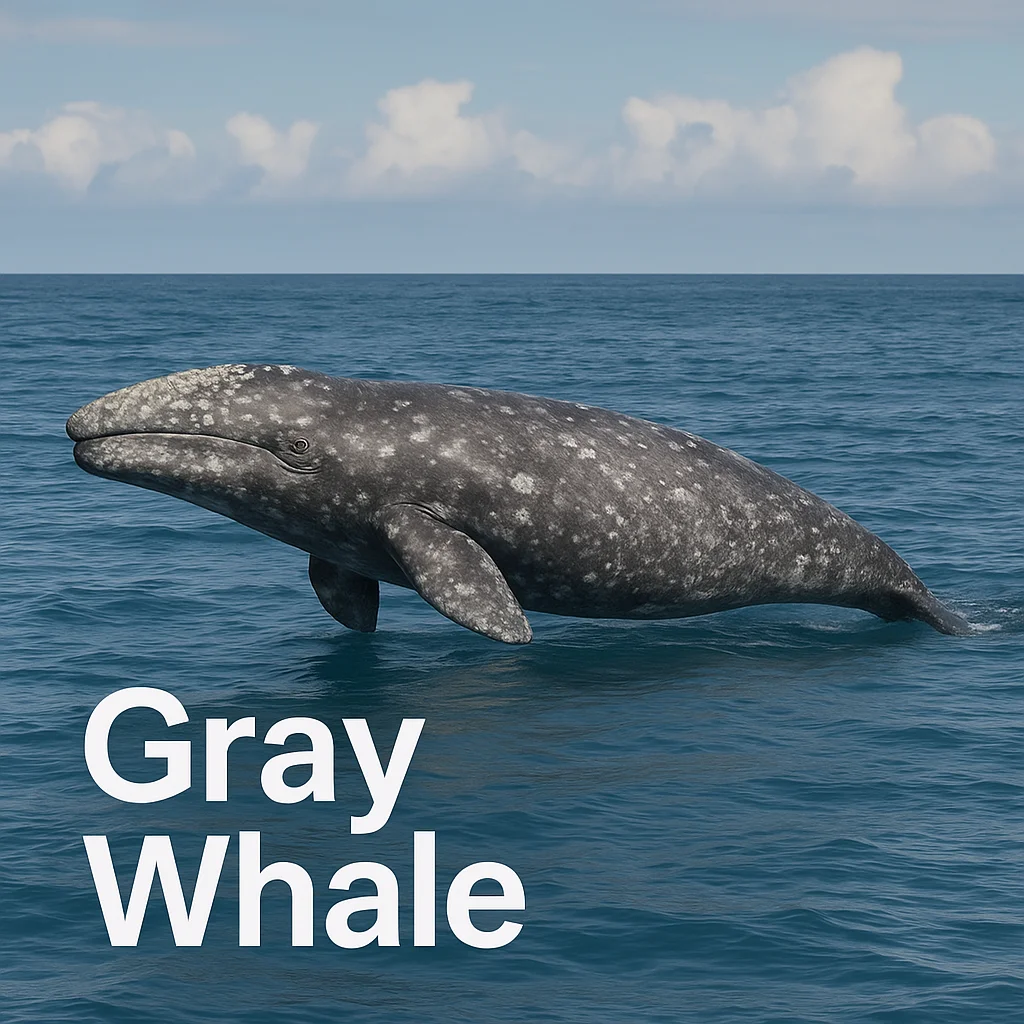
- Common name(s): Gray Whale
- Scientific name: Eschrichtius robustus
- Animal type: Mammal
- Typical adult size: 40–50 feet (12–15 meters) in length, 30–40 tons in weight
- Typical lifespan: 50–70 years in the wild
- Diet type: Carnivore; feeds mainly on amphipods and other small sea creatures
- Activity pattern: Diurnal
- Social structure: Usually solitary or small groups
- Speed / movement highlights: Migrates over 10,000 miles annually
- Intelligence/learning: Demonstrates migratory pattern learning and navigation skills
- Primary habitats: Coastal waters, open ocean
- Geographic range: Primarily found in the Pacific Ocean
- Predators/threats: Orcas (natural predators), human impacts include ship strikes and entanglement
- Conservation status: Varies by region; some populations are recovering, while others remain endangered
🔍 Identification & Appearance
The Gray Whale's appearance is distinctive, making it easily recognizable among whales. This species exhibits a tapering body with a series of knuckles rather than a dorsal fin. The skin is often marked with barnacles and whale lice, which contribute to its gray and mottled appearance.
- The whale's head is narrow and triangular.
- It lacks a dorsal fin but has a series of small humps.
- Its skin is rough, sporting patches of barnacles.
- Generally gray in color, the skin has lighter and darker mottling.
- The tail fluke is commonly seen breaching the surface.
- The blow is heart-shaped, which is a significant identifier.
- Barnacle and lice coverage varies with each individual.
- They have two blowholes on top of their head.
- Look for their unique "snorkel-like" feeding breaths.
- The pectoral fins are paddle-shaped and short.
- Top ID Tips
- Look for the heart-shaped blow from its twin blowholes.
- Note the absence of a dorsal fin, replaced by a series of knuckles.
- Identify by the gray, mottled, and barnacle-encrusted skin.
- Watch for the powerful, slow movements and feeding behaviors.
- Observe the unique bumps and ridges along its spine.
- Notice the presence of whale lice around patches of barnacles.
🧱 Body Structure & Physical Adaptations
The Gray Whale is a robust marine mammal with several adaptations that suit its oceanic lifestyle. The body's streamlined shape aids in its extensive migrations, while the absence of a true dorsal fin is replaced with humps aiding in stability.
- Their baleen plates allow efficient filter-feeding.
- Robust pectoral fins provide maneuverability.
- Their thick blubber insulates against cold waters.
- They possess a highly sensitive tactile response.
- Can protect itself with formidable bulk and agility.
- Eye positioning aids in vision and navigation.
- Migratory routes are guided by geomagnetic cues.
- Key Adaptations
- Specialized baleen for filtering bottom-dwelling prey.
- Powerful tail flukes enable strong swimming.
- Sensory adaptations for detecting prey in sediment.
- Body grooves allow expansion for gulp-feeding.
- Efficient acoustic communication for navigation and socializing.
- Sturdy anatomy for enduring long migrations.
🌍 Range & Distribution
Gray Whales are primarily found in the North Pacific Ocean, with distinct eastern and western populations. They are known for one of the longest migratory patterns of any mammal, traveling between cold feeding grounds in the Arctic and warm breeding lagoons off Mexico.
- Where You Might Find It
- Near U.S. west coast during migration periods.
- Feeding in the Bering and Chukchi Seas.
- Breeding in Baja California's lagoons.
- Coastal regions of Korea and Japan (western population).
- Rarely, in the northwestern Pacific regions.
- Along migration routes, usually in shallow coastal waters.
- Past migratory paths sometimes include the North Atlantic.
🏞️ Habitat & Shelter
Gray Whales prefer shallow coastal waters and are often seen near shorelines, which assist in navigating their migratory paths. They frequent lagoons and coastal sea beds where their favorite food is abundant, using their baleen to filter the crustaceans from the sediments.
Understanding their habitat preferences is crucial for conservation efforts, as these whales rely on specific breeding and feeding grounds for their life cycle.
🧭 Behavior & Ecology
Gray Whales engage in an epic seasonal migration, showcasing their remarkable endurance. They are frequently observed performing impressive breaches and slaps, behaviors that may serve as communication. Known for their curious nature, these whales often approach boats, providing excellent opportunities for observation.
- Behavior Highlights
- Breaching and lobtailing are common displays.
- Migration is a fundamental part of their life cycle.
- Feeding involves rolling on the sides in shallow waters.
- Calves rely heavily on protective behaviors of their mothers.
- Whale-watching is popular due to their friendly approaches.
- Communication includes vocal, physical, and echolocation signals.
👥 Social Life & Group Dynamics
Gray Whales are generally solitary but may be seen in small, loose groups. Their social interactions are most apparent during mating and during their communal migration. While mothers and calves form strong bonds, adults typically interact minimally outside the breeding season.
- Social Structure Notes
- Generally solitary, but can be seen in pairs.
- Mother-calf pairs are the strongest social bonds.
- Mating behavior can involve groups of competing males.
- Forms temporary associations during migration.
- Sporadic social gatherings at feeding grounds.
- Typically non-territorial except during feeding.
🍽️ Diet, Prey & Predators
The Gray Whale's diet primarily consists of amphipods and other small benthic creatures, which they scoop from the ocean floor using their baleen. Their foraging strategy involves stirring up sediments to reveal hiding prey. Natural threats to Gray Whales include orcas, while human activities pose significant dangers, such as entanglement in fishing gear.
- Feeding Notes
- Feeds primarily on bottom-dwelling invertebrates.
- Employs side-rolling technique to scoop up prey.
- Vulnerable to changes in benthic communities.
- Calves nurse on mother’s rich milk during early life.
- Significant seasonal variation in diet availability.
- Occasional surface feeding, depending on region.
🦌 Hunting, Foraging & Movement
As efficient, slow swimmers, Gray Whales rely on endurance rather than speed, utilizing grace and power in water to cover vast distances. They are bottom-feeders, a strategy that involves a specialized side-swimming behavior, using their baleen plates like a sieve to capture prey from sediments.
- Movement & Strategy
- Notable for having one of the longest mammalian migrations.
- Use of known migratory routes to navigate annually.
- Pivotal role in marine sediment turnover through feeding.
- Strong swimmers with extended stamina for long distances.
- Migration driven by breeding and feeding sites availability.
🧠 Intelligence & Senses
Gray Whales demonstrate remarkable spatial awareness and memory, highlighting their intelligence. Equipped with acute hearing, they rely on echolocation and vocalizations to navigate. Despite limited visual acuity, they interact with the marine environment through perceptive tactile and auditory cues.
- Notable Abilities
- Demonstrate knowledge of complex migratory routes.
- Use sophisticated vocal communication.
- Highly sensitive skin detects environmental changes.
- Calves quickly learn survival techniques from mothers.
- Spatial maps likely aid their extensive migrations.
🪺 Reproduction, Pregnancy & Parenting
Breeding occurs mainly in winter, with females giving birth to one calf after a gestation period of 13–14 months. Parenting is primarily the responsibility of the female, who nurses and trains the calf for migration. Courtship behaviors include intricate displays and complex social interactions among whales.
- Reproduction Snapshot
- Breed between December and February.
- Gestation lasts about 13–14 months.
- Usually give birth to a single calf.
- Calves are born in warm lagoon waters.
- Calves are precocial, starting migration shortly after birth.
- Strong mother-calf bond; crucial for calf survival.
♀️♂️ Male vs Female Differences
While males and females are generally similar in appearance, females tend to be slightly larger. Behavioral differences are most evident during breeding, where males often show more aggressive and competitive behaviors to secure mating opportunities.
- Sex Differences at a Glance
- Females are bulkier, aiding calf rearing.
- Male behaviors can be more exploratory.
- Females more protective, especially with calves.
- Size differences are subtle but consistent.
- Breeding behaviors show significant male competition.
🧬 Subspecies & Variation
The Gray Whale is generally considered a monotypic species, though there are two main populations: the Eastern North Pacific population and the critically endangered Western North Pacific population. Populations display some variations in migratory patterns and slight genetic differences.
- Variation Notes
- Eastern and Western populations show genetic distinctions.
- Western population is much smaller and critically endangered.
- Migratory patterns differ between populations.
- Potential local adaptations in feeding habits.
⚠️ Threats, Conservation & Human Interaction
The greatest threats to Gray Whales include habitat degradation and climate change, impacting their food sources and migratory routes. Interactions with shipping and fishing industries also pose risks. Conservation measures at breeding and feeding grounds are vital, emphasizing sustainable coexistence strategies.
- Responsible Notes
- Monitor and minimize shipping lane conflicts.
- Implement and support marine protected areas.
- Avoid disturbing whales while watching from boats.
- Report sightings to build knowledge for conservation.
- Support efforts to clean oceanic pollution.
✨ Fun Facts & Unique Traits
- Known as the "devilfish" in whaling days due to aggressive defensive behavior.
- Their migrations span over 10,000 miles annually, the longest for any mammal.
- They are among the oldest living mammal species, with some individuals over 70 years old.
- Gray Whales were among the first whale species to be granted fully-protected status.
- These whales have been known to approach boats, displaying natural curiosity.
- Unique feeding techniques involve rolling on the seabed to stir up prey.
- They play a crucial ecological role in marine sediment turnover.
📌 Summary
- Distinctive gray, mottled appearance with barnacle coverage.
- Primarily found in the North Pacific Ocean, highly migratory.
- Utilizes shallow coastal areas for feeding and breeding.
- Solitary or in mother-calf pairs, complex behavioral displays.
- Baleen feeders, primarily consuming benthic invertebrates.
- Conservation status varies, with some populations recovering.
- Remarkably long migrations, moving between Arctic and Mexico.
- Human impacts include shipping lanes and environmental changes.