🦁 Hawaiian Monk Seal
🧾 Quick Facts
The Hawaiian Monk Seal (Neomonachus schauinslandi) is a unique marine mammal found exclusively in the Hawaiian Islands. Known for its earless appearance, this seal is one of the most endangered seal species in the world.
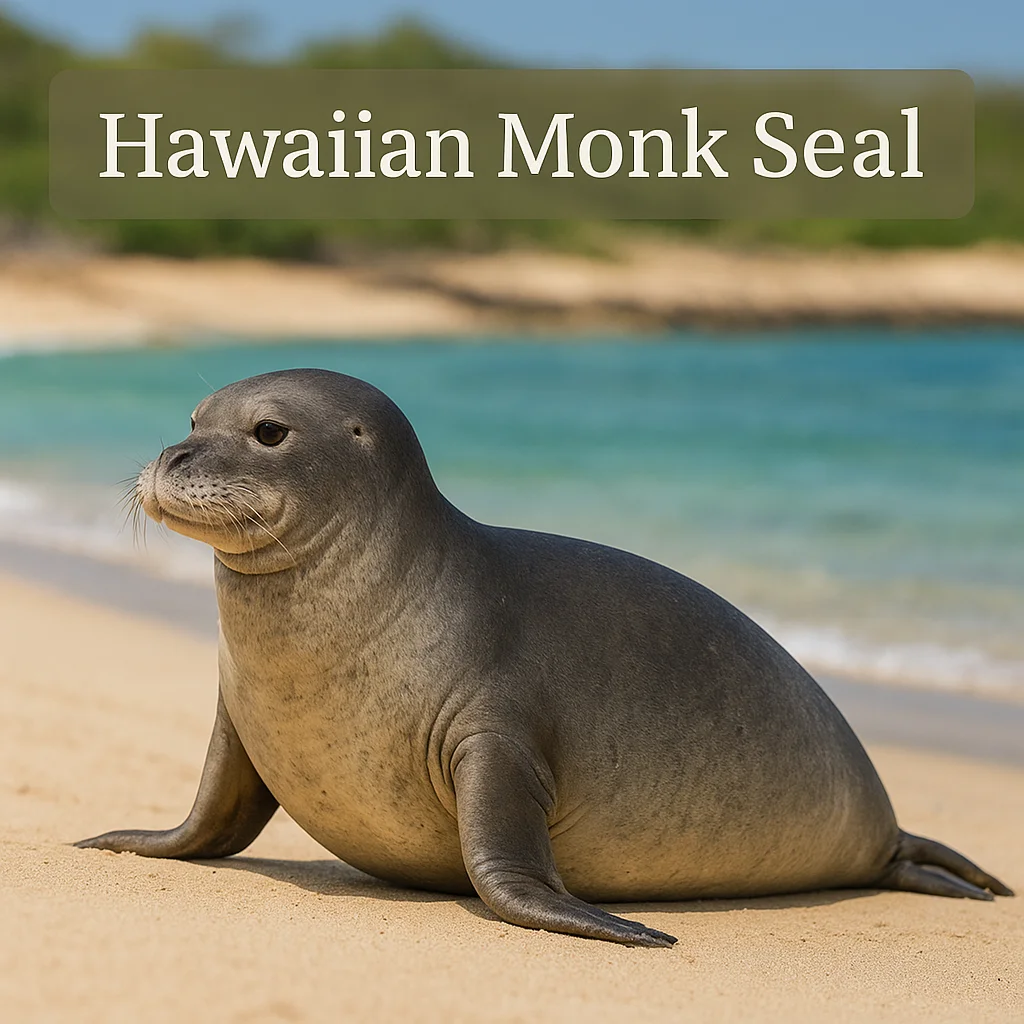
- Common name(s): Hawaiian Monk Seal
- Scientific name: Neomonachus schauinslandi
- Animal type: Mammal
- Typical adult size: 7–7.5 feet (2.1–2.3 m); 400–600 pounds (181–272 kg)
- Typical lifespan: 25–30 years in the wild
- Diet type: Carnivore; primarily fish, squid, and crustaceans
- Activity pattern: Diurnal
- Social structure: Solitary
- Speed / movement highlights: Powerful swimmer; movement mostly in the water
- Intelligence/learning: Adaptable foragers with keen learning abilities
- Primary habitats: Tropical oceans, beaches, and coral reefs
- Geographic range: Hawaiian Islands, primarily the Northwestern Hawaiian Islands
- Predators/threats: Sharks are natural predators; human-related threats include habitat loss, entanglement, and disease
- Conservation status: Endangered
🔍 Identification & Appearance
Hawaiian Monk Seals are identifiable by their robust, cylindrical bodies and smooth coats, which vary in color from silver to dark brown. As juveniles, they have a softer, lighter gray appearance. Key identifying features include their whiskered faces, lack of external ears (typical of true seals), and relatively short, clawed flippers. Their tracks on sandy beaches appear as slender, undulating grooves.
- Robust, streamlined body
- Short, whiskered face with no external ears
- Color ranges from silver-gray to dark brown
- Flippers are short, with visible claws
- Juveniles have lighter gray coats
- Distinctive sound includes grunting and barking
- Presence of a fiddler-shaped tail is unique
- Tracks show undulating grooves on sandy beaches
🧱 Body Structure & Physical Adaptations
The body of the Hawaiian Monk Seal is built for aquatic life. They have streamlined bodies that help in swimming swiftly and efficiently. Their jaws are strong with teeth adapted for gripping and shearing prey. Fins are crucial for propulsion, and they are adept at propelling their bodies through water with minimal effort. Senses of smell and hearing are well-developed, compensating for their relatively poor eyesight.
- Streamlined body for efficient swimming
- Strong jaws with specialized teeth
- Short, clawed flippers for maneuverability
- Well-developed senses of smell and hearing
- Limited color vision under water
- Thick blubber layer for insulation
- Flippers aid in sudden directional changes
🌍 Range & Distribution
The Hawaiian Monk Seal is endemic to the Hawaiian Islands, specifically frequenting remote, uninhabited beaches in the Northwestern Hawaiian Islands. These areas provide an ideal environment with minimal human disturbance. The seals do not migrate and are considered resident across their small range.
- Endemic to the Hawaiian Islands
- Primarily found in the Northwestern Hawaiian Islands
- Relatively localized distribution
- Prefers remote, uninhabited beaches and reefs
- Marine distribution away from populated islands
- Concentration in marine protected areas
🏞️ Habitat & Shelter
Hawaiian Monk Seals prefer tropical oceanic environments and are commonly associated with sandy beaches and coral reefs, which provide sites for resting, birthing, and nursing. These seals often haul out on the beaches to rest, a crucial behavior to their survival. Understanding their habitat preferences helps in conservation efforts aimed at protecting their beach and reef ecosystems.
🧭 Behavior & Ecology
Monk seals are generally solitary, occasionally seen together during breeding seasons. They tend to rest and haul out on sandy shores, using vocalizations to communicate. Predominantly bottom feeders, they have an essential role in maintaining the health of reef ecosystems by controlling fish populations. Their behavior includes the use of specific resting and birthing sites, which are often reused across generations.
- Solitary but gather during breeding
- Vocalizations for communication
- Utilizes specific beaches for hauling out
- Bottom feeders, influencing fish populations
- Rests predominantly during the day
- Minimal interactions with other species unless breeding
👥 Social Life & Group Dynamics
Hawaiian Monk Seals are primarily solitary animals, but they do form temporary groups during breeding and molting seasons. While not forming permanent colonies, some loose aggregations are seen when resources are clumped. The social interactions include territorial displays and vocalizations to resolve conflicts, predominantly related to mating rights and space for hauling out.
- Mostly solitary except during specific seasons
- Temporary aggregations for breeding
- Vocalizations serve social functions
- Site fidelity observed for resting beaches
- Minimal end-to-end cooperation
🍽️ Diet, Prey & Predators
The diet of the Hawaiian Monk Seal includes a variety of fish, squid, octopus, and crustaceans found in coral reef systems. They typically forage alone and employ various techniques like searching the ocean floor with their sensitive whiskers. Known predators are limited to larger sharks, while human-induced threats also exist, such as entanglement in fishing gear and habitat competition.
- Diet comprises fish, squid, and octopus
- Primarily solitary foragers
- Powerful bites are used for catching prey
- Sharks are known natural predators
- Entanglement threats from fishing gear
- Foraging can be both day and night
🦌 Hunting, Foraging & Movement
Hawaiian Monk Seals are efficient swimmers, using their streamlined bodies and strong flippers to navigate and hunt within coral reefs. They are capable of diving to significant depths in search of prey. Seals spend substantial time moving between forage zones and beach resting areas. Despite their agility in water, they are considerably slow and awkward on land, where they shuffle using their flippers.
- Expert swimmers with streamlined bodies
- Dive deeply to forage on ocean floors
- Primarily utilizes tidal movements in foraging
- Significantly slower movement on land
- Shuffling movement on beaches observed
- Strong navigational instincts between sites
🧠 Intelligence & Senses
With acute senses, Hawaiian Monk Seals exhibit remarkable adaptation to their marine environment. They possess a high ability to learn new foraging techniques and adapt to different depths and prey types. Their senses are beautifully tuned to detect prey both visually and through sensitive whiskers. Scent aids in locating haul-out sites and potential mates.
- Excellent sense of smell above water
- Acute auditory senses supporting life in the water
- Adaptive learning in foraging behavior
- Whiskers used for tactile sensing under water
- Visual acuity crucial for hunting
- Research limited on deep-dive sensory limits
🪺 Reproduction, Pregnancy & Parenting
Hawaiian Monk Seals breed between late winter and early summer. They are mostly monogamous, with males actively competing for females. Gestation lasts about 11 months, and females give birth to a single pup that remains dependent for several weeks. Mothers nurse their pups on beaches, providing intense maternal care until weaning occurs, with little male involvement beyond mating.
- Breeding occurs from spring to early summer
- Monogamous pair bonding observed
- Gestation lasts approximately 11 months
- Typically one pup per birth
- Nursing spans around 6 weeks
- Females are the exclusive caregivers
♀️♂️ Male vs Female Differences
Differences between male and female Hawaiian Monk Seals are subtle. Both sexes appear similar in size and coloration; however, males tend to have slightly exaggerated neck creases and can exhibit more aggressive behaviors during mating seasons. Females are primarily responsible for pup care, using aggression to protect their young from potential threats.
- Males generally have more prominent neck folds
- Females are primary caregivers in pup development
- Size and coloration are generally similar
- Males show elevated aggression during breeding
- Behavioral roles especially notable in rearing periods
🧬 Subspecies & Variation
There are no recognized subspecies of the Hawaiian Monk Seal. The species exhibits little noticeable variation across its range, attributed to its geographically limited habitat span. Local adaptations, if present, remain undocumented with current studies suggesting a uniformity in moderating coastal conditions.
- No established subspecies
- Limited geographic variation observed
- Certain behavioral patterns may vary seasonally
- Genetic studies suggest species uniformity
⚠️ Threats, Conservation & Human Interaction
The Hawaiian Monk Seal faces several conservation challenges including habitat degradation, climate change implications, and fisheries entanglement. Efforts are made to sustain its population through protected environments and awareness programs. Interactions with humans are generally limited, conservation bodies advise maintaining a respectful distance to ensure the seal’s safety and habitat stability.
- Exposure to human-related pressures limited
- Entanglement in marine debris poses a threat
- Protected areas critical for habitat conservation
- Climate changes affecting feeding grounds
- Recommended distance from seals minimizes stress
- Human awareness critical in conservation efforts
✨ Fun Facts & Unique Traits
- The Hawaiian Monk Seal is one of only two extinct monk seal species.
- They are more closely related to tropical seals than polar ones.
- Monk seals were named for the solitary nature mimicking monastic reclusiveness.
- Females fast during the lactation period to ensure pup survival.
- Populations are gradually rebuilding under conservation efforts.
- They use vocalizations both underwater and on land to communicate.
📌 Summary
- Hawaiian Monk Seals are earless, streamlined marine mammals.
- They are endemic to the Hawaiian Islands, residing primarily in coral reefs.
- Primarily solitary, they play a crucial ecological role in marine ecosystems.
- Key threats include human-caused habitat disturbance and marine debris.
- Active conservation efforts are vital in preserving this endangered species.
- Breeding is seasonal, with monogamous pairings and intense maternal care.
- Monk Seals exhibit robust adaptability, specialized sensory adaptations.
- Both natural predation by sharks and human interference pose challenges.