🦁 Humpback Whale
🧾 Quick Facts
The humpback whale, known for its impressive size and distinctive behaviors, is one of the most widely recognized species of whales. It is renowned for spectacular breaching displays and intricate songs, captivating marine enthusiasts and researchers alike.
- Common name(s): Humpback Whale
- Scientific name: Megaptera novaeangliae
- Animal type: Mammal
- Typical adult size: 39-52 feet (12-16 meters)
- Typical lifespan: 45-50 years in the wild
- Diet type: Carnivore; primarily krill and small schooling fish
- Activity pattern: Mostly diurnal, with some nocturnal foraging
- Social structure: Generally solitary or in small groups
- Speed / movement highlights: Up to 15 miles per hour (24 km/h) when necessary
- Intelligence/learning: High intelligence with complex vocal communication
- Primary habitats: Open ocean, coastal waters
- Geographic range: Found in all major oceans worldwide
- Predators/threats: Killer whales, large sharks, ship strikes, entanglement in fishing gear
- Conservation status: Least Concern, but some populations are vulnerable
🔍 Identification & Appearance
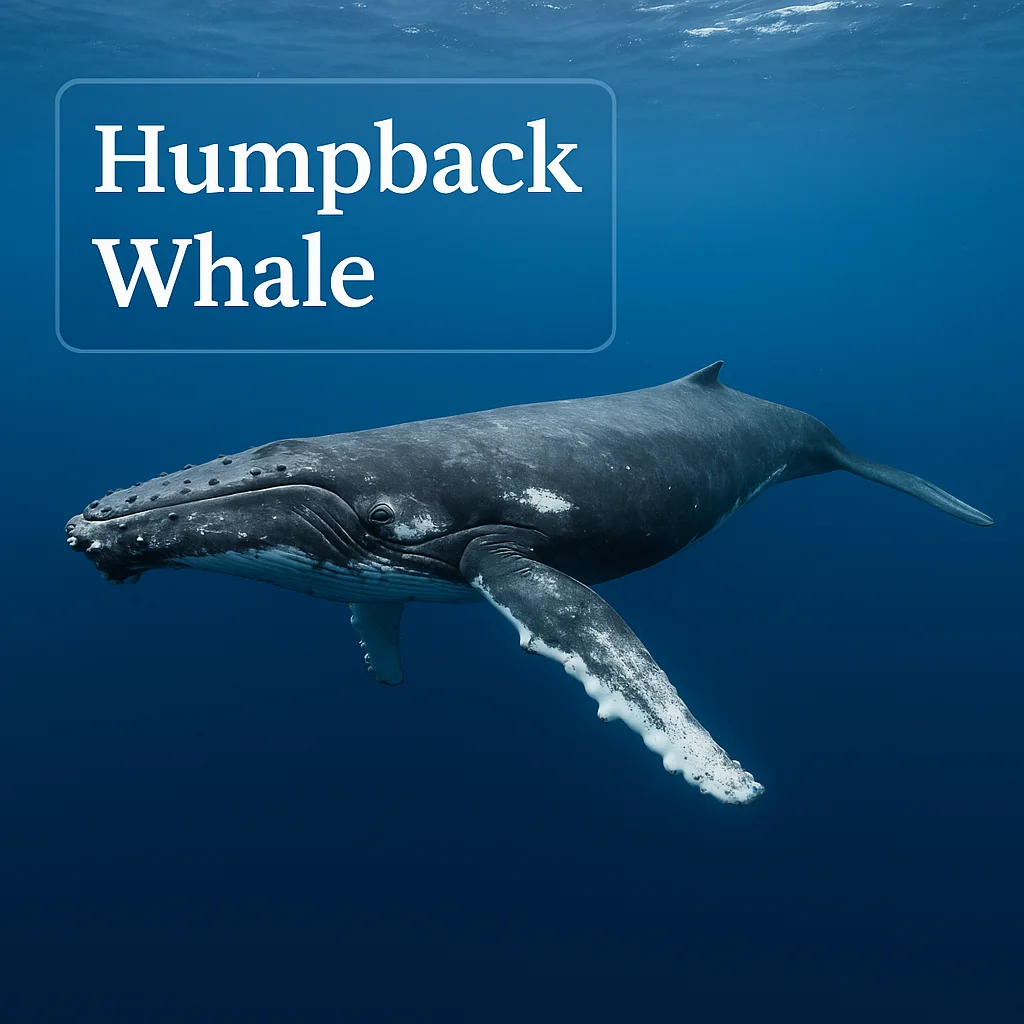
Humpback whales can be identified by their distinct body shape, which includes long pectoral fins and a knobby head. Their dark coloration is offset by unique white patterns on the underside of their flukes, used to identify individuals. Their dorsal fin is small and often stubbier compared to other whale species.
- Large, bulky body with long pectoral fins
- Dark gray or black coloration with white patches underneath the fluke
- Finned hump on the back
- Knobby protuberances on the head (tubercles)
- Distinctive blow when exhaling, reaching up to 10 feet (3 meters) high
- Often seen breaching and slapping water with fins and tails
- Commonly mistaken for other baleen whales but distinguished by long fins
- Top-sided dorsal fin located further down the back
🧱 Body Structure & Physical Adaptations
Humpback whales have evolved a robust physique ideal for both enduring long migrations and exhibiting acrobatic behaviors. Their baleen plates enable efficient filter feeding, while their large vocal cords facilitate complex song structures essential for communication and breeding.
- Robust, streamlined body with large head
- Long pectoral fins for maneuverability
- Throat grooves for expanding when feeding
- Eyes positioned towards the sides of the head, allowing broad vision
- Thick layer of blubber for insulation and energy storage
- Baleen plates for filtering small prey from the water
- Relatively limited terrestrial hearing, optimized for underwater acoustics
- Advanced lung capacity for deep and extended dives
🌍 Range & Distribution
Humpback whales are widespread and can be found from polar to tropical waters. They undertake long migratory journeys annually, traveling between feeding areas in colder climates and breeding grounds in warmer waters.
- Atlantic and Pacific Oceans are primary ranges
- Summer feeding grounds in high-latitude regions
- Winter breeding grounds in subtropical waters
- Migratory routes can exceed 3,000 miles (4,800 kilometers)
- Commonly seen in the Gulf of Alaska, the Caribbean, and the southern coast of Australia
🏞️ Habitat & Shelter
Humpback whales favor open ocean habitats and are often found near coastlines. These giants navigate seasonal changes by moving between shallow coastal regions during breeding and deeper open ocean areas during feeding. Weather and water temperature greatly influence their movement and behavior.
Understanding their habitat preferences is crucial for conservation efforts and minimizing human impact.
🧭 Behavior & Ecology
Humpback whales are known for their captivating behaviors, including breaching and tail slapping. These actions serve purposes ranging from communication to removal of parasites. Socially, they can be solitary but are also found in temporary groups for feeding and migration.
Their intricate songs, produced primarily by males, are believed to play roles in courtship and social bonding.
- Tend to rest on ocean surfaces between dives
- Elaborate vocalizations and songs are a cornerstone of their communication
- Display cooperative feeding methods using bubble nets
- Acts as one of the ocean's primary grazers of krill and small fish
- Occasional interactions with dolphins and other small whale species
👥 Social Life & Group Dynamics
Humpback whales exhibit a primarily solitary lifestyle or travel in small, temporary groups. Unlike some other whale species, long-term social bonds are uncommon. However, they do form coalitions during migration and teamwork is observed during feeding activities.
- Solitaires are common during non-breeding periods
- Temporary group formations for cooperative hunting
- Strong, audible communications to maintain brief associations
- Herding behavior during bubble-net feeding
- Mother-calf bonding is significant during early life stages
🍽️ Diet, Prey & Predators
The dietary habits of humpback whales focus on their preference for small schooling fish and krill, which they capture using a unique bubble-net feeding strategy. Under threat from natural predators like killer whales and large sharks, they rely on size and group defense strategies for protection.
- Feeds primarily on krill and small fish such as herring and sand lance
- Uses filter feeding aided by baleen plates
- Relies on group feeding to maximize food intake
- Utilizes bubble-net feeding as a strategic hunting method
- Regular threats from predatory killer whales
- Seasonal variations may influence prey selection
🦌 Hunting, Foraging & Movement
Humpback whales are expert swimmers, employing powerful waves of tail flukes to propel themselves. Their complex foraging technique, especially bubble-net feeding, involves creating a ring of bubbles to trap prey efficiently. These whales are adept at long-distance migrations, often traveling thousands of miles between feeding and breeding grounds.
- Adept long-distance migrants
- Utilizes massive flippers for fine maneuvering
- Exhibits spectacular breaching abilities
- Pioneers in cooperative bubble-net feeding
- Navigates by vocalizations and possibly earth's magnetic field
🧠 Intelligence & Senses
Humpback whales exhibit significant intelligence, evident in their complex acoustic songs and problem-solving abilities. Their well-developed senses allow efficient environmental interaction, with keen hearing for echolocation and social communication. Despite extensive research, the full extent of their cognitive abilities remains partly understood.
- Advanced vocal communication between individuals
- Songs and complex sound patterns used for mating
- High degree of social intelligence
- Good memory for migratory routes
- Sensitive to underwater acoustic changes
- Research on problem-solving is ongoing
🪺 Reproduction, Pregnancy & Parenting
Humpback whales practice mating rituals that involve complex song displays by males. Their breeding season is typically in the winter months, with gestation lasting about 11 months. Calves are born in warm waters and are nursed by their mothers, who provide sole parental care.
- Breed in winter, primarily in warm, tropical waters
- Males perform intricate songs for courtship
- Gestation period approximately 11-12 months
- Typically gives birth to a single calf
- Calves are born precocial, ready to swim immediately
- Female humpbacks are responsible for childcare
♀️♂️ Male vs Female Differences
There are subtle distinctions between male and female humpback whales, most notably in their reproductive roles and subtly varied vocalizations. Overall, the physical appearances are similar, with males slightly smaller in size but not significantly different in coloration or markings.
- Males slightly smaller than females on average
- Males vocalize more frequently during breeding season
- Females are primary caregivers for young
- No major differences in coloration or fluke patterns
- Behavioral differences mostly in context of reproduction
🧬 Subspecies & Variation
Currently, there are no widely recognized subspecies of the humpback whale, although populations can show genetic diversities attributed to geographical barriers. Differences in song patterns and behaviors have been noted in distinct population groups but are not consistent enough to designate subspecies.
- No recognized subspecies; variations noted in populations
- Song variations observed between isolated groups
- Geographic genetic differences noted in studies
- Migratory patterns can vary between hemispheres
⚠️ Threats, Conservation & Human Interaction
While humpback whale populations show signs of recovery, they still face threats from entanglement, ship strikes, and environmental pollution, including noise pollution from human activities. Responsible marine activities and awareness are key in ensuring their continued survival.
- Threats from commercial fishing gear entanglement
- Ship strikes pose significant risk near heavily trafficked areas
- Impacts from noise pollution on communication and navigation
- Conservation efforts have improved some population numbers
- Educating the public on safe whale watching practices
✨ Fun Facts & Unique Traits
- Humpback whales are capable of leaping fully out of the water, a behavior known as breaching.
- Their tails, or flukes, exhibit patterns as unique as human fingerprints.
- They produce the longest and most complex songs in the animal kingdom.
- Humpback whales can consume up to 2,000 pounds of food per day.
- Their flippers can measure up to one-third of their body length.
- Humpbacks are known to assist other marine animals in distress, a phenomenon not yet fully understood.
📌 Summary
- Identified by long pectoral fins, knobby heads, and a distinctive blow.
- Found across all major oceans, favoring coastal and open ocean habitats.
- Primarily feeds on krill and small schooling fish using unique bubble-net feeding.
- Few natural predators; main threats are human activities and environmental changes.
- Exhibits mainly solitary or small, temporary group dynamics.
- Breeds in warmer waters with significant maternal care for calves.
- Highly intelligent with complex vocalizations facilitating mating and social interaction.
- Notable for long migrations and high adaptability to aquatic environments.