🦁 Leopard Seal
🧾 Quick Facts
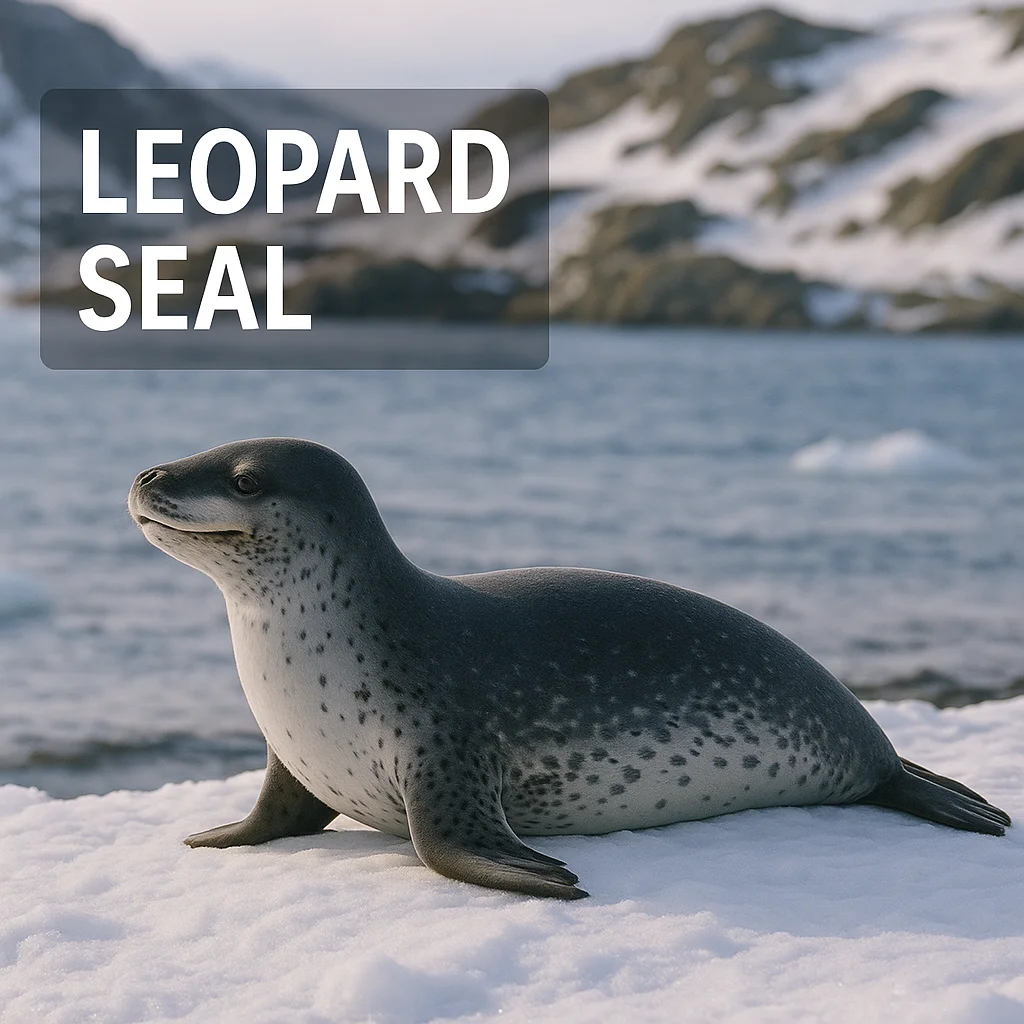
The leopard seal (Hydrurga leptonyx), named for its distinctive spotted coat, is a formidable predator found in the icy waters surrounding Antarctica. As the only seal known to regularly prey on warm-blooded animals, it holds a unique position in the marine ecosystem.
- Common name(s): Leopard Seal
- Scientific name: Hydrurga leptonyx
- Animal type: Mammal
- Typical adult size: 2.4 to 3.5 meters in length, 200 to 600 kg in weight
- Typical lifespan: 12 to 26 years
- Diet type: Carnivore; eats fish, krill, penguins, and other seals
- Activity pattern: Primarily diurnal
- Social structure: Solitary
- Speed / movement highlights: Can swim up to 37 km/h
- Intelligence/learning: Displays problem-solving skills and hunting strategies
- Primary habitats: Sea ice, Antarctic waters
- Geographic range: Circumpolar in the Antarctic region
- Predators/threats: Sharks, killer whales, climate change
- Conservation status: Least Concern, but data varies by region
🔍 Identification & Appearance
The leopard seal’s elongated, muscular body and large head with a reptilian-like form are notable characteristics. It is easily identified by its distinctively long body, large fore-flippers, and dark spots scattered over a silver, grey, or dark bluish-grey coat.
- Body shape and silhouette: Long, streamlined with a pronounced head
- Key colors/patterns: Silvery-gray body with black spots; no seasonal changes
- Distinctive features: Large jaws, spotted pattern
- Tracks & signs: Rarely leaves tracks due to aquatic lifestyle
- Common look-alikes: Can be confused with other seal species, like the crabeater seal, but distinguishes by head shape and spots
- Long, sleek body with distinctive spots
- Reptilian-like head structure
- Dark spots on silver body
- Large, powerful fore-flippers
- Behaviorally solitary
- Integral feature of Antarctic marine life
🧱 Body Structure & Physical Adaptations
The leopard seal features a powerful build optimally adapted for hunting in icy waters. Its massive jaws equipped with long canine teeth and a flexible neck allow it to catch agile prey. The front flippers are large and enable swift, agile swimming, crucial for both hunting and avoiding predators.
- Build and proportions: Stocky, elongated body with thick layers of blubber
- Teeth/jaw adaptations: Sharp, interlocking teeth designed for grasping and slicing prey
- Claws/fins: Strong fore-flippers with webbed digits for propulsion
- Sensory strengths: Keen sense of hearing and sight for detecting prey in water
- Thick blubber for insulation
- Muscular build for powerful swimming
- Sturdy jaws with interlocking teeth
- Front flippers for agile movement
- Keen underwater vision
- Acute hearing helps in hunting
🌍 Range & Distribution
The leopard seal is primarily found in the icy waters of the Antarctic and sub-Antarctic regions. Its range extends to include the southern coasts of South America, South Africa, and Oceania. It is a species adapted to polar climates and does not migrate seasonally, although it may travel extensive distances over the ice and open ocean within its range.
- Antarctic Peninsula
- Sub-Antarctic islands
- Southern Ocean
- Occasionally near the southern coasts of Australia, New Zealand, and Africa
- Mostly found on sea ice in polar regions
- Thrives in colder, nutrient-rich waters
🏞️ Habitat & Shelter
Leopard seals are typically associated with the pack ice, inhabiting areas where there is a combination of open water and floating ice. During the austral summer months, they are commonly found along the edges of ice floes, where they haul out to rest or hunt nearby. Knowledge of the leopard seal's habitat is crucial for conservation efforts, as their reliance on sea ice makes them particularly vulnerable to climate change.
- Ice floes and pack ice
- Open ocean waters in the Antarctic
- Relies on sea ice for resting and breeding
- Dives under ice to escape predators
🧭 Behavior & Ecology
The leopard seal's behavior revolves around its solitary and predatory lifestyle. Razor-sharp coordination and acute senses make it a skilled predator, often seen swimming along the waterline searching for prey. Vocal communications are primarily underwater, including various growls and moans.
- Diurnal activities centered on hunting
- Resting on ice floes between hunts
- Vocal communication underwater with a range of calls
- Predominantly solitary with aggressive territorial displays
- Plays a critical role as a top predator in the polar ecosystem
- Notable endurance and swimming capabilities
👥 Social Life & Group Dynamics
Although primarily solitary, leopard seals may occasionally be observed in loose groups, often when food is abundant. During the breeding season, these seals exhibit more interaction, though without forming lasting bonds. Cooperation among individuals is rare, and their interactions can occasionally be aggressive.
- Predominantly solitary lifestyle
- Occasional loose group formations when preying
- Minimal cooperation among individuals
- Crucial solitary hunting strategies
- Breeding involves temporary aggregation
- Aggressive behavior towards potential competitors
🍽️ Diet, Prey & Predators
As apex predators, leopard seals have a varied diet, feeding mostly on krill, fish, penguins, and other seals. Their hunting strategy involves stalking and ambushing prey, and they are known to dismember their catch on the water surface. Although they face few natural predators, orcas and large sharks may pose a threat to younger seals.
- Feeds on krill, fish, and occasionally penguins
- Preys on other seal species, notably the crabeater seal
- Utilizes ambush hunting strategies
- Known for playing with captured prey
- Large body size deters most natural predators
- Adapted to sudden, stealthy attacks
🦌 Hunting, Foraging & Movement
Leopard seals are exceptional swimmers, using their strong fore-flippers to propel through water with speed and agility essential for ambushing prey. Their movement style alternates between stealth and bursts of speed, and they often forage alone, exploring the icy waters and edges of ice shelves.
- Primarily an ambusher and forager
- Uses fore-flippers for agile swimming and quick pivots
- Capable of reaching speeds up to 37 km/h in pursuit
- Hunts by stalking prey near ice edges
- Demonstrates impressive endurance during hunts
🧠 Intelligence & Senses
Leopard seals exhibit remarkable intelligence akin to other marine mammals. They demonstrate sophisticated hunting tactics and problem-solving abilities, although specific studies on their cognitive capabilities are limited. Their advanced sensory adaptations play a vital role in detecting prey under the ice where visual clues are minimal.
- Great problem-solving abilities exhibited in hunting
- Highly adaptable hunting techniques
- Keen underwater sight adapted for low light
- Heightened auditory senses for navigation and communication
🪺 Reproduction, Pregnancy & Parenting
Leopard seals have a polygynous mating system, with a breeding season extending from December to January. The gestation period lasts about 11 months, with births occurring in early spring. Pups are born with a thick layer of fur and are precocial, meaning they are relatively mature and mobile from birth. Mothers are the primary caregivers, nursing pups on the ice for weeks before they are weaned.
- Breeding occurs in summer (December to January)
- Polygynous mating system
- Gestation lasts approximately 11 months
- Usually gives birth to a single calf
- Pups are born on the ice with a layer of fur
- Mother provides the majority of care and protection
♀️♂️ Male vs Female Differences
Sexual dimorphism in leopard seals is relatively subtle compared to other seal species, with females generally being slightly larger than males. Males and females exhibit similar coloration and patterns, but behavioral roles may vary slightly during the breeding season, with males exhibiting more territorial aggression.
- Females tend to be larger on average
- Both sexes have similar spotting patterns
- Males exhibit more aggressive territorial behaviors
- Both participate in brief mating interactions
🧬 Subspecies & Variation
There are no recognized subspecies of the leopard seal, making population variations relatively minor. However, geographical isolation can lead to subtle differences in size and behavior based on environmental pressures. Continued research is essential to understand any potential local adaptations or genetic diversification.
- No officially recognized subspecies
- Minor geographical variations in size
- Behavioral adaptations based on local prey availability
- Conservation studies important for understanding genetic diversity
⚠️ Threats, Conservation & Human Interaction
Currently listed by the IUCN as Least Concern, the leopard seal faces few direct threats due to its remote habitat, although climate change and consequent ice depletion present substantial risks. Human interactions are limited but increasing with polar tourism, research, and fishing activities potentially impacting their environment. Responsible conservation includes promoting awareness and minimizing disruption to their natural habitat.
- Listed as Least Concern but vulnerable to climate change
- Loss of ice habitat due to warming poses a significant threat
- Bycatch in fishing operations is an occasional concern
- Encounters with humans mainly through scientific research
✨ Fun Facts & Unique Traits
- Leopard seals can produce haunting underwater vocalizations
- They are named after the big cat for their spotted coat
- Known to play with penguins before consuming them
- A rare seal that primarily hunts warm-blooded prey
- One of the top predators in the Antarctic ecosystem
- Remarkable endurance allows them to dive over 300 meters
📌 Summary
- Identified by its reptilian-like head and spotted coat
- Lives within the icy waters of Antarctica
- Highly adaptable carnivore, preying on krill, fish, penguins
- Keystone predator impacting the ecosystem balance
- Socially solitary and territorial
- Breeds during Antarctic summer with thorough pup care
- Adapted to diverse hunting strategies
- Faces challenges from climate change and habitat alterations