🦁 Narwhal
🧾 Quick Facts
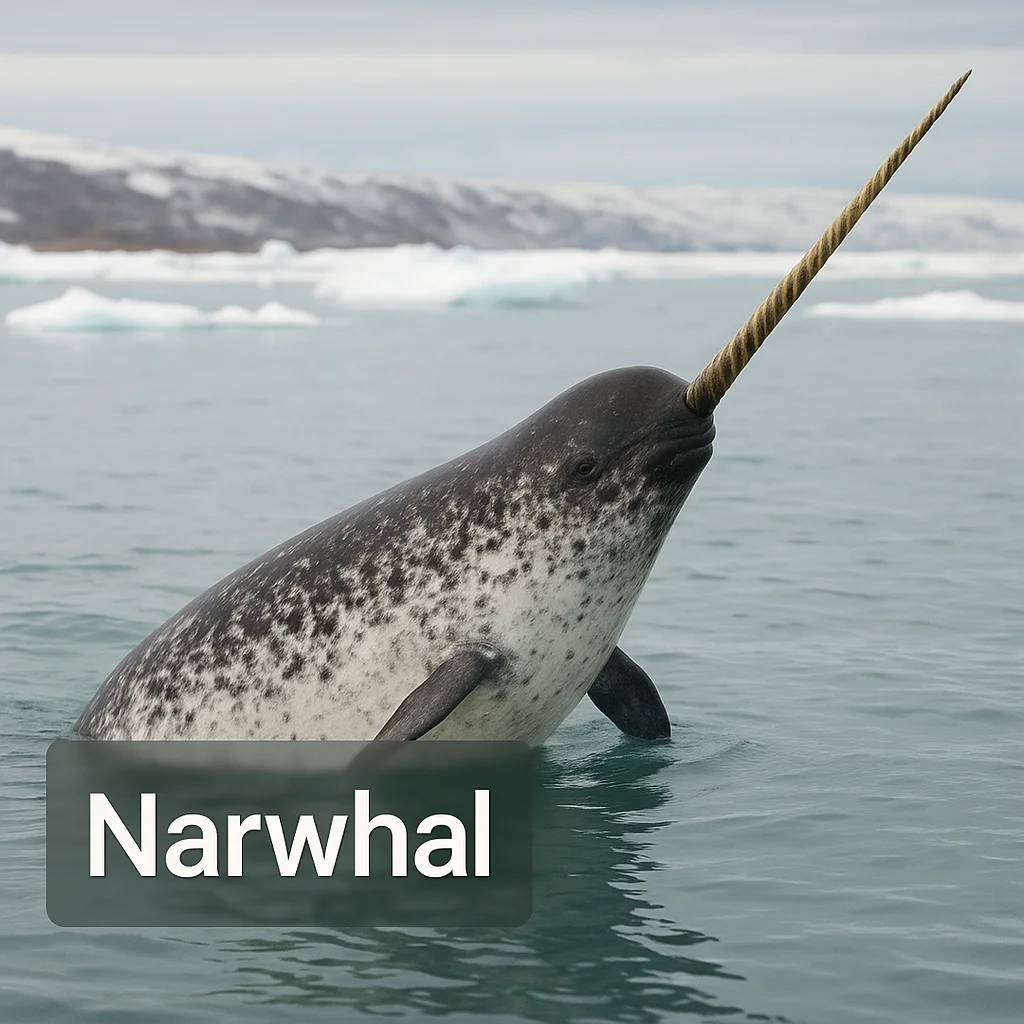
The narwhal, often nicknamed the unicorn of the sea, is an enchanting marine mammal renowned for its long, spiral tusk protruding from its head. These elusive creatures inhabit some of the coldest waters on Earth, where they have adapted to thrive in Arctic environments.
- Common name(s): Narwhal
- Scientific name: Monodon monoceros
- Animal type: Mammal
- Typical adult size: 3.5-5.5 meters (11.5-18 feet) in length; 800-1,600 kg (1,760-3,530 lbs) in weight
- Typical lifespan: 20-50 years in the wild
- Diet type: Carnivore; consumes mainly fish, squid, and shrimp
- Activity pattern: Primarily diurnal
- Social structure: Group-oriented, often seen in pods
- Speed / movement highlights: Moderate swimmers; known for diving up to 1,800 meters (5,905 feet)
- Intelligence/learning: Demonstrates problem-solving skills and social intelligence
- Primary habitats: Arctic waters
- Geographic range: Arctic regions of Canada, Greenland, Norway, and Russia
- Predators/threats: Orcas, polar bears, some human-related threats
- Conservation status: Near Threatened
🔍 Identification & Appearance
Narwhals are easily recognized by their distinctive tusk, a long, spiraling tooth extending from the upper jaw in males. Their bodies are robust and cylindrical, tapering at both ends with a mottled grayish color that provides camouflage against aquatic predators.
- Body shape: Streamlined with a blubber layer for insulation
- Key colors: Mottled gray and white, with age-related changes
- Distinctive features: Iconic tusk, small head, lack of dorsal fin
- Tracks, scat, signs: Rarely visible as they spend time primarily in water
- Common look-alikes: Beluga whale; distinguishable by tusk and color
- Top ID Tips:
- Look for the long, straight tusk in males
- Notice the sleek, blubber-insulated body
- Mottled gray color acts as a natural camouflage
- No dorsal fin; sleek silhouette
- Smaller heads with short, rounded flippers
- Pods often break surface for air
- Males are generally larger due to their tusk
🧱 Body Structure & Physical Adaptations
Narwhals are uniquely adapted to their frigid environments. Their tusk, primarily in males, is an enigmatic feature believed to be used in mating displays and possibly in sensory functions. Their thick layer of blubber insulates them against the icy waters, while their finless body minimizes heat loss.
- Stocky build with thick blubber for warmth
- Tusk is a modified tooth, usually on males
- Rounded flippers for maneuverability
- Excellent hearing for navigation and communication
- Limited vision in deep waters
- Key Adaptations:
- Blubber layer for insulation
- Spiral tusk with possible sensory functions
- Lack of dorsal fin reduces heat loss
- Ability to dive deep for extended periods
- Streamlined body for efficient swimming
- Flukes for propulsion
🌍 Range & Distribution
Narwhals inhabit the icy waters of the Arctic Circle, thriving in remote and harsh environments. They reside primarily in the waters around Greenland and the Canadian Arctic, with smaller numbers found near Russian and Norwegian shores.
- Greenland and Canadian Arctic territories
- Occasional presence in Norway
- Some populations near Russian coasts
- Primarily found in Arctic waters
- Can venture near ice floes
- Tend to remain in Arctic year-round
- Where You Might Find It:
- Arctic seas
- Adjacent coastlines
- Deep fjords and channels
- Near pack ice edges
- Remote northern inlets
🏞️ Habitat & Shelter
Narwhals inhabit icy, cold waters of the Arctic, often seen near the edges of sea ice where they hunt for food. They thrive in habitats that include deep fjords and ice-covered seas. Interaction with sea ice is critical, providing a platform for resting and avoiding predators.
Their choice of habitat is strongly influenced by the availability of breathing holes in ice and the presence of prey species.
🧭 Behavior & Ecology
Narwhals exhibit a complex social structure, living in family groups called pods, which can include up to 20 individuals. They communicate with a variety of clicks, whistles, and knock-like sounds, enabling navigation and coordination during migration and hunting trips.
As predators, narwhals play a crucial role in maintaining the balance of their aquatic ecosystem. Their diet consists primarily of fish, squid, and shrimp, making them integral to the marine food web.
- Behavior Highlights:
- Social and communication-oriented lives
- Vocalizations include complex sounds and songs
- Dive deep for feeding, sometimes up to 1,800 meters
- Strong migratory patterns following ice melts
- Feeds primarily during warmer months
- Plays a predator role in marine ecosystems
👥 Social Life & Group Dynamics
Narwhals are social animals, typically found in pods comprising related individuals. Group size varies but often reaches 20 individuals. These pods provide safety in numbers, as well as platforms for social learning and communication through social bonds.
- Social Structure Notes:
- Pod-based social life
- Males exhibit tusk jousting displays
- Stable family bonds within pods
- Defensive formations against predators
- Collaborative efforts in searching for food
- Structured but dynamic social hierarchy
🍽️ Diet, Prey & Predators
Narwhals have a carnivorous diet focused on arctic fish species, squid, and shrimp. In summer months, feeding intensifies in rich coastal waters, while during winter, they rely on prey found at remarkable ocean depths.
Natural predators include orcas and polar bears, with human interactions posing increasing threats, such as hunting and habitat disturbance.
- Feeding Notes:
- Relies on Arctic fish, squid, and shrimp
- Dives deep in search of prey
- Seasonal variation in diet
- Has few natural predators
- Evades predators through pack formations
- Human threats include hunting and pollution
🦌 Hunting, Foraging & Movement
Narwhals are agile swimmers, well-adapted to the challenges of icy waters. They utilize echolocation to locate prey, diving to significant depths in pursuit of food. While their movements are generally elegant and deliberate, narwhals are capable of quick maneuvers to evade predators.
- Movement & Strategy:
- Strong navigational skills
- Efficient echolocation for hunting
- Cold water adaptations for diving
- Agile swimmers
- Seasonal migration tracking ice meltoff
- Collaboration in pack foraging
🧠 Intelligence & Senses
Research shows narwhals possess advanced cognitive abilities, including problem-solving and social learning. Their echolocation skills are highly developed, allowing navigation in dark, deep environments, while their hearing and vocalization skills support social communication.
However, our understanding of narwhal cognition remains limited, with ongoing studies aiming to reveal more.
- Notable Abilities:
- High social intelligence
- Strong sense of echolocation
- Problem-solving in hunting trips
- Complex vocalizations
- Advanced social learning
🪺 Reproduction, Pregnancy & Parenting
Narwhals have a seasonal mating period occurring in the spring, with gestation lasting around 14-15 months. Calves are generally born in warmer summer months when conditions are more favorable. Female narwhals typically give birth to a single calf, raising it in the protective environment of the pod.
Parenting roles are predominantly maternal, though social interactions within pods likely facilitate some level of collective caregiving.
- Reproduction Snapshot:
- Breeding occurs in spring
- Gestation lasts 14-15 months
- Single calf per birth
- Calving in summer for optimal conditions
- Highest maternal care
- Collective pod support
♀️♂️ Male vs Female Differences
Males and females are generally similar in body size, yet males distinctly possess the long, spiral tusk. The presence and length of the tusk is the most significant difference, as it is a sexually dimorphic feature used in mating displays and tusk jousting, signifying social ranking.
- Sex Differences at a Glance:
- Males possess tusks, females generally don't
- Minor size differences favoring males
- Males engage in tusk jousting
- Similar coloration and physical build
- Social roles often overlap
🧬 Subspecies & Variation
While no subspecies of narwhals are formally recognized, geographic isolation leads to variations in behaviors and population characteristics. Some differences in dietary habits and migration patterns between populations have been observed, though the genetic divergence is limited.
- Variation Notes:
- No subspecies officially recognized
- Behavioral variation across regions
- Marginally different dietary habits between groups
- Migratory patterns are region-specific
- Gene pool shows low divergence
⚠️ Threats, Conservation & Human Interaction
Narwhals face various threats, both natural and human-induced. Climate change affects their ice habitats, while hunting, entanglement in fishing nets, and pollution pose increasing dangers. Conservation efforts focus on habitat protection and regulation of hunting practices.
- Responsible Notes:
- Climate change threatens habitats
- Human hunting pressures
- Pollution impacts health and habitat
- Conservation focuses on habitat protection
- Research continues to guide conservation
- Sustainable practices essential for coexistence
✨ Fun Facts & Unique Traits
- Male narwhals are known for their spiral tusks, which are actually elongated teeth.
- Narwhals can dive to depths of up to 1,800 meters, or over a mile deep.
- Their tusks have millions of nerve endings, possibly serving a sensory purpose.
- Despite popular myths, only about 15% of females grow tusks.
- Narwhals are thought to use their tusks to detect changes in water chemistry and pressure.
- The complexity of their vocalizations suggests advanced communication skills.
- They are one of the few whale species that live exclusively in Arctic waters year-round.
- Narwhals and belugas are technically the closest living relatives, sharing a similar dental pattern.
- Their diving capability allows them to hunt in deep-sea environments that few other species can access.
📌 Summary
- Iconic for their tusks, narwhals inhabit Arctic waters.
- Pod-based, social animals with sophisticated vocal communications.
- They dive deep for fish, squid, and shrimp.
- Natural threats include orcas and polar bears, with human pressures notable.
- Male tusks are their most distinctive feature.
- Reproduction involves a prolonged gestation period, with summer births.
- Conservation efforts focus on protecting their Arctic habitats.
- Unique adaptations make narwhals masters of their icy domains.
- Mostly unchanged in appearance over time with no recognized subspecies.