🦁 Bornean Orangutan
🧾 Quick Facts
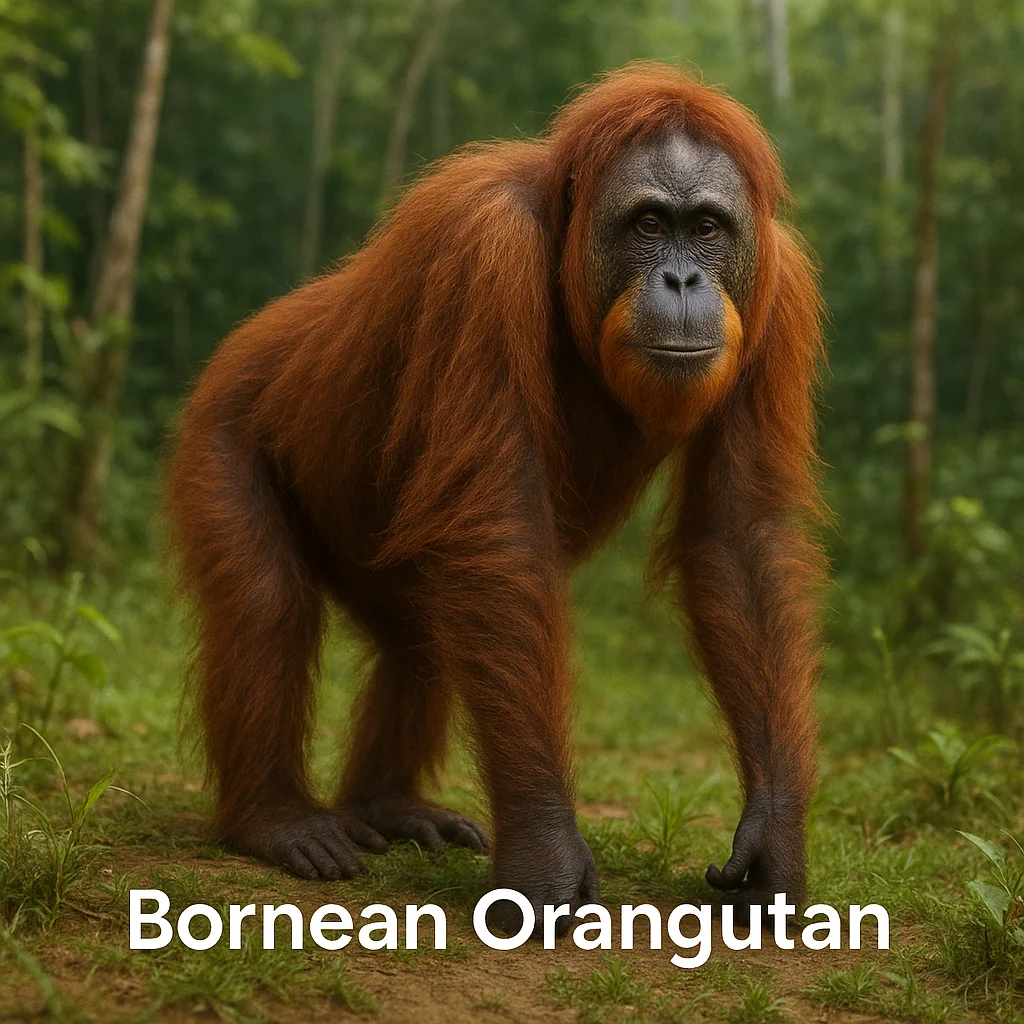
The Bornean Orangutan, known for its intelligence and arboreal lifestyle, is one of the great apes inhabiting the rainforests of Borneo. These fascinating mammals are critical components of their ecosystem and exhibit unique behaviors and adaptations that make them a subject of interest for wildlife enthusiasts and conservationists alike.
- Common name: Bornean Orangutan
- Scientific name: Pongo pygmaeus
- Animal type: Mammal
- Typical adult size: Males: 1.2-1.5 meters, Females: 1-1.2 meters; Weight: Males 50-100 kg, Females 30-50 kg
- Typical lifespan: 30-40 years in the wild, up to 50 years in captivity
- Diet type: Omnivore; primarily fruits, along with leaves, bark, and insects
- Activity pattern: Diurnal
- Social structure: Solitary, with occasional group interactions
- Speed/movement highlights: Arboreal climber, capable of moving swiftly through trees
- Intelligence/learning: High; capable of using tools and learning complex tasks
- Primary habitats: Tropical and subtropical forests
- Geographic range: Borneo (Indonesia and Malaysia)
- Predators/threats: Humans, deforestation, illegal pet trade
- Conservation status: Critically Endangered
🔍 Identification & Appearance
Recognizing a Bornean Orangutan involves noting its robust build and distinct reddish-brown hair. Their long arms and hook-shaped hands are adapted for an arboreal lifestyle. These apes have a large face with prominent cheek pads in males and small ears.
- Robust body with long arms
- Reddish-brown hair
- Males have prominent cheek pads
- Small eyes and expressive face
- Long, shaggy hair extending over the back
- Hook-shaped hands assist in tree climbing
- Females are smaller with less pronounced features
- Tracks are rarely seen due to arboreal habits
- Similar to the Sumatran Orangutan but with darker, coarser hair
🧱 Body Structure & Physical Adaptations
The Bornean Orangutan's body is uniquely adapted for life high in the forest canopy. Their long arms, reaching lengths of up to 2 meters, allow them to grasp branches with ease, while their strong fingers and toes maintain a secure grip.
- Stocky build with long limbs ideal for climbing
- Strong jaw muscles developed for chewing hard fruits
- Long, curved fingers and toes for grasping branches
- Excellent binocular vision for navigating through trees
- Smaller ears reduce heat loss in the humid forest
- Opposable thumbs for precise manipulation of objects
- Large abdominal region to support digestive needs of fibrous plant material
- Highly developed cerebrum supporting cognitive functions
- Sparse body hair helps regulate temperature in the tropical climate
🌍 Range & Distribution
Bornean Orangutans are found exclusively on the island of Borneo in Southeast Asia. Their range covers tropical lowland forest regions and swamps of Borneo in both Malaysia and Indonesia.
- Island of Borneo
- Found in both Malaysian and Indonesian territories
- Tropical rainforest habitats
- Swamp and peat swamp regions
- Live primarily in lowland forest areas
- Adapted to varied terrains of forest canopy
- No significant population found outside Borneo
- Non-migratory but may travel distances for food
🏞️ Habitat & Shelter
Favoring dense, tropical rainforests, Bornean Orangutans thrive in regions abundant with fruiting trees. They rely heavily on the forest canopy for movement and shelter, constructing nests from branches high in the trees to sleep at night.
- Tropical and subtropical lowland forests
- Fruiting trees provide primary food source
- Construct nests high in trees for sleeping
- Canopy dwellers rarely come to the ground
- Seasonal availability of fruits influences movement within forests
- Occasional use of secondary forests
- Variances in weather lead to seasonal shifts in diet and activity
🧭 Behavior & Ecology
Bornean Orangutans exhibit a largely solitary lifestyle, although they showcase complex social interactions when they encounter other individuals. They are known for their slow, cautious movements and measured intelligence, using tools to assist in foraging.
- Primarily solitary, interaction limited to mothers with young or occasional social feeding
- Tool use for extracting insects and opening fruits
- Construct new nests for sleeping each night
- Vocalizations include long calls from males to communicate territory
- Role as seed dispersers critical for forest ecology
- Minimal terrestrial activity, relying on the canopy
- Feeding often involves periods of rest and digestion
- Preference for high-value fruiting trees
- Females spend considerable time with offspring for years
👥 Social Life & Group Dynamics
Typically solitary, Bornean Orangutans have unique social interactions that mainly occur between mothers and their offspring. Adult males lead solitary lives, with interactions primarily during mating.
- Solitary with occasional group formations
- Mothers bond closely with their young
- Adult males maintain territories through vocal displays
- Tool use passed socially among populations
- Interactions often brief and centered around feeding opportunities
- No permanent social groups or troops
- Juveniles may exhibit playful behavior before becoming independent
- Females less territorial than males
🍽️ Diet, Prey & Predators
Bornean Orangutans are primarily frugivorous but have a varied diet including leaves, bark, and insects to supplement their nutritional needs. The rich diversity of the rainforest provides a wide selection of food sources.
- Fruit is the primary dietary staple
- Consume varying proportions of leaves and bark
- Occasional ingestion of soil for mineral intake
- Insectivorous tendencies for protein sources
- Minimal predation; humans major threat
- Use tools to aid in food extraction
- Avoidance behaviors to limit predator interactions
- Follows seasonal availability of fruit
- Behaviors modulated by fruit abundance and variety
🦌 Hunting, Foraging & Movement
Orangutans are adept climbers and primarily rely on their arboreal skills to forage and move across the dense forest canopy. Their movement is deliberate and energy-efficient, avoiding unnecessary terrestrial travel.
- Efficient climbers using long arms and strong grips
- Slow deliberate locomotion to conserve energy
- Foraging involves selecting high-value fruiting trees
- Avoid terrestrial movement unless necessary
- Tool use to extract insects or open tough fruits
- No migration; home range is observational
- Navigate using mental maps of the forest
- Foraging strategy changes with the season
🧠 Intelligence & Senses
Known for their remarkable cognitive abilities, Bornean Orangutans demonstrate complex problem-solving skills and tool use. Their intelligence is paralleled by subtle communication forms, indicating a deep understanding of their environment and social structure.
- Exhibit problem-solving capabilities
- Use and makes tools for feeding
- Advanced memory for locating food sources
- Capable of mimicry and learning from humans
- Acute sense of smell for locating food
- Solid understanding of cause and effect
- Communication involves varied vocalizations and gestures
- Research into their cognitive abilities is ongoing
🪺 Reproduction, Pregnancy & Parenting
The reproductive cycle of Bornean Orangutans is slow, with females giving birth approximately every 6-8 years. This extended birth interval is associated with intensive care, often requiring females to commit years to their offspring.
- Long interval between births
- Extended maternal care lasting up to 7–8 years
- Breeding not seasonally restricted
- Promiscuous mating system
- Single offspring typical per birth
- Newborns are dependent and altricial
- Females responsible for teaching survival skills
- Male involvement limited to mating
♀️♂️ Male vs Female Differences
Bornean Orangutans exhibit sexual dimorphism, with males being significantly larger and possessing prominent cheek pads and throat pouches used in long calls to attract mates or deter rivals.
- Males larger, with weight up to 100 kg
- Females smaller, approximately 30-50 kg
- Cheek pads present only in males
- Males have large throat pouches
- Males exhibit solitary territorial behaviors
- Females more nurturing and less solitary
- Differences in vocal communication capabilities
🧬 Subspecies & Variation
There are three recognized subspecies of the Bornean Orangutan, differentiated by geographic location and some physical characteristics. The classification emphasizes ecological diversity across the island of Borneo.
- Pongo pygmaeus pygmaeus: Found in northwest Borneo
- Pongo pygmaeus wurmbii: Found in south and central regions
- Pongo pygmaeus morio: Northeast Borneo
- Subspecies distinctions based on physical traits and distribution
- Minor variances in size and hair texture
- Research ongoing into further classification
⚠️ Threats, Conservation & Human Interaction
Bornean Orangutans face significant threats from habitat destruction due to logging, agricultural expansion, and illegal wildlife trade. Efforts are ongoing to preserve their dwindling populations through habitat conservation and legal protections.
- Severe habitat loss due to deforestation
- Threatened by agricultural encroachment
- Illegal pet trade poses a significant risk
- Conservation status: Critically Endangered
- Cooperative conservation programs involve multiple nations
- Global awareness campaigns aim to reduce poaching
- Strict legal measures required for habitat preservation
✨ Fun Facts & Unique Traits
- Bornean Orangutans can use large leaves as umbrellas during rain
- Their arms are exceptionally long, helping them swing between trees efficiently
- Capable of learning sign language and communicating with humans
- They build a new nest every night
- Their name "orangutan" means "person of the forest" in Malay
- They have a notable role in seed dispersal, aiding forest regeneration
- Known to share close genetic and behavioral characteristics with humans
- Often employs ingenious ways to obtain food not easily accessible
📌 Summary
- Reddish-brown hair, robust arms for climbing
- Lives in tropical forests of Borneo
- Diet primarily consists of fruits, supplemented by leaves and insects
- Critically endangered due to habitat loss
- Solitary with elaborate social interactions during mating
- Breeding every 6-8 years, intensive maternal care
- Significant sexual dimorphism; males are larger with cheek pads
- Subspecies distinctions reflect variable habitats and conditions