🦁 Capuchin Monkey
🧾 Quick Facts
Capuchin monkeys are a fascinating and intelligent group of primates native to Central and South America. Known for their lively behavior and social intelligence, these small monkeys are a favorite subject of study for both scientists and wildlife enthusiasts.
- Common Name(s): Capuchin Monkey
- Scientific Name: Cebus and Sapajus species (varies by region and classification)
- Animal Type: Mammal
- Typical Adult Size: Length 30–55 cm (11.8–21.7 in); weight 2–4 kg (4.4–8.8 lbs)
- Typical Lifespan: 15–25 years in the wild; can live longer in captivity
- Diet Type: Omnivore; fruits, insects, small vertebrates, and plants
- Activity Pattern: Diurnal
- Social Structure: Group (troop); typically 10–30 members
- Speed/Movement Highlights: Agile climbers with highly flexible limbs
- Intelligence/Learning: Notable for problem-solving and tool use
- Primary Habitats: Tropical forests
- Geographic Range: Central and South America
- Predators/Threats: Snakes, raptors, and human encroachment
- Conservation Status: Varies by species; some are threatened
🔍 Identification & Appearance
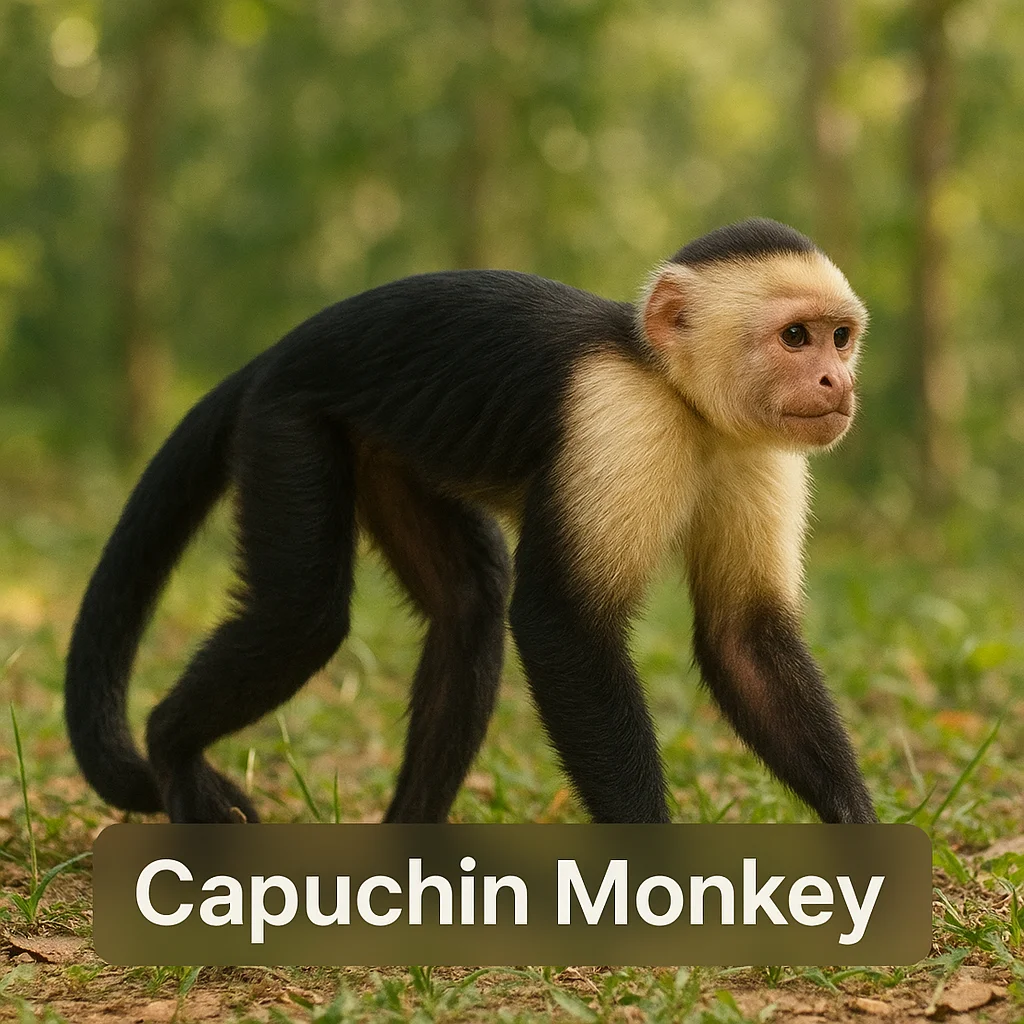
Capuchin monkeys are easily recognized by their small-to-medium size and distinctive black or brown bodies with a lighter face. Named for their resemblance to the brown hoods worn by Capuchin monks, these monkeys are often noted for their expressive faces and long, prehensile tails.
- Small to medium size; compact and agile build
- Brown or black bodies; creamy white or light tan face
- Long limbs and prehensile tail for gripping branches
- Features a characteristic dark cap of fur on the head
- Large, expressive eyes and short snout
- Distinctive cap of hair resembles a hood
- Look-alikes include Squirrel Monkeys but Capuchins have larger bodies and tails
- Communicates through a range of facial expressions and vocalizations
-
Top ID Tips:
- Look for the small size and compact, agile body
- Dark caps of hair on their heads
- Long prehensile tails used for climbing and balancing
- Distinct facial markings with lighter coloration
- Expressive facial features and bright eyes
- Loyally remain with troops found in forested landscapes
- Ability for intricate tool use and problem-solving is notable
🧱 Body Structure & Physical Adaptations
Capuchin monkeys have adapted to a life spent largely among the trees. Their limbs and tail are highly flexible, allowing them to negotiate the complex three-dimensional environment of the forest canopy. This agility is crucial for accessing food sources and avoiding predators.
- Slender build with highly mobile joints for climbing
- Prehensile tail acts as a fifth limb for enhanced grip
- Strong, nimble fingers for grasping and manipulating items
- Shortened snout with a versatile jaw for varied diet
- Teeth adapted for shearing both plant material and small animals
- Excellent binocular vision for depth perception in the canopy
- Moderate hearing ability; communication via vocalizations and expressions
- High intelligence; demonstrated ability in tool use and problem-solving
- Adaptability in diet and behavior contributes to widespread distribution
-
Key Adaptations:
- Prehensile tail aids in climbing and balance
- Highly flexible limbs for three-dimensional movement
- Sharp teeth capable of processing a variety of foods
- Strong memory and learning abilities for resource tracking
- Versatile dietary habits; use of tools to access food
- Complex social behaviors and communication skills
🌍 Range & Distribution
Capuchin monkeys are found across a wide geographic range in Central and South America. This adaptability to various forest habitats is facilitated by their flexibility in diet and social structure, enabling them to colonize diverse environments from lowland forests to mountainous areas.
- Primarily inhabit Central and South America
- Common in countries such as Brazil, Argentina, and Colombia
- Prefer tropical and subtropical forests; moist and dry woodlands
- Can be found from sea level to mountainous regions
- Generally non-migratory, remaining within defined territories
- Occasionally cross open areas between forest patches
- Expanding human development affecting range in some areas
-
Where You Might Find It:
- Tropical rainforests of the Amazon Basin
- Subtropical forests in Colombia and Venezuela
- Lowland forests of Central America
- Mountainous areas of the Andes
- Protected nature reserves and parks
- Potentially near settled areas due to habitat incursions
🏞️ Habitat & Shelter
Capuchin monkeys prefer dense forest environments where the canopy provides both food and protection. These forests range from humid rainforests to dryer deciduous forests, with the monkeys using the trees for shelter and as an avenue for travel and foraging.
- Reside primarily in tropical and subtropical forests
- Highly dependent on dense tree cover for safety and food access
- Utilize tree hollows and dense foliage for sleep and refuge
- During rainy seasons, exploit seasonal abundances in food
- Typically shift behavior based on seasonal food availability
- Understanding habitat allows predictive modeling of movement and behavior
🧭 Behavior & Ecology
Capuchin monkeys exhibit a complex array of behaviors that include foraging during the day, social grooming sessions, and vocal communication. These monkeys are known for their social intelligence and complex troop dynamics, often displaying cooperative behaviors and complex problem-solving skills.
- Primarily diurnal; active during daylight hours
- Engage in social grooming for bonding and hygiene
- Use vocalizations and body language to communicate
- Interact with a variety of species, impacting seed dispersal
- Significant role as both predator and prey within their ecosystem
- Foraging and traveling in groups, enhancing food finding efficiency
-
Behavior Highlights:
- Daytime activities include foraging and social interactions
- Complex vocal and physical communication methods
- Keen problem-solving skills; observed using tools
- Active participation in group grooming rituals
- Vital seed dispersers within their habitats
- Dynamic relationships with other forest species
👥 Social Life & Group Dynamics
Capuchin monkeys live in structured groups known as troops, which are typically composed of several males, females, and their offspring. Social hierarchies are often present, and monkeys engage in cooperative care and defense strategies within the troop.
- Exist in social groups known as troops; typically 10–30 members
- Group structures include multiple adults and offspring
- Cooperative in defending territory and caring for young
- Dominance hierarchies often determine access to resources
- Conflict resolution through grooming and appeasement displays
- Females often remain in natal groups, males may disperse
-
Social Structure Notes:
- Engage in complex social interactions and hierarchy
- Troops protect territory collectively from threats
- Cooperate in taking care of young and maintaining group cohesion
- Hierarchies influence resource allocation and mating access
- Mutual grooming helps to maintain group harmony and resolve conflicts
- Male dispersal helps prevent inbreeding and strengthens genetic flow
🍽️ Diet, Prey & Predators
Capuchin monkeys are omnivorous, exhibiting dietary flexibility that allows them to consume a broad variety of foods. They play a critical role in their ecosystems as seed dispersers and as prey for larger predators. Their diversified diet helps them thrive in differing environments.
- Omnivorous diet includes fruits, nuts, insects, and small animals
- Dietary staples shift with seasonal availability
- Known to use tools to access hard-to-reach or protected foods
- Main predators include birds of prey and large snakes
- Employ mobbing behavior to deter smaller predators
- Fruit eating aids seed dispersal for forest regeneration
-
Feeding Notes:
- Consume a diverse array of fruits, insets, nuts, and small vertebrates
- Highly adaptable foragers; dietary habits enable survival in varied environments
- Tool use for accessing food like cracking nuts or reaching insects
- Play a significant role in the dispersal of forest plant seeds
- Predators include large birds of prey and snakes
- Use vigilance and alarm calls to alert troop to potential dangers
🦌 Hunting, Foraging & Movement
Adept at navigating treetops, Capuchin monkeys showcase impressive dexterity and acrobatics. Their movement through the jungle canopy is integral to their foraging strategy, enabling them to exploit a range of ecological niches while avoiding ground-level predators.
- Locomotion is arboreal; adept climbers with prehensile tails
- Forages primarily during the day; pattern depends on food availability
- Travels in troops, providing safety through numbers
- Capable of short bursts of speed but rely on agility
- Foraging strategy is opportunistic, often following a seasonal availability of resources
- Navigate the canopy and forest floor, maximizing resource access
-
Movement & Strategy:
- Swift, agile climbers of the rainforest canopy
- Efficient collaborative foragers; share information within groups
- Prehensile tails provide balance and grip
- Adaptive movement patterns based on food resources
- Exploit seasonal fluctuations in resource availability
- Stay mostly within forest canopies to avoid ground-level threats
🧠 Intelligence & Senses
With a reputation for intelligence, Capuchin monkeys exhibit problem-solving and tool-use abilities that suggest a sophisticated level of cognitive function. Their senses are well-honed for their environment, with a particular emphasis on visual and tactile acuity.
- Demonstrates advanced problem-solving and tool-using abilities
- Possesses keen memory, aiding in resource location
- Displays social intelligence through nuanced troop interactions
- Sight: excellent vision for spotting predators and food
- Research on cognitive abilities varies and continues to evolve
-
Notable Abilities:
- Problem-solving abilities rank among the highest in non-human animals
- Demonstrates tool use, including nut cracking and using sticks for foraging
- Sharp memory for recognizing troop members and resource locations
- Complex social structures showcase advanced communication abilities
- Visual acuity supports navigation and foraging in dense forests
- Studies highlight notable variation in intelligence across populations
🪺 Reproduction, Pregnancy & Parenting
The reproductive strategies of Capuchin monkeys contribute to their success within their habitats. They practice a non-breeding-season-limited pattern of reproduction, with females often assuming the primary role in infant care, though alloparenting occurs within the troop.
- No strict breeding season; reproduction can occur year-round
- Mating systems are generally polygamous
- Gestation lasts about 5–6 months
- Typically single births; infants highly dependent at birth
- Primarily female responsibility to rear young, with family support
- Alloparenting observed in closely knit social groups
-
Reproduction Snapshot:
- Reproduce year-round; no strict breeding season
- Gestation period ranges from 5 to 6 months
- Typically give birth to one offspring at a time
- Strong maternal bond; mother is primary caregiver
- Presence of alloparenting indicates social cooperation
- Infants are born helpless and remain dependent for months
♀️♂️ Male vs Female Differences
Sexual dimorphism in Capuchin monkeys is subtle; however, some differences exist in terms of size and social behavior. Males may be slightly larger and often play different roles within the troop compared to females.
- Males generally larger and heavier than females
- Males often take on roles of troop defense
- Females involved primarily in caretaking and social structuring
- Subtle coloration differences may exist between sexes and vary among species
- Reproductive roles largely determine social standings
-
Sex Differences at a Glance:
- Males often slightly larger than females
- Males more involved in territorial defense
- Females primarily caregiving and nurturing within the troop
- Possible subtle coloration differences
- Varying degrees of sexual dimorphism across species and subspecies
🧬 Subspecies & Variation
The classification of Capuchin monkeys into subspecies and species can be complex, with ongoing research refining our understanding. Variations can exist in terms of size, coloration, and behavioral adaptations, often influenced by environmental and geographical conditions.
- Variation in physical and behavioral traits among regions
- Notably diverse subspecies across the Cebus and Sapajus genera
- Some adapted to colder climates, others to arid or humid environments
- Differences include size, coloration, and social structure
- Subspecies classification is subject to scientific debate
-
Variation Notes:
- Range of sizes and adaptations linked to environment
- Some subspecies exhibit unique coat patterns
- Genetic studies continue to clarify classification debates
- Island and isolated populations often show distinct traits
- Behaviors and diet may vary extensively between different regions
⚠️ Threats, Conservation & Human Interaction
While Capuchin monkeys face pressures from habitat loss and human encroachment, awareness and conservation efforts are crucial for their survival. Adaptive behaviors allow some populations to thrive near human settlements, but this can also lead to challenges.
- Habitat loss due to deforestation poses significant threats
- Illegal pet trade and hunting continue to impact populations
- Conservation efforts focus on habitat protection and legal enforcement
- Natural threats include larger predators and ecological competition
- Coexistence strategies involve minimal disruption and habitat management
-
Responsible Notes:
- Conserve tropical forests to maintain natural habitats
- Support legal protections against hunting and trade
- Minimize human impact by promoting habitat preservation
- Foster coexistence through environmental education
- Initiatives to restore habitats crucial for long-term survival
✨ Fun Facts & Unique Traits
- Known for ‘washing’ food, capuchins sometimes rub foods like fruits with leaves or sand
- Tool use includes using rocks to crack open nuts and shells
- Complex problem-solving skills have been observed, using stick 'tools' to access insects
- Capuchin monkeys can store memories for future plans while solving puzzles
- Observed creating and using ‘bridges’ with branches to cross water bodies
- Highly social creatures; capuchins have distinct "friendships" within their groups
- Capuchins have been key subjects of study on primate intelligence and social behaviors
- Their name stems from their coloration, reminiscent of Capuchin monks