🦁 Chimpanzee
🧾 Quick Facts
The chimpanzee is a highly intelligent primate commonly found in central and western Africa. These fascinating animals are known for their complex social structures and behavioral adaptability, which closely resemble those of humans.
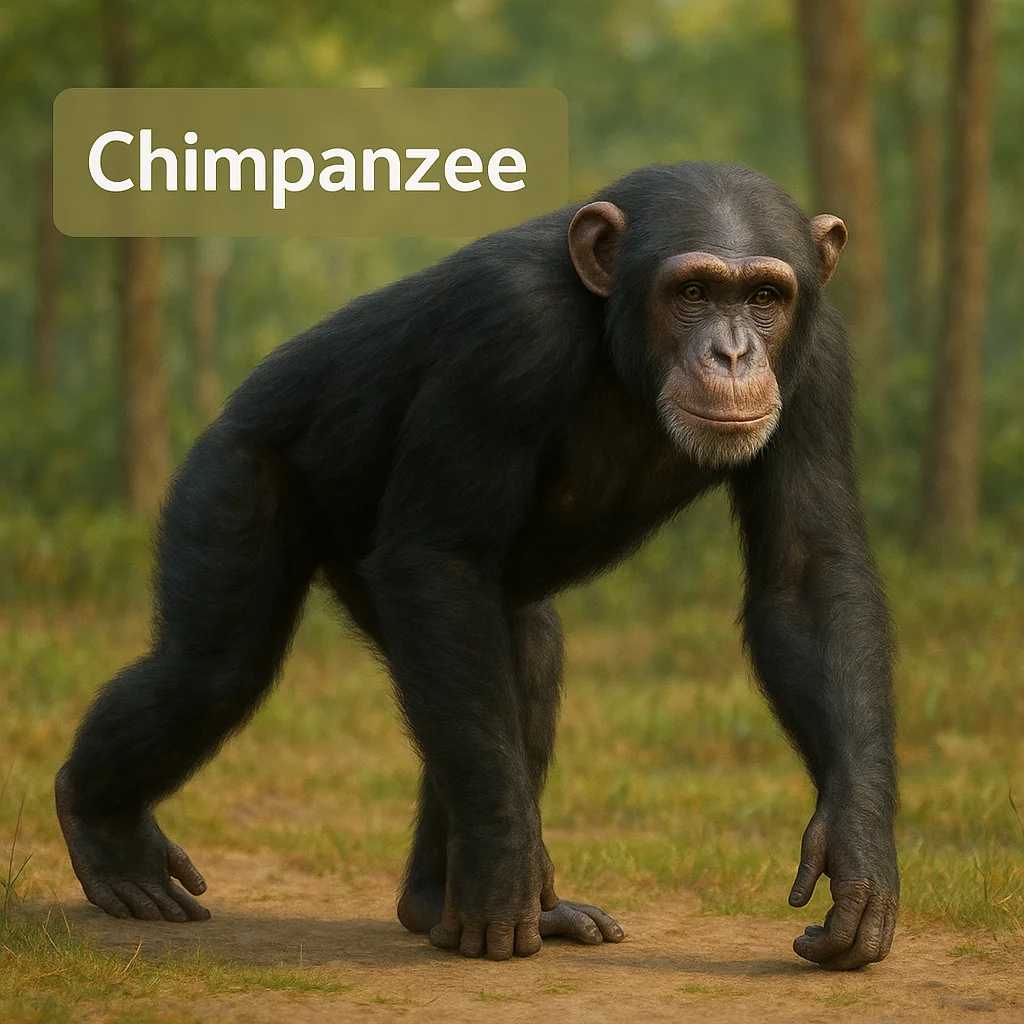
- Common Name: Chimpanzee
- Scientific Name: Pan troglodytes
- Animal Type: Mammal
- Typical Adult Size: 70 to 130 cm in height, 40 to 70 kg in weight
- Typical Lifespan: 30 to 40 years in the wild, up to 50 years in captivity
- Diet Type: Omnivore; includes fruits, leaves, seeds, insects, and occasional small animals
- Activity Pattern: Diurnal
- Social Structure: Group-living in large communities called troops
- Speed / Movement Highlights: Capable climbers and can walk bipedally for short distances
- Intelligence/learning: High cognitive abilities; known for tool use and problem-solving
- Primary Habitats: Tropical rainforests and savannas
- Geographic Range: Broad regions of central and eastern Africa
- Predators/Threats: Leopards, humans, habitat destruction
- Conservation Status: Endangered, varies by region
🔍 Identification & Appearance
Chimpanzees can be easily recognized by their robust build and prominent facial features. Their bodies are covered with coarse hair that is typically black, but may turn gray with age. Their faces, ears, hands, and feet are bare and range from pink to black in color. Chimpanzees have a characteristic knuckle-walking gait and possess long arms and opposable thumbs.
- Top ID Tips:
- Stocky build with a broad chest and shoulders
- Long arms extending past the knees
- Hairless face with expressive eyes
- Pinker faces become darker with age
- Noticeable brow ridge above the eyes
- Big ears compared to the size of the head
- Presence of tool use or evidence of spears and stones
- Commonly seen in groups within forested areas
🧱 Body Structure & Physical Adaptations
Chimpanzees have adapted to a life spent partially in the trees and on the ground. Their long arms and flexible shoulder joints aid in climbing and brachiation. They have strong jaws equipped with robust molars that help in grinding a variety of foods. Their sensory systems, particularly their eyesight, are highly developed.
- Key Adaptations:
- Long arms for brachiation and climbing
- Strong grips due to flexible feet with opposable big toes
- Robust jaw and teeth for varied diet
- Keen eyesight for detecting predators and food
- Powerful sense of hearing
- Knuckle-walking for terrestrial locomotion
- Highly developed brain for complex tasks and social interactions
🌍 Range & Distribution
Chimpanzees are found in several regions across Africa, primarily in the tropical rainforests of Central Africa, as well as in savannas and woodlands. They are mostly resident, with some populations experiencing minor seasonal movements related to food availability but not long migrations.
- Where You Might Find It:
- Congo Basin
- Western African countries like Guinea and Cote d'Ivoire
- Equatorial Africa
- Forested areas in Tanzania
- Ugandan rainforests
- Wooded savannas
- Along water sources
- Regions with abundant fruit trees
🏞️ Habitat & Shelter
The primary habitats of chimpanzees are tropical rainforests, although they can also be found in savanna woodland and grassland areas. They prefer areas with a dense canopy that provides food and protection. Chimpanzees build nests in trees to sleep at night, offering them safety from predators and a comfortable resting place.
Understanding their habitat preferences is vital for conservation efforts, as it informs habitat protection and restoration strategies that ensure their survival.
🧭 Behavior & Ecology
Chimpanzees exhibit complex social relationships and behaviors. They spend their days foraging, grooming, and socializing within their troop. Communication is an integral part of their behavior, using vocalizations, facial expressions, and physical gestures to express emotions and intentions. They play a significant role in seed dispersal, boosting forest regeneration and ecology.
- Behavior Highlights:
- Daily grooming routines to strengthen social bonds
- Vocal communications including hoots and screams
- Use and modification of tools to access food or water
- Complex dominance hierarchies within groups
- Involvement in playful activities and games
- Expressive gestures for communication
- Nesting in treetops for night rest
- Interaction with other forest animals and humans
👥 Social Life & Group Dynamics
Chimpanzees are inherently social creatures. They live in communities often referred to as troops, which can consist of anywhere from a few individuals to more than 100 members. Within these troops exist complex social structures, including dominance hierarchies typically led by an alpha male.
These social systems allow them to cooperatively care for young, share resources, and defend their territory against rival groups.
- Social Structure Notes:
- Live in multi-male, multi-female groups
- Prominent alpha male leading the troop
- Strong mother-infant bonds
- Cooperative interactions during group hunts
- Frequent conflicts and reconciliation behaviors
- Juveniles play important roles in group dynamics
- Established territories communicated through vocalizations
🍽️ Diet, Prey & Predators
Being omnivorous, chimpanzees have a diet that includes a wide range of foods such as fruits, nuts, seeds, and insects, along with occasional small mammals and birds. Their ability to adapt their diets is part of what makes them resilient.
Natural predators include leopards and occasionally other large animals. Their main defenses against predation are cooperation, vigilance, and using their arboreal nesting sites.
- Feeding Notes:
- Fruits are a staple year-round
- Includes protein sources like insects
- Seasonal variation in fruits and food items
- Occasional hunting of small mammals and birds
- Exploits ripe fruit and nut availability in their range
- Adaptive use of tools to access challenging food sources
🦌 Hunting, Foraging & Movement
Chimpanzees are skilled foragers, using their intelligence and adaptable movement to access a variety of foods. They often move on all fours (knuckle-walking) and are adept climbers, acrobatically using the forest canopy. They forage at different times of day, primarily in the morning and late afternoon, adjusting to food availability.
- Movement & Strategy:
- Skillful climbers using all limbs for balance
- Travel in groups during foraging expeditions
- Use of sticks and stones to access food
- Capacity for slow bipedal walking
- Exhibiting patience and strategy during hunts
- Spatial memory of feeding spots
- Group cooperation in capturing prey
🧠 Intelligence & Senses
Chimpanzees are known for their superior cognitive abilities, capable of using tools, solving problems, and exhibiting complex social behaviors. Their intelligence extends to memory, emotional sensitivity, and learning through observation. They possess acute senses, particularly in sight and hearing, aiding them in navigation and survival.
- Notable Abilities:
- Skillful in using and creating tools
- Capacity for learning and mimicry
- Strong problem-solving skills
- Communicates emotional states effectively
- Adept at reading social cues
- Sound memory of resource locations
- Recognizes individual identities within troops
🪺 Reproduction, Pregnancy & Parenting
Chimpanzees do not have a defined breeding season, and mating can occur year-round. Female chimpanzees exhibit swelling when fertile and mate with multiple males within the troop. Gestation lasts about eight months, leading to a single offspring who depends heavily on the mother. Parenting is a communal effort, with other females often assisting in caregiving.
- Reproduction Snapshot:
- Gestation period averages around eight months
- Typically, a single young is born
- Mother primarily provides care, with social help
- Offspring learn social and survival skills early
- High parental investment in juvenile survival
- Infant development critically dependent
♀️♂️ Male vs Female Differences
Chimpanzees display sexual dimorphism, with males typically larger than females. Males are more likely to engage in aggressive displays and defense of the group, while females focus heavily on childcare. The subtle differences between sexes can vary from one group to another.
- Sex Differences at a Glance:
- Males larger and heavier with broader shoulders
- Females exhibit more infant care roles
- Males often more dominant in group hierarchies
- Greater involvement in defense and patrol by males
- Both sexes involved in foraging
🧬 Subspecies & Variation
Four subspecies of chimpanzees are recognized, each with unique characteristics adapted to their environments: Central Chimpanzees, Western Chimpanzees, Eastern Chimpanzees, and Nigeria-Cameroon Chimpanzees. These differences include variations in size, behavior, and adaptations to habitat requirements.
- Variation Notes:
- Central and Western are more forested
- Subspecies size and behavior vary
- Some debate over classification remains
- Regional adaptations to climate and food sources
⚠️ Threats, Conservation & Human Interaction
Chimpanzees face numerous threats including habitat loss due to logging, agriculture expansion, hunting, and disease. Conservation efforts are crucial to their survival and include habitat protection and anti-poaching initiatives. Responsible human interaction involves respecting natural habitats, observing from a distance, and supporting conservation programs.
- Responsible Notes:
- Avoid close contact to prevent disease transmission
- Support logging bans in sensitive areas
- Encourage ethical wildlife tourism practices
- Promote reforestation in depleted areas
- Attract conservation awareness and funding
- Instill laws against poaching and illegal pet trades
- Partner with local communities for sustainable solutions
✨ Fun Facts & Unique Traits
- Chimpanzees share about 98% of their DNA with humans.
- Their ability to use tools is documented across many groups, showing cultural differences among populations.
- Chimpanzees can learn human sign language to a limited extent.
- Their nests are often constructed fresh each night for sleeping comfort and safety.
- They exhibit laughter-like vocalizations during play.
- Even infants possess a surprising level of social awareness.
- Some populations use sticks to "fish" for termites and ants.
📌 Summary
- Identified by robust build, expressive features, and knuckle-walking gait
- Primarily inhabit tropical forests and some savanna regions
- Distributed in central and western Africa
- Omnivorous diet with emphasis on fruits, seeds, and occasional small animals
- Face natural predators like leopards, in addition to human threats
- Live in complex social structures with clear dominance hierarchies
- Reproduction does not adhere to a strict season, leading to a long term maternal bond
- Exhibit advanced cognitive skills including tool use and cultural variations
- Four distinct subspecies with characteristic regional adaptations
- Endangered by habitat loss and poaching but sustainable practices may aid conservation