🦁 Coati
🧾 Quick Facts
Coatis are fascinating creatures known for their curious behavior and unique social structures. Ranging across the Americas, they are members of the raccoon family, with intriguing adaptations that suit their diverse habitats.
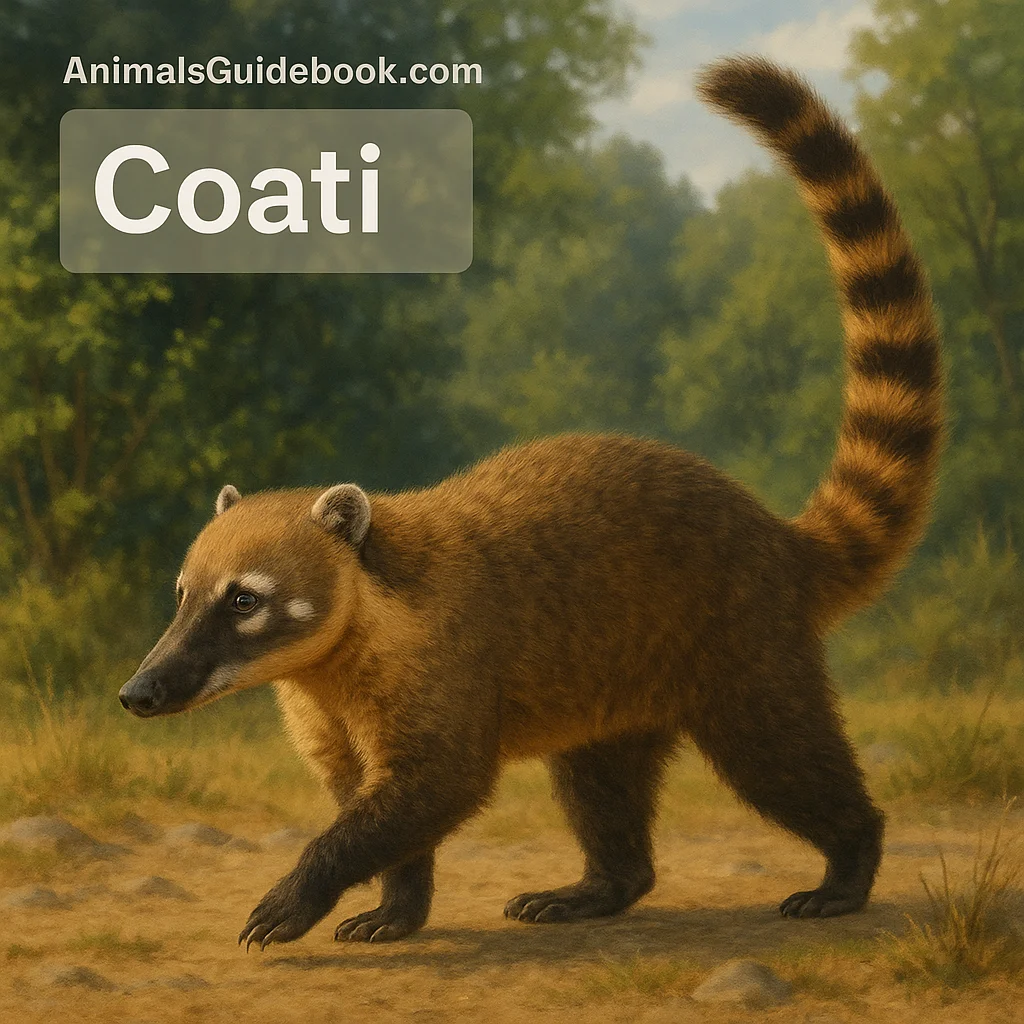
- Common name(s): Coati, Coatí, Ring-tailed Coati
- Scientific name: Nasua narica (White-nosed Coati), Nasua nasua (South American Coati)
- Animal type: Mammal
- Typical adult size: 40-70 cm (16-28 inches) in body length; tail adds another 32-69 cm (13-27 inches)
- Typical lifespan: 7-14 years in the wild; up to 20 years in captivity
- Diet type: Omnivore; fruits, small animals, insects, eggs
- Activity pattern: Diurnal
- Social structure: Group-living, particularly females and juveniles; males often solitary
- Speed / movement highlights: Agile climbers and diggers; swift runners
- Intelligence/learning: Highly intelligent, with notable problem-solving skills
- Primary habitats: Forests, woodlands, and grasslands
- Geographic range: From the southwestern United States to northern Argentina
- Predators/threats: Jaguars, pumas, raptors, and human encroachment
- Conservation status: Least Concern, though some populations vary regionally
🔍 Identification & Appearance
Coatis are easily recognized by their elongated snouts and distinctive ringed tails. Their overall appearance is a blend of raccoon and lemur, making them quite unique among mammals.
- Their bodies are slender yet robust, with a slight arch to their backs.
- Fur colors range from reddish-brown to gray with lighter patches around the face.
- Notable features include their pointed, mobile nose and long, flexible tails used for balance.
- Tracks often show five toes with sharp claws; scat can vary depending on diet.
- Distinguished from raccoons by longer legs and more pointed snouts.
- Top ID Tips
- Elongated, mobile nose
- Long, ringed tail held upright
- Slim, but muscular body
- Dense, soft fur with varying colors
- Sharp claws for climbing and digging
- Prominent facial mask or markings
🧱 Body Structure & Physical Adaptations
Coatis possess several physical adaptations that enable them to thrive in their environments, particularly regarding their arboreal lifestyle and omnivorous diet.
- Slender but muscular build aids in climbing and running.
- Teeth adapted for a varied diet, including sharp canines and molars for grinding.
- Powerful claws for climbing trees and digging for food.
- Acute sense of smell for locating food sources.
- Excellent vision, particularly useful for spotting predators and food.
- Key Adaptations
- Highly flexible snout for probing
- Prehensile tail for balance
- Sharp claws for tree climbing
- Robust dentition for varied diet
- Adaptable senses for environmental navigation
🌍 Range & Distribution
The coati's range extends across multiple continents and climates, showcasing its adaptability in varied environments.
- Primarily found in Central and South America.
- Ranges include the southwestern United States down to Argentina.
- Inhabit a variety of biomes, including tropical rainforests and temperate woodlands.
- Most populations are resident, with minimal migration.
- Where You Might Find It
- Forests across Central America
- Tropical rainforests of the Amazon
- Woodlands and shrublands
- Highland forests in the Andes
- National parks in Belize and Guatemala
🏞️ Habitat & Shelter
Coatis are adaptable and can thrive in diverse habitats, often utilizing trees and other natural structures for shelter and resources.
- Prefer forested areas, from lowland rainforests to montane forests.
- Use trees for shelter, resting, and escape from predators.
- Adapt behavior seasonally, being more ground-dwelling during cooler months.
- Understanding habitat is key to understanding their foraging and social behavior.
🧭 Behavior & Ecology
Coatis are social creatures with complex behaviors, their activities ranging from foraging to intricate communication.
- Primarily diurnal, with a routine that includes foraging and resting.
- Communicate using a series of vocalizations and scent marks.
- Form groups called bands, generally consisting of females and young.
- Play a crucial role in seed dispersal and as prey for larger predators.
- Behavior Highlights
- Group foraging strategies
- Vocal communication: squeaks and grunts
- Scent marking for territory
- Pivotal in ecosystem seed dispersal
- Complex social interactions
- Use of tail gestures for signaling
👥 Social Life & Group Dynamics
Coati social structures are intriguing, displaying social bonds, maternal care, and group cohesion primarily among females.
- Females and young form groups, enhancing safety and foraging efficiency.
- Males are often solitary except during the breeding season.
- Minimal hierarchy observed; more equality compared to other animals.
- Cooperation observed in sharing food and protecting young.
- Social Structure Notes
- Female-centric group dynamics
- Seasonal male participation
- No strict dominance hierarchies
- Mutual grooming practices
- Juvenile play integral to learning
🍽️ Diet, Prey & Predators
As omnivores, coatis have a versatile diet, consuming a broad range of foods that provide essential nutrients year-round.
- Diet primarily consists of fruits, insects, small mammals, and eggs.
- Utilize flexible snouts to forage for invertebrates and plants.
- Common predators include jaguars, pumas, and large raptors.
- Defense strategies include climbing, vocal warnings, and group defense.
- Feeding Notes
- Mainly fruit and insect diet
- Occasionally hunt small animals
- Effective at finding hidden prey
- Prey to large predators like jaguars
- Quick climbers to escape danger
🦌 Hunting, Foraging & Movement
Coatis are adept foragers and swift movers, displaying impressive agility and a keen sense for locating food.
- Active during the day, foraging in groups for safety and efficiency.
- Agile climbers, often forage in trees for fruits and small creatures.
- Utilize a mix of locomotion styles from climbing to terrestrial exploration.
- Highly adept at navigating their environment using sight and smell.
- Movement & Strategy
- Energetic during daylight hours
- Agile in both trees and ground
- Group foraging minimizes predation risk
- Utilize various terrains for movement
- Adaptable in accessing different food sources
🧠 Intelligence & Senses
Coatis exhibit a high level of intelligence, which aids in their ability to solve problems and adapt to changing environments.
- Known for their problem-solving capabilities in accessing food.
- Acute sense of smell and excellent vision aid in foraging.
- Use advanced cognitive skills for social interactions and communication.
- Research into these aspects is ongoing and varies by population.
- Notable Abilities
- Keen problem solvers
- Strong memory of resource locations
- Social intelligence for group dynamics
- Advanced scent tracking abilities
- Excellent visual recognition
🪺 Reproduction, Pregnancy & Parenting
The breeding strategies of coatis are well-adapted to ensuring the survival of their offspring in their natural habitats.
- Breeding generally occurs in the spring, with males joining female groups.
- Polygynous mating systems observed, with one male mating with multiple females.
- Females gestate for approximately 77 days, with litters ranging from 2-7 kits.
- Young are born altricial, cared for by the mother until independence.
- Reproduction Snapshot
- Spring breeding season
- Gestation around 77 days
- Litter size of 2-7 kits
- Maternal care crucial
- Polygynous mating system
♀️♂️ Male vs Female Differences
Coati males and females exhibit some physical and behavioral differences, mostly driven by reproductive roles and group dynamics.
- Males are generally larger and more solitary.
- Females tend to remain with groups, taking central roles in childcare.
- Males usually have more developed body strength for competitive displays.
- Coloration differences are subtle and vary by individual.
- Sex Differences at a Glance
- Males larger than females
- Females dominant in social groups
- Males solitary outside of breeding season
- Slight coloration differences
- Role differentiation in childcare
🧬 Subspecies & Variation
Coatis exhibit regional variations, with certain subspecies demonstrating distinct adaptations based on their specific environments.
- Main subspecies include the White-nosed and South American Coati.
- Differences mainly in size, coat coloration, and geographical range.
- Adaptations to diverse environments include variations in fur thickness and dietary preferences.
- Some classification debates exist regarding subspecies delineation.
- Variation Notes
- Regional color pattern differences
- Size variability across habitats
- Dietary adaptations by location
- Distinct fur density for climates
- Debates around subspecies classification
⚠️ Threats, Conservation & Human Interaction
Coatis face various threats, both natural and human-induced, with conservation efforts focusing on habitat protection and education.
- Habitat loss due to deforestation and agricultural expansion poses significant threats.
- Coatis are occasionally hunted for food and as perceived pests.
- Protected areas and wildlife reserves play crucial roles in their preservation.
- Coexistence requires understanding and mitigating human-wildlife competition.
- Responsible Notes
- Conservation status generally stable
- Threats from deforestation
- Occasional pest control issues
- Protected in many reserves
- Necessity for habitat conservation
✨ Fun Facts & Unique Traits
- Coatis can rotate their ankles to descend trees headfirst, a unique trait among mammals.
- Their long, ringed tails are highly expressive and used for communication among group members.
- Females often form lasting social bonds, unlike many related species.
- Coatis possess a unique technique of foraging in the leaf litter and under debris using their highly flexible snouts.
- The group dynamic among coati bands is complex, with sophisticated social structures and cooperative behaviors.
- They can make a variety of vocalizations, from grunts to chirps, to communicate with each other.
📌 Summary
- Coatis are omnivorous mammals with distinctive features including a long, ringed tail and an elongated snout.
- They inhabit diverse habitats ranging from forests to dry grasslands in the Americas.
- Coatis are adept climbers and agile foragers, using their strong sense of smell and sharp claws.
- They are social creatures, living in groups primarily composed of females and juveniles.
- Diet includes fruits, insects, and small animals, making them key contributors to ecosystem balance.
- Male coatis tend to be solitary, while females participate in communal child-rearing.
- Their conservation status is generally stable, though specific populations face regional threats.
- Unique adaptations, such as their ankle flexibility for climbing, set them apart from their relatives.