🦁 Giant Anteater
🧾 Quick Facts
The giant anteater (Myrmecophaga tridactyla) is a fascinating creature known for its long snout and specialized diet of ants and termites. Uniquely adapted to its environment, this species showcases intriguing behaviors and characteristics.
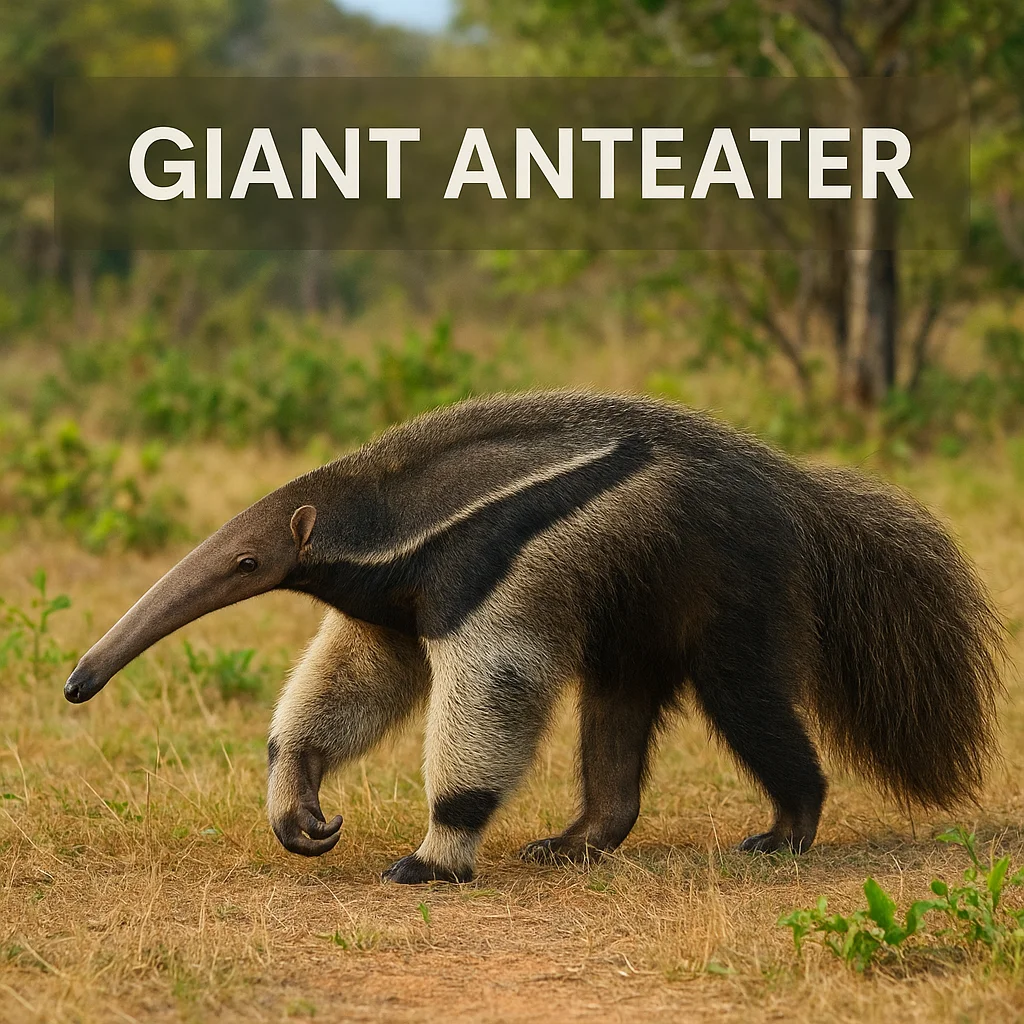
- Common name(s): Giant Anteater
- Scientific name: Myrmecophaga tridactyla
- Animal type: Mammal
- Typical adult size: 5-7 feet long (including tail); 60-90 pounds
- Typical lifespan: 14-16 years in the wild
- Diet type: Carnivore; primarily consumes ants and termites
- Activity pattern: Diurnal, though may be nocturnal in disturbed areas
- Social structure: Solitary
- Speed / movement highlights: Can trot at a reasonable pace; primarily walks
- Intelligence/learning: Known for problem-solving in food extraction
- Primary habitats: Grasslands, forests, savannas
- Geographic range: Central and South America
- Predators/threats: Jaguars, pumas; habitat loss due to human activity
- Conservation status: Vulnerable
🔍 Identification & Appearance
The giant anteater is recognized by its unique appearance and distinct body shape. Its elongated snout and bushy tail make it easily identifiable.
- Body shape and silhouette: Elongated body with a tubular snout
- Key colors/patterns: Grey with distinct black and white shoulder bands
- Distinctive features: Long bushy tail, typically the length of its body
- Tracks, scat, or other field signs: Tracks show five claws on forefeet and claw marks
- Common look-alikes: Tamandua; shorter snout and prehensile tail help differentiate
- Top ID Tips
- Look for an elongated snout and a bushy tail
- Check for a large body size and black-white shoulder bands
- Long forearms and large claws are characteristic
- Observe unique feeding behavior of probing with snout
- Distinctive gait with unique forefoot motions
- Tubular skull shape
🧱 Body Structure & Physical Adaptations
The giant anteater’s body is specially adapted for its insectivorous diet. Its physical structure supports unique feeding and movement techniques.
- Build and proportions: Stout with a long tail, short powerful limbs
- Teeth/beak/jaw adaptations: Lacks teeth; elongated jaw helps in consuming insects
- Claws/hooves/wings/fins: Large, curved claws for digging into insect nests
- Sensory strengths: Acute sense of smell; limited vision
- Key Adaptations
- Elongated snout housing a long, sticky tongue
- High muscle-powered forelimbs with claw strength
- Durable stomach enzymes for digesting insects
- Thick, rugged coat protecting against insect bites
- Flexibility in accessing difficult terrains due to build
- Strong digestion for hard exoskeletons
🌍 Range & Distribution
Giant anteaters are primarily found across diverse habitats in Central and South America. Their range stretches from southern Belize to northern Argentina.
- Typically inhabits tropical forests, savannas, and grasslands
- Present across diverse elevations in their range
- Largely non-migratory and resident within territories
- Where You Might Find It
- Amazon Rainforest
- Brazilian Cerrado
- Venezuelan Llanos
- Chaco Region of Paraguay and Argentina
- Pampas grasslands
- Costa Rican dry forests
🏞️ Habitat & Shelter
The giant anteater is adaptable to multiple habitats, from dense tropical forests to open grasslands. Sheltering in these environments plays a crucial role in their survival and foraging behavior.
- Grasslands provide prominent foraging sites
- Forests offer cover from predators and extreme weather
- Seasonal fluctuations may shift their activities from day to night
- Habitat loss and fragmentation threaten their shelters
- Understanding habitat is critical for conservation efforts
🧭 Behavior & Ecology
Known for its unique feeding strategy, the giant anteater plays a vital role in controlling insect populations and maintaining ecological balance.
- Feeds primarily on ants and termites using its long tongue
- Mostly solitary; relies on marking territories with scent glands
- Improves forest regeneration by dispersing seeds unintentionally
- Competition with other insectivores for resource access
- Rest frequently to conserve energy due to low nutrient diet
- Behavior Highlights
- Scent marking for territorial boundaries
- Extensive grooming behavior for hygiene
- Displays aggressive stance as defensive mechanism
- Ant-eating technique characterized by brief visits to mounds
- Skilled in locating insect nests via keen sense of smell
- Minimal vocalizations; communication through body gestures
👥 Social Life & Group Dynamics
Giant anteaters are primarily solitary creatures known for their independence and minimal social interaction except during mating or mother-pup bonds.
- Solitary, primarily meets others only during mating
- Mother-offspring bond after birth; young ride on mother’s back
- Occasional encounters with other anteaters tend to be brief
- Territory defense involves scent-marking rather than direct conflict
- Social Structure Notes
- Independent except for short-term mother-pup interactions
- Interact mainly through scent markings
- Defensive; avoids confrontation unless threatened
- Transient mating associations with limited bonding
- Territorial autonomy is a consistent trait
🍽️ Diet, Prey & Predators
The diet of a giant anteater is highly specialized, mainly comprising insects, specifically ants and termites. They have adapted to efficiently raid insect nests.
- Diets consist mainly of ants and termites sourced via keen smell
- Use of formidable claws to breach insect mounds
- Threats include large predators such as jaguars and habitat loss
- Deploy defensive posture if threatened; relies on tail as shield
- No significant scavenging behavior observed
- Feeding Notes
- Consumes tens of thousands of insects daily
- Actually damages nests minimally to ensure sustainability
- Avoids deforestation-impacted areas due to habitat changes
- Occlusive mouth prevents ants from escaping while feeding
- Seasonal variation in prey availability influences range and movement
- Dietary specialization reduces competition for mixed resources
🦌 Hunting, Foraging & Movement
Giant anteaters are proficient foragers, using their physical adaptations to efficiently source and consume their primary food sources.
- Utilize a steady, strategic walk for mobility
- Foraging often targeted; uses smell to pinpoint insect activity
- Short bursts of movement with enhanced agility when under threat
- Individual territories act as main foraging ranges
- Feeding times adapt to environmental disturbances
- Movement & Strategy
- Locates food by scent and memorized locations
- Clever handling of formidable claws for digging
- Sustained trot with focus on energy conservation
- Preference for predictable foraging paths
- Adaptation to different terrains within range
- Resistance to fatigue despite a low-caloric diet
🧠 Intelligence & Senses
Though not commonly associated with intelligence, giant anteaters have demonstrated impressive problem-solving skills related to their survival needs.
- Exhibits strategic behavior when foraging
- Keen olfactory senses enable precise food location
- Problem-solving intelligence demonstrated in foraging obstacles
- Sense of smell compensates for limited visual acuity
- Understanding of predator threats helps influence behavior
- Notable Abilities
- Ability to detect hidden prey via smell
- Clever manipulation of environment for foraging success
- Limited learning through changing conditions
- Spatial memory supports sustaining foraging routes
- Navigation through diverse terrains in native ranges
🪺 Reproduction, Pregnancy & Parenting
Giant anteaters follow specific reproductive behaviors, with distinct parental involvement ensuring young are nurtured during formative months.
- Breeding occurs year-round in suitable climates
- Promiscuous mating behavior observed with no fixed partnership
- Gestation lasts about 190 days, resulting in a single offspring
- Newborns are altricial, reliant on maternal carrying for mobility
- Mother provides sole parental care; males uninvolved post-mating
- Reproduction Snapshot
- Young often ride hugged onto mother's back
- Primarily solicit feeding during initial months
- Seasonal mating peaks potentially driven by food abundance
- Mother's care vital for offspring survival due to dependency
- Varied courtship but concise mating encounters
- Dependent on solitary lifestyle for nurturing conditions
♀️♂️ Male vs Female Differences
Sexual dimorphism is limited in giant anteaters; however, some distinctions are present in size and certain behavioral roles.
- Males usually larger and heavier than females
- Females assume all child-rearing responsibility
- Limited color variation between sexes
- Subtle size differences may affect range activity impacts
- Behavior being comparable, focus remains on maternal dedication
- Sex Differences at a Glance
- Males exhibit some size advantage
- Females identified by presence of offspring
- Parental role exclusive to females
- Social behavior uniform between sexes
- Low impact of size dimorphism on behavior
🧬 Subspecies & Variation
There is minimal recognized subspecies variation in giant anteaters; however, certain local adaptations have occurred related to their habitats.
- Isolated populations may show minor genetic variation
- Phenotypic similarity broadly consistent across range
- Classification remains largely undisputed in subspecies context
- Habitat-driven variations related to resource availability
- Variation Notes
- General uniformity in physical appearance
- Genetic diversity not overtly impactful on species
- Minor physical or behavioral traits adapted locally
- Conserved adaptations crucial to ecological niches
⚠️ Threats, Conservation & Human Interaction
The giant anteater faces numerous threats, predominantly from habitat destruction and human-related pressures. Conservation efforts are critical in mitigating these impacts.
- Habitat loss due to agriculture and urban expansion
- Exposure to roadway accidents in fragmented habitats
- Threats from fire in grassland and savanna ecosystems
- Efforts in habitat protection and restoration are crucial
- Conservation initiatives focus on mitigating human conflict
- Responsible Notes
- Support local conservation efforts
- Encourage sustainable land management practices
- Promote research into population dynamics
- Avoid off-road driving in wild habitats
- Advocate for protected corridors connecting habitats
✨ Fun Facts & Unique Traits
- The giant anteater's tongue can reach two feet and flick 150 times per minute
- Consumes up to 35,000 ants in a single day
- The tail is used as a blanket during cold nights
- Strategies are in place to avoid over-harvesting insect mounds
- Has a low metabolic rate, unique among similar-sized mammals
- Termed "antbear" in local folklore
- Can fend off predators using a stand-and-swipe technique
📌 Summary
- Notable for its long snout and bushy tail
- Predominantly resident in Central and South America
- Relies heavily on ants and termites for sustenance
- Prefers diverse habitats like grasslands and forests
- Vulnerable to predation and human-induced habitat loss
- Solitary except for mother-young attachment
- Reproductive involvement is limited to the mother
- Maintains ecological balance via insect population control
- Unique adaptations for efficient insectivory
- Faced with significant conservation challenges