🦁 Howler Monkey
🧾 Quick Facts
Howler monkeys are a group of New World monkeys known for their distinctive vocalizations which can be heard from miles away. They are widely distributed in Central and South America, thriving in various forest habitats.
- Common name(s): Howler Monkey
- Scientific name: Often listed as Alouatta spp.
- Animal type: Mammal
- Typical adult size: 0.5 to 1.2 meters (20 to 47 inches) including tail
- Typical lifespan: 15 to 20 years in the wild
- Diet type: Herbivore; primarily leaves, fruits, flowers
- Activity pattern: Diurnal
- Social structure: Group; often in troops of 10 to 20 individuals
- Speed / movement highlights: Slow movers; adept climbers
- Intelligence/learning: Known for vocal communication and social learning
- Primary habitats: Tropical rainforests
- Geographic range: Central and South America
- Predators/threats: Jaguars, birds of prey, human deforestation
- Conservation status: Varies by region; some species are threatened
🔍 Identification & Appearance
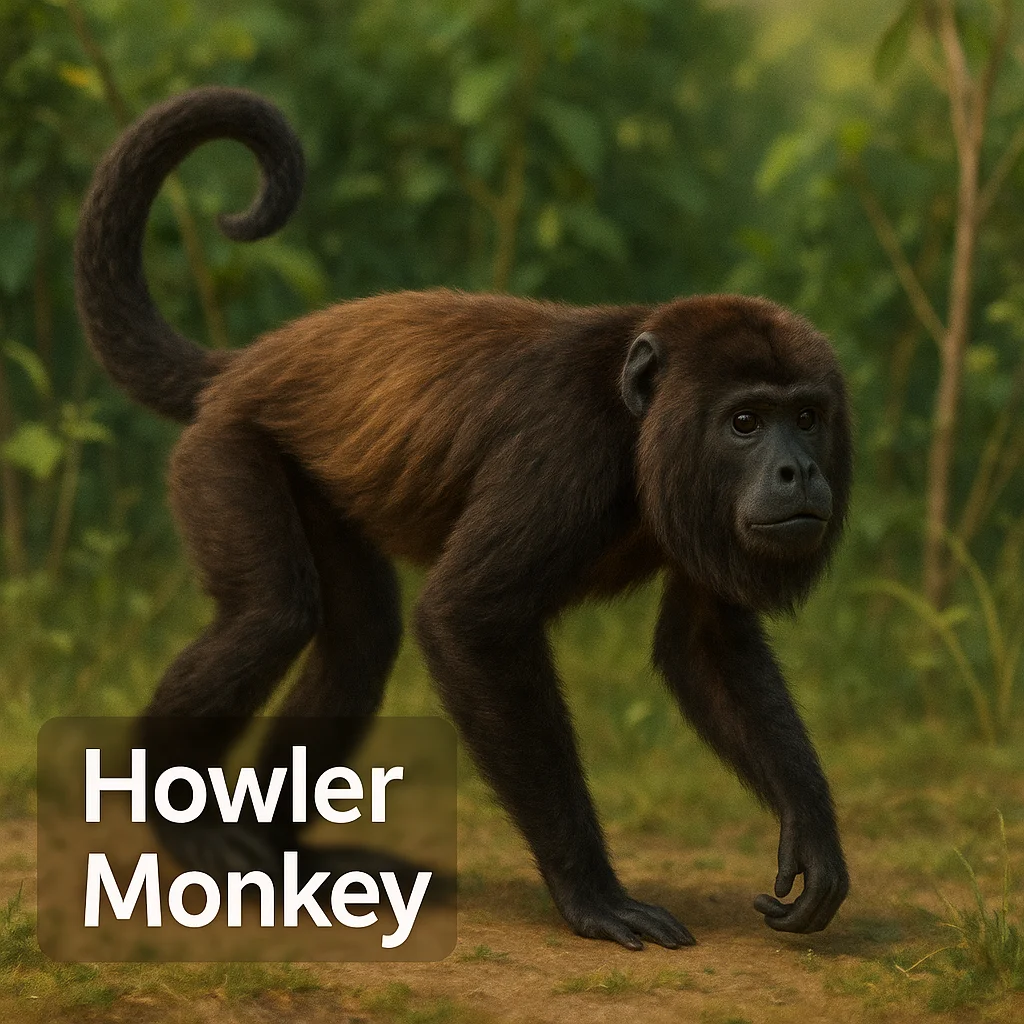
Howler monkeys are easily identifiable by their robust build and long, prehensile tails. Their thick fur ranges in color from black to reddish-brown, with some species displaying distinct color patterns or markings.
- Stocky body with a rounded silhouette
- Typically black or reddish-brown fur
- Prehensile tail used for gripping branches
- Large vocal sac for powerful calls
- Dark face with a short muzzle
- Similar species: Spider monkeys, differentiated by slimmer bodies and less robust vocalizations
- Top ID Tips
- Listen for deep roars, particularly at dawn
- Look for large groups resting in tree canopies
- Note the color and fur density
- Observe the use of a prehensile tail
- Spot their robust jaw and prominent brow ridge
🧱 Body Structure & Physical Adaptations
Howler monkeys are well-adapted for arboreal life, with strong limbs and tails that aid them in maneuvering through the trees. Their vocal apparatus is uniquely adapted for loud communication.
- Strong, muscular build ideal for climbing
- Long limbs for navigating dense canopies
- Specialized vocal anatomy for loud howling
- Large teeth for grinding leaves
- Prehensile tails act as a fifth limb
- Developed sensitivities for vision and hearing
- Key Adaptations
- Sharp vocal calls for communication over large distances
- Prehensile tail for grasping branches securely
- Robust limbs for navigating tree branches
- Leaf-eating dentition
- Specialized gut for digesting foliage
🌍 Range & Distribution
Howler monkeys are distributed across a wide geographical range, inhabiting the dense rainforests of Central and South America. They are typically non-migratory and remain in their territories year-round.
- Found across Central and South America
- Thrive in rainforests and deciduous forests
- Occur from southern Mexico to northern Argentina
- Mostly found at low to mid-elevations
- Resident species with defined home ranges
- Where You Might Find It
- Amazon rainforest
- Atlantic Forest of Brazil
- Lowland tropical forests
- Cloud forests in higher altitudes
- National parks and protected reserves
🏞️ Habitat & Shelter
Howler monkeys prefer the cover of lush, tropical forests where they can find an abundance of food and shelter. They are arboreal creatures that rarely descend to the ground, spending most of their time in the forest canopy.
- Prefer dense, humid rainforests
- Arboreal; rest in tree canopies
- Use large tree branches for security
- Alter behavior based on seasonal food availability
- Display adaptability in mixed forest environments
🧭 Behavior & Ecology
Howler monkeys are known for their vocal prowess and social structures. Their roaring calls are a fundamental aspect of their behavioral ecology, used for communication and territorial defense.
- Primarily diurnal; peak activity in the morning
- Vocalizations to communicate and assert territory
- Form strong social bonds within troops
- Interact with a variety of other species
- Play a role in seed dispersal due to frugivory
- Behavior Highlights
- Roaring calls used to communicate over distances
- Spend significant time resting to aid digestion
- Males tend to be dominant in group hierarchies
- Use scent marking for additional communication
- Display grooming rituals within troops
👥 Social Life & Group Dynamics
Howler monkeys live in social groups that can include multiple males and females. These troops have defined hierarchies and exhibit cooperative behaviors that are central to their survival and reproductive success.
- Live in groups typically comprising 10-20 individuals
- Social structures include both males and females
- Express cooperation through grooming and defense
- Males often assert dominance to maintain order
- Females take care of young with occasional shared care
- Social Structure Notes
- Form stable, multi-generational troops
- Dominant males are central to group cohesion
- Group foraging helps in resource finding
- Occasional conflict resolved through displays
- Strong communication fosters group unity
🍽️ Diet, Prey & Predators
Howler monkeys have a predominantly herbivorous diet, focusing on foliage, fruits, and flowers. They have few natural predators, with their large size and arboreal habits offering some protection.
- Primarily consume leaves, fruit, and nuts
- Occasionally eat flowers and bark
- Natural predators include large birds and big cats
- Demonstrate defensive behavior through loud calls
- Rarely forage on the ground; prefer tree canopies
- Feeding Notes
- Seasonal variation in diet based on availability
- Spend long periods feeding due to leaf-heavy diet
- Leaves require specialized digestion
- Foraging strategy centers on accessibility
- Protective vocalizations help deter predators
🦌 Hunting, Foraging & Movement
Howler monkeys are predominantly leaf-eaters and foragers, known for their slow and deliberate movements through the trees. While not fast, they are efficient in their arboreal habitat, using both limbs and tails for locomotion.
- Primarily slow movers relying on climbing
- Use vocalizations to coordinate group foraging
- Most active during early morning and late afternoon
- Rely heavily on canopy routes for movement
- Home ranges vary by resources and troop size
- Movement & Strategy
- Efficient yet slow climbers
- Use prehensile tail for stability
- Non-migratory; remain within a defined home range
- Group movements are coordinated by vocal calls
- Navigate complex terrains using adaptive pathways
🧠 Intelligence & Senses
Howler monkeys demonstrate a significant degree of intelligence and are equipped with sharp senses to navigate their environment. Their complex vocalizations indicate a high level of social cognition.
- Known for their vocal complexity
- Show adaptability in problem-solving
- Sharp sense of hearing aids in communication
- Vision helps in identifying ripe fruits
- Sensitive to environmental changes
- Notable Abilities
- Loudest vocalizations among terrestrial animals
- Adept at navigating dense forests
- Social intelligence aids in group coordination
- Use calls to avoid conflicts over territory
- Demonstrates memory in fruitful foraging routes
🪺 Reproduction, Pregnancy & Parenting
Howler monkeys demonstrate a promiscuous mating system, with breeding activity varying throughout the year. Both parents have roles in early stages of rearing their young, though females are more involved post-birth.
- Mating can occur year-round
- Promiscuous mating practices
- Gestation lasts about 6 months
- Typically birth a single offspring
- Young are altricial; dependent on mother
- Reproduction Snapshot
- Frequent social interactions may lead to mating
- Offspring tend to stay with mother up to a year
- Male investment mostly ends post-mating
- Females are primary caretakers
- Group dynamics influence reproductive success
♀️♂️ Male vs Female Differences
Male and female howler monkeys exhibit sexual dimorphism, with differences in size and dominance roles. While males are typically larger and more dominant, females focus more on nurturing young and social bonding.
- Males are larger and more muscular
- Females have a slightly smaller build
- Males lead in vocalizing during disputes
- Females are central to nurturing and care in groups
- Sexual dimorphism less pronounced in juveniles
- Sex Differences at a Glance
- Males have a deeper call
- Dominance displays mostly male-oriented
- Females are central to group cohesion
- Size difference helps males in asserting dominance
- Both sexes contribute to group alarms and defense
🧬 Subspecies & Variation
There are numerous recognized species within the howler monkey group, each adapted to its specific environment. Coat color, size, and vocalization may vary, and classification is often subject to scientific debate.
- Several species within the genus Alouatta
- Notable species include Black, Red, and Brown Howlers
- Variations in vocalization patterns
- Coat color can range from black to reddish-brown
- Regional adaptations to different forest types
- Variation Notes
- Genetic studies continue to evolve classifications
- Distinct species protective of unique ranges
- Adaptations may include dietary preferences
- Subtle differences in facial structure and size
- Conservation status varies by species and locale
⚠️ Threats, Conservation & Human Interaction
While naturally equipped to navigate forest ecosystems, howler monkeys face numerous threats primarily from human activities such as deforestation and habitat fragmentation. Conservation efforts focus on habitat preservation and understanding human-wildlife interactions.
- Deforestation poses a major threat
- Vulnerable to habitat fragmentation
- Occasional conflict with agriculture
- Conservation reliant on forest protection
- Some howler monkeys are a tourist attraction, with both positive and negative impacts
- Responsible Notes
- Support sustainable eco-tourism
- Promote conservation programs
- Habitat preservation is critical
- Awareness can mitigate conflicts
- Captive care requires specific ethical considerations
✨ Fun Facts & Unique Traits
- Howler monkeys are the loudest land animals, with calls audible over 3 miles.
- Their vocal range allows them to communicate complex messages across large distances.
- They play a crucial role in seed dispersal, helping maintain forest health.
- Howler monkeys have a prehensile tail that can support their entire body weight.
- Their large hyoid bone is key to their resounding calls.
- Howlers have a specialized digestive system to break down tough foliage.
- They are very social and have complex hierarchies within their troops.
📌 Summary
- Identified by their loud calls and robust bodies with prehensile tails
- Inhabit tropical rainforests in Central and South America
- Adapted to an arboreal lifestyle, critical for navigating forest canopies
- Primarily diet consists of leaves and fruits
- Face threats from deforestation and habitat fragmentation
- Acknowledged for their intelligence and social structures
- Reproduce year-round, with prominent maternal care
- Exhibit group dynamics that aid in survival and reproduction