🦁 Meerkat
🧾 Quick Facts
The meerkat, a small and social mammal, is native to parts of Southern Africa. Known for its erect posture while on the lookout, the meerkat is a fascinating species found in the deserts and arid regions.
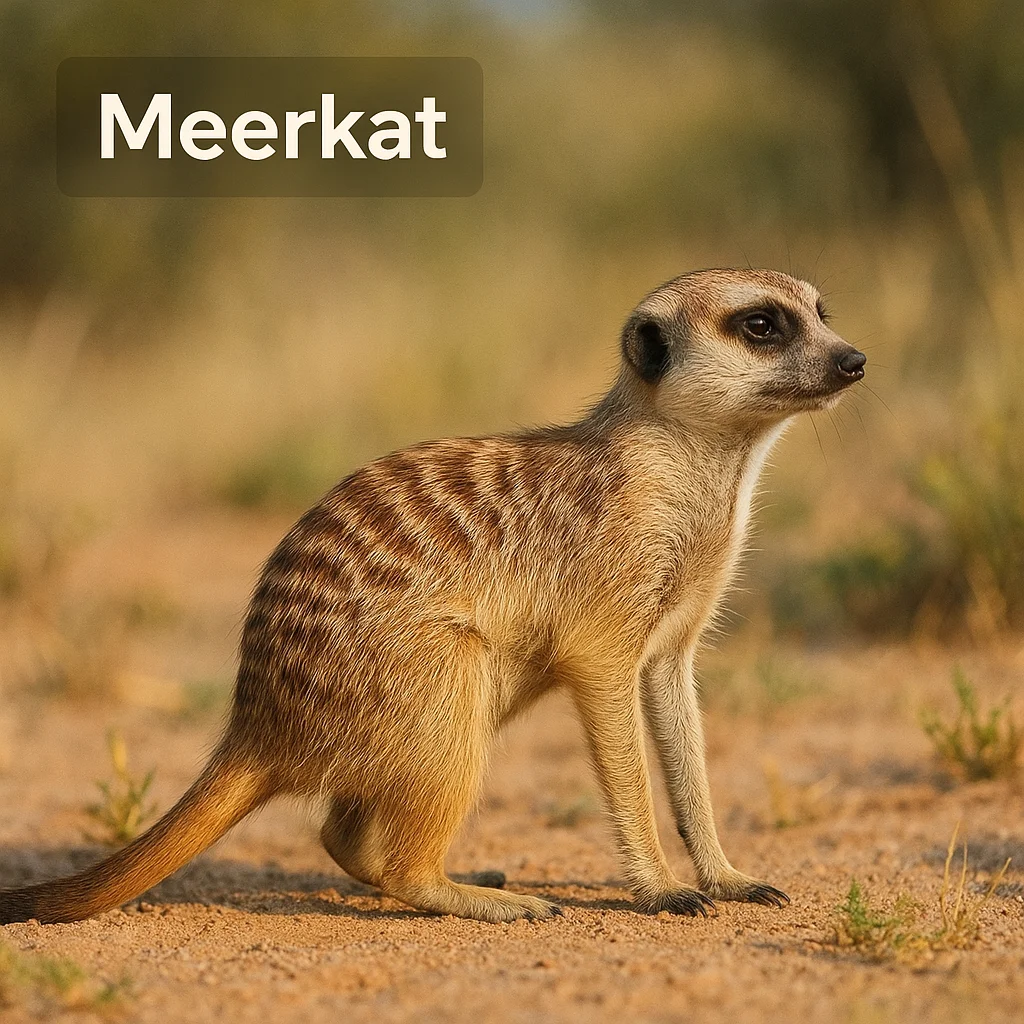
- Common name(s): Meerkat, Suricate
- Scientific name: Suricata suricatta
- Animal type: Mammal
- Typical adult size: 25-35 cm (10-14 inches) excluding tail
- Typical lifespan: 6-8 years in the wild, up to 10-14 years in captivity
- Diet type: Omnivore (insects, small vertebrates, plants)
- Activity pattern: Diurnal
- Social structure: Live in colonies or mobs
- Speed/movement highlights: Agile runners, capable of quick sprints
- Intelligence/learning: Known for cooperative behavior and social learning
- Primary habitats: Deserts and arid grasslands
- Geographic range: Southern Africa, including South Africa, Namibia, Botswana, and Angola
- Predators/threats: Birds of prey, snakes, jackals, and human-induced habitat changes
- Conservation status: Least concern, though specific threats vary by region
🔍 Identification & Appearance
Meerkats have a distinctive slender body and small head, which is offset by their large eyes and ears. Their sandy-colored coat, with unique horizontal stripes across their back, helps them blend into their desert surroundings.
- Slender body with a flat conical face
- Sandy to light brown coat with dark stripes
- Dark patches around the eyes, reducing glare from the sun
- Long tail used for balance
- Tracks show small, delicate footprints with visible claw marks
- Often confused with mongoose species, but meerkats can be distinguished by their distinct posture and social behavior
- Top ID Tips:
- Slim body and pointed snout
- Prominent eye rings
- Horizontal stripes on the back
- Small paws with non-retractable claws
- Sparse hair on the belly, with skin visible
🧱 Body Structure & Physical Adaptations
Meerkats are perfectly adapted to their arid environment. They can dig quickly and efficiently with their strong, clawed forelimbs, and they have exceptional vision to spot predators from a distance. These adaptations make them effective burrowers and sentinels in their harsh habitats.
- Long, non-retractable claws for digging
- Sharp, conical teeth for grasping and eating insects
- Large eyes with dark circles for protection from sun glare
- Highly mobile neck allowing 360-degree vision
- Thin, muscular tail provides balance when standing upright
- Enhanced sense of smell for detecting prey and predators
- Thick skin protects from thorny scrub and burrowing injuries
🌍 Range & Distribution
Meerkats inhabit regions of southern Africa. Found extensively in parts of South Africa, Botswana, Namibia, and Angola, they prefer open areas that allow them to detect predators early. They thrive in loose sand and arid climates.
- Where You Might Find It:
- Kalahari Desert
- Mojave-type drylands
- Open scrublands in Namibia
- Grasslands with sandy soil
- African arid savannas
🏞️ Habitat & Shelter
Meerkats favor open, sunny places where they can dig extensive burrow systems. These burrows provide shelter from extreme temperatures and predators. Their habitat choices are crucial for their survival, providing both shelter and a vantage point for spotting dangers.
- Prefer arid, sandy environments with minimal vegetation
- Burrows can be several meters deep and include multiple rooms
- Seasonal behavior changes, such as basking in the morning sun
- Shelters in burrows during extreme heat and cold
🧭 Behavior & Ecology
Meerkats are social, living in cooperative groups that share duties such as foraging and keeping watch for predators. Their daily activities include sunbathing to raise body temperature and sophisticated communication to warn the group of approaching threats.
- Highly social, live in tight-knit colonies or 'mobs'
- Use complex vocalizations to communicate different threats
- Engage in mutual grooming and play
- Act as ecosystem engineers through burrow digging
- Competitive encounters with other meerkat colonies
- Behavior Highlights:
- Onset behavior for predator detection
- Cohesive social structure within colonies
- Vocal alarms for specific predatory threats
- Cooperative breeding and shared parental care
- Shared burrow maintenance and defense responsibilities
👥 Social Life & Group Dynamics
Meerkats are exceptionally social animals that exhibit pronounced group dynamics. They live in colonies usually made up of multiple family groups, exhibiting behaviors such as communal grooming and raising offspring cooperatively.
- Communal care within stable family units
- Group sizes range typically from 10 to 30 individuals
- Shared vigilance duty with sentinels posted to warn of danger
- Dominance hierarchies with a dominant breeding pair
- Conflict resolution through vocal and physical displays
🍽️ Diet, Prey & Predators
As omnivores, meerkats have a varied diet consisting mainly of insects, small vertebrates, and plants. They employ a variety of foraging techniques and are proficient at excavating sand to uncover hidden prey.
- Feeding Notes:
- Diet includes insects, eggs, and small mammals
- Skilled at hunting scorpions and removing their stingers
- Consume roots and tubers for moisture
- Utilize group foraging to maximize food collection
- Rely on alert sentinels while foraging
🦌 Hunting, Foraging & Movement
Meerkats are proficient foragers, using their claws to dig for food. They're agile and swift, which aids in avoiding predators. Their mornings and late afternoons are often characterized by busy foraging activity.
- Primarily ground-dwellers skilled at fast, purposeful digging
- Active during cooler parts of the day to avoid midday heat
- Use keen senses of smell and hearing to locate prey
- Exploratory movement within a designated home range
- Movement & Strategy:
- Quick burrowing ability
- Group foraging for enhanced protection
- Efficient in spotting predators from elevated positions
- Adaptable scavengers in lean periods
🧠 Intelligence & Senses
Meerkats possess a high degree of social intelligence, indicative of their cooperative societies. They demonstrate complex problem-solving abilities and communication methods adapted for survival in their harsh environments.
- Capable of learning and remembering alarm calls
- Use vocal signals to coordinate group activities
- Strong social bonds increase group survival
- Acute vision adapted for spotting aerial predators
- Notable Abilities:
- Complex cooperative behaviors
- Intricate vocal communication
- Effective predator avoidance strategies
- Keen spatial awareness in territory mapping
🪺 Reproduction, Pregnancy & Parenting
Breeding in meerkats is often monopolized by the dominant pair in the colony, with subordinate members contributing through alloparenting. Puppies are born blind and helpless, relying heavily on group protection and care.
- Breeding can occur up to three times a year
- Gestation lasts approximately 11 weeks
- Litters typically consist of 2-5 young
- Puppies are altricial, requiring extensive care
- Both sexes may participate in rearing young
- Reproduction Snapshot:
- Monopolized breeding by dominant pair
- Cooperative care from all group members
- High flexibility in breeding depending on resources
- Puppies nursed in protected burrow dens
♀️♂️ Male vs Female Differences
Sexual dimorphism is subtle in meerkats. Males and females are similar in size and appearance, but differences may occur in behavior and social roles, especially regarding reproduction and territorial defense.
- Marginal size differences between genders
- Females typically lead in terms of dominance
- Males may disperse to find new colonies
- Breeding roles led by dominant pair
- Sex Differences at a Glance:
- Slightly larger males
- Behavioral roles closely tied to social status
- Reproductive control by dominant female
- Potential dispersal by maturing males
🧬 Subspecies & Variation
While no widely recognized subspecies of meerkats exist, there are variations in their size and coat color that occur across their geographical range. Adaptations to local environments have led to differing protective behaviors and social structures.
- Variation Notes:
- Geographical variation in size across regions
- Coloration differences blend with local habitats
- Temperament variances in response to predators
- Social dynamics may shift with habitat changes
⚠️ Threats, Conservation & Human Interaction
Meerkats face several threats from habitat loss and climate change, despite being currently classified as least concern. Human interaction typically causes environmental pressures rather than direct harm. Conservation efforts aim to preserve the natural habitats crucial for their survival.
- Responsible Notes:
- Avoid habitat encroachment and degradation
- Mitigate climate change impacts by protecting ecosystems
- Respect meerkats in captivity, ensuring ethical practices
✨ Fun Facts & Unique Traits
- Meerkats have a "solar panel" function, warming up by the morning sun to kickstart their day
- Each colony can have dozens of burrow entrances and exit routes
- A meerkat rarely stands alone; social vigilance ensures group safety
- Meerkats are immune to some scorpion venom
- They engage in "billboard" displays to show dominance or territorial claims
- Juveniles learn survival skills through play and observing adults
📌 Summary
- Slender-bodied mammals with distinct dark eye circles
- Prefer arid, open desert and scrubland habitats
- Inhabit southern Africa, thriving in specific, sandy environments
- Omnivorous diet including insects, small animals, and plant matter
- Natural predators include birds of prey and jackals
- Highly social, living in colonies with complex cooperative dynamics
- Breeding is led by a dominant pair in each colony
- Adapted for desert life with effective predator avoidance strategies
- Unique for their cooperative care and alert behaviors