🦁 Pangolin
🧾 Quick Facts
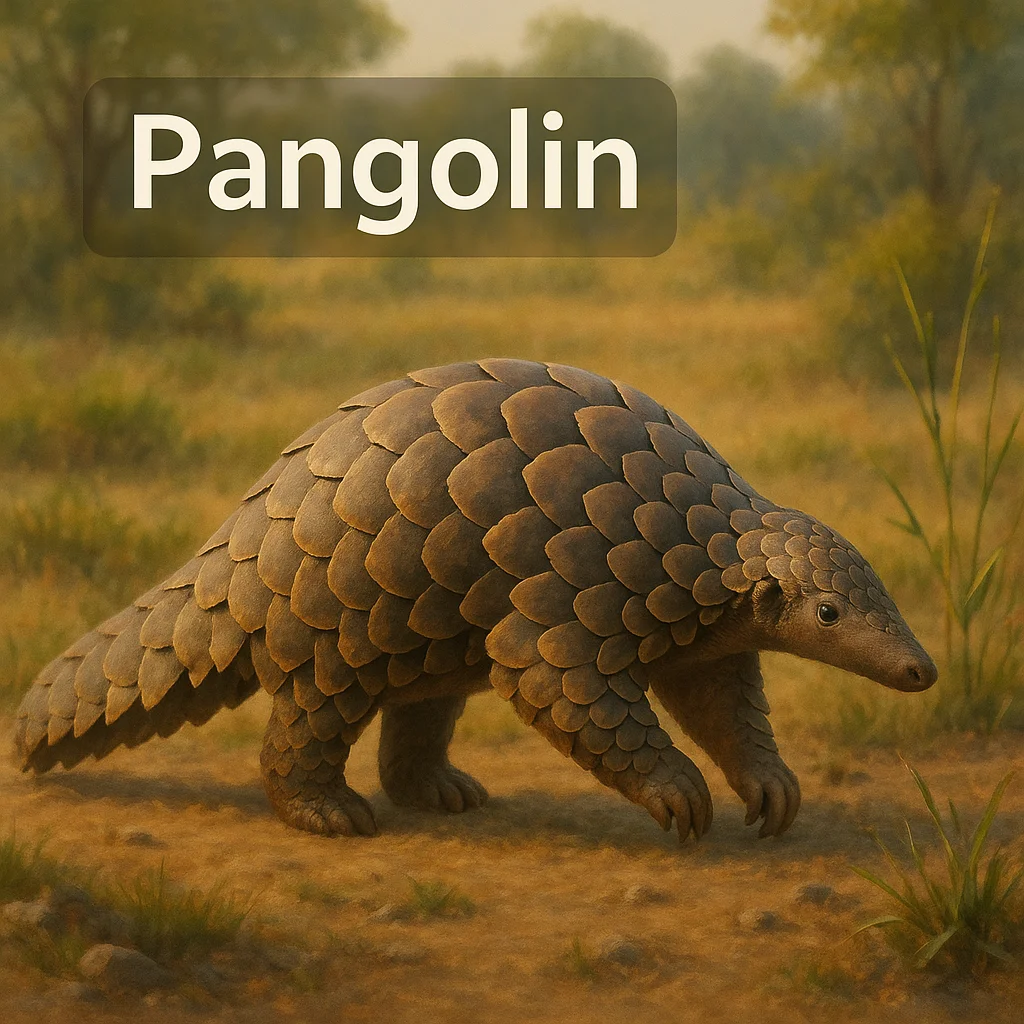
Pangolins, often referred to as "scaly anteaters," are unique mammals known for their protective keratin scales. These nocturnal creatures are found in diverse regions across Africa and Asia and have gained recent attention due to conservation concerns.
- Common name(s): Pangolin, scaly anteater
- Scientific name: Manis (Asian pangolins) and Phataginus/Smutsia (African pangolins)
- Animal type: Mammal
- Typical adult size: 30–100 cm (12–39 inches) in length, 1–33 kg (2–72 pounds) in weight
- Typical lifespan: Average 15–20 years in the wild
- Diet type: Carnivore; primarily feeds on ants and termites
- Activity pattern: Nocturnal
- Social structure: Mostly solitary
- Speed / movement highlights: Walks slowly; curls into a ball when threatened
- Intelligence/learning: Adapt skilled foragers, capable of identifying ant/termite nests
- Primary habitats: Forests, savannas, grasslands
- Geographic range: Asia and Africa
- Predators/threats: Major threats include humans (poaching), habitat destruction
- Conservation status: Ranges from Vulnerable to Critically Endangered
🔍 Identification & Appearance
Pangolins are distinctly recognized by their armor-like scales covering their backs and tails. Their elongated snouts and curved claws enable them to break into insect nests.
- Body shape and silhouette: Long body covered in scales, tapering tail
- Key colors/patterns: Brown to yellowish hues vary by age/individual
- Distinctive features: Overlapping scales, tubular snout, large foreclaws
- Tracks, scat, or other field signs: Wide claw marks; scat contains insect remnants
- Common look-alikes: Armadillos; distinguish by scales (not armor plates) and snout shape
- Top ID Tips:
- Look for the overlap of scales
- Check for elongated snout
- Observe the behavior of curling into a ball
- Note the claw size and shape
- Distinguish by scale coloring
- Look for insect-eating behavior
🧱 Body Structure & Physical Adaptations
Pangolins possess a unique body structure tailor-made for insect consumption and defense against predators.
- Build and proportions: Rounded, with contrasting long tails
- Teeth/beak/jaw adaptations: Toothless; rely on sticky tongues to capture prey
- Claws/hooves/wings/fins: Large, strong claws for burrowing and breaking ant mounds
- Sensory strengths: Strong sense of smell, moderate hearing, poor eyesight
- Key Adaptations:
- Overlap of scales for defense
- Sticky saliva traps ants and termites
- Digestive tract adapted to digest insects
- Cynical behavior as predator defense
- Burrowing capabilities
- Simplified chewing: absence of teeth
🌍 Range & Distribution
Pangolins inhabit diverse regions across Africa and Asia, with distinct species occupying different geographic areas suited to their survival needs.
- Asian pangolins found in: India, China, Southeast Asian countries
- African pangolins found in: Sub-Saharan regions
- Typical biomes: Tropical forests, savannas, grasslands
- Elevation range: From sea level to mountain slopes
- Mostly resident, no major migrations
- Where You Might Find It:
- Asian rainforests
- African savanna woods
- Forest floor during night
- Slopes in subtropical regions
- Mounded termites sites
🏞️ Habitat & Shelter
Pangolins are versatile habitat inhabitants, taking shelter primarily in forests and savanna regions, though their survival is environment-dependent.
- Preferred habitats: Dense forests, open savannas, shrublands
- Microhabitats and shelter: Utilize burrows, tree hollows, and termite mounds
- Weather changes: Rainy seasons increase food availability; dry season poses challenges
- Knowledge importance: Understanding the habitat supports conservation efforts
🧭 Behavior & Ecology
Pangolins exhibit specialized behavioral patterns, primarily involving foraging and defense mechanisms, significantly impacting local ecosystems.
- Daily routine: Nocturnal foraging, resting in borrowed burrows
- Communication: Limited vocalizations, uses scent marking
- Interactions: Predator to ants and termites; role in reducing insect populations
- Role: Part of the ecosystem's balance by affecting insect quantities
- Behavior Highlights:
- Solitary foragers
- Uses a curling defense mechanism
- Scent tracking to locate prey
- Impact on insect population control
- Defense against larger predators
👥 Social Life & Group Dynamics
Pangolins are predominantly solitary, coming together briefly during mating seasons. Their independence is a defining characteristic in their social structure.
- Solitary vs social tendencies: Predominantly solitary
- Group types: Brief maternal care, usually solitary
- Cooperation: Limited, generally during mating
- Dominance: Low interaction leading to minimal competition
- Social Structure Notes:
- Primary solitary existence
- Brief reproductive pair interactions
- Mothers care for offspring until young
- Minimal territoriality conflict
🍽️ Diet, Prey & Predators
Pangolins exhibit specialized feeding habits with a profound diet based almost entirely on insects such as ants and termites.
- Diet: Primarily ants and termites
- Hunting targets: Specialist feeders targeting specific nests
- Main natural predators: Leopards, hyenas, humans threaten populations
- Anti-predator defenses: Curling into impenetrable ball
- Feeding Notes:
- Heavy reliance on specific ant species
- Nocturnal feeding habits
- Detects insect nests via scent
- Prey capture with the elongated tongue
- Role in controlling pest populations
🦌 Hunting, Foraging & Movement
Pangolins, slow movers with coordinated digging and climbing abilities, are adept in foraging despite their sluggish nature.
- Locomotion style: Tree-climbing, ground-dwelling
- Speed and endurance: Slow pace; excellent endurance in burrowing
- Typical hunting/foraging tactics: Use strong claws to dig into nests
- Navigation and spatial behavior: Specify home range, no consistent territorial claims
- Movement & Strategy:
- Adept climbers
- Scent-based prey localization
- Reliance on claw use
- Borrows limitedly in loosened ground
- Utilizes curling as a defensive mechanism
🧠 Intelligence & Senses
Pangolins possess a unique sensory adaptation with a strong sense of smell. Their cognitive abilities complement their primary feeding habits and defense mechanisms.
- Problem-solving and learning: Limited, highly specialized to habitat
- Senses: Predominantly olfactory-based, weak eyesight and basic hearing
- Notable Abilities:
- Recognition of termite/ant colony locations
- Olfactory navigation techniques
- No use of tools or complex problem-solving
- Dependence on tactile and olfactory senses
- Avoidance of pronounced predation risk
🪺 Reproduction, Pregnancy & Parenting
Pangolins have a distinct reproductive cycle influenced by environmental factors. Maternal care is crucial for offspring development in their solitary species.
- Breeding seasonality: Varies by region; influenced by environmental conditions
- Mating system: Typically monogamous pairings
- Gestation period: Ranges from 95 to 150 days
- Litter size range: Usually one offspring per birth
- Parenting roles: Female provides primary care
- Reproduction Snapshot:
- Maternal bonding crucial for young survival
- Single offspring litters
- Solitary up to the reproductive age
- Low population growth rates
♀️♂️ Male vs Female Differences
Gender differences in pangolins are subtle yet visible in varying coloration and size. However, behavioural dimorphisms are consistent due to the species' solitary nature.
- Size/weight differences: Males often larger than females
- Coloration differences: Slight hue variations; generally uniform
- Behavioral role differences: No distinct differences beyond reproductive participation
- Sex Differences at a Glance:
- Males typically larger
- No pronounced differences in coloration
- Behavioral roles are consistent on gender
- Mating participation driven by seasonality factors
🧬 Subspecies & Variation
Multiple species and subspecies exist, with regional adaptations varying in scale texture, size, and environmental tolerance. Pangolins adapt to diverse habitats through localized characteristics.
- Known subspecies: Eight recognized species across Africa and Asia
- Local adaptations: Desert color variations, temperature tolerances, altitude adaptations
- Variation Notes:
- Distinct African and Asian lineages
- Environmental influence on scale and skin coloration
- Adaptation to humid tropical environments
- Subspecies recognized by region and environmental context
⚠️ Threats, Conservation & Human Interaction
The survival of pangolins is threatened by escalating habitat destruction, alongside the illegal wildlife trade that has severely impacted populations throughout Africa and Asia.
- Threats include poaching for scales, habitat loss, and bycatch in traps
- Naturally low reproduction rates hinder population recovery
- Conservation: Efforts focus on anti-poaching, legal protection, and habitat restoration
- Coexistence tips: Support conservation efforts and promote awareness critically
- Responsible Notes:
- Participate in community conservation initiatives
- Encourage protection of natural habitat
- Adverse effects of illegal trade recognized globally
- Promote awareness of species' ecological roles
✨ Fun Facts & Unique Traits
- Pangolins are the only scaled mammals in the world.
- A single pangolin can consume up to 70 million insects annually.
- Their scales are made from keratin, the same protein found in human nails.
- Pangolins have a keen sense of smell but poor vision.
- They can voluntarily curl into a ball as an instinctive defense.
- Pangolins are known to possess a significantly long tongue, sometimes exceeding the length of their own body when fully extended.
- The name "pangolin" derives from the Malay word "pengguling," meaning "one who rolls up."
📌 Summary
- Pangolins are recognized primarily through their unique scaly armor.
- Found across Africa and Asia, adjusting to various habitats
- They are primarily nocturnal insectivores foraging alone.
- Populations face threats from poaching and habitat loss.
- Exhibit specific solitary social structures with limited interactions.
- Reproduction involves a single offspring with strong maternal ties.
- Pangolins have specialized defensive adaptations, including rolling into a defensive ball.
- With eight species, significant adaptive variation exists among them.