🦁 Raccoon
🧾 Quick Facts
The raccoon, often seen rummaging through urban and rural areas, is a highly adaptable mammal known for its intelligence and unique physical traits. Its adaptability has allowed it to thrive in various environments across North America and beyond.
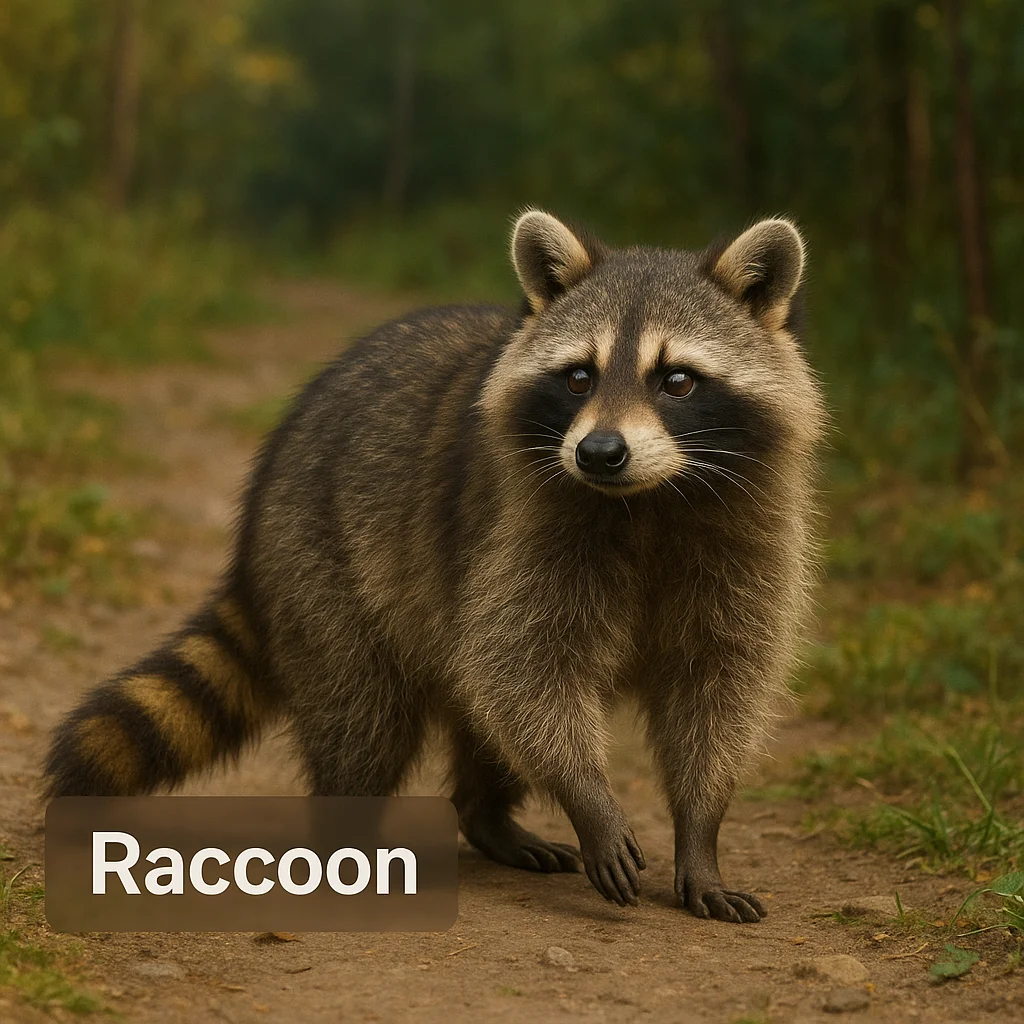
- Common name(s): Raccoon
- Scientific name: Procyon lotor
- Animal type: Mammal
- Typical adult size: 16-28 inches long, 8-20 pounds
- Typical lifespan: 2-3 years in wild, up to 20 years in captivity
- Diet type: Omnivore; eats fruits, insects, eggs, and small mammals
- Activity pattern: Nocturnal
- Social structure: Solitary or small family groups
- Speed / movement highlights: Capable climber and swimmer
- Intelligence/learning: High problem-solving skills, curious nature
- Primary habitats: Forests, urban areas, wetlands
- Geographic range: North America, parts of Europe and Japan
- Predators/threats: Coyotes, owls, humans
- Conservation status: Least concern
🔍 Identification & Appearance
Raccoons are medium-sized mammals with a distinctive black "mask" across their eyes and ringed tails. Their fur is generally grey-brown and dense, providing camouflage in wooded environments. The body is rotund with pointed snouts and dexterous front paws similar to human hands.
- Short, stocky body shape
- Grey-brown fur with black facial mask and ringed tail
- Dextrous front paws used for climbing and handling food
- Tracks resemble small human handprints
- Commonly mistaken for badgers; distinguishable by tail and mask
- Top ID Tips
- Look for the characteristic black mask
- Note the ringed tail
- Observe their unique gait with five-fingered tracks
- Distinguish by rotund body compared to leaner mammals
- Rhomboid face and pointy nose are distinctive
- Often seen near water sources
🧱 Body Structure & Physical Adaptations
Raccoons have a sturdy build that allows them to thrive in varied environments. Their front paws are highly sensitive and dexterous, assisting in foraging. They possess strong, sharp claws ideal for climbing trees and digging.
- Sturdy, stocky build with a rotund profile
- Sharp canine teeth for tearing food
- Dextrous front paws for manipulating objects
- Acute sense of touch enhanced by facial vibrissae
- Adaptable ears with keen hearing abilities
- Key Adaptations
- Strong sense of touch for searching food in dark
- Sharp claws for climbing and digging
- Highly adaptable diet allows survival in urban areas
- Keen hearing aids in detecting predators
- Thick fur provides insulation in varied climates
- Unique eye pattern provides camouflage
🌍 Range & Distribution
Raccoons are native to North America but have expanded their range to parts of Europe and Asia due to both accidental and intentional introductions. They are adaptable, thriving in forests, urban areas, and near water.
- Found throughout North America
- Introduced populations in Europe, Japan, and the Caucasus
- Inhabit temperate to subtropical regions
- Frequently found in urban and suburban areas along with natural forests and wetlands
- Where You Might Find It
- Wooded areas near rivers and streams
- Suburban backyards
- Forests with abundant food sources
- Urban parks and cityscapes
- Temperate climates with diverse ecosystems
🏞️ Habitat & Shelter
Raccoons are versatile creatures, able to adapt to varied environments. They prefer habitats near water with abundant food supplies. Their intelligence allows them to make homes in both natural settings and man-made structures.
- Prefer habitats near water sources like streams and lakes
- Can nest in tree hollows, burrows, and urban structures
- Adapt to weather changes such as seasonal food availability
- Urban raccoons often raid trash bins for food
🧭 Behavior & Ecology
Raccoons are nocturnal foragers, using their keen touch and intelligence to locate food. They communicate through vocalizations, body language, and scent markings. As omnivores, they're vital in controlling insect populations and dispersing seeds.
- Nocturnal activity patterns
- Use of touch and highly developed senses to locate food
- Vocalize to communicate alarm and identify mating opportunities
- Scrap food provides energy for nocturnal activity
- Integral to ecosystems as seed dispersers
- Behavior Highlights
- Solitary foraging, but may share territory with related raccoons
- Highly adaptable and opportunistic in food habits
- Can display aggressive behavior when threatened
- Known to wash food, though this behavior varies
- Scavenging plays a crucial role in urban ecology
👥 Social Life & Group Dynamics
Raccoons have complex social structures that vary by region and food availability. They are primarily solitary but may form loose groupings, particularly females with their young.
- Primarily solitary with occasional small family groups
- Adult females often seen with offspring
- Loose territories overlap and share resources
- Little established dominance but some territorial disputes
- Social Structure Notes
- Shared territories are typical in resource-rich areas
- Mother-offspring bonds are strong yet temporary
- Males are more transient, often solitary
- Few consistent social hierarchies
🍽️ Diet, Prey & Predators
Raccoons are opportunistic omnivores, eating a mix of plant and animal foods depending on availability. This wide-ranging diet helps them adapt to various habitats and seasons.
- Diet includes fruits, nuts, insects, eggs, and small vertebrates
- Urban raccoons often forage in garbage bins
- Prey on small animals like fish and amphibians
- Predators include canids, owls, and humans
- Major survival strategy involves avoidance and concealment
- Feeding Notes
- Nimble fingers help forage for diverse foods
- Ability to consume both natural and man-made food sources
- Frequent forager with varied diet across seasons
🦌 Hunting, Foraging & Movement
Raccoons are dexterous and versatile foragers. They primarily move and feed during the night, using their sensitive paws and keen senses to locate food. They are proficient swimmers and climbers, often exploiting both abilities for foraging and escape from predators.
- Primarily nocturnal foragers
- Capable climbers with a talent for scaling trees
- Use of swimming skills to capture certain prey
- Vast exploratory behavior to access food sources
- Movement & Strategy
- Agile climbers able to ascend trees easily
- Confidence in water promotes riverine hunting
- Clever foragers, able to exploit human food resources
- Mobile within home ranges, yet territorial
🧠 Intelligence & Senses
Raccoons are renowned for their intelligence, particularly in problem-solving and foraging strategy. Their acute sense of touch and developed senses allow them to adapt and thrive across environments.
- Use problem-solving skills to access food sources
- Sensitive whiskers enhance tactile navigation
- Strong vision and hearing conducive to nocturnal lifestyle
- Cognitive capabilities aid in remembering locations of food sources
- Notable Abilities
- Problem-solving for accessing complex food caches
- Acute sense of touch aids in nocturnal foraging
- Visual acuity and adaptability under low-light conditions
🪺 Reproduction, Pregnancy & Parenting
Raccoons typically breed in late winter, with the female raising her offspring alone. Young raccoons stay with their mother until winter to learn essential survival skills.
- Breeding: Late winter or early spring
- Gestation period: 63-65 days
- Litter size: 2-7 kits
- Females exhibit strong maternal care and teach foraging skills
- Males generally do not participate in offspring care
- Reproduction Snapshot
- Breeding occurs once a year
- Mothers rear kits without male involvement
- Offspring learn key survival skills during dependence
♀️♂️ Male vs Female Differences
While male and female raccoons are similar in appearance, there can be subtle differences in size and behavior, particularly during the breeding season when males become more transient.
- Males generally larger than females
- Males roam widely, less territorial
- Females exhibit stronger parental roles
- Sex Differences at a Glance
- Subtle size difference, males slightly larger
- Behavioral variations more evident during mating season
🧬 Subspecies & Variation
Different subspecies of raccoons exist, exhibiting mild morphological and behavioral variation. Subspecies may differ in size, coloration, or adaptations depending on their environment.
- Subspecies exhibit minor differences, mostly in size and fur coloration
- Adaptations manifest to suit local climates
- Variations in behavior due to habitat changes
- Variation Notes
- Minor subspecies adaptation to extreme climates
- Regional differences in size and foraging behavior
⚠️ Threats, Conservation & Human Interaction
Raccoons often face natural predation and human-induced threats like habitat destruction and vehicle collisions. While adaptable, they rely on suitable habitats for food and shelter.
- Habitat destruction poses a significant threat
- Vehicle encounters lead to higher mortality rates
- Regarded as pests in some urban settings due to foraging habits
- Encouraging coexistence requires smart waste management and respect for natural habitats
- Responsible Notes
- Promote habitat preservation to support biodiversity
- Reduce urban expansion in ecologically sensitive areas
✨ Fun Facts & Unique Traits
- Raccoons can remember the solution to tasks for up to three years
- Their "washing" behavior is not directly related to cleanliness
- Raccoons have dexterous paws capable of opening latches and doors
- Urban raccoons often adapt to human activities and structures
- Known for distinctive nighttime vocalizations
📌 Summary
- Raccoons are easily identifiable by their black masks and ringed tails
- They are found across North America and adapt well to urban environments
- Their diet is omnivorous, including fruits, insects, and small mammals
- Raccoons have natural predators like coyotes and owls
- They exhibit solitary or loose social structures
- Females raise offspring without male assistance
- Raccoons show remarkable adaptability and problem-solving skills
- Conservation concerns include habitat loss and urbanization