🦁 Three-toed Sloth
🧾 Quick Facts
The three-toed sloths are fascinating arboreal mammals best known for their slow movements and unique adaptations to life in the trees. Despite the name, there are multiple species within this group, each exhibiting subtle variations.
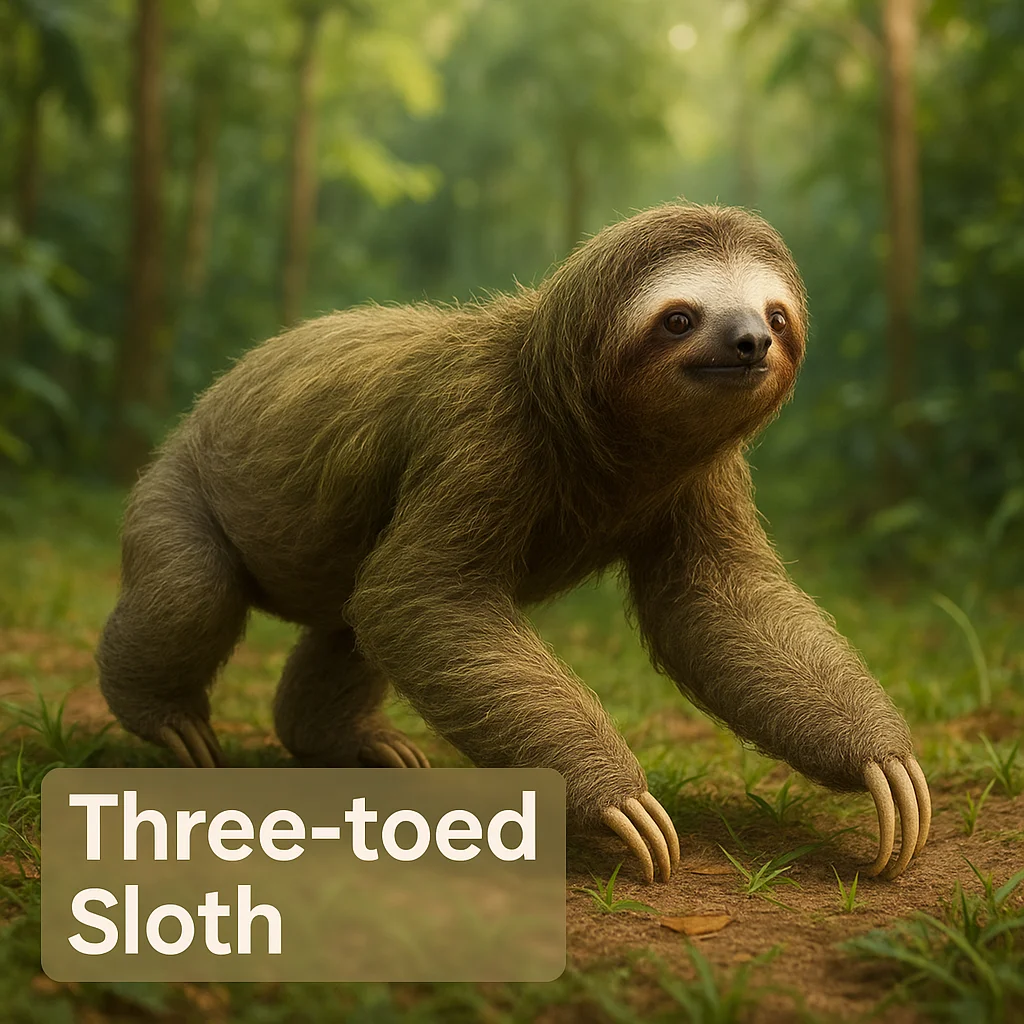
- Common name(s): Three-toed sloth
- Scientific name: Bradypus variegatus (Brown-throated sloth); B. tridactylus (Pale-throated sloth); B. pygmaeus (Pygmy three-toed sloth)
- Animal type: Mammal
- Typical adult size: 50-60 cm in length; 3.5-7 kg in weight
- Typical lifespan: 20-30 years in the wild
- Diet type: Herbivore; primarily eats leaves
- Activity pattern: Largely diurnal but with extended periods of rest
- Social structure: Solitary, except during mating or with young
- Speed / movement highlights: Exceptionally slow; minimal movement per day
- Intelligence/learning: Basic problem-solving; relies heavily on instinct
- Primary habitats: Tropical rainforests
- Geographic range: Central and South America
- Predators/threats: Jaguars, eagles, and human-related habitat destruction
- Conservation status: Varies by species; some are threatened
🔍 Identification & Appearance
Three-toed sloths are easily identified by their slow movements and unique body structure adapted for an arboreal lifestyle. They possess a stocky body covered in coarse, often greenish-brown fur that aids in camouflage. Their faces have a characteristic gentle expression with a blunt snout, and they have long limbs ending in three prominent claws.
- Body shape and silhouette: Compact, rounded body
- Key colors/patterns: Gray-brown with possible green tint due to algae growth
- Distinctive features: Three elongated claws on each limb
- Tracks and signs: Rarely leave tracks; tend to remain in trees
- Look-alikes: Two-toed sloths, which have two digits on front limbs; larger size
- Top ID Tips
- Look for three claws on each limb
- Notice the gentle facial expression with a short snout
- Check for the unique green tint in the fur, especially in densely vegetated areas
- Observe the slow and deliberate movements when navigating branches
- Identify by its solitary nature
- Listen for low vocalizations, though they are generally quiet
🧱 Body Structure & Physical Adaptations
The three-toed sloth's body is highly adapted for a life spent mostly in the treetops. Its limbs are long and strong, though not built for speed. The three claws are effective for hanging from branches for long periods, while their necks have more vertebrae than most mammals, allowing them to turn their heads about 270 degrees.
- Build and proportions: Compact body with long limbs
- Teeth/jaw adaptations: Simple, peg-like teeth for shredding leaves
- Claws: Long claws adapted to grasp and hang from branches
- Sensory strengths: Good sense of smell, poor eyesight offset by hearing
- Key Adaptations
- Clawed limbs for arboreal grip
- Neck flexibility for broad field of vision
- Slow metabolism to conserve energy
- Coarse fur that provides camouflage
- Green algae in fur aiding in camouflaging
- Reduced muscle mass reflecting the slow movement
🌍 Range & Distribution
Three-toed sloths are predominantly found in the tropical rainforests of Central and South America. They are distributed over countries such as Brazil, Panama, Costa Rica, and Peru and can be found primarily in lowland and montane forests.
- Continents/regions: Central and South America
- Typical countries: Brazil, Panama, Costa Rica, Peru
- Elevation range: Mostly in lowland to montane rainforests
- Seasonal movements: Largely resident, with occasional shifts for resources
- Where You Might Find It
- Rainforest canopies of Brazil
- Lowland forests in Costa Rica
- Wilderness areas of Panama
- Montane regions within Peru
- Amazonian biomes
🏞️ Habitat & Shelter
Preferring densely vegetated areas, three-toed sloths are most commonly found above the forest floor, inhabiting the canopy layer of tropical rainforests. They utilize branches for shelter and rely heavily on continuous foliage cover to hide from predators. Their vulnerability increases during the rainy season, when they become slower due to colder temperatures, necessitating warm dry rests on tree branches to maintain their body heat.
🧭 Behavior & Ecology
The three-toed sloth spends most of its day resting and digesting its plant-based diet, often hanging upside down on tree branches, which conserves energy. Sloths communicate through sounds like hisses or whistles, especially during mating season. As seed dispersers, they play a crucial role in forest ecology by ensuring plant regeneration.
- Daily routine: Mostly resting interspersed with brief periods of foraging
- Communication: Limited vocalizations often related to mating
- Interactions with others: Limited interactions except when mating
- Ecosystem role: Act as seed dispersers and are prey for some predators
- Behavior Highlights
- Primarily solitary lifestyle
- Exceptional balance when moving across branches
- Use camouflage as a primary defense
- Consume leaves from various trees
- Dependent on the forest canopy for shelter
👥 Social Life & Group Dynamics
Three-toed sloths are predominantly solitary creatures, coming together only during the mating season. Their social interactions are minimal, and they generally occupy territories that provide sufficient access to food resources. Sloths maintain low conflict levels, showing little aggression or territorial defense.
- Solitary vs social tendencies: Generally solitary
- Group types: No structured group layout
- Cooperation: No significant cooperation observed
- Dominance hierarchies: Minimal conflict; lack of established hierarchy
- Social Structure Notes
- Tends to avoid others outside of mating season
- Displays of aggression are rare
- Mating occurs opportunistically
- No parental cooperation post-mating
🍽️ Diet, Prey & Predators
Three-toed sloths are folivores, consuming mainly leaves, supplemented occasionally by fruits and shoots. This selective diet impacts their slow metabolism and necessitates a large digestive caecum to process their food. Jaguars, harpy eagles, and humans are their primary threats, with sloths often using their cryptic coloration to avoid detection.
- Dietary staples: Leaves from a variety of tree species
- Main predators: Jaguars, harpy eagles
- Defense mechanisms: Cryptic coloration and slow, inconspicuous movements
- Feeding Notes
- Primarily feeds on Cecropia leaves
- Consumes mineral-rich leaves when available
- Rare fruit consumption provides additional nutrients
- Seldom descends to the ground except to defecate
🦌 Hunting, Foraging & Movement
As climbers, three-toed sloths showcase a deliberate, methodical movement style finely tuned to minimize energy expenditure. They forage independently, usually during the day, slowly moving among tree branches. Their muscles are optimized for endurance rather than speed, allowing for prolonged hanging periods.
- Locomotion style: Arboreal climber
- Typical foraging times: Daytime foraging with long sleep phases
- Navigation: Reliance on well-trodden pathways within home ranges
- Movement & Strategy
- Movements are energy-efficient yet slow
- High endurance in hanging from branches
- Uses consistent tree routes to conserve energy
- Direct paths across tree selections
🧠 Intelligence & Senses
Three-toed sloths are not known for high problem-solving skills but exhibit instinct-driven survival behaviors. Their olfactory senses are especially keen for detecting food sources and potential threats. While their visual acuity is limited, their hearing aids in alertness against predators.
- Tool use: None observed; reliance on natural cover for survival
- Sensory strengths: Olfaction is strongest, followed by hearing
- Learning observations: Minimal observed; survival relies largely on instinct
- Effective leaf selection using olfactory cues
- Avoidance of predators through camouflage
- Instinctual navigation and path retracing
- Bears minimal learning flexibility
🪺 Reproduction, Pregnancy & Parenting
Three-toed sloths breed year-round, although the timing may vary based on local environmental conditions. They are promiscuous, with either partner having multiple mating opportunities. Gestation lasts approximately six months, producing a single offspring that clings to the mother for a further six to nine months.
- Breeding timing: Year-round
- Mating system: Promiscuous mating with multiple partners
- Gestation period: About six months
- Litter size: Single offspring
- Parenting: Mother provides sole care
- Reproduction Snapshot
- Birth intervals based on species
- Mothers offer all the initial care
- Young sloth clings to the mother postpartum
- Duration of maternal dependency typically six to nine months
♀️♂️ Male vs Female Differences
Three-toed sloths exhibit only minimal sexual dimorphism, meaning males and females look quite similar. However, males and females are similar in size and appearance, with no vivid coloration or size variation. They also lack distinctive secondary sexual characteristics such as horns or antlers.
- Size/weight differences: Minimal differences observed
- Behavioral roles: Both sexes exhibit similar behaviors
- Visual differences: Not markedly different apart from reproductive organs
- Sex Differences at a Glance
- Both sexes similar in size
- No apparent coloration differences
- Minimal behavioral role variation
🧬 Subspecies & Variation
The three-toed sloths comprise multiple species, with subtle variations in size and habitat preferences. While the Brown-throated sloth is widespread, the Pygmy three-toed sloth exhibits island dwarfism traits and is critically endangered.
- Pygmy three-toed sloth: Notable island dwarfism traits
- Range variation: Even within species range can vary, impacting adaptation
- Habitat differences: Some adapt to more humid regions or drier patches
- Classification debates: Genetic research ongoing for clearer sub-classifications
- Variation Notes
- Distribution varies by species, with island-specific adaptations
- Smaller Pygmy sloths show higher vulnerability
- Debate exists on the classification of subspecies
- Local adaptations affect habitat preferences and subspecies distribution
⚠️ Threats, Conservation & Human Interaction
Three-toed sloths face several challenges, notably from habitat loss due to deforestation, urban development, and climate change. Conservational efforts focus on protecting remaining rainforest habitats and promoting sustainability to ensure their survival. Awareness of their ecological importance and careful cohabitation principles can alleviate human impact.
- Natural challenges: Predation by eagles and large cats
- Human-related pressures: Deforestation, habitat encroachment
- Coexistence tips: Preserve natural habitats and create safe passages in urban regions
- Ethical notes on captivity: Requires specialized care; conservation in situ preferable
- Responsible Notes
- Forest protection crucial for survival
- Awareness about impact of habitat conversion
- Ecological role as seed disperser
- Interactions should prioritize habitat protection
✨ Fun Facts & Unique Traits
- Three-toed sloths can rotate their heads up to 270 degrees due to extra neck vertebrae.
- Algae growing in their fur provides camouflage.
- Sloths descend to the ground once a week to defecate.
- Their slow movements are thought to help conserve energy and avoid drawing the attention of predators.
- Despite being slow movers, they are excellent swimmers.
- Three-toed sloths are known to sleep up to 15 hours a day.
- They can survive on very meager diets of low-nutrient leaves.
📌 Summary
- Recognized by their three claws and gentle face
- Primarily inhabit tropical rainforests of Central and South America
- Folivorous diet, with leaves comprising their main food source
- Natural predators include jaguars and eagles
- Solitary lifestyle except during mating
- Females care for the young until they can manage independently
- Key adaptations include slow movement and camouflaged fur
- Extremely energy-efficient, avoiding predator detection
- Conservation efforts needed due to habitat loss
- Possess the unique ability to turn their head around significantly