🦉 Burrowing Owl
🧾 Quick Facts
The Burrowing Owl (Athene cunicularia) is a small, charismatic bird known for its unique habit of nesting and roosting in burrows underground. These intriguing birds exhibit a variety of behaviors and physical adaptations that suit their open-country habitats across the Americas.
- Common name: Burrowing Owl
- Scientific name: Athene cunicularia
- Animal type: Bird
- Typical adult size: 19–28 cm in length, with a wingspan of 51–61 cm
- Typical lifespan: 6–8 years in the wild; up to 10 years in captivity
- Diet type: Carnivore; primarily insects and small mammals
- Activity pattern: Crepuscular, with some daytime activity
- Social structure: Often found in loose colonies
- Speed / movement highlights: Capable of short bursts of fast flight
- Intelligence/learning: Known for adaptive hunting strategies
- Primary habitats: Grasslands, deserts, and prairies
- Geographic range: North, Central, and South America
- Predators/threats: Hawks, eagles, foxes, habitat destruction
- Conservation status: Varies by region; some populations are declining
🔍 Identification & Appearance
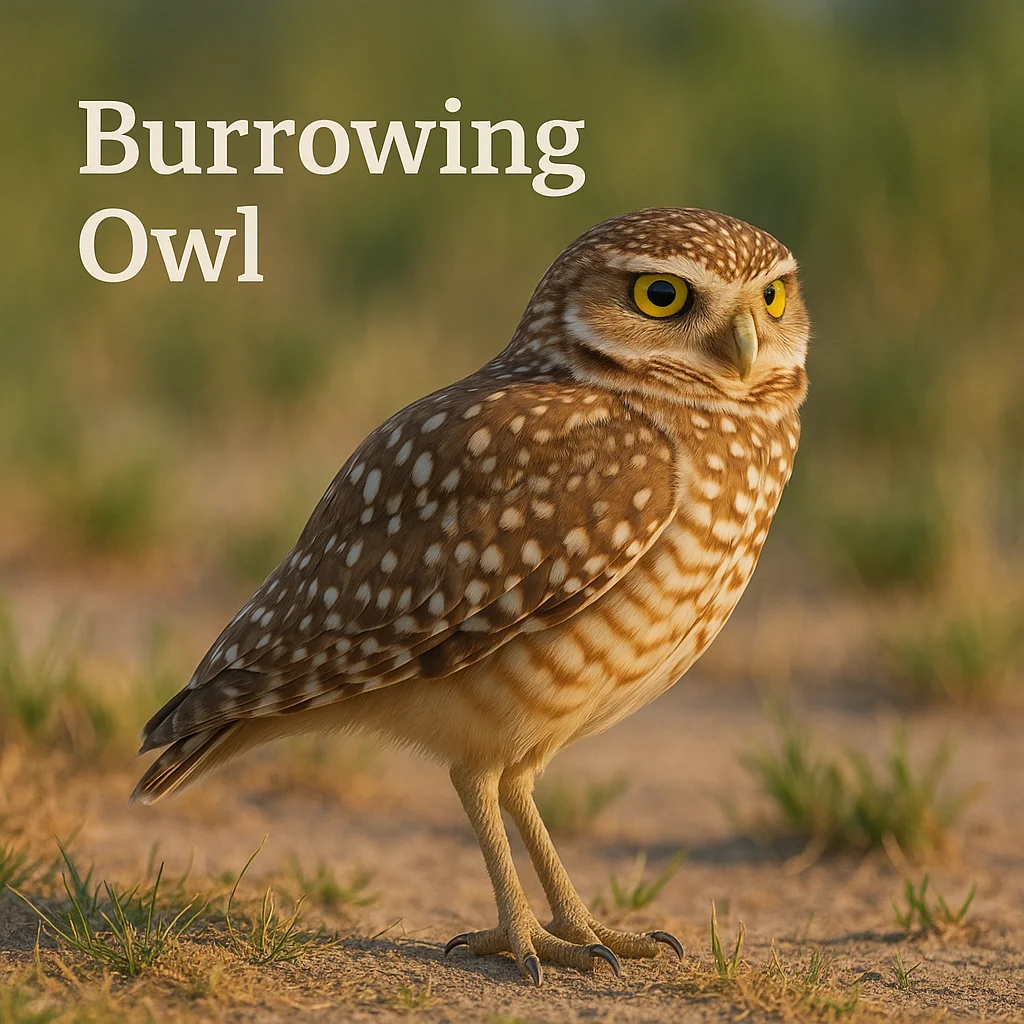
Burrowing Owls are recognizable by their small size, upright stance, and distinctive facial disk. They have long legs, rounded heads without ear tufts, and yellow eyes. Their plumage is mostly brown with white spots and barring, providing excellent camouflage in their habitats.
- Body shape and silhouette: Small, round-bodied with long legs
- Key colors/patterns: Brown with white spots and streaks
- Distinctive features: Yellow eyes, sandy-colored, bold facial disks
- Tracks, scat, or other field signs: Often seen standing near burrow entrances
- Common look-alikes: Short-eared Owls, distinguishable by their habitat and behavior
- Top ID Tips:
- Look for their distinctive upright stance
- Notice their long legs compared to other owl species
- Watch for them near the entrance of burrows
- Listen for their distinctive calls, a series of high-pitched ‘coos’
- Observe their movement patterns during dusk and dawn
- Note the bright yellow eyes standing out against a round face
🧱 Body Structure & Physical Adaptations
The Burrowing Owl's physical adaptations are closely tied to its life both above and below the ground. Its slender, long legs are well-suited for running on the ground, and its wings are optimized for quick flights.
- Key Adaptations:
- Slender build with long legs for efficient movement on the ground
- Strong claws adapted for digging and capturing prey
- Small beak for capturing insects and small vertebrates
- Excellent binocular vision for spotting prey
- Advanced hearing aids their hunting capabilities
- Camouflaged plumage that blends into the open habitat
🌍 Range & Distribution
Burrowing Owls are native to the Americas, with their range covering large portions of North, Central, and South America. While populations can be found from Canada to Argentina, they are mostly resident in open landscapes, varying by region.
- Where You Might Find It:
- Southern United States grasslands
- Central and Western South American plains
- Prairies and agricultural areas of Central America
- Deserts of the Southwestern United States
- Some Canadian prairies during breeding seasons
- Low elevation habitats across their range
🏞️ Habitat & Shelter
The Burrowing Owl prefers open habitats such as grasslands, prairies, and deserts. They occupy burrows, often those abandoned by other animals, such as prairie dogs. Seasonally, these owls may adjust their habitat use based on prey availability and climate conditions.
🧭 Behavior & Ecology
Burrowing Owls are primarily crepuscular, active during dawn and dusk, but they may also be seen during the day. They communicate using various vocalizations and have an essential role as predators in their ecosystem, controlling insect and small mammal populations.
- Behavior Highlights:
- Active mostly during dawn and dusk
- Located near burrow entrances
- Use a variety of vocal calls for communication
- Major predators of insects and small mammals
- Sometimes utilize livestock as lookout posts
- Engage in sunning behavior near burrows
👥 Social Life & Group Dynamics
While often solitary or found in pairs during the breeding season, Burrowing Owls can sometimes be seen in loosely structured colonies. These colonies are typically centered around areas with ample burrow sites.
- Social Structure Notes:
- Often seen single or paired
- Can form loose colonies
- Pairs bond for breeding but separate after
- Shared nesting burrows in some populations
- Flexible social structure depending on resources
🍽️ Diet, Prey & Predators
Burrowing Owls primarily feed on insects and small mammals, adjusting their diet to the season's prey abundance. They hunt using a combination of perching and swooping onto prey, often incorporating ground pursuit into their methods.
- Feeding Notes:
- Insects like grasshoppers and beetles
- Small mammals such as mice and voles
- Occasional small birds and reptiles
- Flexible diet depending on season and availability
- Utilize both hunting and scavenging strategies
- Face predation from larger birds of prey
🦌 Hunting, Foraging & Movement
Burrowing Owls are agile fliers and effective runners. They often hunt from elevated perches, using their sharp vision to spot prey before swooping in for the catch.
- Movement & Strategy:
- Hunt using perches or by running
- Short bursts of speed help capture prey
- Active during early morning and late afternoon
- Adapted to quick ground movement
- Young have a notable ‘run and hide’ reflex
🧠 Intelligence & Senses
Burrowing Owls are intelligent birds capable of learning and using their environment to their advantage. Their keen senses of sight and hearing are crucial for hunting and avoiding predators.
- Notable Abilities:
- Excellent low-light vision
- Advanced hearing for detecting prey
- Problem-solving capabilities in accessing food
- Adaptable to urban environments
- Communication through complex vocalizations
🪺 Reproduction, Pregnancy & Parenting
Burrowing Owls are generally monogamous, with pairs working together to raise their young. They typically have a single brood per year, with the female responsible for incubation while the male provides food.
- Reproduction Snapshot:
- Monogamous breeding system
- Breeding season from March to September
- Clutch size averages 4–12 eggs
- Incubation lasts about 28–30 days
- Chicks fledge approximately 40 days after hatching
- Both parents involved in care
♀️♂️ Male vs Female Differences
Male and female Burrowing Owls are similar in size and appearance, though females may appear slightly larger. Behavioral differences include more active roles in nest defense by males.
- Sex Differences at a Glance:
- Females slightly heavier during breeding
- Males more aggressive in territorial defense
- Sexes visually similar with subtle differences
- Nesting roles see females incubating, males hunting
- Non-breeding plumage does not differ significantly
🧬 Subspecies & Variation
There are several recognized subspecies of the Burrowing Owl, differing in size, coloring, and geographic distribution. Notable subspecies include A. c. hypugaea in North America and A. c. grallaria in South America.
- Variation Notes:
- Size and coloration vary with latitude
- Distinct subspecies across North and South America
- Some regional adaptations notable
- Migratory behavior differs by population
- Adaptations to local environments observed
⚠️ Threats, Conservation & Human Interaction
Burrowing Owls face threats from habitat destruction and human development. Conservation efforts focus on habitat protection and restoration. Coexistence with urban environments is possible but requires careful management.
- Responsible Notes:
- Habitat destruction major threat
- Conservationists promote burrow preservation
- Climate change affecting prey availability
- Urban adaptation presents challenges and opportunities
- Legal protection in some regions
✨ Fun Facts & Unique Traits
- Unique among owls for their burrow-based lifestyle
- Can mimic the sound of rattlesnakes to deter predators
- Often observed 'dancing' or bobbing their heads
- Capable of semi-colonial nesting habits
- Notable for their curiosity and approachability
- Attract mates through a series of complex displays
📌 Summary
- Small, ground-dwelling owl with long legs and yellow eyes
- Found in open habitats from the Americas
- Carnivorous diet includes insects and small mammals
- Predators include hawks and other raptors
- Can form loose colonies, generally monogamous breeding
- Key adaptations enable survival in diverse settings
- Conservation status varies; habitat loss a major threat
- Burrowing and mimicry skills set them apart from other owls