🦁 Eurasian Eagle-Owl
🧾 Quick Facts
The Eurasian Eagle-Owl is one of the largest and most powerful nocturnal birds of prey. Known for its striking appearance and keen hunting skills, this bird commands attention in the vast regions across its geographical range.
- Common name: Eurasian Eagle-Owl
- Scientific name: Bubo bubo
- Animal type: Bird
- Typical adult size: 60–75 cm tall, wingspan 160–188 cm
- Typical lifespan: 10–20 years in the wild; up to 60 years in captivity
- Diet type: Carnivore
- Common foods: Small mammals, birds, reptiles, fish
- Activity pattern: Nocturnal
- Social structure: Solitary or in pairs
- Flight: Silent and powerful, primarily for hunting
- Intelligence: Highly perceptive with strong hunting instincts
- Primary habitats: Forests, mountains, plains, deserts
- Geographic range: Europe, Asia, North Africa
- Predators/threats: Adult birds have few natural predators; human activity is a threat
- Conservation status: Least Concern; population stable in general, varies regionally
🔍 Identification & Appearance
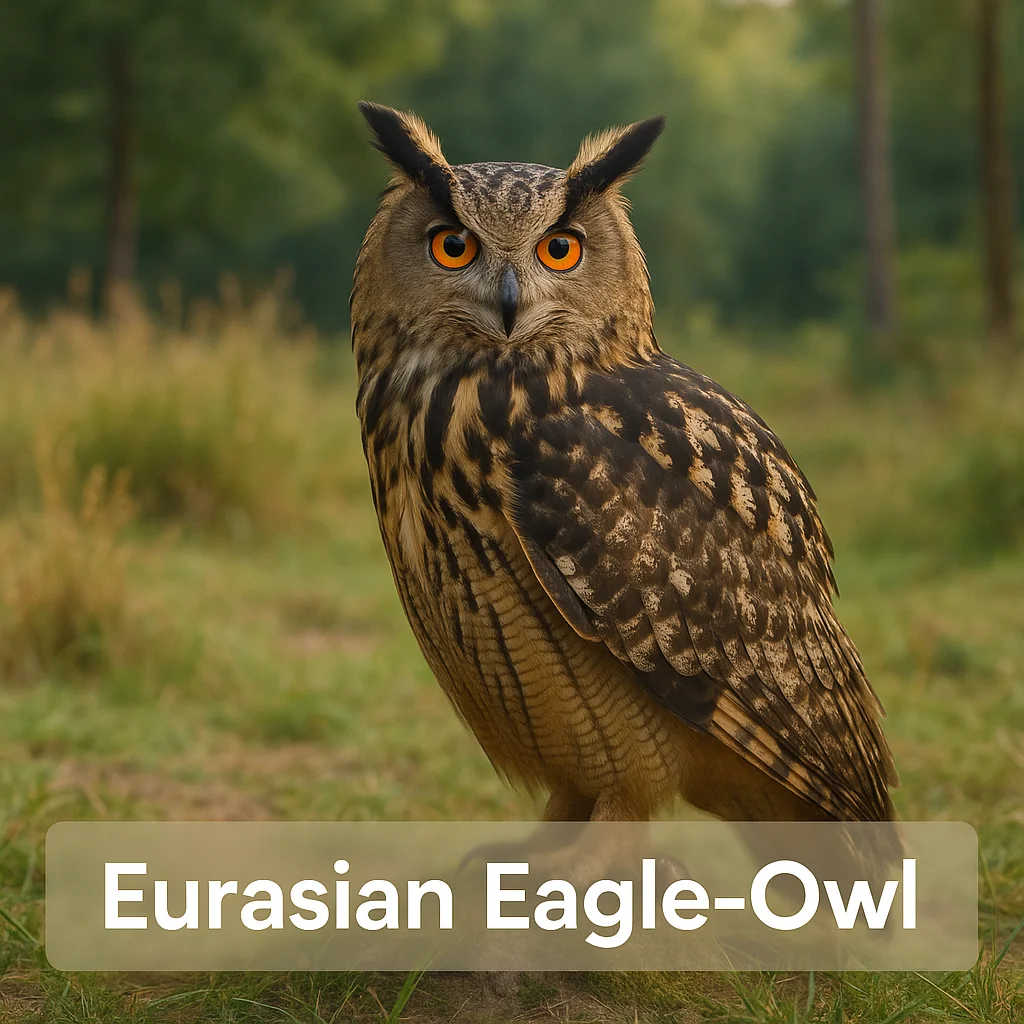
The Eurasian Eagle-Owl is recognizable by its large size and striking features. It possesses distinctive ear tufts or "horns" and intense orange-red eyes. Its plumage is mottled with browns, blacks, and beiges, providing excellent camouflage in wooded environments.
- Broad, rounded wings and a long tail for maneuverability in flight
- Mottled brown and buff plumage helps in camouflage
- Orange-red eyes and prominent ear tufts
- Strong, curved beak and sharp talons for hunting
- Fluffy, thick feathering provides insulation
- Similar species include the Great Horned Owl, but larger with more robust build
- Seasonal color variations are generally subtle
- Juvenile birds have similar but less distinct coloration
- Feathered legs and feet
- Common field marks: head-to-tail view shows full tuft and plumage spread
🧱 Body Structure & Physical Adaptations
The Eurasian Eagle-Owl is built for strength and agility, attributes that aid its predatory lifestyle. Its physical adaptations are optimized for hunting and survival across various environments.
- Robust, muscular build for powerful flight
- Hooked beak specialized for tearing prey
- Sharp talons designed for gripping and killing
- Large, forward-facing eyes enhance night vision
- Excellent hearing, with asymmetrically placed ears to detect prey
- Flight feathers adapted for silent movement
- Adaptable plumage that provides camouflage
- Flexible neck for wider range view
- Efficient respiratory and circulatory systems for sustained activity
- Cadge allows for efficient digestion of bones and fur
🌍 Range & Distribution
The Eurasian Eagle-Owl enjoys a wide distribution across the Palearctic region. It inhabits a variety of landscapes, demonstrating impressive adaptability.
- Predominantly found across Europe and Asia
- Ranges to the north of the Arctic Circle and south to North Africa
- Thrives in diverse climates from deserts to dense forests
- Elevation range from sea level to mountain zones
- Mostly a resident species with local movement patterns
- Spans across countries including Russia, China, India, and parts of Scandinavia
- Population density varies based on prey availability and habitat
- Experiences minor seasonal movements depending on food supply
- Non-migratory by nature, except for some regional commuters
🏞️ Habitat & Shelter
The Eurasian Eagle-Owl is versatile in its habitat preferences. It occupies a range of settings where it can find sufficient food and suitable nesting sites.
- Forests provide cover and hunting grounds
- Mountainous regions offer nesting sites on cliffs
- Adapted to open terrain like moors and farmlands
- Dense, heightened habitats preferred for nesting
- Permanent residents of suitable areas avoiding significant seasonal migration
- Human encroachment can force eagle-owls closer to urban areas
- Habitat knowledge aids conservation efforts and management practices
🧭 Behavior & Ecology
As a top predator, the Eurasian Eagle-Owl plays a vital role in controlling populations of its prey. Its behavior is characteristic of many sole and territorial birds of prey.
- Nocturnal hunter, with peak activity during dawn and dusk
- Territorial and will aggressively defend chosen areas
- Vocalizations include hoots and calls for communication
- Monitors local prey populations, keeping numbers in check
- Primarily a solitary existence, forming pairs during breeding
- Camouflaging during the day in dens or high perches
- Capable of regulated thermoregulation, optimal for hunting
- Minimal interaction with non-prey species except in competition
- Utilizes both sight and sound for hunting efficiency
- Adaptable predation methods prove critical to ecosystem balance
👥 Social Life & Group Dynamics
The Eurasian Eagle-Owl is predominantly solitary, but its social behavior becomes evident during the breeding season when pairs may bond for life.
- Mainly solitary except during mating pairs
- Stable pair bonds increase reproductive success
- Pairs may defend large territories together
- Lone individuals widely disperse in search of food and mates
- Displays through vocalization and physical postures
- Subtle dominance expressed through territory acquisition
- Breeding pairs often occupy and remain close to the same nests
- Agonistic behavior mainly for mate protection and territory
- Non-breeding, immature birds may form temporary groupings
- Territorial disputes handled through displays rather than conflict
🍽️ Diet, Prey & Predators
Eurasian Eagle-Owls are fierce and effective hunters, feeding on a varied diet that reflects their adaptability and predatory prowess across different habitats.
- Prey includes small to medium-sized mammals, birds, reptiles
- Hunts primarily at night using stealth and surprise
- Known for silently swooping on prey from above
- Utilizes keen eyesight and acute hearing to locate targets
- Can switch prey types based on environmental availability
- Occasionally scavenges on carrion, depending on food scarcity
- Few natural predators; vulnerable to eagles and large cats
- Threat reduction through keen awareness and camouflage
- Strong talons and beak efficient for dismantling prey
- Minimal scavenging behavior but opportunistic
🦌 Hunting, Foraging & Movement
As a skilled aerial predator, the Eurasian Eagle-Owl's movements and hunting strategies have evolved to maximize efficiency and success in diverse environments.
- Primarily an ambush predator with silent flight
- Capable of sustained, powerful flight to cover extensive areas
- Hunting mostly occurs during nighttime
- Often uses high vantage points to survey potential prey
- Employs surprise and precision in its attacks
- Can maintain sustained flight for prey pursuit across territories
- Navigation relies on visual landmarks and spatial memory
- Typically territorial with well-defined hunting ranges
- Cliff faces and tall trees are favored for strategic vantage
- Seasonal movements minor and localized, not migratory
🧠 Intelligence & Senses
The Eurasian Eagle-Owl's formidable hunting capabilities are underpinned by its intelligence and acute sensory perceptions, essential for surviving in the wild.
- Impressive problem-solving abilities observed in hunting strategies
- High learning aptitude for new hunting techniques
- Demonstrated memory for tracking movements of prey
- Powerful vision optimized for low-light conditions
- Asymmetrical ears offer superior auditory precision
- Strong underplay on tool use; relies on instinctual hunting
- Keen tactile senses through feathers enhance environmental awareness
- Limited research on complex social intelligence
- Individual adaptability reflects situational intelligence
🪺 Reproduction, Pregnancy & Parenting
The breeding and rearing practices of the Eurasian Eagle-Owl underscore the importance of pair bonding and shared responsibilities in the nurturing of young.
- Breeding season typically occurs in late winter to early spring
- Generally monogamous per season with some lifetime partners
- Incubation period lasts approximately 34–36 days
- Clutch size ranges from 1 to 4 eggs, often 2–3
- Chicks are altricial and rely heavily on parental support
- Both parents participate in feeding and protecting the young
- Nests located on cliff ledges, in trees, or adapted environment
- Young fledge at around 50–60 days but remain dependent
- Extended parental care into post-fledging period ensures higher survival
- Breeding success linked with territory quality and food availability
♀️♂️ Male vs Female Differences
The Eurasian Eagle-Owl displays typical sexual dimorphism found in raptors, with variations in size and some behavioral aspects between genders.
- Females usually larger and heavier than males
- Coloration and markings generally similar across sexes
- Males more prominently involved in hunting during brood-rearing
- Females focus on incubation and early chick care
- Slight difference in vocalization pitches
- Behavioral roles complement mutual territorial defense
- Sexual dimorphism aids in role distribution during breeding
- No significant differences in plumage patterns
🧬 Subspecies & Variation
The Eurasian Eagle-Owl encompasses several subspecies, each adapted to its specific regional environment, reflecting in slight differences in size and plumage.
- Subspecies classification based on regional variances
- Slight size variation among northern and southern populations
- Island populations may exhibit dwarfism traits
- Desert subspecies may show lighter plumage for camouflage
- Colder regions may feature denser plumage for insulation
- Plumage coloration may vary subtly from region to region
- Some subspecies classification debated due to overlapping traits
⚠️ Threats, Conservation & Human Interaction
While not currently endangered, Eurasian Eagle-Owls face threats from habitat destruction and other human activities. Conservation efforts focus on habitat protection and awareness.
- Vulnerable to habitat loss due to deforestation and urban expansion
- Ingested pesticides and pollutants pose health risks
- Vehicle collisions due to road encroachment in natural habitat
- Legal protection varies by region and affects population dynamics
- Human persecution historically for livestock protection
- Feather trade reduced significantly due to protective laws
- Efforts include creating protected areas and public education
- Captive breeding programs aid population stabilization
- Ethical considerations for keeping in captivity for conservation
- Coexistence strategies focus on minimizing conflict
✨ Fun Facts & Unique Traits
- The Eurasian Eagle-Owl is one of the largest owl species in the world.
- Its calls can be heard up to two kilometers away.
- Unlike many owls, it is capable of preying on animals close to its size.
- Records show they can lift prey weighing over three kilograms.
- Their eyes are fixed, requiring them to move their entire head to look around.
- They are known for distinctive urn-shaped nests on cliff faces and treetops.
- Their ear tufts are not used for hearing, but for communication and camouflaging.
- Male and female Eagle-Owls take turns incubating eggs during the breeding season.
- Their primary response to threats is to become silent and camouflaged.
- Despite having few predators, they are cautious and attentive at all times.
📌 Summary
- The Eurasian Eagle-Owl is a large and powerful raptor distinguished by its ear tufts and orange-red eyes.
- Its habitats range from forests and mountains to open plains across Europe, Asia, and North Africa.
- Primarily nocturnal, it exhibits exceptional vision and hearing to hunt rodents and small animals.
- Generally solitary but forms monogamous pairs during breeding seasons.
- Females typically larger than males; subspecies differences reflect regional adaptations.
- Faces threats from habitat loss and climate change; current conservation status is Least Concern.
- Fascinating for their role as apex predators in ecosystems, controlling prey populations.
- Known for their deep, resonant calls and silent, precise hunting techniques.
- Adaptations include powerful talons, silent flight, and excellent night vision.
- A beloved subject of fascination, with many features and behaviors continuing to intrigue bird enthusiasts worldwide.