🦁 Great Gray Owl
🧾 Quick Facts
The Great Gray Owl, scientifically often listed as Strix nebulosa, is an iconic bird known for its majestic appearance and hauntingly beautiful presence in dense forests. This Northern Hemisphere resident captivates bird enthusiasts and naturalists alike with its impressive size, distinct facial features, and silent flight.
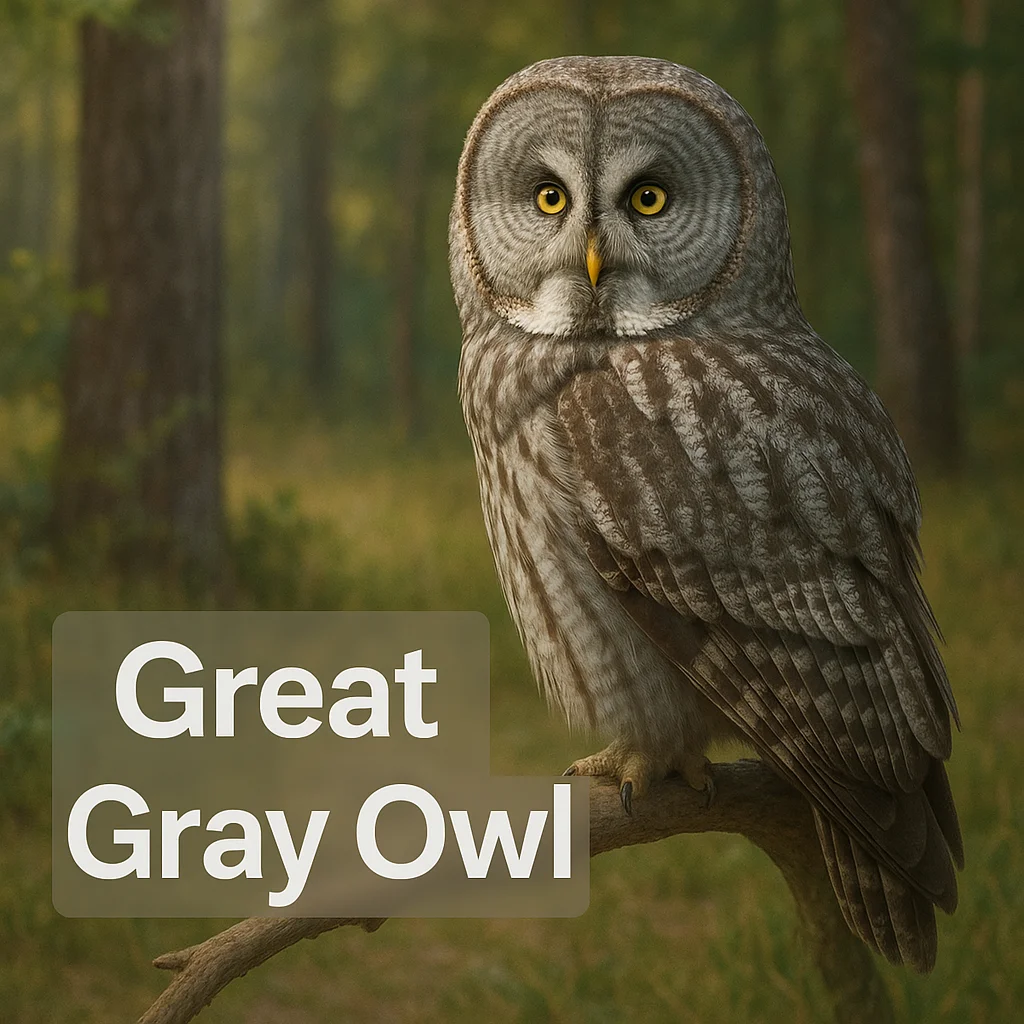
- Common name: Great Gray Owl
- Scientific name: Strix nebulosa
- Animal type: Bird
- Typical adult size: 61-84 cm (24-33 inches) in length, wingspan of 142 cm (56 inches)
- Typical lifespan: 10-12 years in the wild, longer in captivity
- Diet type: Carnivore; mainly small mammals like voles and lemmings
- Activity pattern: Primarily nocturnal, occasionally crepuscular
- Social structure: Solitary, except during breeding
- Speed / movement highlights: Silent, graceful flyer; adept at short-distance gliding
- Intelligence/learning: Highly observant with excellent memory for hunting grounds
- Primary habitats: Dense forests, boreal and montane woodlands
- Geographic range: Northern North America and Eurasia
- Predators/threats: Larger birds of prey, human encroachment, deforestation
- Conservation status: Generally stable, varies by region
🔍 Identification & Appearance
The Great Gray Owl can be identified by its large size, fluffy appearance, and distinctive facial disc that features concentric rings and large yellow eyes. Its plumage is mostly gray and brown, peppered with fine white streaks and bars that offer excellent camouflage among the trees. The owl’s long tail further distinguishes it from many other owl species.
- Body shape: Large, rounded head with a thick, cylindrical body and long tail
- Key colors/patterns: Gray-brown with fine white striations
- Distinctive features: Large facial disc, absence of ear tufts
- Tracks and signs: Round tracks with three forward-facing toes
- Common look-alikes: Barred Owl, Great Horned Owl
- Top ID Tips:
- Look for the large, disc-shaped face with concentric ring patterns
- Notice the lack of ear tufts, unlike the Great Horned Owl
- Check for the substantial wingspan when in flight
- Observe the notably long tail when perched or in flight
- Inspect for intricate camouflaged feather patterns
🧱 Body Structure & Physical Adaptations
The Great Gray Owl has evolved various adaptations that make it a proficient predator and a master of the silent hunt. Its powerful talons are a key asset in capturing prey swiftly from the ground. Its hearing is exceptionally acute, allowing it to detect even the faintest sounds under deep snow or foliage, enabling successful hunts in low-light conditions.
- Build and proportions: Large, barrel-chested with a broad wingspan and relatively long legs
- Beak/jaw adaptations: Strong hooked beak for tearing prey
- Claws/wings: Sharp talons; wings optimized for silent flight
- Sensory strengths: Superb hearing and night vision
- Key Adaptations:
- Specialized feathers for silent flight
- Facial disc to funnel sound to ears
- Large eyes adapted for night vision
- Strong talons for grasping small mammals
- Thick plumage for cold weather insulation
🌍 Range & Distribution
The Great Gray Owl spans across coniferous forests in the Northern Hemisphere, touching on both North American and Eurasian territories. They reside in regions that range from temperate to frigid, from the Sierra Nevada and Rocky Mountains to the vast Siberian taiga.
- Continents/regions: North America, Northern Europe, and Asia
- Elevation range: Prefer lowland to montane regions
- Migration: Mostly resident, with some altitudinal movements
- Where You Might Find It:
- Boreal forests in Canada and Alaska
- Montane forests of the Western United States
- Taiga biomes in Siberia and Scandinavia
- Forested areas near the Great Lakes
- Forests in northwestern Europe
🏞️ Habitat & Shelter
The Great Gray Owl is best suited to dense, mature forests where it nests in tree cavities or utilizes abandoned nests from other large birds. These owls can also inhabit areas near meadows and open spaces conducive to hunting. Seasonal changes may bring owls slightly lower in altitude or to edge environments where prey is more accessible during winter.
Understanding their habitat is crucial to their conservation and tracking efforts. They rely heavily on old-growth and mature forests with a complex understory structure.
🧭 Behavior & Ecology
Great Gray Owls are quiet but effective hunters known for their patience and formidable hunting skills. They rest during the day, perching close to tree trunks for camouflage. Communication is subtle, consisting mainly of low-frequency hoots and screeches. They play a significant role as top predators within their ecosystems, controlling rodent populations.
- Behavior Highlights:
- Regularly preen their feathers for maintenance
- Use wing claps and vocalizations during courtship
- Exhibit territorial behaviors during breeding season
- Utilize keen hearing to detect prey movement
- Primarily hunt from a perch, scanning for movement below
- Rarely engage in vocal disputes with other owls
👥 Social Life & Group Dynamics
Great Gray Owls are predominantly solitary outside of the breeding season. However, they form strong pair bonds and exhibit notable cooperation during breeding by sharing responsibilities, such as defense of the territory and feeding of the young. They do not maintain a strict dominance hierarchy but exhibit occasional aggressive behaviors towards intruders.
- Social Structure Notes:
- Primarily solitary with occasional pair bonding
- Pairs defend nesting sites vigorously
- Both males and females participate in raising young
- Little social interaction beyond breeding season
- Non-aggressive to conspecifics outside mating periods
- Minimal migratory group formations
🍽️ Diet, Prey & Predators
Great Gray Owls are carnivores that primarily feast on small mammals, but they may consume birds and insects when necessary. Their main targets vary seasonally, with voles and lemmings constituting major prey in colder months. Natural predators include larger birds of prey, while nestlings may fall prey to raccoons or martens.
- Feeding Notes:
- Ambushes prey from elevated perches
- Seasons affect prey availability and diet
- Excels in capturing prey beneath snow cover
- Occasional kleptoparasitism has been noted
- Adapted to catch elusive, quick-moving prey
🦌 Hunting, Foraging & Movement
Renowned for their silent flight, Great Gray Owls can approach prey stealthily. Their flight is a powerful glide supported by large wings, and they demonstrate incredible patience and observational skills. Most hunting occurs at dawn and dusk, utilizing vantage points to scan for movement and opportunity.
- Movement & Strategy:
- Mostly stationary, relying on ambush tactics
- Effective at hunting in dense forest understories
- Nocturnal and crepuscular peak activity periods
- Uses keen hearing and vision for prey detection
- Capable of sudden, swift flight for short distances
🧠 Intelligence & Senses
Great Gray Owls possess excellent cognitive abilities, particularly in spatial memory and prey detection. Their hearing is unrivaled, with a facial disc funneling sound to asymmetrically placed ears. They exhibit seasoned problem-solving skills in navigating dense underbrush and locating hidden food sources, yet research on their full cognitive range remains limited.
- Notable Abilities:
- High adaptability to varying forest environments
- Finely tuned acoustic localization techniques
- Acute night vision aids low-light hunting
- Displays of innovative foraging under snow
- Moderate problem-solving capacity documented
🪺 Reproduction, Pregnancy & Parenting
The breeding season of the Great Gray Owl is typically from March to June. They are monogamous, often forming long-term pair bonds. After a courtship involving calls and displays, females lay 2-5 eggs that require an incubation period of about 28-35 days. Both parents partake in delivering food to the nest and protecting the young, which are altricial at birth.
- Reproduction Snapshot:
- Courtship includes vocal duets and displays
- Eggs are incubated primarily by the female
- Males provide most of the food during early chick development
- Chicks fledge in approximately 3-4 weeks
- Nesting often occurs in old raptor nests or broken tree tops
♀️♂️ Male vs Female Differences
Males and females of the Great Gray Owl species are similar in appearance, making them difficult to distinguish in the field by sight alone. However, females are generally larger and heavier, which plays a role in egg incubation and defense. Behavioral roles during rearing can vary minimally beyond differing physical pursuits of food and protection.
- Sex Differences at a Glance:
- Females are usually larger than males
- Males may exhibit higher hunting frequency
- No distinct coloration differences
- Both participate in territorial defense
- Subtle role variations during breeding
🧬 Subspecies & Variation
There are no recognized subspecies of the Great Gray Owl, although size and plumage may exhibit slight regional variations. Depending on the geographic location, slight differences in behavior and diet may occur, reflecting local prey availability and environmental conditions. Debate on subspecies classification is largely nonexistent.
- Variation Notes:
- Body size varies with latitude
- Plumage adjusts to regional camouflage needs
- Vocalizations may have local dialects
- Prey diversity reflects local ecological niches
- Minor climate-based behavioral adjustments
⚠️ Threats, Conservation & Human Interaction
The primary threats to Great Gray Owls stem from habitat loss due to forest clearing and climate changes impacting prey populations. They are occasionally involved in human-wildlife conflicts where populations overlap with human activities. Conservation efforts focus on habitat preservation and ensuring sustainable forestry practices.
- Responsible Notes:
- Support conservation of old-growth forests
- Recognize the impact of climate change on prey cycles
- Encourage responsible wildlife watching practices
- Highlight research needs for climate impact studies
- Limit disturbances during mating and nesting seasons
✨ Fun Facts & Unique Traits
- Great Gray Owls have the largest facial disc of any raptor species.
- The owls can locate prey up to two feet under snow.
- Despite their size, they only weigh as much as a large barn owl.
- They can turn their head nearly 270 degrees.
- Their call is characterized as a series of deep, rhythmic hoots.
- Females often take over the oldest and deepest tree holes for nesting.
- Their feathers trap air, acting as insulation against harsh winter weather.
📌 Summary
- 🔍 Identified by its massive facial disc and gray-brown plumage
- 🏞️ Found in dense, mature forests across Northern Hemisphere
- 🌍 Non-migratory but altitudinally adaptive
- 🍽️ Predominantly consumes small mammals
- 🧭 Solitary but forms strong pair bonds during breeding
- 🪺 Monogamous breeding with both parents nurturing
- 🧱 Physical adaptations include silent flight and acute hearing
- ⚠️ Conservation challenges include habitat destruction
- ✨ Known for its impressive size but not considered as aggressive