🦉 Great Horned Owl
🧾 Quick Facts
The Great Horned Owl, often considered a symbol of wisdom and mystery, is a large and powerful bird of prey found throughout the Americas. This majestic bird is notable for its distinct "horns," impressive hunting skills, and widespread adaptability.
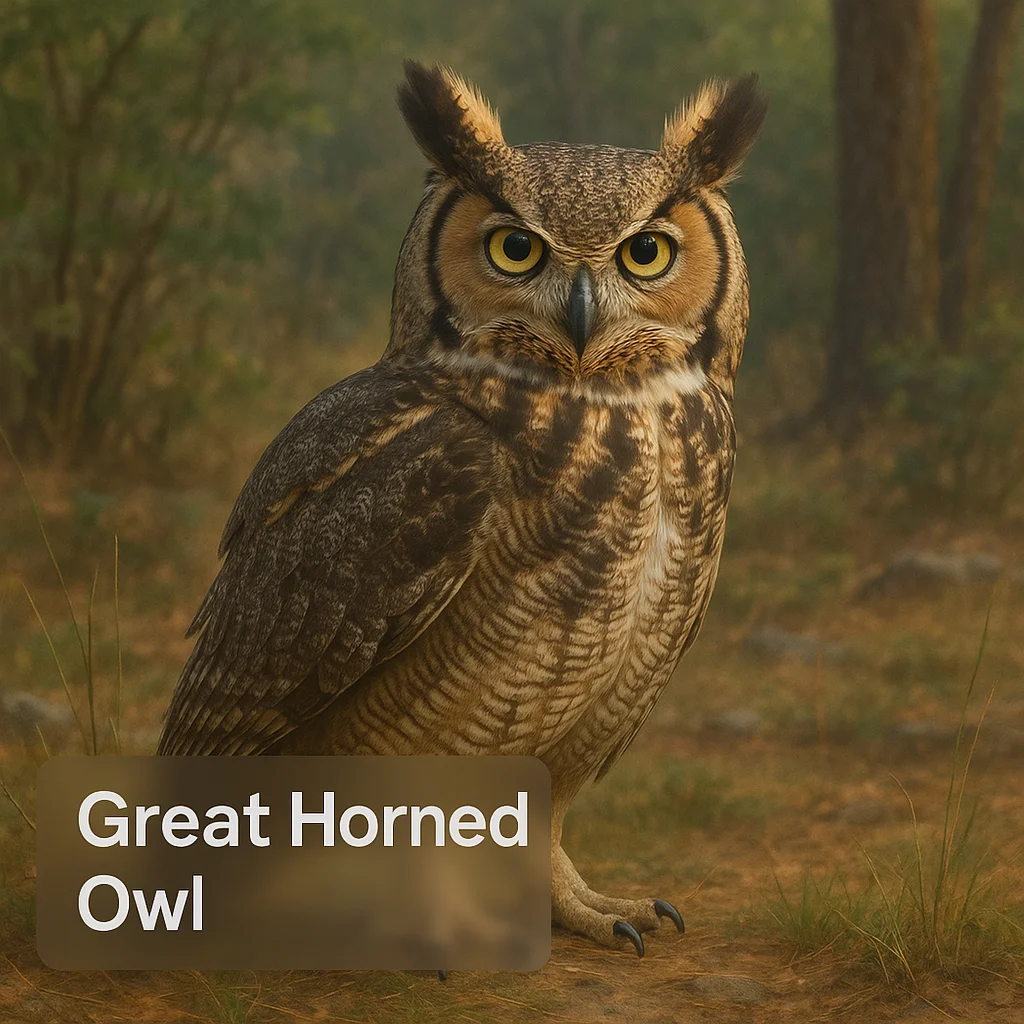
- Common name(s): Great Horned Owl
- Scientific name: Bubo virginianus
- Animal type: Bird
- Typical adult size: 18–25 inches in length, wingspan 3.3–4.8 feet, weight 2–5.5 pounds
- Typical lifespan: 13–15 years in the wild, up to 28 years in captivity
- Diet type: Carnivore; commonly eats small mammals, birds, reptiles, and insects
- Activity pattern: Nocturnal
- Social structure: Mostly solitary except during breeding
- Speed / movement highlights: Swift and agile in flight
- Intelligence/learning: Known for problem-solving skills and stealthy hunting
- Primary habitats: Forests, grasslands, deserts, wetlands, suburbs
- Geographic range: Throughout North and South America
- Predators/threats: Larger raptors, humans (habitat destruction)
- Conservation status: Least Concern, varies locally
🔍 Identification & Appearance
The Great Horned Owl is recognized by its large size and striking "horns," which are actually tufts of feathers. Its plumage is a mix of mottled gray, brown, and white, which provides excellent camouflage. These owls also have bright yellow eyes and a powerful hooked beak.
- Bulky body with a distinctive ear-tuft silhouette
- Barred pattern on the belly and wings
- Seasonal and age-related color variations are minimal
- Tracks are rarely seen, given their nocturnal habits
- Look-alikes include Long-eared and Short-eared Owls but are differentiated by size and ear tufts
- Top ID Tips: Large size; ear tufts; yellow eyes; deep hoots; mottled brown, gray, and white patterns
🧱 Body Structure & Physical Adaptations
Great Horned Owls have robust, muscular bodies optimized for silent flight and powerful hunting. They possess strong talons and a curved beak for capturing and consuming prey.
- Stocky build with strong, broad wings
- Hooked beak designed for tearing meat
- Large talons optimized for grip and killing prey
- Keen hearing with asymmetrical ears for locating prey
- Excellent night vision thanks to large eyes
- Key Adaptations: Silent flight; flexible neck; powerful feet; feather tufts for expression
🌍 Range & Distribution
The Great Horned Owl has one of the most extensive ranges among owls. It can be found from the Arctic tundra to the southern tip of South America, demonstrating its remarkable adaptability to various environments.
- Present across North America
- Resides in Central and South America
- Wide range of habitats including forests and deserts
- Adaptable to both rural and urban areas
- Mostly resident, with some local movements based on prey availability
- Where You Might Find It: Throughout America; across Canada and the U.S.; in Mexican and Brazilian forests
🏞️ Habitat & Shelter
Great Horned Owls prefer a variety of habitats, thriving in environments ranging from dense forests to open grasslands and urban settings. They nest in tree hollows, abandoned nests of other large birds, and occasionally on cliff edges.
- Prefers forests, woodlands, and city parks
- Nests in trees, cacti, cliffs, or human-made structures
- Adapts to seasonal weather changes by modifying hunting times
- Critical for maintaining ecological balance as a predator
🧭 Behavior & Ecology
Great Horned Owls are solitary and territorial birds, exhibiting fierce protection of their habitats. They are skillful nocturnal hunters, using their keen eyesight and silent flight to catch unsuspecting prey.
- Nightly hunting expeditions
- Vocal communication includes a series of hoots
- Interaction often through competition for prey
- Crucial predator in controlling rodent populations
- Behavior Highlights: Territorial calls; solo roosting; agile maneuvers in flight; defensive displays
👥 Social Life & Group Dynamics
Great Horned Owls are largely solitary, except during breeding when they form monogamous pairs to raise young. Territorial disputes can occur, typically settled with hooting and swooping.
- Solitarily roosting is common
- Pairs form mainly in the breeding season
- Defend territory fiercely against intruders
- Cooperation primarily in mates raising chicks
- Social Structure Notes: Permanent pairs; nest defense; territorial competitions; minimal group interactions
🍽️ Diet, Prey & Predators
Adept hunters, Great Horned Owls primarily consume mammals such as rabbits and rodents, though they are known to hunt small birds, reptiles, and occasionally invertebrates. Their main predators include other large birds of prey, such as eagles.
- Hunts rabbits, mice, and squirrels
- Occasional consumption of reptiles and amphibians
- Prowess in aerial hunting of small birds
- Few natural predators, but at risk from larger raptors
- Feeding Notes: Opportunistic diet; varied based on region; efficient in prey dispatch; seasonal shifts in diet focus
🦌 Hunting, Foraging & Movement
As nocturnal predators, Great Horned Owls rely on stealth and their exceptional senses to hunt. They use a perch-and-pounce strategy, scanning from elevated spots before swooping down silently on prey.
- Efficient silent flier
- Stealth-based ambush hunter
- Primarily hunts at dusk and dawn
- Territorial with a defined hunting range
- Movement & Strategy: Silent gliding; crouched attacks; reliance on perching and surveying; adaptable hunting zones
🧠 Intelligence & Senses
Great Horned Owls possess acute senses essential for nocturnal hunting. Their ability to detect slight movements and sounds, coupled with strategic hunting behavi, implies a level of problem-solving for successful predation.
- Exceptional night vision for low-light hunting
- Highly developed auditory location skills
- Adaptable hunting strategies across varied environments
- Limited evidence on tool use or advanced memory skills
- Notable Abilities: Eerie silent flight; precision in strike; acute sound triangulation; visual acuity in darkness
🪺 Reproduction, Pregnancy & Parenting
Great Horned Owls breed between late winter and early spring, forming monogamous pairs for the season. Females lay 1–3 eggs, incubated for about 30–37 days. Both parents contribute to feeding and protecting the young.
- Breeding season begins in late winter
- Monogamous pairs during breeding
- Incubation period ranges from 30 to 37 days
- Chicks are altricial and require significant parental care
- Reproduction Snapshot: Single brood per year; active in nest defense; rapid chick development; high parental involvement
♀️♂️ Male vs Female Differences
While similar in appearance, female Great Horned Owls are generally larger and heavier than males. Both sexes participate actively in territorial defense and chick rearing.
- Females are typically larger than males
- Plumage is very similar between sexes
- Shared roles in nesting and feeding young
- Both sexes vocalize for communication and defense
- Sex Differences at a Glance: Subtle size differences; joint parenting duties; equal territorial behaviors; mutual nest defense
🧬 Subspecies & Variation
The Great Horned Owl has several recognized subspecies, mainly varying by size and plumage patterns adapted to specific regional environments. Differences include variations seen in desert, forested, and temperate zone populations.
- Subspecies: Eastern, Western, Arctic, and others
- Plumage variation for effective camouflage in local environments
- Size adaptations to prey availability and habitat
- Possible local adaptations to climate conditions
- Variation Notes: Adapted plumage variants; regional size disparities; limited genetic studies; habitat-induced differences
⚠️ Threats, Conservation & Human Interaction
Though widespread, Great Horned Owls face threats from habitat destruction and secondary poisoning. Conservation efforts focus on preserving habitats and ensuring safe nesting sites. They are often found near human habitation, benefiting from edge environments and fewer predators.
- Main threats: habitat loss and pollution incidents
- Rare incidents of conflict with humans
- Beneficial proximity to human structures for hunting
- Conservation promotes habitat diversity preservation
- Responsible Notes: Encourage habitat conservation; report concerns to local wildlife officials; understand ecological impact; support local conservation efforts
✨ Fun Facts & Unique Traits
- Great Horned Owls can turn their heads almost 270 degrees.
- They are among the most versatile and adaptable of all owl species.
- Their calls can be heard up to several kilometers away.
- They do not build their nests but use those constructed by other species.
- Their diet includes varied prey, showing remarkable ecological flexibility.
- Young owls leave the nest at 6–9 weeks, yet depend on parents for food thereafter.
- The owl's tufts may aid in camouflage and communication.
📌 Summary
- Identifiable by large size, ear tufts, and mottled coloring.
- Thrives in diverse habitats from forests to urban areas.
- Range extends from the Arctic regions to South America.
- Carnivorous, opportunistically hunting varied prey.
- Few natural threats; impacted by habitat pressures.
- Primarily solitary, but forms pairs during nesting season.
- Breeds in late winter with involved parenting.
- Unique adaptations, including silent flight and strong talons.
- Distinguished by versatile diet and extensive range.