🦁 Harris’s Hawk
🧾 Quick Facts
Harris's Hawk, known for its unique hunting behaviors and striking appearance, is a bird of prey native to the southwestern United States and Central and South America. This bird is a member of the family Accipitridae and is recognized for its social nature, often hunting in cooperative groups.
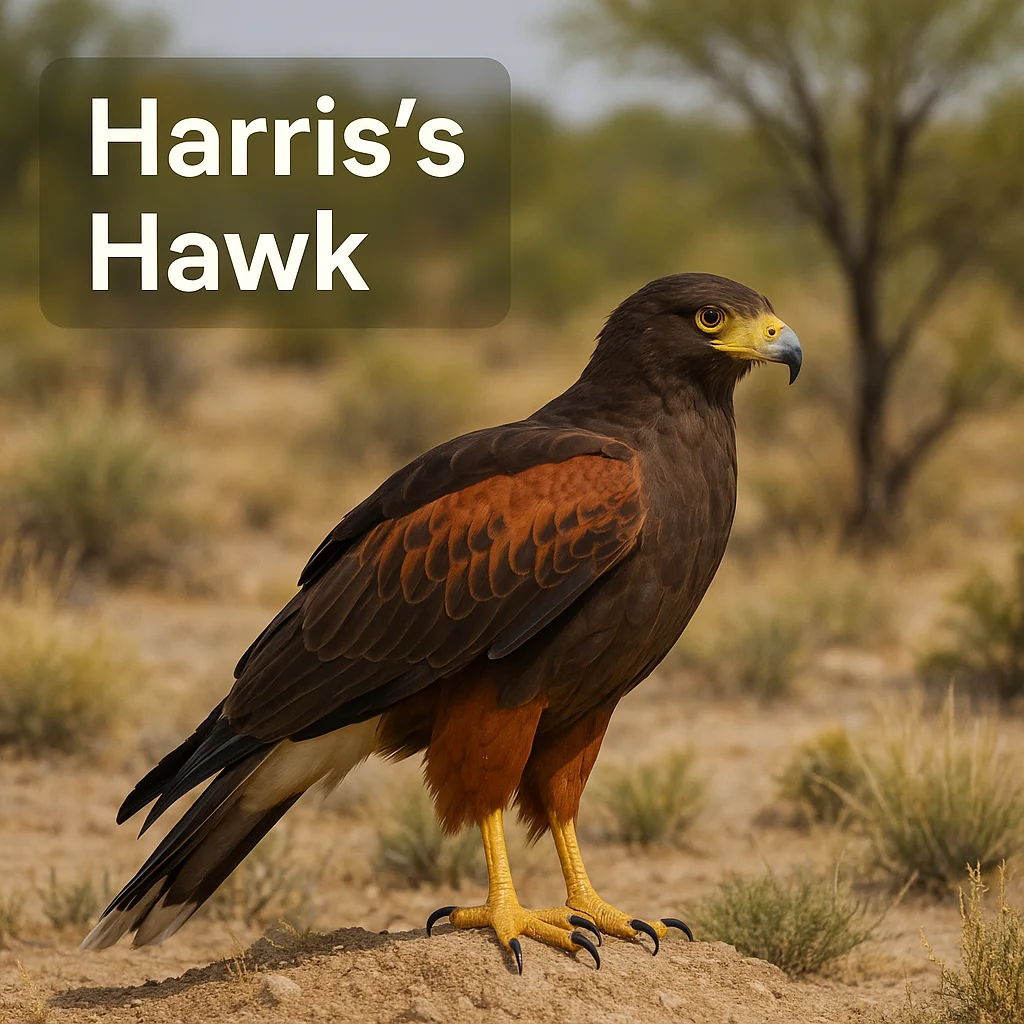
- Common name(s): Harris's Hawk
- Scientific name: Parabuteo unicinctus
- Animal type: Bird
- Typical adult size: 46-76 cm in length; wingspan of 103-120 cm
- Typical lifespan: 10-20 years in the wild, longer in captivity
- Diet type: Carnivore; commonly preys on small mammals, birds, and reptiles
- Activity pattern: Diurnal
- Social structure: Social, often forming family groups for hunting
- Speed / movement highlights: Agile flier with strong soaring capabilities
- Intelligence/learning: Known for problem-solving abilities and cooperative hunting tactics
- Primary habitats: Arid deserts, semi-arid woodlands, and savannas
- Geographic range: Southwestern United States, Mexico, Central America, and parts of South America
- Predators/threats: Larger birds of prey; habitat loss and human disturbance
- Conservation status: Least Concern but may vary regionally
🔍 Identification & Appearance
The Harris's Hawk is easily recognizable by its bold black plumage with chestnut shoulder patches and leg feathers. Its long tail is typically black with a distinct white rump and tip. In flight, the broad wings of the Harris's Hawk are unmistakable, displaying a contrast between dark upperparts and lighter underparts.
Juveniles usually have less distinct coloration, featuring more mottled brown feathers. The hawk's strong, hooked beak and sharp talons are characteristic of its predatory lifestyle, aiding in its ability to catch and subdue prey.
- Dark brown to black coloration with chestnut patches
- White-tipped tail with a white base
- Yellow legs and cere set against a black face
- Broad wings and distinctive soaring flight
- Juveniles have more mottled and lighter plumage
- Small head compared to body size
- Typically seen perched in groups
- Often confused with the Red-tailed Hawk but distinguishable by plumage and group behavior
- Characteristic vocalizations resembling a harsh "kack-kack" sound
🧱 Body Structure & Physical Adaptations
Harris's Hawks are medium-sized raptors with a robust build that supports their predatory lifestyle. Their broad wings are adapted for both soaring high in the sky and quick maneuvers near the ground. The hawk's strong, hooked beak is perfect for tearing flesh, while its powerful talons are crucial for capturing and holding onto prey.
Their vision is exceptionally sharp, allowing them to spot prey from great distances. This hawk's senses are primarily dominated by acute vision rather than smell or hearing, which aligns with their ecology as visual hunters.
- Robust body structure optimized for strength
- Broad wings allow for adept soaring and swift dives
- Hooked beak designed for tearing prey
- Powerful talons for hunting and gripping
- Exceptional vision for spotting prey from afar
- Relatively limited reliance on smell or hearing
- Stable, balanced flight supported by tail
- Long legs adapted for capturing prey
🌍 Range & Distribution
The Harris's Hawk inhabits a diverse range of areas from southwestern United States through Central America and into parts of South America. Typically found in dry, open woodlands and semi-arid environments, these birds are well adapted to warm climates. Elevation is generally lower, focusing more on flat or gently rolling landscapes.
The hawks are generally resident birds, showing little evidence of migration but may expand their range opportunistically, especially in areas where food availability increases.
- Southwestern United States
- Northern to Central Mexico
- Central and South America
- Arid and semi-arid environments
- Open woodlands and savannas
- Typically present at low to moderate elevations
- Adapted to warm, dry climates
- Resident populations with localized movements
🏞️ Habitat & Shelter
Harris's Hawks prefer arid and semi-arid habitats such as deserts, scrublands, savannas, and open woodlands. They make use of tall trees and cacti for perching and nesting, leveraging these structures to get a better view of potential prey. These biomes provide ample hunting opportunities due to the presence of small mammals and reptiles.
During adverse weather conditions, such as intense heat or precipitation, these hawks may be less active, often seeking refuge among the foliage or inner branches of trees for better protection and camouflage.
🧭 Behavior & Ecology
Unlike many other raptors, Harris's Hawks exhibit a strong social structure, often seen hunting in groups of up to six individuals. This cooperative behavior makes them particularly effective hunters, allowing them to take down larger prey than they could alone. They are territorial and will engage in vocal communications to establish dominance and maintain social bonds.
Vocalizations are part of their complex communication, which includes various calls for maintaining group coordination. Harris's Hawks play an essential role in managing prey populations, contributing to the ecological balance within their habitats.
- Cooperative hunting behavior
- Strong social bonds within family groups
- Territorial, often using vocalizations to assert dominance
- Prey management contributes to ecological balance
- Resting and perching in high vantage points
- Complex communication including calls and displays
- Roles as both predators and scavengers
- Frequent sun-bathing; aids in feather maintenance
👥 Social Life & Group Dynamics
Harris's Hawks are well known for their social behavior, which is uncommon among raptors. They often live and hunt in groups consisting of family members, displaying cooperative tactics which increase their success rate when hunting. These groups usually consist of a dominant pair and several juvenile or non-breeding birds.
Hunting, nesting, and even territory defense are group activities, highlighting their complex social structures and cooperation. Conflicts within the group are relatively rare, usually settled through hierarchy without the need for aggressive behavior.
- Group sizes typically range from 3 to 7 individuals
- Hunting collaboration increases efficiency
- Clear dominance hierarchy within groups
- Cooperation in raising young among all group members
- Shared duties include hunting and defense
- Territorial defense strengthened through group presence
- Juveniles learn social and hunting skills within the group
- Multiple family units may overlap territories peacefully
🍽️ Diet, Prey & Predators
As carnivores, Harris's Hawks primarily feed on a diet of small mammals, birds, and reptiles. They utilize various hunting techniques, including ambush and pursuit, often aided by their companions. Their ability to hunt in groups allows them to take on larger prey, including jackrabbits.
Natural predators of the Harris's Hawk include larger raptors such as eagles and owls. To defend against these threats, they rely on sharp vision, swift flight, and robust social structures. While relatively uncommon, they will scavenge on carrion when available.
- Main diet consists of small mammals and birds
- Group hunting enables capture of larger prey
- Uses both ambush and pursuit tactics
- Will occasionally scavenge to supplement diet
- Vigilant against larger raptors
- Group defense enhances survival
- Relies on visual acuity for locating prey
- Prey choice varies seasonally based on availability
🦌 Hunting, Foraging & Movement
Harris's Hawks are versatile fliers known for their strong, sustained flight and agile maneuvers during hunting. They typically engage in cooperative hunting, working together to flush out prey or drive it towards waiting group members. This strategy increases their effectiveness and allows them to capture prey more successfully than solitary attempts.
They are known for their patience, often spending long periods perched, surveying their surroundings for potential prey before initiating a hunt. Their movements are calculated and deliberate, providing an advantage in the diverse landscapes where they reside.
- Strong flier with well-developed soaring abilities
- Prefers cooperative hunting tactics
- Engages in ambush and strategic pursuit
- Capable of rapid takeoffs and precise landings
- Frequently perch to observe territory
- Adaptable to different terrains and conditions
- Long periods of surveying increase hunt success
- Utilizes team coordination for group hunting
🧠 Intelligence & Senses
Harris's Hawks demonstrate remarkable intelligence, particularly in social coordination and problem-solving. Their ability to collaborate in groups during hunts showcases not only teamwork but also an understanding of roles and strategic planning.
Their vision is among their strongest senses, allowing them to detect prey from considerable distances. While there is limited research on cognitive abilities beyond social intelligence, their complex social interactions hint at advanced learning capabilities.
- High social intelligence for cooperative hunting
- Excellent vision for spotting prey at great distances
- Role understanding within group dynamics
- Problem-solving skills evident in hunting tactics
- Able to adapt hunting methods based on prey behavior
- Limited research on further cognitive capabilities
- Exhibits memory use in group behavior
- Keen observation skills for environmental changes
🪺 Reproduction, Pregnancy & Parenting
The breeding season of Harris's Hawks varies by region but typically occurs from spring to early summer. They practice monogamy, forming long-lasting pair bonds, and often engage in elaborate courtship displays including aerial acrobatics.
Females lay 2 to 4 eggs, with incubation lasting about 33 to 36 days. Both parents are involved in incubating and caring for the chicks, with help often coming from older siblings or non-breeding group members. The young are altricial at birth, requiring significant parental care.
- Breeding season usually in spring and early summer
- Monogamous pair bonds with elaborate courtship
- Clutch size typically 2-4 eggs
- Incubation period around 33-36 days
- Shared parenting responsibilities within group
- Altricial young needing significant care
- Older siblings may aid in chick rearing
- Parental cooperation bolsters chick survival
♀️♂️ Male vs Female Differences
Differences between male and female Harris's Hawks are subtle and primarily involve size; females are generally larger and more robust than males, a common trait among birds of prey. Behavioral roles are largely similar, though females often play a more prominent role during incubation.
While plumage and coloration do not differ significantly between sexes, their role in the social hierarchy may be influenced by size, with larger females often having a dominant presence in group dynamics.
- Females larger and more robust than males
- No significant plumage differences between sexes
- Incubation often led by females
- Similar hunting roles between males and females
- Size affects dominance in social hierarchy
- Subtle behavioral differences in care responsibilities
- Female size provides greater presence in group
🧬 Subspecies & Variation
Harris's Hawk is generally considered monotypic, meaning it does not have well-recognized subspecies. However, there can be regional variations in size and coloration, reflective of local environmental adaptations. These variations are not prominent enough to warrant formal subspecies categorization but remain interesting for ecologists studying the species.
- Generally considered monotypic; no formal subspecies
- Regional size variations due to environmental factors
- Coloration may vary slightly by location
- Adaptations observed to specific climate conditions
- Research into subtle local adaptations ongoing
⚠️ Threats, Conservation & Human Interaction
Despite being listed as Least Concern, Harris's Hawks face threats from habitat loss and human disturbances such as agricultural expansion and urban development. Conservation efforts focus on habitat preservation and reducing human-wildlife conflict.
They are seen in falconry, a practice that showcases their intelligence and trainability. Ethical considerations involve ensuring their captive environments meet their physical and psychological needs without promoting harmful capture practices.
- Habitat loss due to agricultural expansion
- Impact of urban development on natural habitats
- Beneficial presence in falconry reveals intelligence
- Proper management of human-wildlife interactions needed
- Conservation focuses on habitat preservation
- Care environments must meet biological needs
- Educating public about their ecological role
✨ Fun Facts & Unique Traits
- Known as "the wolf of the sky" for its pack-like hunting behavior
- Cooperative hunting makes them unique among raptors
- Can be used effectively in pest control due to hunting skills
- Often featured in falconry thanks to intelligence and trainability
- Their social nature allows for complex group dynamics
- May form lifelong pair bonds reinforced by group living
- Their vocal range includes many different calls used for communication
- Harris's Hawk is the only member of its genus
📌 Summary
- Striking plumage with black, white, and chestnut colors
- Prefers arid environments and open woodlands
- Found across a wide range from the U.S. to South America
- Carnivorous diet primarily of small mammals and birds
- Few natural predators; relies on group defense
- Highly social with complex group hunting dynamics
- Monogamous breeding with shared parental duties
- Adapted for powerful flight and exceptional vision
- Unique social behavior makes it a standout raptor