🦁 Osprey
🧾 Quick Facts
The Osprey is a remarkable bird of prey known for its fish-catching prowess and widespread global presence. It is a unique species, distinct in its appearance and hunting skills, and holds the scientific name Pandion haliaetus.
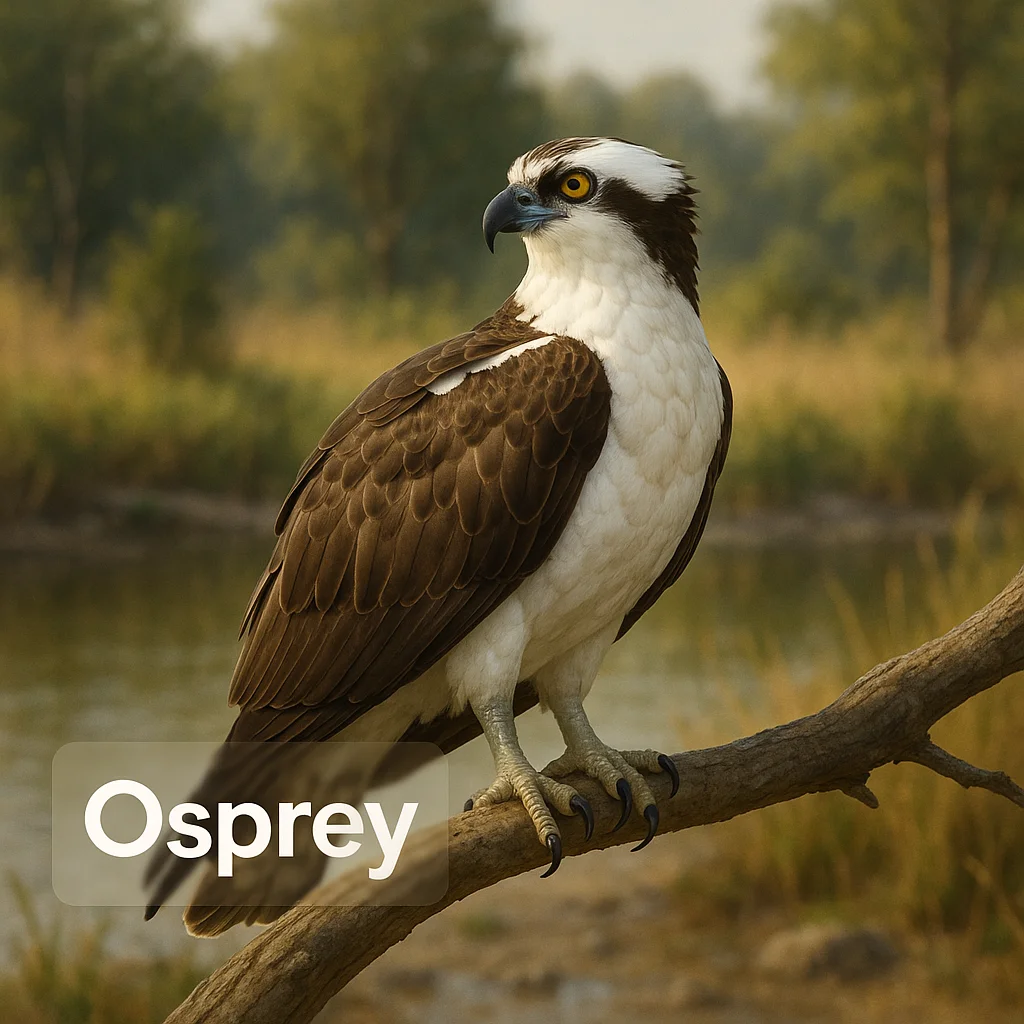
- Common name(s): Osprey, Sea Hawk, Fish Hawk
- Scientific name: Pandion haliaetus
- Animal type: Bird
- Typical adult size: 50–66 cm (20–26 in) in length; wingspan 127–180 cm (50–71 in)
- Typical lifespan: 7–10 years in the wild, up to 25 years in captivity
- Diet type: Carnivore; primarily fish
- Activity pattern: Diurnal
- Social structure: Often solitary or in pairs; may congregate in loose groups when feeding
- Speed / movement highlights: Capable of flying at speeds up to 80 km/h (50 mph)
- Intelligence/learning: Known for precise hunting techniques and excellent memory for nesting sites
- Primary habitats: Freshwater and coastal marine environments
- Geographic range: Found on all continents except Antarctica
- Predators/threats: Larger birds of prey, habitat disturbance by humans
- Conservation status: Least Concern, but varies by region
🔍 Identification & Appearance
The Osprey is easily recognizable by its distinctive shape and coloration. Its body is streamlined, designed for efficient hunting and flying.
- Broad wings with a bend at the "wrist" creating an "M"-shape silhouette in flight
- White underparts with conspicuous dark patches on the wings
- Dark eye stripe running down the sides of the face, contrasting with a white head
- Golden-yellow eyes
- Brown upperparts providing effective camouflage from above
- White legs and feet with reversible outer toes for gripping prey
Common look-alikes include the Bald Eagle, but the Osprey's slimmer wings and distinctive eye stripe are key differentiators.
- Top ID Tips
- Look for the distinctive M-shape in flight
- Note the dark eye stripe that contrasts with the white head
- Observe the bird's fishing behavior over water
- Spot the white underparts and wing patches in flight
- Check the habitat: Ospreys are often near water
- Listen for its distinctive high-pitched vocalizations
- Look for its large stick nests near water bodies
🧱 Body Structure & Physical Adaptations
The Osprey's body is built for a life of hunting in aquatic environments. Its physical adaptations are uniquely suited to this lifestyle.
- Slender body and long, angled wings for efficient flight and hovering
- Strong, powerful talons with barbed pads for gripping slippery fish
- Reversible outer toe for a secure grasp on prey
- Curved beak for tearing fish flesh
- Excellent eyesight allows spotting prey from above
- Water-resistant plumage aids in diving
- Key Adaptations
- Barbed pads on talons for gripping slippery fish
- Powerful wings cover large distances effortlessly
- Oily feathers to repel water
- Acute vision helps in locating fish under the surface
- Reversible toe adaptation for fish hunting
- Aerodynamic body aids in efficient flight
🌍 Range & Distribution
Ospreys have one of the widest distributions of all raptors, occupying various water-rich regions around the globe.
- Widely found across the Americas, Europe, Asia, and Africa
- Familiar in diverse ecosystems including coastal waters, lakes, and rivers
- Seasonal migratory patterns vary; some populations travel long distances
- Inhabit various altitudes, mostly at lower elevations near water bodies
- Known to relocate to regions with warmer climates during winter months
- Where You Might Find It
- North American coastlines and inland waterways
- Northern Europe's rich lakes and rivers
- Tropical coastal areas in Asia and Africa
- Australian shores and coastal lagoons
- Wintering grounds in South America and Africa
🏞️ Habitat & Shelter
Ospreys are excellent indicators of healthy aquatic habitats due to their diet and nesting needs.
- Prefer habitats with shallow waters rich in fish populations
- Build large, conspicuous nests on tall structures or treetops near water
- Adapted to live along coastlines, rivers, and occasionally inland lakes
- During rainy seasons, they may remain close to protected nests against heavy winds
- Habitat necessary for nesting sites affects breeding behaviors and survival
🧭 Behavior & Ecology
Ospreys exhibit fascinating behaviors both in flight and as skilled hunters, playing an important role in their ecosystems.
- Swoop down swiftly to snatch fish from water surfaces
- Build large, platform-like nests which they reuse annually
- Exhibit solitary hunting but may peacefully feed alongside others
- Vocalize with a series of high-pitched whistles, especially during breeding season
- Serve as apex predators in their ecosystems, helping control fish populations
- Behavior Highlights
- High-pitched whistle communication
- Exceptional fishing abilities from the air
- Suspending over water and hovering before diving
- Strong territoriality during breeding season
- Nest reuse fosters family continuity
👥 Social Life & Group Dynamics
While generally solitary, Ospreys exhibit interesting social behaviors, especially during the breeding season.
- Mostly solitary hunters but may gather loosely during abundant feeding seasons
- Form monogamous pairs that often return to the same nest each year
- Pairs participate in cooperative activities such as nest building and chick rearing
- Occasional conflicts with other Ospreys over territory or prime fishing spots
- Usually resolve conflicts through vocalizations or displays rather than physical altercations
- Social Structure Notes
- Monogamous pair bonding
- Cooperation in nest building
- High site fidelity, returning to nest locations
- Loose aggregations during plentiful fishing times
- Tolerance of human presence near settlements
🍽️ Diet, Prey & Predators
The Osprey's diet primarily consists of fish, emphasizing its role as a specialized piscivore.
- Feeds almost exclusively on live fish, capturing prey mid-dive
- Adapts to seasonal fish availability, targeting the most abundant species
- Uses sharp talons and reversible toes to grasp slippery catches
- Faces predation from larger birds, though primarily at the egg and chick stages
- Avoids human conflict through adaptability in nesting and feeding
- Feeding Notes
- Swoops to catch fish closest to water's surface
- High dive speeds for successful fishing
- Adjusts diet to regional fish species
- Fish-flipping behavior in air ensures streamlined flight
- Adaptive hunting in varied aquatic settings
🦌 Hunting, Foraging & Movement
The Osprey's advanced hunting strategies and versatile movement make it an adept fisherman.
- Highly agile flier with a capacity to hover and make precise dives
- Usually hunts in the early morning or late afternoon
- Employs sight-based hunting, swooping with feet-first dives
- Migrate in North America between breeding and wintering grounds
- Maintains structured hunting territories near reliable fish supplies
- Movement & Strategy
- Hovering over water enhances precision dives
- Strong swimmers, able to rise from water after submersion
- Seasonal migrations signal environmental health
- In-flight fish adjustment for head-first carrying
- Efficient glider, exploiting thermals during flight
🧠 Intelligence & Senses
Ospreys are known for their sharp perceptual abilities and adaptability, essential for thriving in diverse environments.
- Possess excellent eyesight, crucial for detecting prey against reflective waters
- Displays problem-solving skills, particularly in nest construction and maintenance
- Exhibits strong site fidelity, remembering and returning to nesting sites yearly
- Vocal and behavioral adaptations for communication among mates
- Research on cognitive abilities remains limited but suggests adept environmental awareness
- Notable Abilities
- Superior eyesight detects fish below water
- Nest location memory ensures annual returns
- Vocal pitch variation for communication
- Territorial singing and display to ward off intruders
- Problem-solving evident in nest material selection
🪺 Reproduction, Pregnancy & Parenting
The Osprey's reproductive behavior is characterized by long-term pair bonding and dedicated parental care.
- Breeding season generally occurs during spring and early summer
- Monogamous pairs engage in elaborate courtship displays
- The female lays 2–4 eggs per clutch, incubating for around 35–43 days
- Both parents participate in chick rearing, though the female primarily incubates
- Chicks fledge within 8–10 weeks but continue learning from parents post-fledging
- Reproduction Snapshot
- Monogamous and loyal pair bonding
- Elaborate aerial courtship rituals
- Dedicated incubation largely by females
- Male provides food during nesting
- Chicks reliant on parents post-fledging for skills
♀️♂️ Male vs Female Differences
Males and females are often similar, but subtle differences exist that aid in identification and understanding of roles.
- Males are generally slimmer than females
- Males tend to have narrower wings
- Behavioral differences apparent in nesting roles
- Females often display more prominent "necklace" markings
- Role adjustments during chick rearing based on energy requirements
- Sex Differences at a Glance
- Females are larger and heavier
- Males have more streamlined wings
- Females incubate; males mainly hunt
- Females often have flecked breast markings
- Behavioral role shifts during parenting
🧬 Subspecies & Variation
The Osprey species shows minimal subspecies variation, indicating robustness and adaptability to varied environments.
- Divided generally into four globally recognized subspecies
- Minor size and plumage variations occur
- North American P. h. carolinensis slightly larger
- Australian and Pacific P. h. cristatus may appear smaller
- Identification by subspecies can be complex due to overlapping ranges
- Variation Notes
- Subtle size differences by regions
- Minimal color variation; largely white underparts
- Adaptive variation supports global distribution
- Subspecies classification under review in some areas
- Population health varies by region
⚠️ Threats, Conservation & Human Interaction
While relatively stable, Osprey populations face ongoing challenges from environmental and anthropogenic factors.
- Threats include habitat degradation and pollution of waterways
- Sensitivity to chemical pollutants, notably historical impacts of DDT
- Conservation efforts focus on habitat protection and nesting platform installations
- Human activity such as fishing lines pose entanglement risks
- Seen in wildlife rehabilitation programs during accidental injuries
- Responsible Notes
- Recognize and protect crucial nesting sites
- Elevated platforms aid in safe nesting
- Minimize aquatic pollution impacts
- Support conservation actions by reducing human disturbance
- Public education critical for cohabitation success
✨ Fun Facts & Unique Traits
- The Osprey is one of the most widely distributed birds of prey and is present on all continents except Antarctica.
- Unique among raptors, Ospreys have a reversible outer toe to clutch their slippery prey effectively.
- Ospreys can close their nostrils when diving to prevent water intake, an adaptation essential for their aquatic hunting.
- The eyes of Ospreys contain specialized adaptations to reduce glare from the water surface.
- This species is known for its strikingly long migrations, with some individuals traveling thousands of kilometers between breeding and wintering grounds.
- Ospreys often reuse the same nest year after year, which can grow to substantial sizes over time.
- In historical contexts, Ospreys featured prominently in folklore and literature, often symbolizing vigilance.
- Ospreys are known to sometimes practice cooperative fishing techniques, with pairs or small groups working together in rich fishing areas.
- The aerodynamic shape of Ospreys allows for efficient energy use during their extensive migratory flights.
- Their keen eyesight is estimated to be 3 to 5 times better than a human's, crucial for spotting prey from significant distances.
📌 Summary
- Osprey is a distinct bird of prey with global distribution, known for its fish-catching skills.
- It inhabits diverse aquatic environments, emphasizing healthy ecosystems.
- An important ecological predator, it controls fish populations in its habitat.
- Ospreys form monogamous bonds, exhibiting cooperative parenting.
- Key physical adaptations include specialized talons for grasping fish.
- Critical conservation efforts focus on preserving nesting habitats.
- Remarkable for its long migratory patterns, occasionally crossing continents.
- Ospreys' evolutionary adaptations include water-repellent feathers and acute eyesight.
- They face natural and human threats, such as environmental contaminants.
- An iconic and adaptable species, the Osprey illustrates ecological interconnections.