🦁 Peregrine Falcon
🧾 Quick Facts
The Peregrine Falcon, known for its remarkable speed and hunting abilities, inhabits a diverse range of environments across the globe. Here's a summary of its key traits:
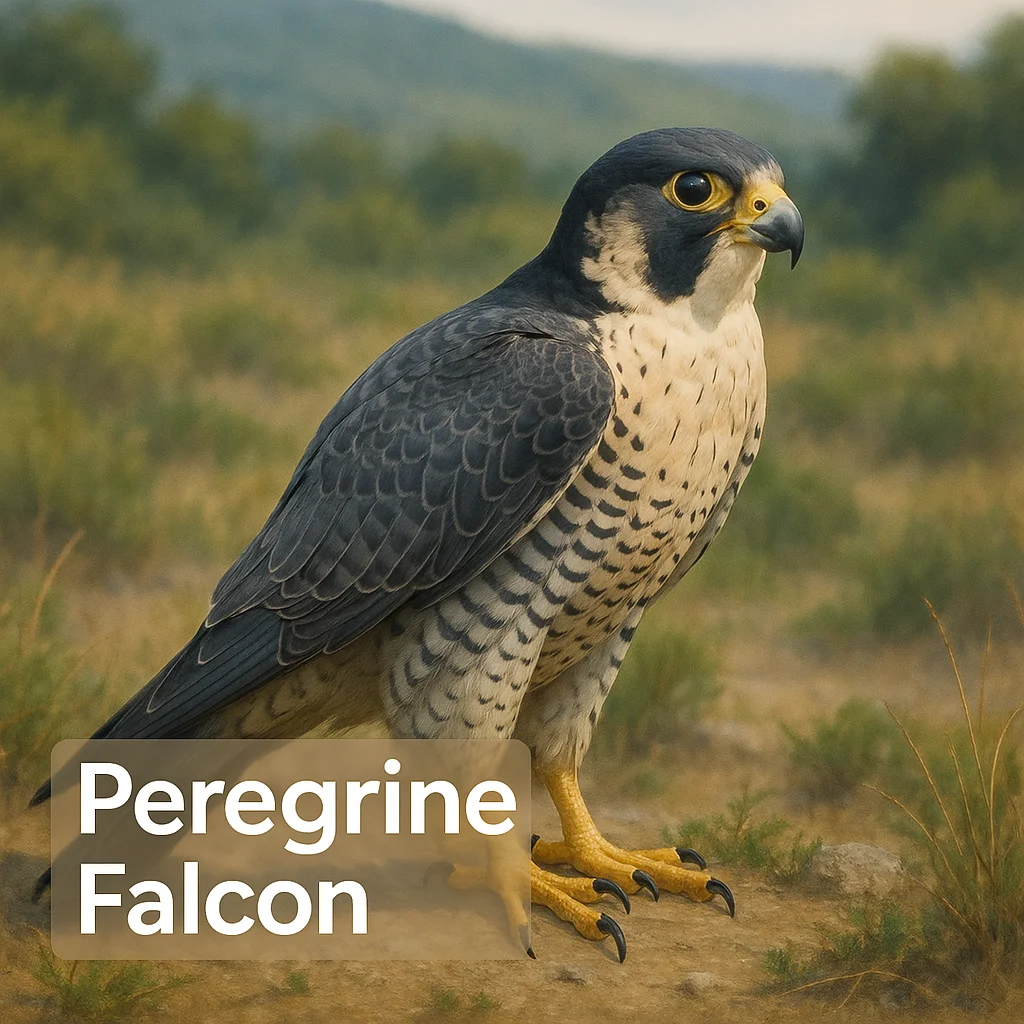
- Common name(s): Peregrine Falcon
- Scientific name: Falco peregrinus
- Animal type: Bird
- Typical adult size: 13-23 inches in length, wingspan about 3.3 to 3.6 feet
- Typical lifespan: 5-15 years in the wild, longer in captivity
- Diet type: Carnivore, mainly preying on birds
- Activity pattern: Diurnal
- Social structure: Primarily solitary
- Speed / movement highlights: Can dive at speeds up to 240 mph
- Intelligence/learning: Exhibits strong learning ability, especially in hunting techniques
- Primary habitats: Mountains, coasts, riversides, and sometimes urban areas
- Geographic range: Worldwide, except extreme polar regions and tropical rainforests
- Predators/threats: Mainly larger birds of prey and human-related challenges
- Conservation status: Least Concern, but varies by region due to habitat loss
🔍 Identification & Appearance
Peregrine Falcons are medium-sized raptors with a distinctive appearance. They have a robust physique, tapered wings, and a short tail. Most have a blue-gray back, barred white underparts, and a black head. Their long, pointed wings and powerful build make them aerodynamic phantoms of the sky.
- Body shape and silhouette: Tapered wings and sleek body
- Key colors/patterns: Blue-gray back, barred underparts, black hood
- Distinctive features: Prominent black ‘moustache’ stripe
- Tracks, scat, or other field signs: Typically no definable tracks due to their flight lifestyle
- Common look-alikes: Gyrfalcon, can be distinguished by size and habitat
- Top ID Tips
- Look for the distinctive ‘moustache’ stripe across the face
- Note the bird’s size and pointed wing shape
- Scan open areas where they may be hunting
- Observe the stooping flight pattern—a high-speed dive
- Identify by the black hood and facial markings
🧱 Body Structure & Physical Adaptations
Peregrine Falcons are designed for speed and agility. Their aerodynamic body and specialized feathers improve their efficiency in flight, allowing them to reach tremendous speeds when hunting. Their keen eyesight is adapted for spotting prey from great distances.
- Build and proportions: Streamlined, medium-sized with pointed wings
- Teeth/beak/jaw adaptations: Sharp, curved beak for tearing flesh
- Claws/hooves/wings/fins: Strong talons to catch and immobilize prey
- Sensory strengths: Exceptional vision to spot prey from above, able to see detailed images from far away
- Key Adaptations
- Aerodynamic body for high-speed dives
- Tear-drop shaped body with pointed wings reduces drag
- Robust talons for gripping prey
- Extreme flexibility in wings for quick turns
- Notch in beak, known as 'tomial tooth', to sever prey vertebrae efficiently
- Third eyelid (nictitating membrane) for eye protection during flight
🌍 Range & Distribution
The Peregrine Falcon is among the most widely distributed birds of prey, with breeding populations spread across every continent except Antarctica. Depending on the region, these birds may migrate long distances or stay resident, adapting to local environments from the tropics to tundra.
- Continents/regions: Found on all continents but Antarctica
- Elevation range: From sea level to 12,000 feet depending on region
- Seasonal movements: Some populations migrate seasonally, others are residents
- Where You Might Find It
- Northern wetlands and coastal cliffs during breeding season
- Urban skyscrapers that mimic natural cliff faces
- Forests and grasslands with open spaces for hunting
- Rugged mountains and highlands
- Eco-regions with a variety of altitudes
🏞️ Habitat & Shelter
Peregrine Falcons exhibit versatility in their habitat preferences, living from coastal cliffs to mountain ranges and even adapting to urban environments. Their nest choices reflect this adaptability, utilizing cliff edges in nature while also nesting on tall, human-made structures like skyscrapers and bridges.
- Preferred habitats: Cliffs, mountains, river valleys, urban settings
- Microhabitats and shelter: Nests on ledges, buildings, and sometimes in tree nests abandoned by other birds
- Seasonal behavior: Migration and breeding inhibit seasonal shifts in range and behavior
- Importance of habitat knowledge: Understanding their habitat helps explain their migration patterns and space use
🧭 Behavior & Ecology
Peregrine Falcons are mostly solitary and territorial, especially during the breeding season. They employ high-energy aerial pursuits to catch birds in flight. Their superior flying skills make them top predators in their chosen habitats.
- Daily routine: Active by day; often hunt in the morning and late afternoon
- Communication: Vocal calls to display territory and during courting
- Species interactions: Apex predator with few natural enemies
- Role in the ecosystem: Control bird populations, especially prey species
- Behavior Highlights
- Known for high-speed stoops to catch prey
- Highly territorial, especial during breeding season
- Remarkable adaptability to different habitats and landscapes
- Cadent, loud calls during social interactions
👥 Social Life & Group Dynamics
Peregrine Falcons are usually seen alone or in pairs. During the breeding season, pairs form strong bonds and fiercely protect their nesting territory. Although mostly solitary, some pairs maintain bonds year-round.
- Social tendencies: Generally solitary except during mating season
- Group types: Primarily monogamous pairs
- Cooperation: Pair bonding includes shared incubation and feeding duties
- Group Dynamics
- Strong pair bonds during breeding season
- Solitary nature most of the year
- Defense of territory against intruders
- Shared responsibilities in nest building and chick rearing
🍽️ Diet, Prey & Predators
The diet of Peregrine Falcons largely consists of other birds, but they can occasionally take mammals, reptiles, or insects. Their primary strategy is to catch prey in mid-flight, utilizing their speed and agility.
- Diet: Primarily birds, including ducks, songbirds, and pigeons
- Hunting methods: Powerful stoop to strike prey in flight
- Natural predators: Occasionally preyed on by larger raptors like eagles
- Feeding Notes
- Prefers open spaces for hunting
- May cache food for later use
- Young falcons learn to hunt with parents
- Selective eating, often consuming the head and breast first
🦌 Hunting, Foraging & Movement
Renowned for its speed, the Peregrine Falcon employs a dynamic hunting method with a distinctive stoop. This high-speed dive enables them to overtake and capture prey mid-air, generally securing their catch with a powerful strike using their talons.
- Locomotion style: High-speed aerial pursuit
- Speed capabilities: Diving speeds exceeding 200 mph
- Hunting tactics: Mainly hunt by surprise and raw speed
- Movement & Strategy
- Primarily a visual hunter during the day
- Focus on capturing prey mid-flight
- Demonstrates long-distance travel during migration
- Favors high perches to spot prey from afar
🧠 Intelligence & Senses
Peregrine Falcons are highly intelligent birds, capable of learning and modifying hunting strategies. They exhibit remarkable problem-solving abilities and are adept at adapting to diverse environments.
- Learning abilities: Improved hunting techniques through experience
- Senses: Exceptional eyesight and hearing
- Uncertainties: Variation in behavioral studies among populations
- Notable Abilities
- Highly acute vision for detecting prey from great distances
- Adapts quickly to varying environments
- Capable of long-distance navigation during migration
- Efficient energy management in flight
🪺 Reproduction, Pregnancy & Parenting
Peregrine Falcons generally form monogamous pairs during the breeding season and exhibit a strong bond. The females lay between 2 to 5 eggs per clutch, with both parents involved in incubation and feeding the chick.
- Breeding seasonality: Spring in the Northern Hemisphere
- Mating system: Mainly monogamous
- Incubation period: Approximately 29-32 days
- Reproduction Snapshot
- Females lay a clutch size of about 2-5 eggs
- Both parents incubate and feed the young
- Young are altricial and leave the nest after 35-42 days
- Mating displays include aerial acrobatics and food offerings
♀️♂️ Male vs Female Differences
In Peregrine Falcons, sexual dimorphism is noted primarily in size, with the female being larger than the male. Both sexes have similar plumage, making visual differentiation challenging outside of comparative observation.
- Size differences: Females are generally 30% larger than males
- Behavioral roles: Females typically incubate more, males may hunt more actively
- Sex Differences at a Glance
- Larger size in females observable through direct comparison
- Similar plumage across sexes
- Sharing of parenting roles, though females may spend more time with the chicks
🧬 Subspecies & Variation
There are several subspecies of Peregrine Falcon recognized around the world, varying in size and coloration depending on the region. These subspecies often adapt to specific environmental niches, though exact classifications can be debated among scientists.
- Known subspecies: Includes Falco peregrinus anatum (North America) and Falco peregrinus tundrius (Arctic tundra)
- Local adaptations: Size and color variations based on climate
- Variation Notes
- Subspecies adapted to regional climates
- Coloration varies among subspecies but maintains the general Peregrine pattern
- Arctic subspecies may migrate longer distances
⚠️ Threats, Conservation & Human Interaction
The Peregrine Falcon faces certain threats primarily from human activities, including habitat destruction and contamination, particularly from pesticides like DDT in the past. Conservation efforts have successfully aided in the recovery of many populations.
- Natural challenges: Predation by larger birds of prey
- Human pressures: Habitat loss, pollution, and historical impacts of pesticide use
- Conservation efforts: Reintroduction and breeding programs have been effective
- Responsibility Notes
- Support conservation by protecting natural habitats
- Reduce pesticide use near falcon habitats
- Participate in local bird-monitoring programs
✨ Fun Facts & Unique Traits
- Peregrine Falcons are the fastest animals on the planet, capable of reaching over 240 mph in a dive.
- They have been used in falconry for over a thousand years due to their hunting prowess.
- The name "Peregrine" means "wanderer" or "pilgrim," reflecting their migratory nature.
- Peregrine Falcons have influenced many aviation designs due to their aerodynamic body.
- They can spot prey from a distance of over three kilometers due to their excellent vision.
- The theeir population rebounded dramatically after the ban on DDT in many regions.
📌 Summary
- Peregrine Falcons are medium-sized, fast-flying raptors.
- Their habitat ranges from cliffs to urban settings worldwide.
- They primarily feed on birds, caught mid-flight.
- Females are larger, and both parents invest in raising chicks.
- Known for their unparalleled diving speed.
- Face some human-related threats but have recovered well due to conservation.
- Subspecies show regional variations in size and color.
- Fun fact: Renowned as the fastest animals, with speeds over 240 mph.