🦁 Red-tailed Hawk
🧾 Quick Facts
The red-tailed hawk, often seen majestically soaring above open fields and roadsides, is one of North America's most common and adaptable birds of prey.
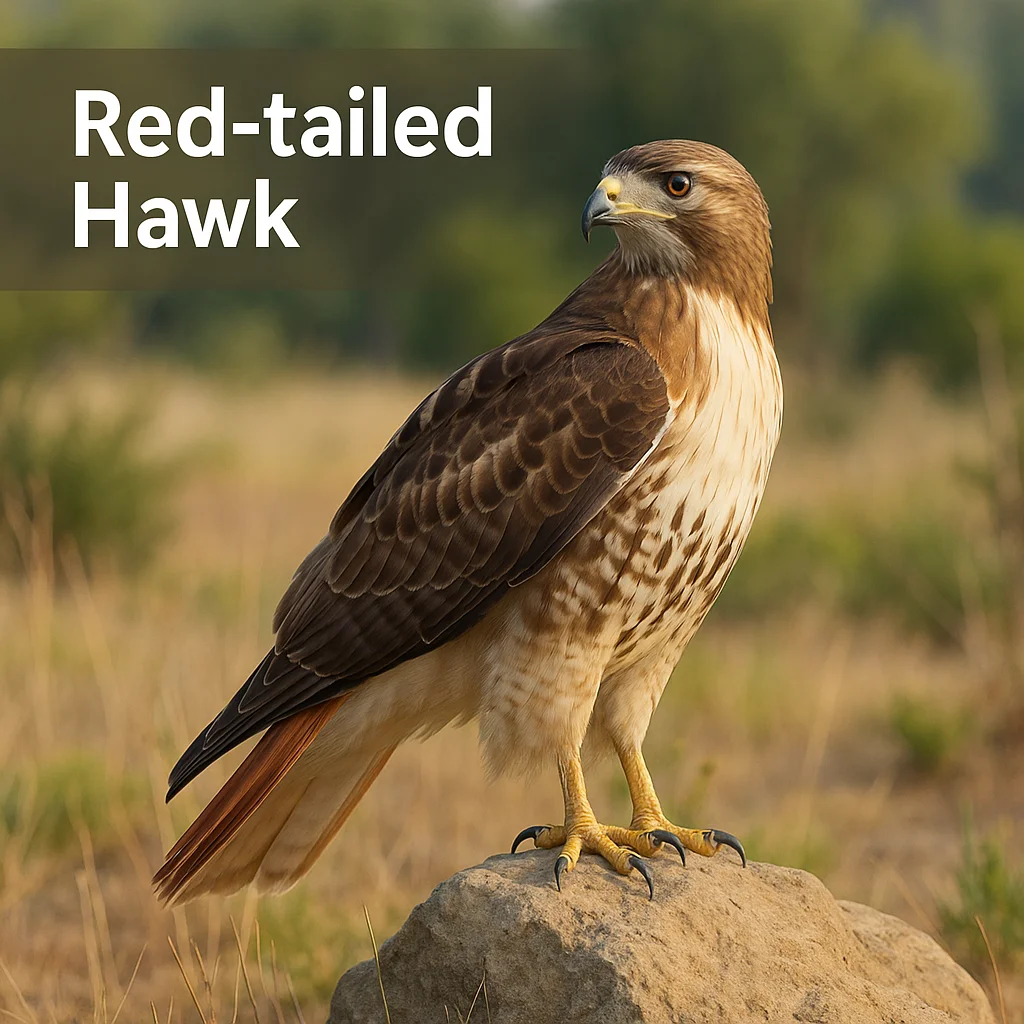
- Common name(s): Red-tailed Hawk
- Scientific name: Buteo jamaicensis
- Animal type: Bird
- Typical adult size: 18-26 inches in length; wingspan of 43-57 inches; weight ranges from 2-4 pounds
- Typical lifespan: 10-15 years in the wild, up to 25 years in captivity
- Diet type: Carnivore; commonly feeds on small mammals and birds
- Activity pattern: Diurnal
- Social structure: Primarily solitary, but may form pair bonds during breeding season
- Speed / movement highlights: Can fly at speeds up to 35 mph, diving speeds over 100 mph
- Intelligence/learning: Exhibits problem-solving skills and excellent hunting strategies
- Primary habitats: Forests, deserts, grasslands, urban areas
- Geographic range: Large range across North America, from Alaska and Canada down to Central America
- Predators/threats: Great horned owls, eagles, human disturbance
- Conservation status: Least Concern, but some local populations face pressures
🔍 Identification & Appearance
The red-tailed hawk is easily identified by its robust body, broad wings, and characteristic reddish-brown tail. The plumage of these birds can vary significantly, making juveniles and adults appear different. Adult hawks have a pale underbelly with a dark band, a reddish tail, and a brownish upper body. Younger birds typically lack the red tail, and their overall coloring can be more mottled and less defined.
- Top ID Tips:
- Broad, rounded wings
- Reddish-brown tail in adults
- Pale underbelly with a dark band
- Dark, streaked belly and wing tips in juveniles
- Creamy or light breasting with a darker crown
- Distinctive raspy scream often heard when soaring
- Thick, hooked beak perfect for tearing prey
- Large, taloned feet used for capturing and holding prey
🧱 Body Structure & Physical Adaptations
Red-tailed hawks possess strong, muscular bodies with features optimized for hunting and flying. They have a hooked beak for tearing flesh and powerful talons for grasping and killing prey. Their keen eyesight allows them to spot prey from a great distance.
- Key Adaptations:
- Strong, broad wings for soaring
- Keen eyesight for spotting prey from afar
- Hooked beak for tearing flesh
- Powerful talons for capturing and holding prey
- Robust, muscular build for strength and endurance
- Camouflaged plumage for blending into surroundings
- Flexible neck to spot prey while flying
- Efficient respiratory and circulatory system for sustained flight
🌍 Range & Distribution
Red-tailed hawks are widespread across North America, from Alaska and northern Canada, down through the USA and into Central America. They are primarily resident birds; however, those in the northernmost regions may migrate southward during the colder months.
- Where You Might Find It:
- North America from Alaska to Panama
- Common in the continental USA
- Forests and mixed woodlands
- Open fields and grasslands
- Deserts and scrublands
- Near agricultural or urban areas
- Migration occurs primarily among those in colder climates
🏞️ Habitat & Shelter
Red-tailed hawks are incredibly adaptable and can be found in a variety of habitats. They typically prefer open areas where they can soar and spot prey but are also found in forests and sometimes urban settings. They build large, sturdy nests high in trees or on cliffs and may adapt to using human-made structures.
Habitat knowledge is essential to understanding their hunting success, breeding habits, and territorial behavior. Weather changes can drive hawks to higher or more sheltered areas to escape extreme conditions.
🧭 Behavior & Ecology
Red-tailed hawks are known for their impressive hunting skills and territorial nature. They are primarily solitary, using their keen eyesight and ambush strategies to capture prey. They communicate through calls and body language, and play a crucial ecological role as apex predators.
- Behavior Highlights:
- Spectacular soaring and diving displays
- Territorial and often resident in chosen areas
- Vocal communication through distinct calls
- Aggressive during breeding season
- Plays significant role in controlling small mammal populations
- Interactions with predatory birds such as eagles and owls
- Occasional scavenger of carrion
👥 Social Life & Group Dynamics
Primarily solitary, red-tailed hawks are most social during the breeding season when they form pair bonds. They exhibit territorial behavior, with pairs often defending a region from others. Despite their solitary tendencies, these birds can occasionally be seen cooperating, especially during shared feeding events.
- Social Structure Notes:
- Typically solitary outside of breeding season
- Monogamous pairs during breeding
- Territorial and aggressive with intruders
- Strong pair bonds can last many years
- Young hawks must establish new territories
- Occasional cooperative feeding or hunting
🍽️ Diet, Prey & Predators
These hawks are carnivorous, preying upon a variety of small animals, including rodents, birds, and reptiles. Their diet can change depending on availability and season. They have few natural predators due to their size, but great horned owls and competing raptors can be threats.
- Feeding Notes:
- Opportunistic predator
- Preys on mice, voles, rabbits, and snakes
- Flexible diet adapts to availability
- Hunts by sight, perching, or while soaring
- Avoids heavily wooded areas with hidden prey
- Capable of caching uneaten food
- Occasionally scavenges on carrion
🦌 Hunting, Foraging & Movement
Red-tailed hawks are exceptional fliers that use their keen eyesight and broad wings to find and catch prey. They are skilled at soaring and hovering, and they dive at high speeds when attacking. Typically hunting during the day, these hawks rely on perching to spot prey from above.
- Movement & Strategy:
- Majestic soarer with broad wings
- Uses high perches to spot prey
- Daytime hunter with ambush tactics
- High-speed dives to capture prey
- Can cover great distances in search of food
- Adjusts position and altitude for optimal hunting
🧠 Intelligence & Senses
Red-tailed hawks exhibit remarkable intelligence, particularly in their problem-solving abilities and sensory acuteness. Their large eyes are adapted for enhanced vision, giving them superior sight that is essential for hunting.
- Notable Abilities:
- Exceptional eyesight for detecting prey
- Advanced spatial awareness
- Adapts to diverse habitats and prey
- Employs strategic hunting techniques
- Responsive to environmental cues
- Displays learning and memory skills
🪺 Reproduction, Pregnancy & Parenting
The breeding season typically begins in early spring. Red-tailed hawks are monogamous, forming strong pair bonds that can last for several years. After courtship, which includes aerial displays and mutual feeding, the female lays one to three eggs. Both parents participate in incubation and caring for the young, which are altricial at birth and require significant parental investment.
- Reproduction Snapshot:
- Breeding season from March to May
- Monogamous pair bonds
- Courtship involves aerial displays
- Clutch of 1-3 eggs
- Both parents share incubation duties
- Fledging occurs around 6-7 weeks
- Parental care extends several weeks post-fledging
♀️♂️ Male vs Female Differences
In red-tailed hawks, sexual dimorphism is subtle. Females are generally larger and heavier than males, a common trait among raptors. Both sexes share similar plumage, though slight variations can occur due to individual or regional differences.
- Sex Differences at a Glance:
- Females are larger and heavier
- Both sexes similar in plumage
- Display similar hunting techniques
- Size difference aids in territory defense
🧬 Subspecies & Variation
There are several recognized subspecies of the red-tailed hawk, each adapted to specific climates and regions. These subspecies exhibit variations in size, plumage, and behavior. Some of the known subspecies include the eastern, western, and desert adaptations.
- Variation Notes:
- Known subspecies: Eastern, Western, and Harlan's hawks
- Plumage varies significantly by region
- Size adapts to available prey and habitat
- Desert-adapted subspecies exhibit lighter plumage
- Some classifications debated
⚠️ Threats, Conservation & Human Interaction
Red-tailed hawks face various threats from habitat loss, collision with vehicles, and secondary poisoning from rodent control. Human activity can disrupt their natural behaviors, though they have shown a remarkable ability to adapt to urban environments. Conservation efforts focus on habitat preservation and minimizing human-wildlife conflicts.
- Responsible Notes:
- Impacts from urban expansion
- Injuries from vehicles and power lines
- Susceptible to secondary poisoning
- Conservation encourages habitat protection
- Encounters with humans typically fear-based
- Adaptability to urban settings
✨ Fun Facts & Unique Traits
- Red-tailed hawk screams are often used in films to represent all raptors
- They possess a nictitating membrane for eye protection
- Part of the diverse buteonine hawks, known for their broad wings
- Notably adaptable, living in a variety of habitats
- Commonly seen perched along highways and power lines
- Their soaring and territorial displays are a common sight
- They have one of the largest geographical ranges of any North American bird
📌 Summary
- Widespread bird of prey known for its red tail in adults
- Makes its home in diverse habitats like forests, grasslands, and urban areas
- Distributed broadly across North America
- Feeds primarily on mammals and occasionally birds and reptiles
- Takes its place at the top of the food chain, facing few natural predators
- Typically solitary, monogamous during breeding season
- Engages in spectacular aerial displays both for courtship and hunting
- Adapted with keen eyesight and powerful talons for hunting
- Notable for the distinct "red tail" and loud calls