🦁 Secretarybird
🧾 Quick Facts
The Secretarybird (Sagittarius serpentarius) is a distinctive terrestrial bird of prey renowned for its long legs and unique hunting style. A member of the Accipitridae family, it occupies a special place among raptors for its ground-based lifestyle, primarily in African grasslands.
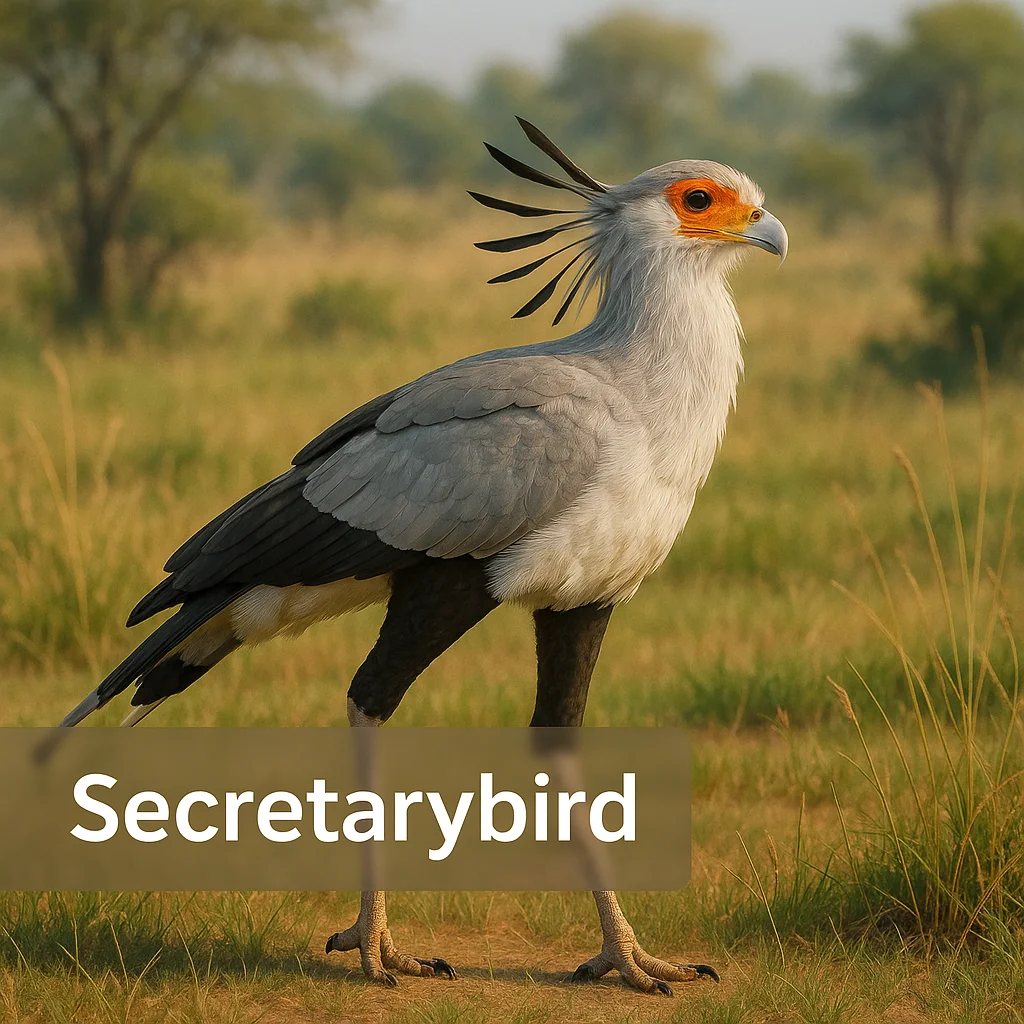
- Common name(s): Secretarybird
- Scientific name: Sagittarius serpentarius
- Animal type: Bird
- Typical adult size: 3.3–4.9 ft (1–1.5 m) in height; wingspan 6.5–7.4 ft (2–2.25 m)
- Typical lifespan: 10-15 years in the wild; up to 20 years in captivity
- Diet type: Carnivore; feeds on snakes, lizards, insects, and small mammals
- Activity pattern: Diurnal
- Social structure: Solitary or in pairs
- Speed / movement highlights: Known for running with speeds up to 18 miles per hour (29 km/h)
- Intelligence/learning: Known for strategic hunting and adaptability
- Primary habitats: Grasslands, savannas
- Geographic range: Sub-Saharan Africa
- Predators/threats: Predominantly humans (habitat loss), some larger scavengers
- Conservation status: Vulnerable (varies by region)
🔍 Identification & Appearance
The Secretarybird is unmistakable with its crane-like build and distinctive crest of long feathers. Its large body is predominantly grey, with black flight feathers and a white wing base. Long, powerful legs end in formidable talons, adept for hunting prey.
- Recognizable thin, crane-like legs
- Distinctive facial markings of orange or red
- Black feathered crest resembling quills tucked behind the ears
- Long tail feathers with black tips
- Grey body plumage contrasted with black flight feathers
- When in flight, wings show a white base with black flight feathers
- Tall, elegant stance when standing
- Juvenile coloration is paler than adults
- Top ID Tips
- Look for tall, crane-like structure
- Note the reddish face with black accents
- Identify the feathered crest on the head
- Observe the lengthy legs and tail
- Consider its terrestrial hunting behavior
- Bigger and taller than most birds of prey on ground
- Check for long, elegant strides when moving
- In flight, note the large wingspan and distinctive tail
🧱 Body Structure & Physical Adaptations
The Secretarybird is adapted for a terrestrial lifestyle, favoring running over flying when hunting. It has a slender, elongated body supported by long, strong legs, designed to stomp and incapacitate prey such as snakes. Its hooked beak is typical of birds of prey, aiding in tearing flesh. Its wings, although large, are used more for balance and leverage during ground pursuits than in the air.
- Long legs specialized for running and hunting prey
- Hooked beak for gripping and dispatching prey
- Wings used for balance; capable of flight but prefers ground
- Powerful talons for grasping and stunning prey
- Crest feathers potentially used in display
- Excellent eyesight allows spotting prey from afar
- Legs act as a defensive weapon against predators
- Extended tail aids in maneuverability during chase
- Key Adaptations
- Adapted for terrestrial hunting
- Long legs for speed and dexterity
- Beak and talons for handling diverse prey
- Keen eyesight for distant spotting
- Strong, flexible legs for defensive kicks
- Black crest for potential signaling or mating displays
🌍 Range & Distribution
The Secretarybird is native to the savannas and grasslands across sub-Saharan Africa. It prefers open plains where it can forage efficiently. While generally resident, some populations may move short distances depending on food availability and environmental conditions.
- Where You Might Find It
- Sub-Saharan African savannas
- Open grassland regions
- Occasionally in shrublands adjoining grasslands
- Habitat ranges from Senegal to Somalia and south to South Africa
- Higher prevalence in protected reserves
- Partial migratory behavior in response to seasonal food scarcity
🏞️ Habitat & Shelter
The Secretarybird predominantly resides in open savannas and grasslands where it can effectively spot prey from a distance. It occasionally visits agricultural fields and requires areas with scattered trees for nesting. Seasonal variations may alter its habitat slightly, with wetter seasons potentially expanding its foraging territory.
Key habitat knowledge aids in understanding its hunting strategy and survival, as these environments offer plenty of space and visibility. The availability of prey determines habitat preference during different times of the year.
🧭 Behavior & Ecology
This bird exhibits a combination of fascinating behaviors, including its signature snake-hunting technique where it stamps its feet to stun or kill prey. Secretarybirds are primarily diurnal, active during daylight, and known for their loud calls, especially during breeding displays. Territorial by nature, these birds may also engage in display flights to mark their domain.
The Secretarybird plays a critical role in controlling prey populations like insects and small animals, acting as both predator and eco-regulator.
- Behavior Highlights
- Daytime hunting and activity
- Uses “kicking” technique to hunt snakes and small creatures
- Often seen alone or in pairs
- Loud vocal displays during breeding and territorial assertion
- Flight displays serve to assert dominance and attract mates
- Impacts local ecology by controlling grassland species populations
👥 Social Life & Group Dynamics
Primarily solitary or found in pairs, Secretarybirds maintain a highly territorial existence. Mated pairs may remain together for long spans, exhibiting cooperation in nest-building and chick-rearing. Though generally non-aggressive towards one another outside of the breeding season, they can be fiercely territorial when it comes to defending nesting areas.
- Social Structure Notes
- Usually solitary except during breeding pair formation
- Pairs showcase long-term monogamous bonds
- Shared responsibilities in raising offspring
- Agonistic behaviors centered on territory protection
- Minimal interaction observed with other bird species
🍽️ Diet, Prey & Predators
The Secretarybird has a varied diet, though its reputation is built on snake hunting. It seeks out snakes, lizards, amphibians, small mammals, and insects while foraging. When preying on snakes, it uses its quick reflexes and strong legs to avoid a strike while relentlessly stomping the reptile.
Despite its predatory prowess, the Secretarybird is vulnerable to egg and chick predation by animals such as large birds of prey. Its primary defenses are its ability to fly and intimidate with size and aggressiveness.
- Feeding Notes
- Specializes in capturing snakes and other reptiles
- Targets insects and small mammals opportunistically
- Employs powerful kicks to subdue prey
- Alternative diet items include amphibians and small rodents
- Sure-footed strides aid in stalking prey in open terrain
- Relocates if prey becomes scarce in a given area
🦌 Hunting, Foraging & Movement
The Secretarybird is a proficient runner, utilizing its long legs for swift terrestrial movements. It employs a specialized hunting tactic that involves stalking prey on foot before delivering a precise and powerful kick to subdue. Navigation within its home range revolves around daily searches for food rather than complex migrations.
- Movement & Strategy
- Remarkable runner rather than flier
- Swift stalking advances in open habitats
- Employs strategic hunting paths on flat terrains
- Clear field advantage when sprinting after prey
- Acts opportunistically, targeting exposed creatures
- Secures territory expediently to maximize resource access
🧠 Intelligence & Senses
Possessing excellent vision, Secretarybirds can spot prey from a significant distance, utilizing their acute sight to locate and react to minor movements on the ground. Lesser-known aspects of their intelligence include adaptive hunting tactics and a marked ability for spatial awareness in their territories. However, specific studies on complex cognition or problem-solving in Secretarybirds remain limited.
- Notable Abilities
- Outstanding visual acuity for terrestrial prey detection
- Adaptability in hunting strategies
- Spatial memory of territories and foraging grounds
- Keen eyesight favors daylight activity
- Despite land-based predation, can transition to flying when needed
🪺 Reproduction, Pregnancy & Parenting
Breeding typically occurs at different times throughout sub-Saharan Africa, often coinciding with regional rainfalls that increase prey availability. These birds engage in monogamous pair bonds, beginning with aerial courtship displays. Nest building involves both partners, crafting platforms of sticks and foliage in isolated trees. Incubation is usually undertaken by the female, lasting around six to eight weeks, with both parents feeding and rearing hatchlings that leave the nest after about 2-3 months.
- Reproduction Snapshot
- Rainfall triggers breeding seasons
- Engage in monogamous pair bonds
- Aerial courtship displays signal reproductive readiness
- Nest building carried out communally by pairs
- Incubation period extends six to eight weeks
- Both parents involved in chick rearing
- Chicks leave nest after 2-3 months
♀️♂️ Male vs Female Differences
Visually, males and females of the species are similar, though females may have slightly longer tail feathers. Behavioral roles during nesting differ slightly, with males sometimes tasked with more territorial displays while females concentrate on incubation. These subtle variations contribute to the cooperative dynamics seen in pair bonds.
- Sex Differences at a Glance
- Slight size variation, females may appear larger
- Females often exhibit longer tail feathers
- Gender roles prominent in nesting behavior
- Males more active in territory defense
- Subtle visual distinctions often limited to plumage length
🧬 Subspecies & Variation
The Secretarybird is the only member of its genus, with no officially recognized subspecies present. Despite this, regional variations can occur depending on climate and availability of resources, affecting aspects like plumage tone and leg coloration. Overall, these variations do not significantly diverge from the typical traits associated with the species.
- Variation Notes
- No recognized subspecies
- Minor regional variations based on environmental factors
- Plumage and leg coloration may adjust slightly
- Physiological adaptations linked to climate responses
- Maintains core traits characteristic of the species
⚠️ Threats, Conservation & Human Interaction
Secretarybirds face natural and anthropogenic pressures such as habitat loss due to agriculture, collision risks with fences and vehicles, and hunting in some regions. Though classified as vulnerable, conservation efforts aim to reverse declining trends, particularly through habitat protection and legal protections.
Coexistence relies on maintaining open landscapes and reducing human-wildlife conflict. Ethically, Secretarybirds are sometimes displayed in zoos, emphasizing conservation education and breeding programs.
- Responsible Notes
- Vulnerable due to habitat loss and human encroachment
- Vehicle collisions pose significant risk
- Fences can create hazards, limiting movement
- Traditional hunting practices impact local populations
- Conservation largely focused on habitat preservation
- Zoos play a role in education and captive breeding
✨ Fun Facts & Unique Traits
- Named "Secretarybird" possibly due to quill-like feathers reminiscent of secretaries holding quills behind ears.
- Primarily a terrestrial predator, yet capable of impressive flight despite infrequent use.
- Uses powerful kicks to defend items or attract mates, considered a defining behavior.
- Despite its name, Secretarybird is a raptor, more closely related to eagles and hawks.
- Known for its ability to hunt and kill venomous snakes, showcasing immense precision with its strikes.
- Utilizes calls and gestures as part of complex territorial defense and courtship.
- Referred to in various African traditions and folklore reflecting cultural significance.
📌 Summary
- Secretarybird stands out with long-legged, crane-like structure
- Adapted for life in open grasslands and savannas
- Native to sub-Saharan Africa, primarily found in protected reserves
- Diet includes snakes, lizards, small mammals, and insects
- Vulnerable to habitat loss and human encroachment
- Displays solitary or pair-bonded social behavior
- Unique breeding requires cooperative nesting and chick rearing
- Features notable adaptations for terrestrial hunting
- Proudly displays remarkable hunting behaviors and crest feathers