🦁 Tawny Owl
🧾 Quick Facts
The Tawny Owl, a beloved and iconic species, captivates bird enthusiasts with its distinct call and adaptability to various environments. Known for its remarkable camouflage abilities, this owl thrives in diverse habitats, primarily across Europe and parts of Asia.
- Common names: Tawny Owl, Brown Owl
- Scientific name: Strix aluco
- Animal type: Bird
- Typical adult size: 37-43 cm in length, wingspan of 81-96 cm
- Typical lifespan: 4-6 years in the wild, up to 18 years in captivity
- Diet type: Carnivore; small mammals, birds, insects
- Activity pattern: Nocturnal
- Social structure: Typically solitary or found in pairs
- Speed/movement highlights: Silent flight; adapted for stealth
- Intelligence/learning: Excellent problem-solving and hunting abilities
- Primary habitats: Forests, woodlands, parks
- Geographic range: Europe, parts of Asia, North Africa
- Predators/threats: Larger birds of prey, habitat loss
- Conservation status: Least Concern; varies by region
🔍 Identification & Appearance
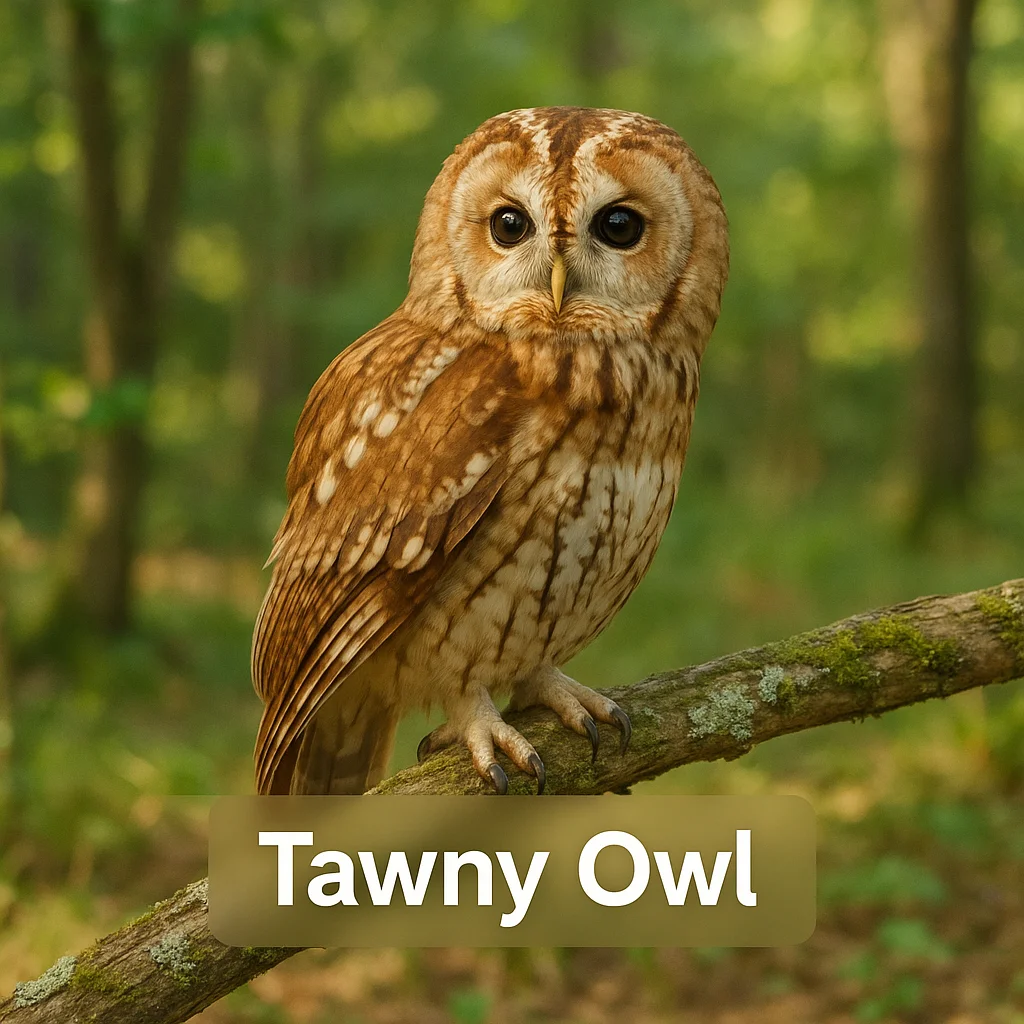
The Tawny Owl is easily recognizable thanks to its compact and rounded body, complemented by a large head and a distinctly flat face. Its plumage is predominantly mottled brown and gray, aiding its ability to blend seamlessly with the forest environment. The owl's eyes are dark, often giving it a soulful gaze, while its beak is sharp and hooked for efficient hunting.
During winter, its plumage does not change color, making its camouflage consistent year-round. Tawny Owls do not exhibit significant sexual dimorphism, though females are typically larger.
While the Tawny Owl is often confused with the Barn Owl, the latter is lighter in color and has a unique heart-shaped facial disk disappearing in the Tawny Owl.
- Rounded body shape
- Mottled brown and gray feathers
- Large, rounded head
- Dark, soulful eyes
- Silent flight due to plumage structure
- Distinct flat face with no visible ear tufts
- Hooked beak
- Female slightly larger than male
🧱 Body Structure & Physical Adaptations
The Tawny Owl is built for silent and effective predation. It has a stocky body that offers great maneuverability among trees and dense foliage. Its wings are broad and rounded, enabling it to fly through woodlands without alerting its prey. In addition, its feathers' specialized fringed edges reduce noise during flight, providing near-silent movement.
The owl's beak is strong and hooked, ideal for catching and consuming small mammals and birds. Enhanced vision and acute hearing are essential adaptations, with its eyes forward-facing for improved binocular vision. The owl can rotate its head up to 270 degrees, a critical feature for surveying its surroundings without moving its body.
- Broad, rounded wings for quiet flight
- Fringed feathers for silent movement
- Strong, curved beak for catching prey
- Excellent binocular vision
- Acute hearing for detecting prey
- Ability to rotate head 270 degrees
- Stocky build for maneuverability
🌍 Range & Distribution
The Tawny Owl is widely distributed across Europe and extends into parts of Asia and North Africa. It can be found from the British Isles across the European continent to western Russia, inhabiting various forested environments. Though primarily resident, individuals may exhibit local movements, especially during harsh weather conditions or food shortages.
- Europe-wide distribution
- Present in parts of Asia
- Reaches as far as North Africa
- Prefers temperate forests
- Occasional movement during food scarcity
🏞️ Habitat & Shelter
Tawny Owls thrive in temperate forests and woodlands, where their plumage provides substantial camouflage against tree bark. They are also adapted to urban parks and gardens where mature trees offer suitable nesting and roosting spots.
Nests are typically found in tree cavities, but they may also occupy old nests of other birds or use man-made structures. They prefer these environments because they offer abundant food and sufficient shelter from weather and predators.
Understanding their habitat preferences is vital as it influences their foraging behavior, nesting sites, and overall survival strategy.
🧭 Behavior & Ecology
The Tawny Owl exhibits a predominantly night-active lifestyle. Its vocalizations, especially during mating season, are a defining feature of its presence. Calls often consist of a range of hoots and screeches used to communicate territory and attract mates.
In an ecosystem, the Tawny Owl plays the role of a predator, keeping small mammal populations in check. It is territorial and capable of guarding its domain, using calls to ward off intruders. This owl occasionally engages in mutualistic relationships with other species, like following badgers to uncover prey items disturbed by the larger mammal.
- Primarily nocturnal activities
- Use of vocalizations for communication
- Territorial behavior
- Predatory role in ecosystem
- Occasional interspecies engagement
- Solitary or pairs outside breeding season
👥 Social Life & Group Dynamics
Typically solitary, Tawny Owls are territorial and tend to remain within their established ranges. However, they form monogamous pair bonds that often last for life. These pairs might hunt or roost together and defend their territory from other Tawny Owls.
Pairs communicate through vocalizations, coordinating their activities and strengthening their bond. There is limited evidence of cooperative behaviors beyond mutual defense of territory and shared parental duties.
- Generally solitary
- Monogamous pair bonding
- Mutual territory defense
- Shared nesting responsibilities
- Vocal communication within pairs
🍽️ Diet, Prey & Predators
The diet of the Tawny Owl primarily consists of small mammals, including voles and mice, but it will also hunt birds, amphibians, and large insects. This diverse diet varies according to seasonal availability and regional differences, making the owl an opportunistic hunter.
As a predator, its hunting strategy is to perch silently before swooping down on unsuspecting prey. While predation risks come from larger birds of prey, habitat loss poses a more significant threat due to changes in human land use.
- Primary prey: small mammals
- Also consumes birds and insects
- Opportunistic feeding habits
- Silent approach for hunting
- Threatened by habitat change
🦌 Hunting, Foraging & Movement
The Tawny Owl employs a strategy known as sit-and-wait hunting. It selects high perches to observe its surroundings before making a swift, silent flight to capture prey. Active primarily at night, it uses keen hearing and vision to locate targets.
While it is resident throughout most of its range, limited seasonal movements may occur in response to food availability. It is agile in flight, capable of navigating through dense forest environments with deftness and precision.
- Sit-and-wait hunting strategy
- Silent, swift flight for surprise attacks
- Primarily nocturnal hunter
- Responds to food shortages with local movements
- Proficient at flying in dense wood
🧠 Intelligence & Senses
The Tawny Owl showcases remarkable intelligence through its adept hunting strategies and problem-solving abilities. Its vision is specialized for low-light conditions, while its acute hearing enables precise location of prey, even under leaves or snow.
Although research on Tawny Owl cognition is ongoing, these birds demonstrate an understanding of their environment and exhibit behaviors that suggest an ability to learn from past experiences. Its combination of sensory abilities and keen adaptation strategies highlights its evolutionary success.
- Highly developed senses for night hunting
- Vision adapted to low-light environments
- Keen auditory precision
- Problem-solving capabilities
- Behavioral adaptability
🪺 Reproduction, Pregnancy & Parenting
Tawny Owls are monogamous and typically bond for life. Breeding occurs annually, with courtship beginning in late winter through vocal and display activities. Once bonded, the pair will select a nesting site in tree cavities or similar structures.
The incubation period lasts around 28-30 days, with females generally taking on the primary role of incubating the eggs. The clutch size typically ranges from 2 to 4 eggs. Chicks are altricial and require extensive parental care from both male and female until they fledge.
- Monogamous long-term pair bonds
- Annual breeding cycle
- Nesting in tree cavities
- 28-30 days incubation period
- Clutch size of 2-4 eggs
- Chicks are altricial
- Both parents involved in care
♀️♂️ Male vs Female Differences
Males and females of the Tawny Owl species exhibit minimal sexual dimorphism in terms of appearance. Females are slightly larger than males, which is common among bird species. This size difference aids in brooding and incubating the eggs.
There is no notable variation in plumage between sexes, though behavioral patterns can vary slightly during the breeding season, with females more actively involved in nesting and incubation.
- Females are slightly larger
- Minimal plumage variation between sexes
- Similar coloration patterns
- Similar roles outside breeding season
- Females engage more in incubation
🧬 Subspecies & Variation
The Tawny Owl species consists of several subspecies, with variations primarily in size and plumage pattern. These variations tend to correspond with geographic distribution, with owls in the north generally exhibiting paler plumage, aiding in camouflage against snowy or lighter backgrounds.
Climate and habitat influence these adaptations, although the impacts of these variations on genetic levels are still being researched. The classification of these subspecies can vary, and further study is needed to clarify these categories.
- Multiple recognized subspecies
- Size and plumage pattern variation
- Geographic distribution influences differences
- Northern populations paler in color
- Subspecies classification is debated
⚠️ Threats, Conservation & Human Interaction
Despite being common, the Tawny Owl faces threats from habitat loss due to deforestation and urban expansion. Vehicle collisions and rodenticide poisoning are additional human-induced threats. However, their adaptability to urban parks and gardens offers them some resilience.
Conservation efforts focus on maintaining forested areas and installing nest boxes to support populations. Understanding Tawny Owl habitats and reducing unnecessary disturbances are key to their conservation.
- Threatened by habitat destruction
- Susceptible to vehicle collisions
- Rodenticide exposure
- Adapts to urban environments
- Conservation through habitat protection
- Installation of nest boxes aids breeding
✨ Fun Facts & Unique Traits
- The Tawny Owl's call is iconic for its classic "twit-twoo" sound.
- They can rotate their heads up to 270 degrees.
- Tawny Owls are highly territorial and will engage in duets to defend their space.
- They can detect the movement of prey under dense foliage or snow, using their acute hearing.
- Tawny Owls have been observed following larger animals to catch prey that becomes disturbed.
- In mythology, the Tawny Owl is often associated with wisdom and mystery.
- They have a highly successful breeding rate in urban environments.
- Their silent flight is due to specialized feather structure.
- Despite their formidable hunting skill, they are solitary by nature.
📌 Summary
- The Tawny Owl is recognized by its mottled brown and gray plumage and rounded shape.
- Found across Europe, parts of Asia, and North Africa.
- Inhabits forests, woodlands, and even urban parks.
- Diet consists of small mammals, birds, and insects.
- Possesses silent flight abilities for effective hunting.
- Usually solitary but forms lifelong monogamous pair bonds.
- Breeds annually with shared parental responsibilities.
- Displays minimal size difference between males and females.
- Faces threats from habitat loss and human activity.
- Exhibits keen intelligence, problem-solving, and adaptability to environments.