🦁 Turkey Vulture
🧾 Quick Facts
The Turkey Vulture, known scientifically as Cathartes aura, is a fascinating bird indigenous to the Americas. Recognizable by their distinct flight style and unique feeding habits, these scavengers play a crucial role in the ecosystem by disposing of carrion.
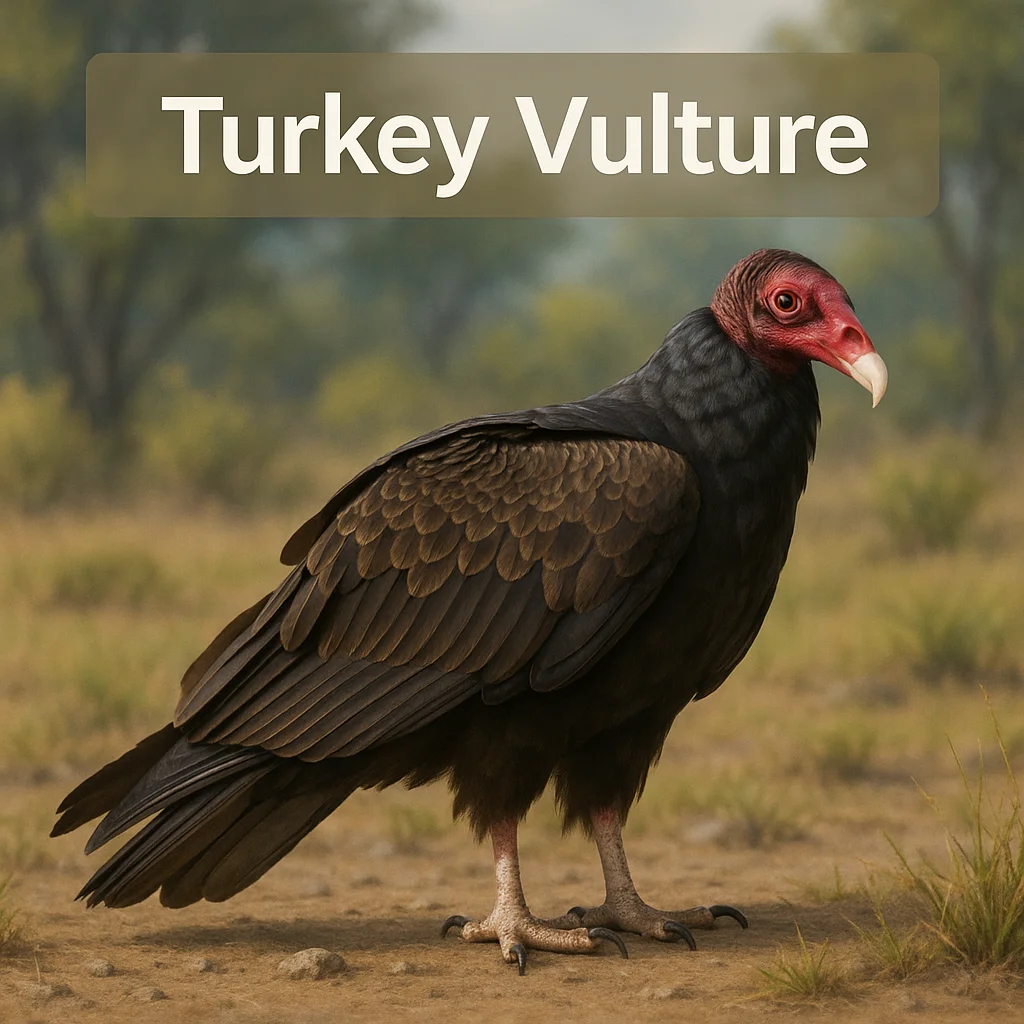
- Common Name: Turkey Vulture
- Scientific Name: Cathartes aura
- Animal Type: Bird
- Typical Adult Size: 62-81 cm (24-32 inches) in length; wingspan 160-183 cm (63-72 inches)
- Typical Lifespan: 10-16 years in the wild; up to 20 years in captivity
- Diet Type: Obligate scavenger; primarily feeds on carrion
- Activity Pattern: Diurnal
- Social Structure: Often solitary or in small groups, larger groups for feeding
- Speed/Movement Highlights: Glides at around 30 miles per hour
- Intelligence/Learning: Known for excellent navigation skills and an acute sense of smell
- Primary Habitats: Open and semi-open areas including lowlands, deserts, and savannahs
- Geographic Range: Broad range from Canada through South America
- Predators/Threats: Eagles, large mammals, habitat encroachment
- Conservation Status: Least Concern
🔍 Identification & Appearance
The Turkey Vulture is easily identified by its large, blackish-brown body and contrasting red, featherless head. In flight, the wings have silver or gray linings on the undersides, giving them a distinctive appearance. They are often seen soaring in circles high above the ground.
- Body Shape: Large body with a convex or slightly crook-winged silhouette
- Key Colors: Blackish-brown body with a red head and pale beak
- Distinguishing Features: Featherless red head helps to keep clean while feeding on carrion
- Tracks: Three forward-pointing toes with rear toe showing a slight arc
- Common Look-Alikes: Black Vultures, which are smaller with shorter tails and lack the red head
-
Top ID Tips
- Notice their red featherless head and pale bill
- Look for large wings with silver-grey undersides
- Observe gregarious gliding patterns in the sky
- When perched, look for the hunched position
- Often found near roadkills and carrion
- Easily distinguished from hawks by their slow circling flight
🧱 Body Structure & Physical Adaptations
Turkey Vultures have a robust body adapted for soaring flight. Their beak is well-suited to tearing flesh, and they have strong, talon-like feet, though not adapted for grasping prey. Their most notable adaptation is their enhanced olfactory system, which is rare among birds.
-
Key Adaptations
- Robust body with long, broad wings for soaring
- Slightly hooked, strong beak for tearing apart carrion
- Large olfactory bulbs to process scent signals for detecting carcasses
- Short, rounded tail used for stability while gliding
- Featherless head to maintain hygiene while feeding
- Good eyesight but relatively poor hearing
🌍 Range & Distribution
The Turkey Vulture's range covers much of the Americas, extending from southern Canada to South America. They are versatile regarding elevation, inhabiting areas from lowlands to mid-elevation forests. While they do migrate seasonally, some populations remain year-round residents.
-
Where You Might Find It
- North America: Throughout the United States and southern Canada during summers
- South America: As far south as Tierra del Fuego
- Central America: Year-round residents
- Migrates to the southern United States during winter
- Prefers open habitats like savannahs, deserts, and grasslands
🏞️ Habitat & Shelter
The Turkey Vulture occupies a wide variety of habitats, largely avoiding densely forested areas. They prefer environments where air currents or thermals allow for easy soaring. These birds use secluded perches and ledges for roosting, often nesting in caves, hollow logs, or thickets.
🧭 Behavior & Ecology
Turkey Vultures perform an important ecological function as scavengers. They spend much of their day soaring to locate food with their keen eyesight and sense of smell. They usually feed in groups, displaying minimal aggression and competition over food resources.
-
Behavior Highlights
- Diurnal soaring for most of the day
- Groups congregate at feeding sites
- Often observed sunning themselves in the morning with wings open
- Role as scavenger, essential for ecosystem health
- Minimal vocalizations; mostly rely on hissing and grunting
- Non-aggressive, often displaced by more assertive scavengers like eagles
👥 Social Life & Group Dynamics
Turkey Vultures are largely solitary but come together at feeding sites. During migration, they may be seen in large flocks. Family units are formed during breeding, and both parents sharemost nesting responsibilities. Their social dynamic is straightforward, involving cooperation mainly in roosting sites.
-
Social Structure Notes
- Largely solitary but roost in groups
- Form feeding aggregations at carcasses
- Cooperate with vultures and scavengers; minimal conflict
- Share nesting duties between mates
- Mixed-species flocking during migration
🍽️ Diet, Prey & Predators
The Turkey Vulture feeds exclusively on carrion. Seasonal changes in carrion availability influence their feeding. Although they face few natural predators due to their size and unpalatable nature, eggs and young may be vulnerable to both mammalian and avian predators.
-
Feeding Notes
- Favors recently dead carrion, which is easier to find by scent
- Often seen feeding on roadkill
- Will feed communally with minimal competition
- Uses vomiting as a defense strategy against predators
- Youth often feed on smaller carrion
🦌 Hunting, Foraging & Movement
Movement is characterized by graceful thermalling and gliding. Turkey Vultures primarily rely on their keen sense of smell to locate food while in flight. They cover vast distances when foraging and exhibit distinct migratory behaviors but remain in regions where food availability permits residence.
-
Movement & Strategy
- Soaring on thermals for energy-efficient travel
- Foraging largely occurs during daylight
- Young birds may test different foraging strategies during development
- Navigates large home ranges; migratory populations travel great distances
- Uses scent and sight to detect prey from afar
🧠 Intelligence & Senses
Turkey Vultures are notable for their advanced navigational and olfactory abilities. They demonstrate keen problem-solving skills and can associate cues with food availability. Their vision is sharp for spotting carcasses from high altitudes, but it’s their acute sense of smell that sets them apart.
-
Notable Abilities
- Excellent navigators, sometimes traveling great distances without fatigue
- One of the few bird species with a highly developed sense of smell
- Proficient at assessing the safety and quality of carrion
- Capable of rapid learning and adaptation to new environments
🪺 Reproduction, Pregnancy & Parenting
Breeding occurs primarily during spring. Turkey Vultures form monogamous pairs that share parenting duties equally. Nests are often minimal, with eggs laid directly on bare surfaces in secluded or sheltered locations. Both parents are involved in incubation and caring for the altricial chicks until they are able to fend for themselves.
-
Reproduction Snapshot
- Breeding season varies with locale; generally begins in spring
- Monogamous pairing; mate for life
- Incubation lasts approximately 30-40 days
- Typically lay two eggs per clutch
- Nesting usually occurs in caves, old buildings, or dense undergrowth
- Both parents participate in incubation and chick rearing
♀️♂️ Male vs Female Differences
Male and female Turkey Vultures are similar in appearance. There are no notable sexual dimorphisms in size or plumage, although subtle differences may exist in individual behavior during breeding.
-
Sex Differences at a Glance
- Males and females look almost identical
- No significant size difference
- Behavioral roles are shared during nesting
- Both genders involved in territory defense
🧬 Subspecies & Variation
There are several subspecies of Turkey Vultures, with variations in size and subtle plumage differences correlated with geography. Northern populations usually migrate, while southern populations tend to be resident. These differences are principally due to local environmental conditions.
-
Variation Notes
- Subspecies differ slightly in size and range
- Migration patterns vary among populations
- Western birds may show darker plumage
- Main ecological role remains consistent
⚠️ Threats, Conservation & Human Interaction
Although not currently threatened, Turkey Vultures face dangers from habitat loss and human activities. They are sometimes killed unlawfully due to misconceptions. Conservation requires preserving habitats and educating the public on their ecological role.
-
Responsible Notes
- Threats include lead poisoning and habitat destruction
- Important to maintain open landscapes and reduce roadkill risks
- Efforts to reduce pesticide use beneficial
- Not usually kept in captivity, but vital for zoo education programs
✨ Fun Facts & Unique Traits
- Turkey Vultures are unique among New World vultures for their acute sense of smell.
- Despite their grim reputation, they provide critical disease control services by consuming carrion.
- Turkey Vultures can soar up to six hours straight without flapping their wings.
- They have been known to play by rising and plunging in air currents.
- Cathartes aura can emit strong acids that help detoxify their food.
- Vomit is used by vultures as a defense mechanism against predators.
- Their scientific name, Cathartes aura, means "purifying breeze" in Latin.
📌 Summary
- The Turkey Vulture is a large scavenger bird with distinctive flight patterns.
- Primarily found across a wide range in the Americas.
- Feeds almost exclusively on carrion.
- Essential scavenger, ensuring ecosystem health.
- Resides in open, semi-open areas; known for efficient soaring.
- Exhibits monogamous breeding and shared parental care.
- Remarkable olfactory abilities set them apart among birds.
- Faces conservation challenges from human activities.