🦁 Humphead Wrasse
🧾 Quick Facts
The Humphead Wrasse, also known as the Napoleon Wrasse, is a large and distinctive reef fish found throughout the tropical Indo-Pacific region. Known for its impressive size and striking appearance, this species plays a crucial role in maintaining the health of coral reefs.
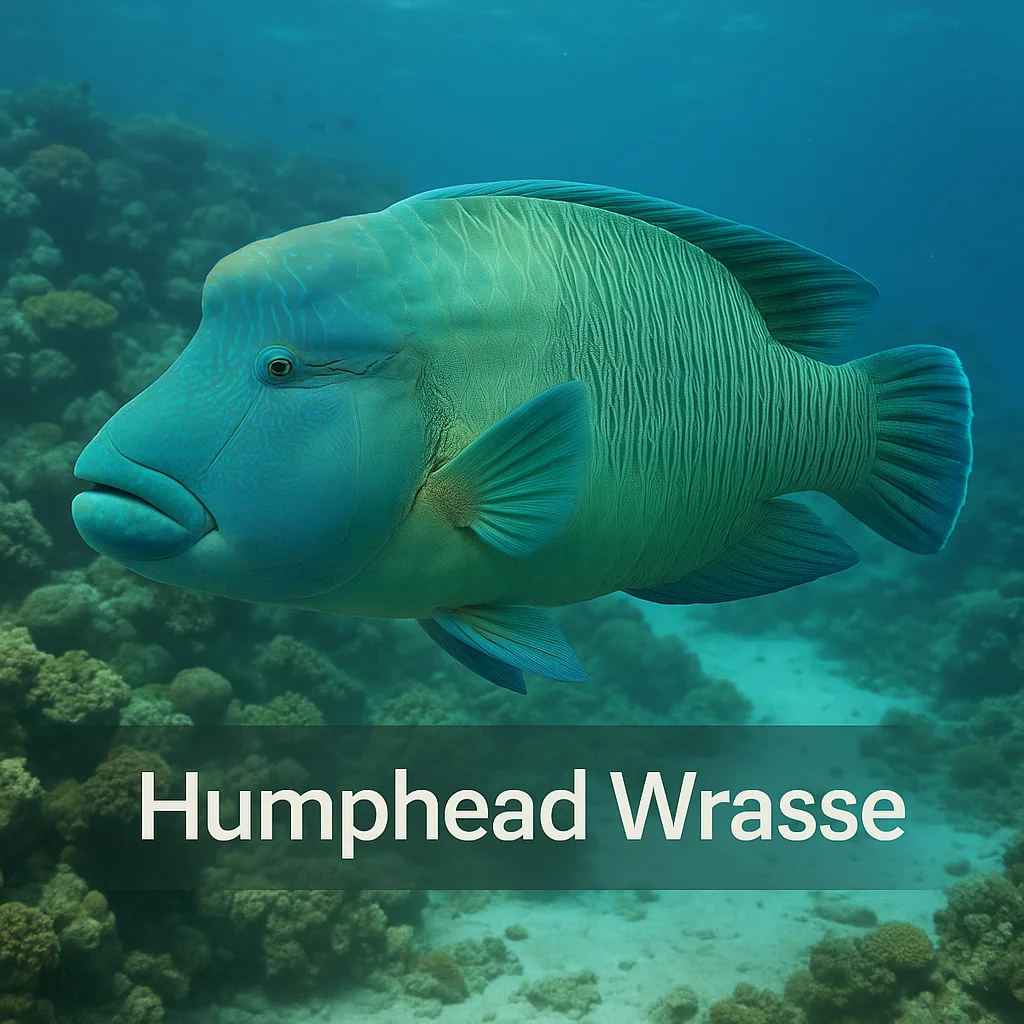
- Common Name(s): Humphead Wrasse, Napoleon Wrasse
- Scientific Name: Cheilinus undulatus
- Animal Type: Fish
- Typical Adult Size: Up to 2.3 meters in length, weighing around 190 kg
- Typical Lifespan: Up to 30 years in the wild
- Diet Type: Carnivore; feeds on mollusks, crustaceans, and echinoderms
- Activity Pattern: Diurnal, active during the day
- Social Structure: Solitary or small groups
- Speed / Movement Highlights: Slow swimmer, cruising through reefs
- Intelligence/Learning: Capable of learning and memory, responsive to environmental changes
- Primary Habitats: Coral reefs, lagoons
- Geographic Range: Indo-Pacific region, from the Red Sea and East Africa to central Pacific islands
- Predators/Threats: Overfishing, habitat loss, and climate change
- Conservation Status: Endangered
🔍 Identification & Appearance
The Humphead Wrasse is easily recognizable by its large size and prominent hump on the forehead, which becomes more pronounced with age. Its body color ranges from bright blue to greenish tones, featuring distinctive scales and a thick, plump body.
- Body Shape and Silhouette: Large, elongated oval with a prominent forehead bump
- Key Colors/Patterns: Vibrant blue-green with dramatic scale patterns, varies with age
- Distinctive Features: Hump on the forehead, thick lips, and a continuous dorsal fin
- Tracks, Scat, or Other Field Signs: Leaves no terrestrial signs; presence is noted by behavior in reefs
- Common Look-alikes: None; very distinctive
- Hump on the forehead is a key feature
- Thick, fleshy lips
- Large size compared to most reef fish
- Vibrant coloration that stands out among coral habitats
- Continuous long dorsal fin
- Solitary behavior helps in distinguishing from smaller, schooling reef fish
- Mature males typically have a more vivid coloration
🧱 Body Structure & Physical Adaptations
The Humphead Wrasse is equipped with physical adaptations suited for its coral reef environment. This includes a robust body for maneuvering through water, thick lips for crushing hard-shelled prey, and a strong jaw equipped with specialized teeth. Despite their size, they can be surprisingly agile among the corals.
- Build and Proportions: Stocky, powerful body, well-suited for coral navigation
- Teeth/Beak/Jaw Adaptations: Thick lips and strong jaw for crushing prey
- Claws/Hooves/Wings/Fins: Large pectoral fins for agile swimming and balance
- Sensory Strengths: Excellent vision for spotting prey and threats
- Limitations: Slow speed compared to predators or prey
- Robust body structure for reef navigation
- Specialized teeth for crushing shells
- Vivid coloration as an adaptation for mating displays
- Large fins for precise movements
- Hump for sexual selection and possibly intraspecies signaling
- Thick lips protect against sharp coral injuries
🌍 Range & Distribution
The Humphead Wrasse is primarily found in the warm tropical waters of the Indo-Pacific. Its range includes coral reefs across the Red Sea, East Africa, the Maldives, and all the way to the Central Pacific islands. It tends to favor deeper areas in the reef, varying from shallow waters to depths of around 100 meters.
- Continents/Regions: Found across the Indo-Pacific region
- Typical Countries/Regions: Indonesia, Australia, Maldives, Fiji, among others
- Elevation Range: From near the surface to depths of approximately 100 meters
- Seasonal Movements or Migration: Mostly resident within territories
- Climate Range: Tropical waters
- Common in coral reefs of the Indo-Pacific
- Usually found in southern and central Pacific islands
- Adapted to tropical marine environments
- Prefers deep lagoons and reef passages
- Observations common in Australia’s Great Barrier Reef
🏞️ Habitat & Shelter
The Humphead Wrasse inhabits coral reefs—complex structures that provide shelter, feeding grounds, and breeding sites. These environments offer hiding spots within their nooks and crannies where Wrasse can rest and avoid predators. Their daily movements often coincide with tidal patterns, influencing feeding and social interactions.
- Preferred Habitats: Coral reefs, particularly around outer slopes and channels
- Microhabitats and Shelter: Looks for caves, crevices, and overhangs for refuge
- Weather/Seasonal Behavior Changes: Less active during extremely cloudy or stormy weather
- Importance of Habitat Knowledge: Preservation of coral reefs is essential for their survival
🧭 Behavior & Ecology
The Humphead Wrasse plays a vital ecological role in coral reefs, consuming organisms that would otherwise harm coral structures, such as the crown-of-thorns starfish. They are generally solitary but can be found in small, loose groups, particularly during breeding seasons. Communication is subtle, often involving body language and occasional vocalizations.
- Daily Routine: Active during the day, resting among coral crevices at night
- Communication: Body movements and rare vocal sounds
- Interactions with Other Species: Helps maintain reef health by controlling invertebrate populations
- Role in the Ecosystem: Acts as both predator and prey within the coral reef ecosystem
- Tends to operate alone
- Crucial for keeping coral predators in check
- Social behavior increases during breeding
- Effective in managing certain invasive reef species
- Territorial to some degree, especially during mating season
👥 Social Life & Group Dynamics
Primarily solitary, the Humphead Wrasse tends to be non-territorial, occasionally interacting with others mainly for mating or during feeding gatherings. When groups do form, they're often small and loose, with little hierarchical structure. Cooperative behaviors are not commonly observed among these fish.
- Solitary vs Social Tendencies: Mostly solitary with some social interactions
- Group Types: Occasional small group formations
- Cooperation: Rarely observed cooperation outside breeding
- Dominance Hierarchies: Minimal conflict, no strong pecking order noted
- Loose group dynamics during feeding
- Solitary and non-territorial most of the time
- Social structure centers around mating needs
- Validated interactions increase with mating interest
🍽️ Diet, Prey & Predators
The Humphead Wrasse is a carnivorous fish that primarily feeds on hard-shelled sea creatures, making use of its powerful jaws to crush through crustaceans and mollusks. It also preys on starfish, allowing them to play a regulatory role in reef ecosystems. Predators of the Humphead Wrasse include larger sharks and humans, who threaten them through overfishing.
- Diet Across Seasons: Consistent diet year-round
- Hunting Targets/Strategies: Slow cruisers, typically ambushing prey
- Anti-Predator Defenses: Large size deters many potential predators
- Scavenging Behavior: Mostly active hunters, not typical scavengers
- Diet mostly includes crustaceans, mollusks, and echinoderms
- Uses strong jaw for capturing and consuming prey
- Regulates populations of potentially harmful reef species
- Large body size helps deter some predators
- Non-selective feeder but prefers accessible easy prey
🦌 Hunting, Foraging & Movement
The Humphead Wrasse relies on slow, methodical swimming to navigate coral reefs and ambush prey. Although not the fastest swimmers, their technique involves patience and precise movement. They tend to forage during the day, using their visual acuity for locating prey and suitable feeding grounds.
- Locomotion Style: Slow cruising among reefs
- Speed and Endurance: Modest speed, high endurance for patrolling territories
- Foraging Times/Tactics: Diurnal; relies on sight for identifying prey
- Navigation and Spatial Behavior: Favors familiar territories, not migratory
- Precision due to powerful jaw adaptation
- Daytime foraging boosts prey visibility
- Tactical pursuits maintain energy over speed
- Tends to stay within known reef sections
- Diurnal energy expenditure optimized by solar patterns
🧠 Intelligence & Senses
The Humphead Wrasse has been observed to demonstrate problem-solving capabilities and adaptability to environmental changes, aided by its acute vision, which plays the primary role in its interactions and survival. Research into its cognitive abilities, while limited, suggests certain levels of memory retention and learning.
- Problem-Solving, Learning, Tool Use: No tool use noted, but adept at environmental navigation
- Senses and Their Uses: Relies heavily on eyesight for threat detection and prey location
- State Uncertainties: Cognitive abilities not fully understood, varies among individuals
- Vision is the most critical sense
- adaptive behavior in changing reef ecosystems
- Curiosity-driven interactions with surroundings
- Memory plays a role in habitat and prey navigation
🪺 Reproduction, Pregnancy & Parenting
The Humphead Wrasse employs a complex, lengthily-spanning reproductive display. Breeding seasons are influenced by environmental factors, where males establish temporary territories and perform elaborate displays to attract females. The species is oviparous, with external fertilization occurring. Offspring receive no care post-hatching and are left to fend within the reef's protective cover.
- Breeding Seasonality and Courtship: Spring and summer months, linked to water temperatures and lunar cycles
- Mating System: Oviparous, external fertilization
- Gestation/Incubation Period: Eggs hatch within days depending on water temperature
- Litter/Clutch Size: Numerous eggs, survival rates are low due to predation
- Parenting Roles: No parental involvement post-spawning
- Spawning is largely temperature-dependent
- Males attract females via territory displays
- High fertility with uncertain juvenile survival
- No parental involvement
♀️♂️ Male vs Female Differences
In Humphead Wrasse, significant sexual dimorphism is evident, with males typically growing larger and displaying more vibrant coloration compared to females. Also, only males develop the characteristic prominent hump on the forehead, exacerbated as they age.
- Size/Weight Differences: Males are larger than females
- Coloration Differences: Males are brighter and more vivid
- Behavioral Role Differences: Males are more active in territorial displays
- When Differences Are Subtle/Variable: Less pronounced in juvenile stages
- Vivid hues more associated with males
- Males possess a more pronounced hump
- Males exceed females in average size
- Females generally blend more into the reef
🧬 Subspecies & Variation
The Humphead Wrasse is currently recognized under a single species, Cheilinus undulatus, with no formally identified subspecies. However, variations can be seen in size and hue based on geographic distribution and environmental conditions, reflecting adaptation to local habitats.
- Known Subspecies: None officially recognized
- Local Adaptations: Size and coloration vary with region
- Classification Debates: Differences seen among populations, though not subspecies
- Adaptations lead to flanking coat and scale size changes
- Observable differences lack formal subspecies classification
- Reef structures contribute to developing pigmentation diversity
⚠️ Threats, Conservation & Human Interaction
The Humphead Wrasse faces numerous threats from human activities, including overfishing, habitat destruction, and climate change. These factors, along with their late reproductive age, have led to declining populations. Conservation efforts focus on protecting coral reef habitats and enforcing sustainable fishing regulations.
- Natural Challenges: Natural predators like large sharks capable of killing them
- Human-Related Pressures: Includes habitat degradation and overharvesting
- Coexistence Tips: Emphasis on reef conservation benefits both marine life and humans
- Kept in Zoos/Aquariums: Critical to maintain natural behavioral patterns
- Legal trade restrictions crucial for population stability
- Notable as aquarium attractions, but care emphasizes avoiding wild capture
- Supports marine biodiversity conservation efforts
✨ Fun Facts & Unique Traits
- The Humphead Wrasse can change color and gender; females can become males under certain conditions.
- They play an essential role in protecting coral reefs by consuming crown-of-thorns starfish.
- Theirs is one of the longest lifespans recorded among reef fishes, living up to 30 years.
- Unlike many fish, Humphead Wrasse are slow-moving and do not rely on speed for survival.
- They are capable of recovering from wounds quickly, thanks to repeated scale formation and regeneration.
- Their lips act as an adaptable feeding tool for crushing hard shellfish.
- Despite their size, they are surprisingly gentle and non-aggressive toward humans.
📌 Summary
- Distinctive large fish with vibrant coloration, unique hump on forehead
- Found in tropical coral reefs across the Indo-Pacific
- Carnivorous diet focusing on hard-shelled marine animals
- Occasional prey to large sharks and threats from overfishing
- Mostly solitary with increased interactions during mating seasons
- Oviparous reproduction with no post-spawning care for young
- Plays an important ecological role in maintaining coral reef health
- Conservation efforts target sustainable fishing practices and habitat protection
- Able to change gender as part of natural life cycle dynamics