🦁 Lionfish
🧾 Quick Facts
Lionfish are a group of venomous marine fish known for their striking appearance and distinctive hunting behavior. They have become notable both as a fascinating species and as an invasive threat in certain parts of the world.
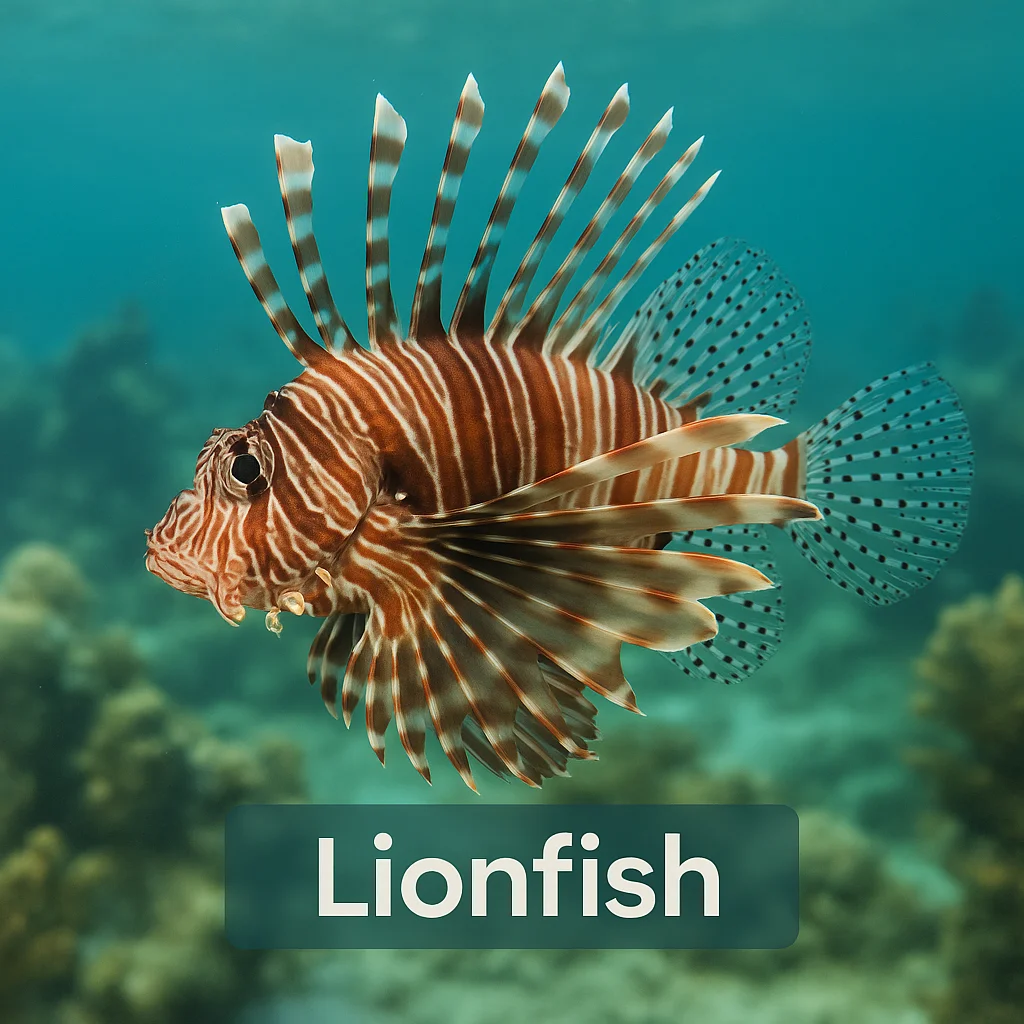
- Common name(s): Lionfish, Turkeyfish, Firefish
- Scientific name: Often listed as Pterois spp.
- Animal type: Fish
- Typical adult size: 6-15 inches (15-38 cm)
- Typical lifespan: 5-15 years
- Diet type: Carnivore; often feeds on small fish and crustaceans
- Activity pattern: Mostly diurnal, but active both day and night
- Social structure: Solitary or in small groups when juvenile
- Speed / movement highlights: Slow swimmer but quick during strikes
- Intelligence/learning: Known for ambush hunting techniques
- Primary habitats: Coral reefs and rocky crevices
- Geographic range: Indo-Pacific & invasive in western Atlantic
- Predators/threats: Few natural predators; human threats include removal efforts
- Conservation status: Varies by region; invasive in some areas
🔍 Identification & Appearance
Lionfish are recognizable by their distinctive finnage and vibrant coloration. They display an elongated, striped body with conspicuous spines and a fan-like presence when fully flared.
- Body shape: Elongated with an elegant, flowing silhouette
- Colors/patterns: Stripes of red, white, and brown
- Distinctive features: Long, venomous spines and fan-like pectoral fins
- Tracks, scat, or field signs: No tracks; traces in coral reef structures
- Look-alikes: Other scorpionfish species, but lionfish have more pronounced spines
- Top ID Tips:
- Look for long, venomous dorsal spines
- Check for red, white, and brown stripes
- Notice fan-like pectoral fins
- Observe distinct slow swimming
- Identify elongated body shape
- Spot in coral reef habitats
- Note solitary or small group presence
- Compare with scorpionfish for key differences
🧱 Body Structure & Physical Adaptations
The lionfish's body structure is specialized for its predatory lifestyle in coral reefs. Its flamboyant appearance is both a warning to potential predators and a means to deceive prey.
- Build and proportions: Slender and elongated
- Teeth: Small teeth adept for capturing small fish and invertebrates
- Fins: Large, venomous dorsal spines; fan-like pectoral fins for show
- Sensory strengths: Acute vision for hunting; excellent camouflage
- Key Adaptations:
- Venomous spines for defense
- Striking coloration for intimidation and camouflage
- Large fins create an imposing silhouette
- Sharp teeth for seizing prey
- Enhanced vision for low-light environments
- Acute spatial awareness in coral reefs
- Adapted to various water salinities
- Able to tolerate a range of temperatures
- Efficient ambush predator traits
🌍 Range & Distribution
Lionfish are originally native to the Indo-Pacific region but have become invasive in the Atlantic, where they pose ecological challenges.
- Continents/regions: Indian and Pacific Oceans; invasive in the Atlantic
- Typical countries: Indonesia, Australia; invasive in the Caribbean and southeastern U.S.
- Elevation range: Shallow coral reefs to deeper ocean waters
- Seasonal movements: Generally sedentary, no significant migrations
- Where You Might Find It:
- Coral reefs in Southeast Asia
- Along Australia's coasts
- Coral forests of the Indian Ocean
- Damselfish and wrasse territories
- Invasive populations in the Bahamas
- Near coastal Florida coral reefs
- On ships’ wrecks used as artificial reefs
- Subtropical warm-water regions
🏞️ Habitat & Shelter
Lionfish are typically found in coral reef zones, hiding among crevices and rocky outcrops. They inhabit these areas to both hunt prey and avoid potential threats.
- Preferred habitats: Coral reefs, rocky crevices, and underwater caves
- Microhabitats: Shelter within coral formations and crevices
- Behavioral adaptation: Shelter-seeking during unfavorable conditions
- Importance of habitat: Impacts survival, predator avoidance, and hunting success
🧭 Behavior & Ecology
Lionfish exhibit several intriguing behaviors that reveal their ecological role as both predators and prey. Their solitary nature is a key aspect of their lifestyle.
- Daily routine: Active during day and night; often rests in crevices
- Communication: Limited vocalization; visual displays using fins
- Species interactions: Competes with native fish for territory; affects local fish populations
- Role in ecosystem: Predatory role; influences fish community structure
- Behavior Highlights:
- Ambush predator techniques
- Solitary except during mating
- Venomous spines as defense
- Use of coral environments for concealment
- Influence over local prey populations
- Territorial behaviors in reef setting
- Minimal intraspecific aggression
- Quiet and stealthy approach to prey
- Adaptive to various prey in introduced ranges
👥 Social Life & Group Dynamics
Lionfish generally lead solitary lives, with interaction predominantly related to reproductive activities or where food is abundant.
- Solitary tendencies: Primarily solitary, except for breeding
- Group dynamics: Small groups observed among juveniles
- Cooperation: Not cooperative hunters
- Conflict resolution: Minimal; often avoid confrontations
- Social Structure Notes:
- Tendency to roam alone
- Juveniles form small clusters
- Adult territoriality without cooperative interaction
- Occasional overlap in rich food areas
- Breeding aggregations in certain conditions
- Avoidance of aggression during feeding
- Neutral interactions when not feeding
- Breeding driven group formations
- Distinct behaviors from juveniles to adults
🍽️ Diet, Prey & Predators
Lionfish are opportunistic predators, consuming a variety of small organisms, which they capture using an ambush strategy.
- Primary diet: Small fish, mollusks, and crustaceans
- Hunting style: Ambush predator; employs sudden lunges
- Predators: Few in native habitats; some large fish, sharks, and groupers
- Defensive tactics: Venomous spines deter many potential threats
- Feeding Notes:
- Utilizes camouflage for ambush
- Feeds primarily at dawn and dusk
- Can expand stomach size to consume larger prey
- Varies diet based on prey availability
- Overcomes prey with swift strikes
- Adapted to thrive on diverse prey in invaded territories
- Prey includes reef fish juveniles
- Impacts prey fish populations
🦌 Hunting, Foraging & Movement
Lionfish employ an effective combination of stealth and speed, adeptly hunting in complex environments such as coral reefs.
- Locomotion style: Slow, deliberate swimmers; sudden bursts of speed
- Speed and endurance: Lacks speed over distance but excels at short bursts
- Hunting times: Primarily crepuscular activity
- Spatial behavior: Territorial within coral structures
- Movement & Strategy:
- Ambush predator reliance
- Efficient in limited home ranges
- Subtle fin movements for prey deception
- Adaptability in different marine environments
- Nocturnal and diurnal hunting shift
- Use of currents for silent approach
🧠 Intelligence & Senses
The intelligence of lionfish is demonstrated through their successful predation tactics, which exploit both visual acuity and environmental familiarity.
- Sensory capabilities: Excellent eyesight for tracking movement
- Learning and problem-solving: Limited but effective within hunting context
- Social intelligence: Minimal due to solitary nature
- Research status: Limited studies beyond hunting strategies
- Notable Abilities:
- Advanced visual acuity
- Strategic anchoring in currents
- Use of environmental camouflage
- Adaptive hunting in varied habitats
- Keen navigation around structure complexities
🪺 Reproduction, Pregnancy & Parenting
Lionfish reproduction highlights a fascinating aspect of their biology, involving unique egg-laying strategies and mating behaviors.
- Breeding system: No specific pairing; promiscuous
- Spawning season: Primarily summer, but can vary
- Egg-laying: Females release buoyant egg masses
- Offspring development: Independent; larvae drift with currents
- Reproduction Snapshot:
- Seasonal spawning mostly in warmer months
- Mass egg releases by females
- Independent larval stage drifting
- Large number of eggs ensuring species survival
- Minimal parent involvement post-spawning
- Rapid juvenile growth in conducive environments
- Successful colonization due to prolific breeding
♀️♂️ Male vs Female Differences
Few visible differences exist between male and female lionfish, making it challenging to distinguish between sexes based on appearance alone.
- Size: No significant sexual dimorphism in size
- Coloration: Similar in both sexes
- Behavioral roles: Both contribute to breeding but separately
- Identification: Typically requires internal examination
- Sex Differences at a Glance:
- Behavioral similarities during non-breeding
- Equal contribution to population via breeding
- Lack of distinctive sexual features
- Reproductive strategies over distinct roles
- Physical appearance consistency across sexes
🧬 Subspecies & Variation
The diversity within the lionfish group includes several species, each with adaptations that reflect their specific environmental niches.
- Notable species: Pterois volitans, Pterois miles
- Size differences: Minor variations across species
- Color pattern variations: Slightly differ based on regional traits
- Range-based adaptations: Found in various Indo-Pacific regions
- Variation Notes:
- Species-specific habitat preference
- Minor anatomical differences
- Color and stripe differentiation
- Behavioral adaptations per environmental niche
- Regional invaders in similar invasive zones
⚠️ Threats, Conservation & Human Interaction
While lionfish are captivating to observe, their introduction into non-native environments poses significant ecological threats.
- Natural challenges: Limited due to venom protection
- Human-related pressures: Invasive control efforts are ongoing
- Ethical notes: Promoted for consumption to curb invasive spread
- Conservation relevance: Native populations stable, invasive under control measures
- Responsible Notes:
- Efforts to control invasive populations
- Sustainable harvesting encourages human intervention
- Monitoring of populations in native regions
- Regulations in place to manage capture efforts
- Encouragement of human-lionfish engagement for control
- Importance of coral habitat preservation
✨ Fun Facts & Unique Traits
- Lionfish can reportedly eat prey over half their own body size.
- Despite their beauty, they represent one of the fastest-growing invasive species in the Atlantic.
- Some lionfish species can live over 15 years.
- Their venomous spines are a strong defense, yet also an analgesic compound for their own use.
- They're also known as turkeyfish due to their fin resemblance to a turkey's plumage.
- Lionfish have become a culinary delicacy in areas seeking to reduce their invasive impact.
- They can adapt to living in both saltwater and brackish waters.
- The ability of lionfish to release multiple egg batches aids in rapid population expansion.
- They have been spotted at depths up to 300 feet but prefer shallower reefs.
📌 Summary
- Recognizable by vivid stripes and venomous spines
- Invasive in the Atlantic from native Indo-Pacific waters
- Solitary, slow-moving ambush predators
- Primarily inhabits coral reef ecosystems
- Reproduces by releasing buoyant eggs
- Diet consists of small fish and crustaceans
- Minimal sexual dimorphism; similar male and female behavior
- Control measures are actively managing invasive populations
- High adaptability contributes to invasive success
- Efforts are being made to use them as a food resource to curb spread