🦁 Moray Eel
🧾 Quick Facts
The moray eel is a fascinating group of elongated fish found in oceans around the world. Known for their distinctively sinuous bodies and sharp teeth, these eels play a unique role in marine ecosystems. Below are some key facts about these intriguing creatures:
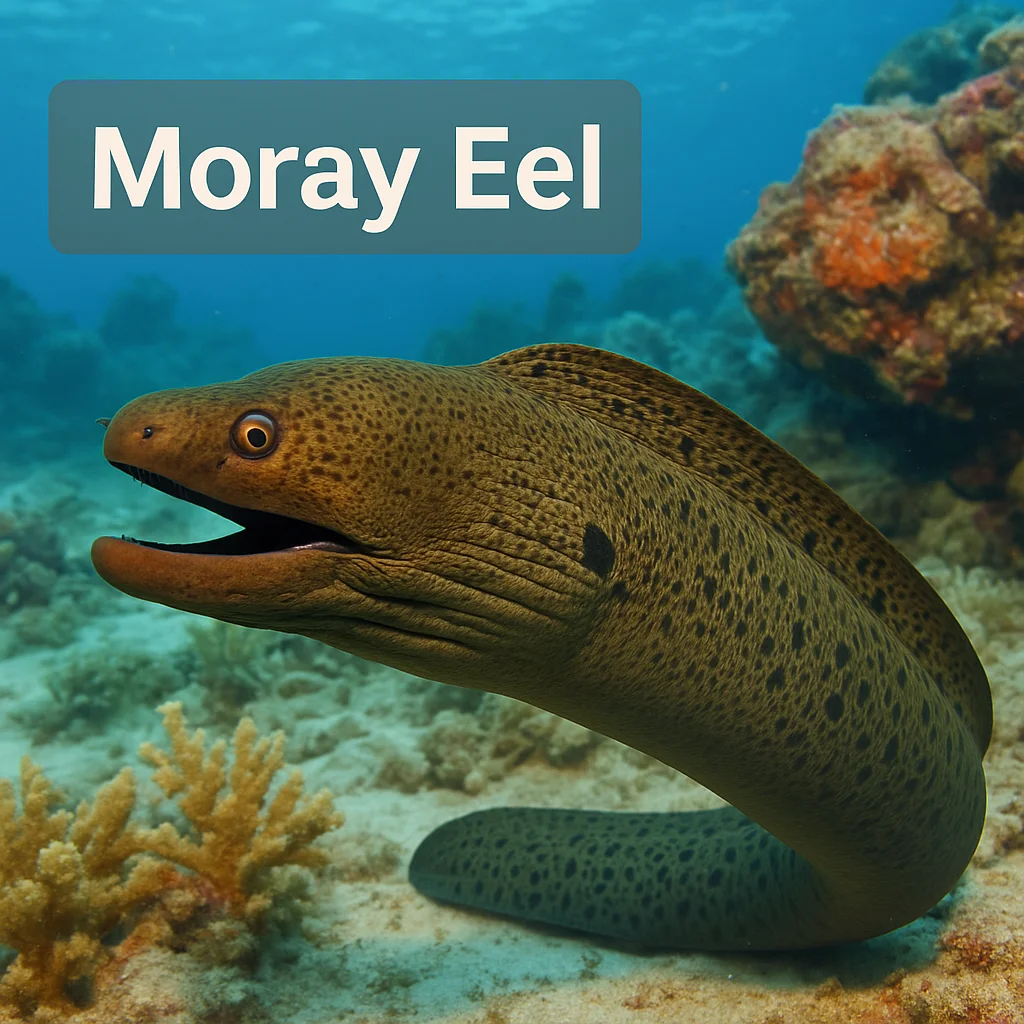
- Common Name(s): Moray Eel
- Scientific Name: Family Muraenidae (varies by species)
- Animal Type: Fish
- Typical Adult Size: 5 inches to 13 feet in length, depending on species
- Typical Lifespan: 6 to 36 years, varying by species and environment
- Diet Type: Carnivore, commonly consuming fish, crustaceans, and cephalopods
- Activity Pattern: Mostly nocturnal
- Social Structure: Primarily solitary
- Speed / Movement Highlights: Swimmers using full-body undulation
- Intelligence/Learning: Capable of simple problem-solving and learning
- Primary Habitats: Coral reefs, rocky crevices, and mangroves
- Geographic Range: Predominantly in tropical and subtropical waters
- Predators/Threats: Larger fish and sharks; human threats include pollution and habitat destruction
- Conservation Status: Varies by region and species
🔍 Identification & Appearance
Recognizing a moray eel involves looking for a few characteristic features. Their elongated, almost snake-like bodies make them stand out among other fish. Their scale-less skin is often vividly colored or patterned.
- Body Shape and Silhouette: Long, cylindrical and sinuous
- Key Colors/Patterns: Range from green, yellow, brown, or patterned with spots or stripes
- Distinctive Features: Round eyes, strong jaws with sharp teeth
- Tracks, Scat, or Other Field Signs: None, as they primarily inhabit water
- Common Look-alikes: Other eel species - distinguishable by their body patterns and head shapes
- Top ID Tips:
- Look for a long, snake-like body
- Check for sharp, protruding teeth
- Observe color patterns – spots or stripes are common
- Round eyes positioned on the head
- Flattened, wide head shape
- No pectoral fins if seen closely
- Smooth, scaleless, and often gleaming skin
- Tend to be in or near crevices or coral reefs
🧱 Body Structure & Physical Adaptations
Moray eels possess a range of physical adaptations that make them efficient hunters and swimmers.
- Build and Proportions: Slender, elongated bodies with muscle-strength for flexibility
- Teeth/Beak/Jaw Adaptations: Multiple rows of sharp teeth for gripping slippery prey
- Claws/Hooves/Wings/Fins: Lack pectoral fins, but have extensive dorsal fins along the back
- Sensory Strengths: Excellent sense of smell; limited eyesight
- Key Adaptations:
- Elongated, flexible muscle structure
- Multiple tooth rows for prey capture
- Reduced vision, compensated by a sharp sense of smell
- Thick, mucus-covered skin aids in protection
- Strong dorsal fin supporting agile swimming
- Camouflage through varied coloration
🌍 Range & Distribution
Moray eels are generally found in warm marine waters but can be widely distributed in different environments.
- Continents/Regions: Found globally in tropical and subtropical oceans
- Typical Countries/Biomes: Common in coral reefs of Indian and Pacific Oceans
- Elevation Range: From shallow coastal waters to about 650 feet deep
- Seasonal Movements: Mostly residents with limited local movement
- Where You Might Find It:
- Coral reefs
- Rocky sea beds
- Tropical lagoons
- Underwater crevices
- Mangrove areas
- Coastal warm waters
- Near islands in warm seas
- Along continental shelves
🏞️ Habitat & Shelter
Understanding the habitat preferences of moray eels is crucial. These formidable predators are most often associated with coral reefs, hiding in crevices during the day and hunting at night.
- Preferred Habitats: Coral reefs, rocky shorelines, and sometimes seagrass beds
- Microhabitats and Shelter: Caves, boulders, rock crevices, coral formations for ambush strategies
- Weather/Season Changes: Little effect; mostly nocturnal and hidden during day regardless of season
🧭 Behavior & Ecology
Moray eels are solitary and secretive creatures. Their nocturnal nature means their daytime activities are limited but they play a critical role as both predators and prey.
- Daily Routine: Active primarily at night; remains hidden during the day
- Communication: Limited; may use body movements for territory disputes
- Typical Interactions: Predatory role in the ecosystem; scavengers of carrion
- Role in the Ecosystem: Control populations of smaller fish; prey for larger predators
- Behavior Highlights:
- Predatory, often employing ambush tactics
- Nocturnal hunters
- Territorial tendencies, defending small areas
- Use camouflage to evade predators
- Opportunistic feeders, targeting varied prey
- Minimal social interaction outside mating
👥 Social Life & Group Dynamics
Though moray eels are mostly solitary, understanding their interactions during breeding seasons and territorial disputes provides insight into their social dynamics.
- Solitary vs Social Tendencies: Primarily solitary
- Group Types and Size: Typically found alone; may congregate during feeding or breeding
- Dominance Hierarchies: Not clearly defined, territory might influence dominance
- Social Structure Notes:
- Usually solitary outside of mating
- Territorial but can tolerate neighbors
- Brief social interactions during mating
- Primarily solitary feeders
🍽️ Diet, Prey & Predators
Moray eels are obligate carnivores, whose diets consist of various marine organisms. They possess specialized hunting techniques to capture their prey.
- What They Eat: Fish, crustaceans, cephalopods, like octopus and cuttlefish
- Main Natural Predators: Sharks, barracudas, and larger fish species
- Anti-predator Defenses: Concealment within crevices and camouflaging patterns
- Scavenging Behavior: Opportunistic scavengers; consume dead prey if available
- Feeding Notes:
- Utilize quick, ambush-style strikes
- Eat prey whole due to expandable jaws
- Prowl reefs at night foraging for prey
- Adept at catching slippery prey
🦌 Hunting, Foraging & Movement
With their streamlined bodies, moray eels are adept at navigating complex environments, adapting their hunting strategies to their surroundings.
- Locomotion Style: Undulating movement, using body waves to propel through water
- Speed and Endurance: Not especially fast; relies on surprise rather than speed
- Hunting/Foraging Tactics: Primarily ambush predators
- Navigation and Spatial Behavior: Navigate through reefs using elongated bodies
- Movement & Strategy:
- Undulating motion for efficient swimming
- Ambush predators, hiding in crevices
- Utilize body length to navigate tight spaces
- Employ stealth as a primary hunting tool
🧠 Intelligence & Senses
Moray eels possess a level of intelligence that allows them to be effective predators. Their sensory adaptations are key to their survival and hunting success.
- Problem-solving: Navigate complex environments with efficiency
- Senses: Acute sense of smell to locate prey, compensated for poor eyesight
- Notable Abilities:
- Utilize their acute sense of smell underwater
- Memorize familiar hunting grounds
- Stealth predators using camouflage and hideaways
🪺 Reproduction, Pregnancy & Parenting
The reproductive behavior of moray eels is understated yet effective. They exhibit fascinating strategies that ensure the continuation of their lineage.
- Breeding Seasonality: Often, but not exclusively, during warmer seasons
- Mating System: Diverse, ranging from monogamous to promiscuous
- Clutch Size: Large numbers of eggs are laid in safe crevices
- Newborn Development: Larval stage where young are dispersed by ocean currents
- Reproduction Snapshot:
- Egg fertilization occurs in the water column
- Larvae live as part of the plankton
- Young eels settle in coastal areas
♀️♂️ Male vs Female Differences
In many species of moray eels, males and females can be similar in appearance, making it difficult to differentiate between them without close examination.
- Size/Weight Differences: Generally similar, but size can vary based on environment and availability of food
- Behavioral Role Differences: Comparable, with little role in offspring care
- Sex Differences at a Glance:
- Minimal external differences between sexes
- Cues for gender often internal
🧬 Subspecies & Variation
Moray eels exhibit a degree of variation across their widespread range. Differences are often subtle between subspecies, reflecting adaptations to specific environments.
- Local Adaptations: Some show coloration that matches their particular habitat
- Classification Challenges: High species variability and diverse habitats lead to ongoing research
- Variation Notes:
- Numerous species within the genus Muraenidae
- Coloration may differ by region
⚠️ Threats, Conservation & Human Interaction
Moray eels face challenges from both natural and human-induced threats. Conservation efforts are paramount to protect their vital roles in marine ecosystems.
- Natural Challenges: Predation by larger marine animals
- Human-related Pressures: Habitat loss, pollution, and overfishing
- Responsible Notes:
- Preservation of reef habitats crucial for their survival
- Responsible diving practices can minimize human impact
- Education on species is essential for conservation
✨ Fun Facts & Unique Traits
- Moray eels have a secondary set of jaws, known as pharyngeal jaws, that help in swallowing prey.
- Their skin secretes a protective mucus to guard against abrasions and parasites.
- Certain moray species have been observed to hunt cooperatively with other fish like groupers.
- Despite their fearsome reputation, moray eels are not aggressive unless provoked.
- Some moray eels can deliver painful bites, but they are not venomous.
- Morays can reside in both shallow reefs and deeper ocean zones offering diverse environmental opportunities.
- They are crucial in controlling the population of reef fish, maintaining ecological balance.
- Morays are often iconic fixtures in cartoon and myths due to their unique appearance.
📌 Summary
- Moray eels are distinctive for their elongated bodies and sharp teeth.
- Predominantly found in coral reefs and rocky marine environments.
- Distributed globally, primarily in tropical and subtropical regions.
- They are carnivorous, preying on fish and other marine organisms.
- Natural predators include sharks and larger fish.
- Social life is generally solitary, coming together briefly for breeding.
- Their reproduction involves external fertilization with larvae stages.
- Key adaptations include a keen sense of smell and camouflage abilities.
- Conservation efforts are essential to protect their habitats and roles in marine ecosystems.