🦁 Snapper
🧾 Quick Facts
Snappers are a diverse group of fish often found in tropical and subtropical waters across the world. This guide provides a comprehensive overview of these fascinating marine creatures, commonly sought after for culinary purposes and popular as a game fish.
- Common name(s): Snapper
- Scientific name: varies across species (e.g., Lutjanus species)
- Animal type: Fish
- Typical adult size: 30-100 cm (12-39 inches)
- Typical lifespan: 10-20 years in the wild
- Diet type: Carnivore; feeds on smaller fish, crustaceans, mollusks
- Activity pattern: Primarily diurnal
- Social structure: Often found in schools, solitary behavior can occur
- Speed / movement highlights: Agile swimmers with bursts of speed
- Intelligence/learning: Known for their wariness and ability to learn from their environment
- Primary habitats: Reefs, coastal waters, estuaries
- Geographic range: Tropical and subtropical oceans worldwide
- Predators/threats: Larger fish, sharks, humans (fishing)
- Conservation status: Varies by region and species, some are overfished
🔍 Identification & Appearance
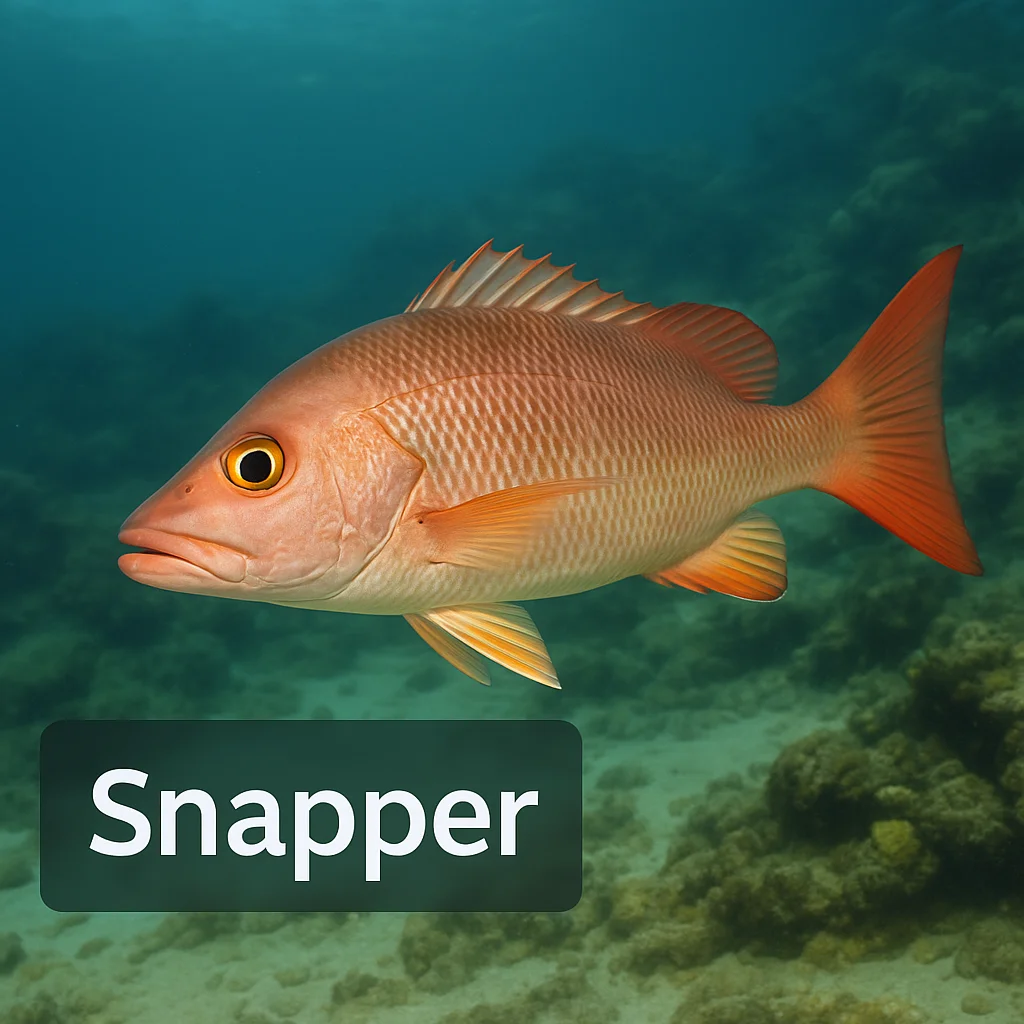
Snappers can be recognized by their elongated bodies, large mouths, and sharp teeth. They exhibit a variety of colors and patterns, which can change with age or season.
- Body shape and silhouette: Torpedo-shaped bodies ideal for swimming
- Key colors/patterns: Often red, yellow, gray; can have stripes or bars
- Distinctive features: Large eyes, dorsal fin
- Tracks, scat, or other field signs: N/A for aquatic species
- Common look-alikes: Sea bass, mullet; differentiated by behavior and habitat
- Elongated and streamlined silhouette
- Coloration varies widely among species
- Large eyes for better underwater vision
- Sharp dorsal fin
- Often display counter-shading
- Large mouth with prominent teeth
🧱 Body Structure & Physical Adaptations
The snapper's physical adaptations make it an adept predator in its marine environment. These adaptations include a streamlined body for efficient swimming and sharp teeth for capturing prey.
- Build and proportions: Sleek and muscular, built for speed and agility
- Teeth/beak/jaw adaptations: Strong jaws with sharp teeth for gripping prey
- Claws/hooves/wings/fins: Fins designed for swift navigation and quick turns
- Sensory strengths: Excellent vision, ability to detect vibrations
- Streamlined, torpedo-like body for speed
- Powerful tail fin for propulsion
- Sharp teeth for gripping and cutting prey
- Acute vision for spotting prey
- Sensory organs for detecting pressure changes
- Adapted to a wide range of water temperatures
🌍 Range & Distribution
Snappers are found in warm ocean waters worldwide, frequently inhabiting coral reefs, rocky environments, and seagrass beds.
- Continents/regions: Worldwide in tropical and subtropical oceans
- Elevation range: Found from shallow coastal areas down to deeper waters
- Seasonal movements: Some species may migrate locally based on breeding and feeding
- Caribbean Sea
- Gulf of Mexico
- Indo-Pacific regions
- Coral reefs of Southeast Asia
- Central Pacific islands
- Western Atlantic Ocean
🏞️ Habitat & Shelter
Snappers prefer structured underwater environments such as coral reefs and rocky outcrops where they can find food and protection. Seasonal changes can affect their distribution and behavior, with some species moving to deeper waters during cooler months.
🧭 Behavior & Ecology
Snappers exhibit complex behaviors in their aquatic environments. They are primarily diurnal, exhibiting solitary and schooling behaviors based on the availability of food and other environmental factors. Communication occurs through visual displays and occasional sounds.
- Daily routine: Active during the day, resting in sheltered areas at night
- Communication: Visual signals and some acoustic signals
- Typical interactions: Predators of smaller fish; play a role as both predators and prey in marine ecosystems
- Role in the ecosystem: Key predators, help maintain balance in fish populations
- Daytime activity peak
- Forms schools for feeding
- Territorial around feeding areas
- Highly adaptable to changing conditions
- Plays a role in controlling fish populations
- Essential component of coral reef ecosystems
👥 Social Life & Group Dynamics
Snappers occasionally form large schools, particularly juveniles, which provide safety in numbers from predators. Adult snappers may be more solitary or form small groups.
- Solitary vs social tendencies: Both solitary and social depending on species and environment
- Group types: Schools (often large in juveniles), loose aggregations in adults
- Cooperation: No significant cooperative behavior
- Dominance hierarchies: Not prominent, but displays occur over territory
- Juveniles form dense schools
- Adults may be solitary
- Occasional small groups
- Some species show territoriality
- Loose formation during feeding
- Behavior varies with food availability
🍽️ Diet, Prey & Predators
As carnivores, snappers primarily feed on smaller fish, crustaceans, and mollusks. They use a combination of stealth and speed to capture their prey. Depending on the region, their predators include larger fish species and humans.
- Main diet: Fish, crustaceans, mollusks
- Hunting strategy: Ambush predators with sudden bursts of speed
- Predators: Sharks, larger fish, humans (particularly overfishing)
- Scavenging behavior: Occasionally scavenge, but mainly hunt live prey
- Diet flexibility based on availability
- Opportunistic feeders
- Ambush and pursuit tactics
- Low predator numbers but vulnerable to overfishing
- Nocturnal inactivity limits predation
- Occurs in areas with high prey density
🦌 Hunting, Foraging & Movement
Snappers are agile swimmers, making swift movements when hunting. They often forage in reef areas where food is plentiful, using their quick movements and sharp teeth to catch prey.
- Locomotion style: Swift swimmers
- Speed and endurance: Capable of sudden fast bursts
- Typical hunting times: Daylight hours
- Navigation: Use familiar landmarks and scents
- Swims in short, quick bursts
- Prefers dawn and dusk for hunting
- Can navigate complex reef systems
- Relies on vision for hunting
- Remains agile and adaptable
🧠 Intelligence & Senses
Snappers are considered intelligent among fish, capable of learning from previous experiences. Their senses, particularly vision, are well developed to aid in hunting and avoiding predators.
- Problem-solving: Adaptable to new conditions
- Senses: Excellent vision, detect vibrations
- Uncertainties: Research on problem-solving is limited
- Keen eyesight
- Highly sensitive lateral line
- Ability to learn from environment
- Strong sense of spatial awareness
- Limited research on cognitive abilities
- Uses environmental cues for navigation
🪺 Reproduction, Pregnancy & Parenting
Reproduction in snappers can vary widely, with some species exhibiting complex courtship rituals. They generally spawn in large groups, releasing eggs and sperm into the water column.
- Breeding seasonality: Often seasonal, based on water temperature
- Mating system: Varies; often promiscuous
- Litter size: Thousands of eggs per breeding event
- Parenting roles: No parental care after spawning
- Spawning periods are temperature-influenced
- High fecundity, many eggs released
- No parental investment post-spawning
- Fertilization is external
- Spawning aggregations common
♀️♂️ Male vs Female Differences
In many snapper species, sexual dimorphism is minimal, though some may have slight coloration variations. Males and females generally exhibit similar roles in both behavior and appearance.
- Size differences: Usually minor
- Coloration: Occasionally males or females have brighter colors during breeding
- Behavioral role differences: Minimal differences, both participate in spawning
- Minor size variations
- Breeding colors can vary
- Similar feeding behaviors
- Shared habitats and roles
- Reproductive functions differentiate sexes
🧬 Subspecies & Variation
The snapper family includes numerous species, each adapted to specific habitats and regions. Variations may occur in terms of size, coloration, and behavior.
- Subspecies: Includes several Lutjanus species
- Local adaptations: Coloration and size adapted to local environments
- Uncertainty: Classification can be debated due to diversity
- Varied skin colors among species
- Differences across geographic locations
- Environmental influence on size
- Several species under a broad family
- Research ongoing for subspecies classification
⚠️ Threats, Conservation & Human Interaction
Snappers face a number of threats, primarily from overfishing and habitat destruction. Conservation efforts focus on sustainable fishing practices and habitat restoration. Ethical consumption and responsible fishing can aid in their conservation.
- Challenges: Overfishing, habitat destruction
- Conservation status: Many species are under pressure
- Human interaction: Valued for food and sportfishing
- Affected by overfishing
- Role in marine eco-tourism
- Managed under fishing quotas
- Importance of habitat protection
- Promote sustainable fishing practices
- Key species in fish markets
✨ Fun Facts & Unique Traits
- Snappers are known to "snap" their jaws, which is how they got their name.
- They play a crucial role in coral reef ecosystems by controlling prey populations.
- Some snappers can change sex based on environmental or social conditions.
- Their keen eyesight allows them to be effective hunters even in murky waters.
- Juvenile snappers often reside in shallow seagrass beds as nurseries.
- They can produce sound by grinding their teeth as a means of communication.
📌 Summary
- Snappers are recognized by their streamlined bodies with varied coloration.
- Found in tropical and subtropical marine environments globally.
- Play a critical ecological role as predators in reef ecosystems.
- Face significant threats from overfishing and habitat degradation.
- Exhibit both solitary and schooling behaviors based on life stage and environment.
- Diverse in species with notable local adaptations in size and coloration.
- Generally, no parental care post-spawning with high fecundity.
- Sustainable fishing practices are crucial for their conservation.
- Snapper species are often challenging to distinguish due to similar appearances.