🦁 Trumpetfish
🧾 Quick Facts
Trumpetfish are fascinating marine fish known for their elongated bodies and stealthy hunting tactics. They belong to the family Aulostomidae and are popular among divers and marine enthusiasts due to their intriguing appearance and behavior.
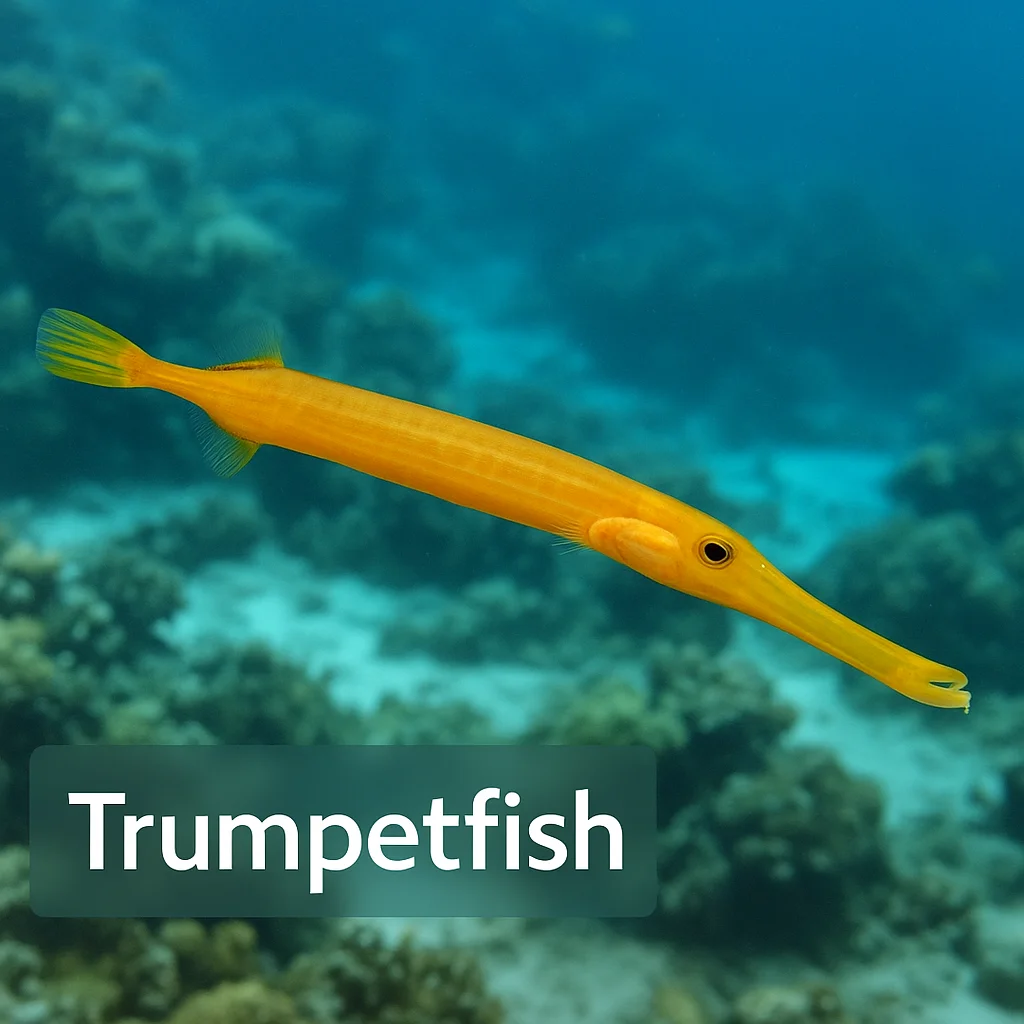
- Common name(s): Trumpetfish
- Scientific name: Aulostomus spp.
- Animal type: Fish
- Typical adult size: 60-90 cm (approx. 24-35 inches)
- Typical lifespan: 6-15 years in the wild
- Diet type: Carnivore; feeds on small fish and crustaceans
- Activity pattern: Diurnal
- Social structure: Typically solitary
- Speed/movement highlights: Slow-moving; can hover and strike fast
- Intelligence/learning: Known for stealth tactics in hunting
- Primary habitats: Coral reefs and seagrass beds
- Geographic range: Tropical and subtropical waters globally
- Predators/threats: Larger predatory fish; habitat loss by humans
- Conservation status: Varies by region
🔍 Identification & Appearance
Trumpetfish are easy to identify thanks to their distinctive, elongated bodies and ability to mimic sea grass. They have a tubular snout and can change color to adapt to their surroundings. Their fins are small and not very prominent, aiding their stealth when hunting.
- Elongated, tubular body shape
- Color ranges from yellow, brown, to gray, often with stripes or spots
- Capable of color change for camouflage
- Snout resembles a trumpet
- Small, rounded pectoral fins
- Thin dorsal tail fin
- Easy to confuse with cornetfish, which have longer bodies and a forked tail
- Hangs vertically to blend with sea grasses
- No significant track marks due to aquatic lifestyle
🧱 Body Structure & Physical Adaptations
Trumpetfish have a slender build optimized for stealth hunting in reefs. Their body allows them to navigate through coral structures with ease. The snout is highly specialized for their method of feeding, which involves quick sucking motions to capture prey.
- Long, slender body with a tubular form
- Specialized long snout for suction feeding
- Compressed body aids in vertical swimming
- Small, rounded fins that aid in subtle swimming movements
- Large mouth relative to body size for engulfing prey
- Excellent vision adapted for spotting prey in coral environments
- Color-changing ability for camouflage
- Small flexible bones to weave through corals
🌍 Range & Distribution
Trumpetfish inhabit tropical and subtropical waters across the globe. They are frequently found around coral reefs, rocky shorelines, and seagrass beds. They do not typically migrate long distances, often staying within their chosen regions.
- Common in Caribbean waters
- Found in the Atlantic Ocean
- Occur in the Indian Ocean
- Pacific Ocean populations near Hawaii
- Coastal regions of Africa and Southeast Asia
- Warm tropical waters between 22-28°C (72-82°F)
- Prefer areas with abundant cover like corals and seagrass
- Mostly found at depths of 0-25 meters
- Resident species with little seasonal migration
🏞️ Habitat & Shelter
Trumpetfish favor the rich ecosystems of coral reefs and seagrass beds, where they find both food and shelter. The complex structures of these habitats provide hiding spots and opportunities to ambush prey. Weather and water temperature shifts can influence their movements within these areas.
- Live among coral reefs and seagrass beds
- Shelter among soft corals and fan-shaped corals
- Inhabit crevices and narrow spaces in rocky areas
- Few adaptations for wide-ranging habitat; restricted to inshore waters
- Less active during rough seas or drastic temperature changes
- Behavior influences by tidal changes, often hiding during strong tides
🧭 Behavior & Ecology
Trumpetfish exhibit a stealth-based approach to hunting, often hovering motionlessly or moving slowly to avoid detection by prey. They are known to align themselves vertically with sea grasses or corals, using their color-changing ability to remain inconspicuous. They are solitary hunters but play an essential role in maintaining the ecological balance by controlling small fish populations.
- Observed hovering in the water column
- Assumes vertical position to mimic surroundings and avoid predator detection
- Little vocal communication; relies more on body language and positioning
- Opportunistic feeder, often following larger fish to catch prey stirred up by them
- Important predator of small reef fish, contributing to the control of prey populations
- Few competitive interactions due to unique hunting strategy
👥 Social Life & Group Dynamics
Trumpetfish are primarily solitary creatures. They occasionally associate loosely with groups, especially when food resources are abundant, but do not form structured social groups. During breeding seasons, they only temporarily pair for mating purposes.
- Predominantly solitary by nature
- Rarely forms groups except in temporary feeding aggregations
- Brief pair bond during mating season
- No complex social hierarchy detected
- Minimal conflict observed among individuals
- Mating involves close proximity but no long-term pair bonds established
🍽️ Diet, Prey & Predators
Trumpetfish are carnivorous, feeding primarily on small fish and invertebrates. They utilize a unique stalking and ambush strategy, often using larger fish species as cover to sneak up on their prey. Their primary predators include larger predatory fish and humans, mainly due to habitat destruction rather than direct predation.
- Feeds on small fish such as cardinalfish and gobies
- Also eats shrimp and small crustaceans
- Uses other fish as 'shields' to ambush unsuspecting prey
- Mouth acts as a vacuum to rapidly ingest prey
- Predators include groupers and sharks
- Major threat from habitat loss due to human activities
🦌 Hunting, Foraging & Movement
Trumpetfish are primarily ambush predators. They showcase remarkable patience, often hovering near their prey until the perfect moment arises. Their slow-moving, stealthy approach makes them successful hunters of small, wary fish in coral ecosystems.
- Ambush predator, relies on stealth and cover
- Suction feeding allows rapid prey capture
- Poor swimmers over long distances; not built for speed
- Active mostly during daylight hours, less active at night
- Hunting involves slow, deliberate movements to remain undetected
- Utilizes coral reefs and larger fish for camouflage and stealth
🧠 Intelligence & Senses
Trumpetfish possess specialized hunting skills that demonstrate a form of ecological intelligence. While not recognized for high cognitive abilities, they utilize visual cues effectively and have adapted to their environment in ways that optimize their predatory efficiency.
- Excellent vision adapted for spotting prey amidst coral
- Displays strategic use of environment for hunting purposes
- Limited problem-solving abilities but effective at stalking prey
- Acute sense of sight helps in camouflage and detection
- No known use of tools or advanced learning behaviors
- More research needed on cognitive capabilities
🪺 Reproduction, Pregnancy & Parenting
Trumpetfish engage in a courtship display where males often exhibit vibrant colors to attract females. Their mating system is loosely monogamous, with pairs forming during the breeding season. After mating, females lay eggs that are left to develop independently without parental care.
- Breeding season varies by region with warmer months being common
- Males display brighter colors to attract mates during courtship
- Monogamous pair bonds form briefly during mating
- Eggs are pelagic, released into the open water
- No parental care after eggs are spawned
- Gestation period varies; eggs hatch into planktonic larvae
- Young are independent and dispersed via ocean currents
♀️♂️ Male vs Female Differences
In trumpetfish, males and females appear quite similar, with few noticeable differences in size or coloration. Males may exhibit more vibrant colors during the breeding season as part of their courtship display tactics.
- Minimal sexual dimorphism in physical size
- Males may show brighter color variations during mating season
- Behavioral differences primarily visible during breeding
- Both sexes participate in similar feeding and habitat usage
- Observation needed to notice subtle color changes in males
🧬 Subspecies & Variation
While trumpetfish are typically classified under the genus Aulostomus, there may be regional variations based on environmental adaptations. Differences might include subtle color variations and habitat preferences, though these variations are not enough for distinct subspecies classifications.
- Regional color variation observed in distinct habitats
- Broader body form in some populations for specific habitats
- No formally recognized subspecies or significant genetic divergence
- Varying color patterns between Caribbean and Pacific populations
- Some debate exists on classifying regional morphs
⚠️ Threats, Conservation & Human Interaction
Trumpetfish face several threats primarily driven by human activities, including habitat degradation due to coastal development and pollution. They are not typically targeted by fisheries but are affected by bycatch and reef damage. Conservation efforts focus on protecting reef habitats to ensure their survival.
- Main threat from habitat destruction and coral bleaching
- Population decline noted in heavily fished regions
- Protected areas help conserve crucial habitats
- Not commonly harvested, low demand in the pet/aquarium trade
- Potential impact from climate change affecting coral reefs
- Encourages eco-friendly tourism and responsible diving practices to protect habitats
✨ Fun Facts & Unique Traits
- Trumpetfish can swim vertically, aligning their bodies with tall sea plants
- Their long snout is perfect for their suction feeding style
- They often use "follow-the-leader" tactics by shadowing larger fish
- Capable of changing colors to blend in with surroundings
- Despite their striking appearance, trumpetfish are non-aggressive
- Known to "hover" motionless for extended periods to ambush prey
- While typically solitary, they demonstrate fascinating social tactics for feeding
📌 Summary
- Distingbatchive for their long, narrow bodies and tubular snouts, trumpetfish are skilled ambush predators.
- Key habitats include coral reefs and seagrass beds in tropical waters, with a focus on camouflage and stealth.
- Typical carnivorous diet of small fish and crustaceans, using unique covert hunting tactics.
- Solitary lifestyle with minimal social interaction except during feeding and breeding.
- Reproduction involves brief mating pairs, with no parental involvement post-spawning.
- Not distinguished by marked male-female differences outside of mating displays.
- Conservation is critical due to threats from habitat loss and environmental changes.
- Play a significant ecological role in maintaining the balance in coral reef ecosystems.