🦁 Alligator Snapping Turtle
🧾 Quick Facts
The Alligator Snapping Turtle is often recognized for its prehistoric appearance and powerful bite. It is the largest freshwater turtle in North America, known for its rugged appearance and unique hunting strategy.
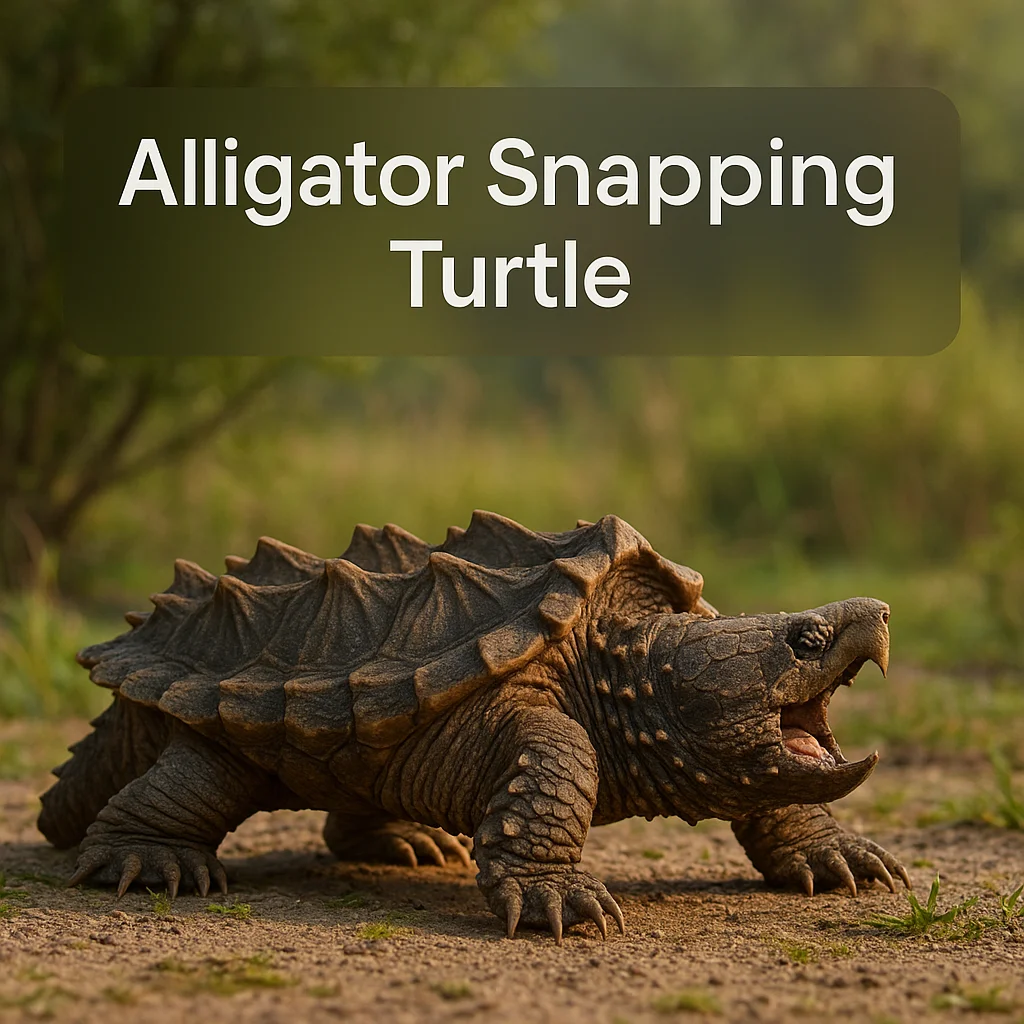
- Common name(s): Alligator Snapping Turtle
- Scientific name: Macrochelys temminckii
- Animal type: Reptile
- Typical adult size: 15-26 inches in shell length; 35-175 pounds in weight
- Typical lifespan: 20-70 years in the wild
- Diet type: Carnivore; feeds on fish, amphibians, smaller turtles, and carrion
- Activity pattern: Primarily nocturnal
- Social structure: Solitary
- Speed / movement highlights: Slow-moving with bursts of speed during hunting
- Intelligence/learning: Capable of simple learning and use of deception in hunting
- Primary habitats: Freshwater rivers, lakes, and swamps
- Geographic range: Southeastern United States
- Predators/threats: Humans, habitat destruction, pollution
- Conservation status: Varies by region; generally considered vulnerable
🔍 Identification & Appearance
Recognizing an Alligator Snapping Turtle involves observing its distinct features beyond just size. Their rugged shell with three prominent ridges provides clear identification marks, complemented by their dinosaur-like head and strong, beak-like jaws.
- Body shape and silhouette: Massive, rough shell with a broad head
- Key colors/patterns: Dark brown to greenish gray, often coated in algae
- Distinctive features: Three dorsal ridges on shell, powerful jaws, worm-like lure in mouth
- Tracks, scat, or other field signs: Rarely leaves tracks; scat is often in water
- Common look-alikes: Common Snapping Turtle; distinguish by head shape and shell ridges
- Top ID Tips
- Look for the jagged ridges along the shell
- Observe the broad, triangle-shaped head
- Check for a spiked tail
- See if the inside of the mouth has a worm-like lure
- Note the thick, muscular legs and claws
- Color can vary with algae growth
- Distinguish from domestic turtles by size and ruggedness
- Recognize the massive, robust structure
🧱 Body Structure & Physical Adaptations
The Alligator Snapping Turtle is built for ambush predation in aquatic environments. Its bulky build, strong jaws, and camouflaged body aid in its survival and hunting strategy.
- Build and proportions: Stocky build with a very large head
- Teeth/beak/jaw adaptations: Sharp, hooked beak used for tearing prey
- Claws/hooves/wings/fins: Powerful claws for digging and gripping
- Sensory strengths: Excellent underwater vision and sense of smell; limited land vision
- Key Adaptations
- Hard, protective shell with ridges
- Camouflaged skin helps in ambush
- Worm-like appendage for luring fish
- Massive jaw strength for catching prey
- Can stay submerged for long periods
- Resilient to low oxygen environments
- Grows algae for added camouflage and ecology
🌍 Range & Distribution
The Alligator Snapping Turtle primarily inhabits freshwater systems in the southeastern United States, thriving in large rivers, lakes, and swamps.
- Continents/regions: North America
- Typical countries/biomes: United States, especially in the Mississippi River Basin
- Elevation range: Typically found in lowland aquatic regions
- Seasonal movements: Mostly resident with no significant migrations
- Where You Might Find It
- Large, slow-moving rivers
- Lakes with abundant shelter
- Swamps and marshes
- Muddy river bottoms
- Shaded aquatic environments
- Water bodies in southeastern states
- Protected conservation areas
🏞️ Habitat & Shelter
These turtles prefer habitats with plenty of submerged logs and muddy bottoms where they can remain inconspicuous. Seasonal changes such as water temperature affect their activity levels, leading them to take refuge in deeper waters during cooler periods.
- Preferred habitats: Freshwater rivers, swamps, wetlands
- Microhabitats and shelter: Under submerged logs and in muddy bottoms
- Weather/season changes behavior: Less active in cooler months
- Importance of habitat knowledge: Essential for protection and survival of the species
🧭 Behavior & Ecology
The Alligator Snapping Turtle's behavior revolves around its solitary, ambush-predator lifestyle. It plays a role as both predator and scavenger in its ecosystem.
- Daily routine: Mostly sedentary; waits for prey
- Communication: Does not use vocalizations; relies on body language
- Interaction with species: Predation on fish populations
- Ecosystem role: Important predator in freshwater ecosystems
- Behavior Highlights
- Masters of camouflage and deception
- Sits still for hours, ambushing prey
- Consumes nearly anything it can catch
- Engages in scavenging dead animals
- Uses natural environments for stealth
- Famous for compelling prey with lure
- Indicates health of freshwater ecosystems
👥 Social Life & Group Dynamics
Primarily solitary, the Alligator Snapping Turtle does not engage in intricate social structures or group dynamics. Interactions are mostly limited to breeding and territory disputes.
- Solitary vs social: Strongly solitary
- Group types: Little to no formation of groups
- Cooperation: Minimal; sometimes found near other turtles without social engagement
- Conflict resolution: Displays and physical combat rarely among males
- Social Structure Notes
- No cooperative breeding or hunting
- Minimal territorial assembly
- Compete for prime locations
- Basking can sometimes be social
- Limited hierarchical structure
🍽️ Diet, Prey & Predators
As carnivores, these turtles rely on a varied diet consisting mainly of aquatic animals. They adopt an ambush strategy by lying still and using their lure to attract fish.
- Diet: Predominantly fish, but also small mammals, birds, and other turtles
- Hunting strategy: Uses a worm-like appendage to lure prey into its mouth
- Natural predators: Humans are the primary threat
- Defense mechanisms: Heavy shell and powerful bite
- Scavenging behavior: Eats carrion opportunistically
- Feeding Notes
- Opportunistic feeders
- Prefers live prey
- Capable of fast strikes in ambush
- Strong jaws for crushing shells
- Can open mouth for hours
- Natural cleaner of ecosystems
🦌 Hunting, Foraging & Movement
Alligator Snapping Turtles are ambush predators, sitting motionless for prey to come near. Despite their slow movement on land, they are effective hunters underwater.
- Locomotion style: Slow walking on land; efficient underwater swimming
- Speed and endurance: Slow but powerful and sudden movements
- Foraging times: Primarily active at night
- Navigation: Remains within a known home range
- Movement & Strategy
- Uses stealth and stillness
- Strategic ambush positions
- Home-bound animals, limited migration
- Skilled swimmers when needed
- Does not chase actively, waits for prey
- Efficient foraging even in murky water
🧠 Intelligence & Senses
The intelligence of the Alligator Snapping Turtle is marked by its use of deceptive hunting methods. While considered primitive, it has well-developed senses tailored for aquatic life.
- Problem-solving: Limited but present in hunting strategy
- Senses: Strong sense of smell and keen underwater vision
- Learning: Capable of basic learning processes, mainly in food-related scenarios
- Notable Abilities
- Camouflage expertise
- Adaptive ambush techniques
- Specialized in luring techniques
- Underwater agility
- Able to remember prime locations
- Exploits ecological niches
🪺 Reproduction, Pregnancy & Parenting
Reproduction occurs mostly in spring, and females lay eggs on land. There's no parental care post-egg laying, which makes hatchlings independent soon after emerging.
- Breeding seasonality: Primarily in late spring
- Mating system: Polygamous with minimal pair bonding
- Gestation/incubation: Eggs incubate for 100-140 days
- Litter/clutch size: Typically 10-50 eggs
- Parental roles: No involvement after egg-laying
- Reproduction Snapshot
- Lay eggs on land
- Incubation affected by temperature
- Hatchlings navigate to water independently
- Simple nesting strategy
♀️♂️ Male vs Female Differences
Differences between male and female Alligator Snapping Turtles are generally subtle but distinct in size and certain physical traits.
- Size/weight: Males are typically larger and more robust
- Behavioral: Males are more territorial
- Tail morphology: Males have longer, thicker tails
- Plastron shape: Females have flatter plastrons
- Sex Differences at a Glance
- Males often have thicker tails
- Females slightly smaller
- Males exhibit more aggression
- Territorial tendency in males
🧬 Subspecies & Variation
No officially recognized subspecies exist, but geographical variation can be seen in size and slight coloration differences among populations.
- Phenotypic variation: Minor size differences across regions
- Coloration variance: Camouflage adaptations depend on habitat
- Adaptive traits: Enhanced in certain environmental settings
- Distinct geographic features: Influenced by local ecosystem type
- Variation Notes
- Adapt to regional waters
- Variations enhance survival
- Camouflage varies slightly with environment
- Broad range but limited speciation
⚠️ Threats, Conservation & Human Interaction
Human activities such as habitat destruction and pollution pose significant threats to the Alligator Snapping Turtle. Conservation efforts focus on protecting habitats and mitigating these problems.
- Natural challenges: Predators are rare; primarily age-related declines
- Human pressures: Habitat loss, hunting, and pollution
- Conservation efforts: Habitat protection and law enforcement
- Coexistence tips: Support wetland conservation and avoid pollution of waterways
- Responsible Notes
- Avoid capturing or disturbing
- Support habitat preservation
- Do not release pets into the wild
- Encourage humane interaction
✨ Fun Facts & Unique Traits
- Has one of the strongest bites in the animal kingdom
- Their mouths are often compared to bear traps
- Alga-covered shells help them blend in perfectly with aquatic habitats
- Can stay submerged without breath for up to 40 minutes
- Older turtles are more solitary than younger ones
- They play a key role in maintaining healthy food webs
- Mistaken for logs by unsuspecting prey
- Notorious for their "patience" as hunters
- Sometimes mistaken in stories as aggressive, but these turtles are typically passive
📌 Summary
- Hard-shelled behemoth of North American waters
- Prefers deep waters, especially in southern states
- Diet mainly consists of fish, luring with unique mouth structure
- Few natural predators, longevity contributes to mystique
- Hunting through ambush—often mistaken for obstacles in water
- Solitary, limited interaction with other turtles
- Reproductive strategy involves multiple egg-laying over lifetime
- Male vs. female differences primarily in size and tail morphology
- Significant conservation focus due to habitat threats