🦁 American Alligator
🧾 Quick Facts
The American Alligator, often found in the southeastern United States, is a powerful reptile known for its formidable presence in freshwater environments. This ancient creature is an impressive display of evolutionary adaptability, with a role that shapes its wetland habitats.
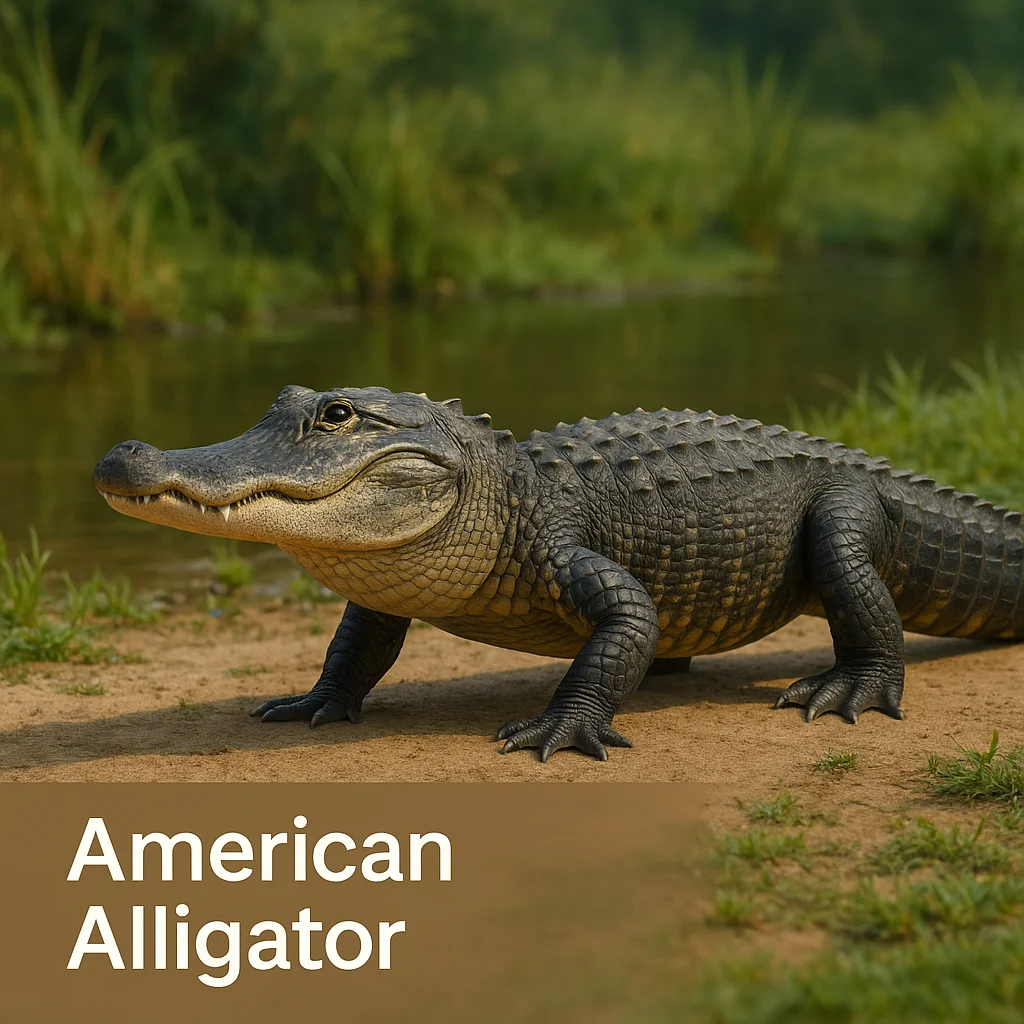
- Common name(s): American Alligator
- Scientific name: Alligator mississippiensis
- Animal type: Reptile
- Typical adult size: 10-15 feet in length, weighing 500-1,000 pounds
- Typical lifespan: 35-50 years in the wild; up to 65 years in captivity
- Diet type: Carnivore; primarily fish, birds, mammals
- Activity pattern: Nocturnal
- Social structure: Generally solitary
- Speed / movement: Up to 20 mph in short bursts on land; excellent swimmer
- Intelligence/learning: Capable of problem-solving and learning routines
- Primary habitats: Freshwater wetlands, swamps, marshes, lakes, rivers
- Geographic range: Southeastern United States
- Predators/threats: Larger alligators, humans (hunting and habitat loss)
- Conservation status: Least Concern, though habitat loss is a concern
🔍 Identification & Appearance
The American Alligator is easily recognized by its robust body, broad head, and thick tail. Its partially submerged positioning in water, with eyes, and nostrils protruding, provides an effortless predatory advantage. Juveniles are characterized by bright yellow stripes on their bodies, which fade as they mature into a darker, olive-brown or blackish hue.
- Sturdy, armored bodies with rough, bumpy skin
- Coloration typically dark olive-brown to black
- Large, rounded snout unlike its cousin, the crocodile
- Adults often exceed 10 feet in length
- Thick, muscular tail used for swimming
- Distinctive eyes and nostrils situated on the top of their head
- Presence of "eyeshine" under light due to a reflective layer in the eyes
- Powerful jaw holds between 74-80 sharp teeth
- Top ID Tips
- Look for a broad, U-shaped snout
- Juveniles show distinct yellowish stripes on a dark background
- Mature against the razor-back ridges on the tail
- Prefer freshwater environments; less likely in brackish water
- Listen for deep, bellowing roars, especially during breeding season
- Watch for "eye-shine" at night using a flashlight or torch
- Note the range; common in southeastern U.S.
- Avoid confusion with crocodiles; alligators have wider snouts
- Observe from a safe distance; avoid direct interaction
🧱 Body Structure & Physical Adaptations
The American Alligator displays various physical adaptations that underscore its predatory nature and aquatic lifestyle. It boasts powerful limbs that are adept at moving in water and traversing land, while its tail aids in impressive swimming abilities. An alligator's highly developed sensory organs ensure that it can detect and react to the slightest of environmental changes, securing its place as an apex predator.
- A sturdy, streamlined body facilitates swimming
- Teeth replaced throughout life, ensuring constant efficiency
- Webbed feet adapt to both aquatic and muddy habitats
- Eyes, nostrils, and ears at head-top optimize surface observation
- Highly sensitive to vibrations in water; detecting prey
- Well-armored skin, granting protection against aggression
- Lung capacity supports prolonged submersion
- Thick skull and jaw structure deliver a forceful bite
- Ample muscle mass for short bursts of speed
🌍 Range & Distribution
The American Alligator resides primarily in the southeastern United States, occupying habitats that provide the warmth and water-dependent environments necessary for their survival. While they are most often associated with expansive wetland regions, they can adapt to other aquatic environments that offer adequate resources.
- Southeastern United States: Florida, Louisiana, and neighboring states
- Prefers warm, humid climates for habitat sustenance
- Resides predominantly in low-elevation wetlands and marshes
- Occasionally found in man-made waterways, such as canals
- Seasonal movement within waterways for food and breeding
- Most abundant in areas with ample prey and suitable nesting sites
- Rare in areas north of the Carolinas
🏞️ Habitat & Shelter
American Alligators are quintessential inhabitants of wetland ecosystems, making their homes in environments that offer still water and an abundance of prey. Their presence is a keystone factor in maintaining the ecological balance of such habitats. Alligators remain predominantly in freshwater locations, migrating to deeper waters seasonally or during harsh weather conditions. They may dig "gator holes" as refuge during dry periods or for temperature regulation.
Understanding their habitat preferences aids in conserving essential wetland habitats that support diverse wildlife populations.
🧭 Behavior & Ecology
The American Alligator's lifestyle revolves heavily around its aquatic environment, influencing their behavioral patterns and ecological role. As opportunistic feeders, their diverse diet allows them to regulate prey populations, subsequently maintaining the ecological balance within their habitat. Vocalizations and physical displays serve as crucial communication tools, especially during the breeding season.
- Typically seen basking in the sun to regulate body temperature
- Active mainly at night; strong crepuscular feeding tendencies
- Vocal communications increase during mating; social signaling
- Key predator in maintaining fish and small mammal populations
- Influences ecosystem by creating alligator holes; shelter for other species
- Territorial; actively defends area from encroaching conspecifics
- Often rests on the water's edge, camouflaged among vegetation
👥 Social Life & Group Dynamics
Generally solitary creatures, American Alligators do congregate for specific purposes such as basking and breeding. While not social in a traditional sense, indirect associations exist through shared habitats and resources. Dominance is often displayed through size and strength during territorial disputes, and smaller individuals tend to avoid larger, more dominant ones.
- Primarily solitary, except during mating or congregated around limited food sources
- Mature males establish territories; females closer to shared nesting sites
- Agonistic encounters resolved mostly by visual displays rather than combat
- Juveniles remain near the mother for protection until they can fend for themselves
- Weak hierarchies established during communal basking
- No true pack or herd dynamics, but loosely tolerant of conspecifics
🍽️ Diet, Prey & Predators
The American Alligator is an apex predator with a diverse diet, which includes fish, birds, mammals, and invertebrates. Young alligators focus on smaller prey such as insects and amphibians, while adults target larger animals. Their powerful jaws and ambush tactics allow successful capturing of these prey species. Natural predators are limited primarily to other alligators and humans, who threaten them through habitat encroachment and hunting.
- Diet varies; includes fish, birds, mammals, and herpetofauna
- Smaller juveniles rely on insects and small fish
- Employ stealth and ambush techniques for hunting larger prey
- Supplement diet with carrion opportunistically
- Predation pressure mostly from larger alligators and humans
- Anti-predator strategy includes camouflage and formidable size
- Generally, avoid unnecessary conflicts
🦌 Hunting, Foraging & Movement
The American Alligator utilizes its immense bodily strength coupled with silent stalking skills to capture prey, both terrestrially and aquatically. Primarily ambush predators, they seldom engage in long pursuits due to inefficiency in stamina, favoring short, powerful bursts of speed instead. Knowledge of its home range contributes to refined hunting tactics within localized areas.
- Efficient swimmers, stealthily approach prey in water
- Occasional terrestrial movement for ambush positioning
- Utilizes sudden, explosive speed in brief hunting bursts
- Primarily ambushes prey, possessing calculated hunting strategies
- Establishes home range based on prey availability
- Migratory movements motivated by environmental conditions and breeding
🧠 Intelligence & Senses
The cognitive abilities of the American Alligator demonstrate adaptability through learned behaviors and problem-solving skills. Its exceptional sensory array enables efficient prey detection and adaptive situational responses, often highlighted through complex behavioral displays during both hunting and social interactions.
- Displays problem-solving abilities, especially in feeding behaviors
- Advanced perceptive abilities through acute olfactory detection
- Effective vision with adaptation suited for low light conditions
- Powerful jaw sensitivity for detecting vibrations in water
- Limited vocal communication but capable of complex signaling
- Possesses spatial awareness within home territory
🪺 Reproduction, Pregnancy & Parenting
The reproductive cycle of the American Alligator is closely tied with their environmental conditions, particularly temperature. Males engage in elaborate displays to attract mates, followed by nesting activities carried out by the females. Post-lay maternal care ensures high rates of offspring survivability, a distinctive feature among reptiles.
- Breeding typically occurs in late spring to early summer
- Males engage in bellowing and splashing to court females
- Polygynous mating system; females select competitive males
- Nesting occurs in late spring, with sites near water edges
- 45-50 days of incubation; hatchlings emerge in late summer
- Females exhibit significant parental care; guard nest and young
- Young alligators stay with mothers for over a year post-hatching
♀️♂️ Male vs Female Differences
Sexual dimorphism is pronounced in the American Alligator, with males reaching significantly larger sizes than females. Behavioral roles differ primarily during the breeding season, with males showcasing aggressive displays and females focusing on nesting and offspring care.
- Males are larger, heavier, and more aggressive
- Females have a rounded postnatal behavior focus
- Distinct bellowing in males as territorial and mating signals
- Size advantage grants males greater territory range
- Females select nest sites and exhibit protective tendencies
🧬 Subspecies & Variation
The American Alligator shows little division into subspecies due to robust and consistent genetic structuring across populations. However, geographic variants exist with minor differences in size and habitat preference, shaped by localized environmental pressures.
- No recognized subspecies within Alligator mississippiensis
- Minor regional size variations; larger in optimal habitats
- Alternate nesting patterns based on local environmental variables
- Discovery in varied subtropical and temperate wetland zones
⚠️ Threats, Conservation & Human Interaction
While currently classified as Least Concern, American Alligators face significant challenges from habitat loss and environmental changes. Often misunderstood, education remains vital in ensuring harmonious human cohabitation with alligator populations. In places where they intersect notably with human activities, management practices help mediate potential conflicts.
- Natural predator numbers low; primary threat is habitat encroachment
- Protected by law; conservation efforts curtail illegal hunting
- Potential danger in human-dominated landscapes; education is key
- Responsible viewing practices to ensure both human and alligator safety
- Prominent conservation success case; recovery through effective protection laws
✨ Fun Facts & Unique Traits
- The American Alligator is one of the few known reptilian species to show parental care to its young.
- They have been living on Earth for over 150 million years, representing evolutionary resilience.
- Alligators can regulate their temperature by basking in the sun or seeking shade.
- Their mouth contains glands to help expel excess salt from brackish environments.
- The bony plates on their back, known as osteoderms, offer both armor and heat conduction.
- Juvenile alligators are highly vocal at hatching to communicate and avoid predators.
- The sex of a hatchling is determined by the temperature of their nesting environment.
- Despite their fierce appearance, American Alligators have a profound ecological impact through habitat creation and maintenance.
📌 Summary
- Recognizable by their broad snouts, armored bodies, and specific regional range.
- Prefer wetlands such as swamps, marshes, and rivers.
- Native to the southeastern United States with primary habitats in Florida and Louisiana.
- Carnivorous diet includes a wide range of prey: fish, mammals, birds.
- Natural predators are larger alligators; human interactions pose primary threats.
- Mainly solitary, territorial, with some seasonal aggregations during mating.
- Show pronounced parental involvement; females guard nests and young post-hatching.
- Key adaptations include powerful tails, acute sensory organs, and formidable jaw strength.
- Distinguished by their ecological role in shaping wetland ecosystems and balance.