🦁 Box Turtle
🧾 Quick Facts
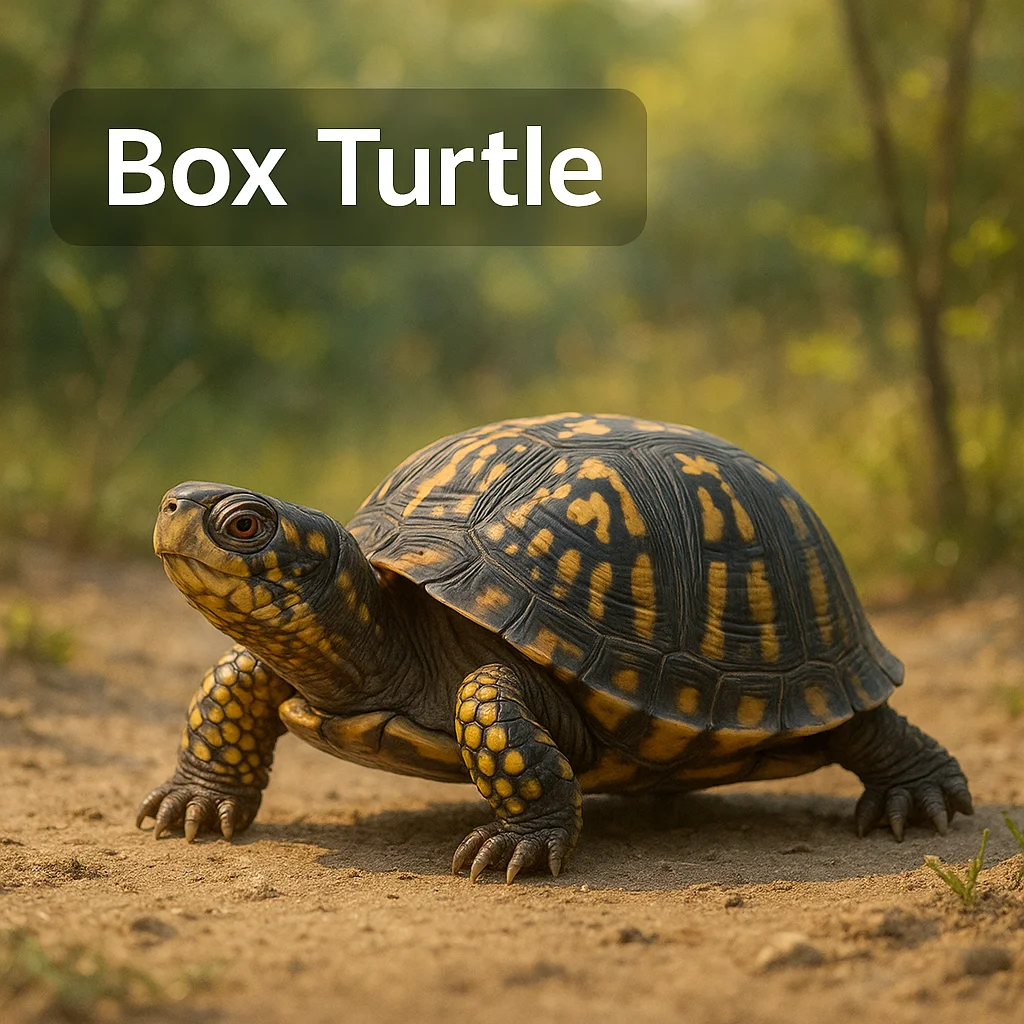
Box turtles are a group of terrestrial turtles characterized by their unique ability to close their shells tightly, providing additional protection from predators. These turtles are native to North America and are fondly known for their distinctive domed shells and friendly demeanor.
- Common name(s): Box Turtle
- Scientific name: Terrapene (varies by species)
- Animal type: Reptile
- Typical adult size: 4.5 to 8 inches in length
- Typical lifespan: 25 to 50 years, potentially more in captivity
- Diet type: Omnivore; eats plants, insects, and small animals
- Activity pattern: Diurnal with peaks in crepuscular hours
- Social structure: Solitary
- Speed/movement: Slow-moving, known for their walking gait
- Intelligence/learning: Moderate problem-solving skills
- Primary habitats: Woodlands, grasslands, and marshes
- Geographic range: North America, primarily eastern and central United States
- Predators/threats: Raccoons, birds, habitat destruction
- Conservation status: Varied by region; some populations are vulnerable
🔍 Identification & Appearance
Box turtles are readily recognized by their high-domed shells and colorful markings. Their carapace can be brownish or olive with vibrant yellow, orange, or red patterns. This intricate coloration helps them blend into their natural environment. Their plastron is hinged, allowing them to completely close off their shells, which is a unique adaptation among turtles. While juveniles are typically brighter, their colors may fade slightly with age.
- Body shape: Dome-shaped shell with a flat bottom
- Key colors: Variety of browns, yellows, and oranges
- Distinctive features: Hinged plastron, colorful patterns
- Tracks: Small, clawed footprints in moist areas
- Look-alikes: Painted turtles, distinguishable by their flatter shells
- Look for a high-domed shell
- Check for bright, intricate patterns
- Observe the hinged plastron closing mechanism
- Note their clawed feet
- Commonly found in moist, wooded environments
- Sturdy legs and claws for digging
- Hinged plastron for protection
- Colorful shell patterns for camouflage
- Strong sense of smell for locating food
- Compact body shape for close-fitting sheath
- Excellent daytime vision
- Eastern United States forests
- Open woodlands in the Midwest
- Meadow edges and grassy fields
- Transition zones between forest and wetland
- Parklands and protected reserves
- Solitary lifestyle
- Visual and minimally vocal communication
- Seed disperser via fecal matter
- Influences insect population dynamics
- Enters brumation in cooler months
- Limited social interaction outside of breeding season
- Primarily solitary creatures
- Interactions increase during breeding season
- Home range familiarity, not strictly territorial
- Minimal social clustering
- No evidence of cooperative behavior
- Diet consists of both plant and animal matter
- Seasonal dietary shifts
- Consumes fruits and insects
- Protected against predators by shell closure
- Important ecological role as seed dispersers
- Slow and steady gait
- Forage in familiar areas
- Strong biting capability for various foods
- Prefers early morning/late afternoon activity
- Uses body and shell color for camouflage
- Moderate problem-solving skills
- Good spatial memory
- Strong sense of smell
- Highly visual organisms
- Limited auditory capabilities
- Breeding occurs in warmer months
- Simple courtship behaviors
- Polygamous mating patterns
- Clutch size of 3-8 eggs
- Incubation lasts 70-80 days
- Offspring are independent from birth
- Males have longer tails
- Males display brighter shell patterns
- Females sometimes larger overall
- Behavioral distinction in mating season
- Males more active in reproductive displays
- Eastern box turtle has bright coloration
- Florida box turtle has distinguishing yellow stripes
- Gulf Coast box turtle adapted to moist, humid environments
- Regional variations in shell shape and color
- Adaptations reflect local environmental conditions
- Habitat loss due to human expansion
- Threat from illegal pet trade
- Conservation efforts emphasize habitat protection
- Importance of public education on species conservation
- Balancing human development with wildlife needs
- Box turtles can live over a century in rare cases.
- They have a unique hinged plastron allowing shell closure.
- They can regenerate tastes and preferences with new environments.
- Box turtles have a keen homing ability.
- They contribute to fungal spore dispersal through their diet.
- Their shell patterns serve as identification markers for researchers.
- Box turtles can swim, despite being land-based creatures.
- They have known to utilize animal burrows during brumation.
- Box turtles are recognized by their domed shells and vibrant patterns.
- Found in woodlands, grasslands, and marshes across North America.
- Omnivorous diet, adapting to available seasonal foods.
- Natural predators include raccoons, birds, and some snakes.
- Mostly solitary, converging only during mating periods.
- Females lay 3-8 eggs, requiring no parental care for hatchlings.
- Possess a hinged plastron for self-defense.
- Variations include differences among subspecies adapted to local habitats.
- Top ID Tips:
🧱 Body Structure & Physical Adaptations
Box turtles boast a compact, sturdy build that suits their terrestrial lifestyle. Their strong limbs and clawed feet are optimized for walking and digging, which help them forage and burrow into the soil for shelter. The hinged plastron is a distinctive adaptation that can seal their shell shut, offering protection from many predators. With excellent olfactory senses, they locate food and mates effectively. Although their vision is adapted for daylight, their hearing is relatively underdeveloped.
- Key Adaptations:
🌍 Range & Distribution
Box turtles are primarily found in North America's eastern and central regions, thriving in a variety of environments including wooded areas, grasslands, and edges of marshes. Typically, they inhabit lowland areas, although their precise elevation range can vary. They are mostly resident in their habitats, with limited seasonal movements.
- Where You Might Find It:
🏞️ Habitat & Shelter
Box turtles favor moist environments where they can access both open spaces for foraging and shaded areas for protection. They often take shelter in leaf litter, under bushes, or in shallow burrows which they dig themselves. Seasonal changes influence their activity; during cooler months, they may enter a hibernation-like state known as brumation, often burrowing deep into the soil to escape the cold.
🧭 Behavior & Ecology
The box turtle's behavior is largely dictated by its need for food, shelter, and reproduction. Being mostly solitary, they avoid social interaction except during the breeding season. Communication primarily occurs through visual cues and limited vocalizations during mating rituals. Their roles in the ecosystem include seed dispersal through feces and helping control insect populations.
- Behavior Highlights:
👥 Social Life & Group Dynamics
Box turtles typically live solitary lives, only coming together during the mating season. There is little evidence of complex hierarchies or cooperative behavior in their populations. While not territorial in the strictest sense, box turtles often return to familiar areas within their home range.
- Social Structure Notes:
🍽️ Diet, Prey & Predators
As omnivores, box turtles have a varied diet. They consume fruits, berries, mushrooms, insects, worms, and even carrion. Their eating habits can shift seasonally, with a greater reliance on vegetation in the summer and increased carnivorous intake in the spring and fall. Predators of box turtles include mammals like raccoons, birds like crows, and snakes. Their best defense is their ability to fully enclose their body within their shell.
- Feeding Notes:
🦌 Hunting, Foraging & Movement
Box turtles have a slow and deliberate movement style, primarily foraging for their food during the early morning and late afternoon. Their strong jaws are capable of crushing tough plant material and small prey alike. Though not fast movers, their spatial memory helps them navigate their home range efficiently, returning to familiar food sources and shelter sites.
- Movement & Strategy:
🧠 Intelligence & Senses
Box turtles are known for their moderate cognitive abilities, including problem-solving and imprinting on their environment. Although not possessing remarkable intelligence, they exhibit a fair memory capacity, often returning to the same areas within their range. Their senses of sight and smell are keen, although their hearing is less well developed.
- Notable Abilities:
🪺 Reproduction, Pregnancy & Parenting
Box turtles have a single breeding season during warmer months. Courtship is simple, involving a few visual and tactile displays. They are generally polygamous, with males mating with multiple females. Female turtles lay between 3-8 eggs per clutch, which incubate for 70-80 days. Hatchlings are largely independent from birth, requiring no parental care.
- Reproduction Snapshot:
♀️♂️ Male vs Female Differences
Males and females can often be distinguished by subtle features. Males usually have longer, thicker tails and brighter, more elaborate shell patterns. In contrast, females generally have shorter, slimmer tails and are sometimes larger in overall size. Behavioral differences during reproduction include males being more active and visibly aggressive during courtship displays.
- Sex Differences at a Glance:
🧬 Subspecies & Variation
Several subspecies of box turtles exist, each exhibiting unique adaptations to their local environments. For instance, the Eastern Box Turtle is known for its vivid colors, while the Florida Box Turtle has prominent yellow stripes. Additionally, subspecies like the Gulf Coast Box Turtle are adapted to coastal environments. These variations underline their adaptability across different regions.
- Variation Notes:
⚠️ Threats, Conservation & Human Interaction
Box turtles face numerous challenges from habitat loss, road traffic, and illegal pet trade. Their habitat is often fragmented by urban development or agriculture. Conservation efforts focus on habitat protection and laws reducing poaching, yet challenges remain in balancing human activity and species survival. Educating the public on responsible pet ownership and conservation importance can aid their preservation.
- Responsible Notes: