🦁 Chameleon
🧾 Quick Facts
Chameleons are fascinating reptiles known for their remarkable ability to change color. These intriguing creatures are primarily found in Madagascar and Africa, with a few species spread across southern Europe and Asia. Known for their slow, deliberate movements and unique hunting techniques, chameleons have captivated human curiosity for centuries.
- Common name(s): Chameleon
- Scientific name: Varies by species (e.g., Chamaeleo calyptratus for Veiled Chameleon)
- Animal type: Reptile
- Typical adult size: 2.5 cm to 68 cm in length
- Typical lifespan: 2-10 years in the wild; varies by species
- Diet type: Primarily insectivore; some consume plant matter
- Activity pattern: Diurnal
- Social structure: Solitary
- Speed/Movement: Slow climbers; tail acts as a fifth limb
- Intelligence/Learning: Capable of learning simple tasks; good memory
- Primary habitats: Woodlands, savannas, and rainforests
- Geographic range: Madagascar, Africa, parts of Asia and Europe
- Predators/threats: Birds, snakes, habitat loss
- Conservation status: Varies by region and species
🔍 Identification & Appearance
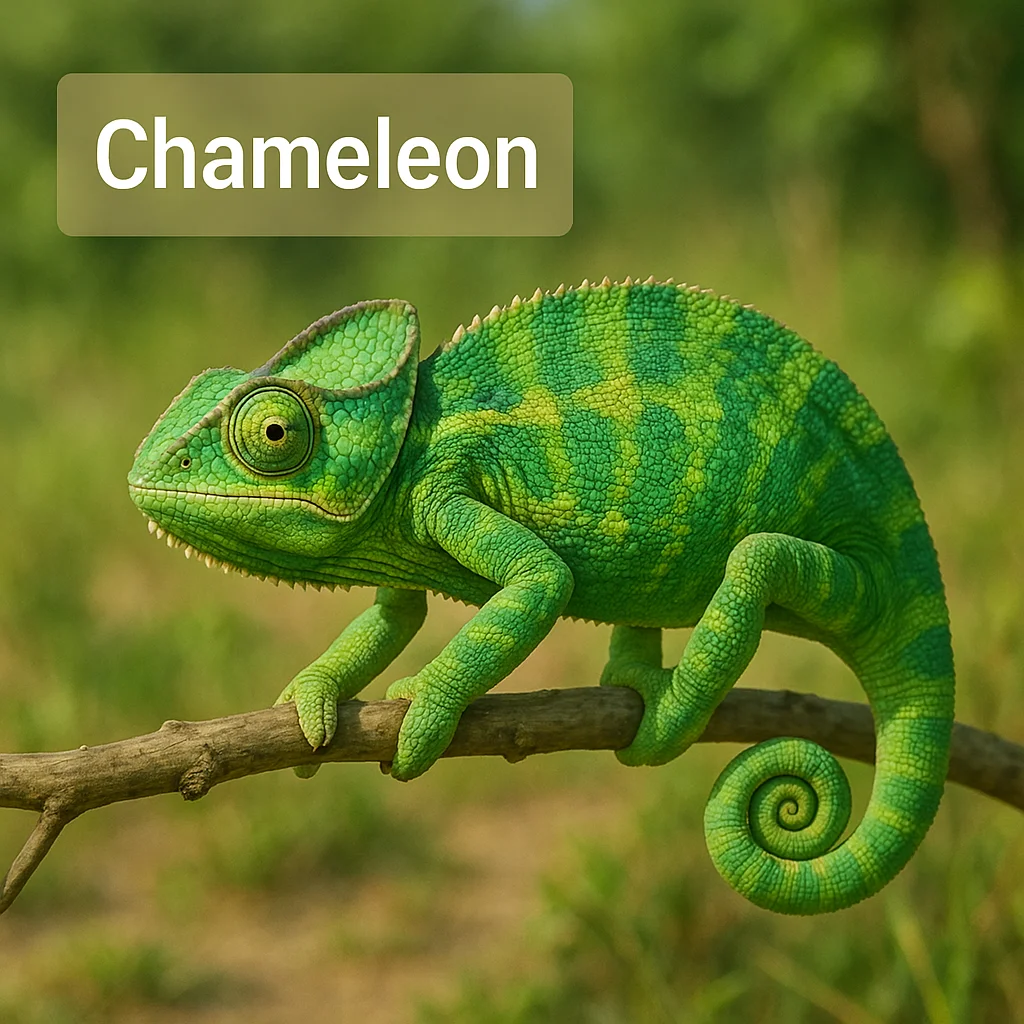
Chameleons are easily identified by their distinct body shape, featuring a laterally compressed body, a long tail, and a casque or helmet-like structure on their heads. Their eyes are independently mobile, allowing them to look in different directions simultaneously. The colors a chameleon displays can vary significantly depending on its mood, temperature, and environmental factors.
- Laterally compressed body assists in camouflage
- Independently rotating eyes for a 360-degree view
- Color changes for communication and thermoregulation
- Clawed feet for gripping branches
- Long prehensile tail used as a fifth limb
- Often confused with geckos; look for the unique eye movement
- Colors range from greens and browns to vibrant hues
- Some have decorative fringes or horns
- Commonly found in trees, with a characteristic "rocking" walk
- Skin texture is typically granular and rough
- Tail usually curls up when at rest
- Typically slow, calculated movements
🧱 Body Structure & Physical Adaptations
Chameleons are built for arboreal living, featuring zygodactylous feet, which are split into two main toes that act like a pincer for grabbing branches. Their long, sticky tongues can exceed their body length, perfect for quickly snatching up insects. Additionally, their skin comprises special pigment cells that facilitate their famed color changes.
- Gripping feet adapted for climbing
- Long, extendable tongue for capturing prey from a distance
- Color-changing abilities for communication and temperature regulation
- Binocular vision for depth perception
- Body designed for camouflage in trees and foliage
- Skin consists of layers that reflect light differently for vibrant colors
- Helical ribs provide flexibility
🌍 Range & Distribution
Chameleons mainly inhabit the tropical and sub-tropical regions of Madagascar and mainland Africa, but smaller populations can be found in the southern parts of Europe and Asia. They prefer warm climates and are often located in forested or bushy terrains. Some species have adapted to a wider range of altitudes and temperatures, but most are tied closely to specific ecological zones.
- Primarily in Madagascar and Africa
- Also found in parts of Southern Europe, the Middle East, and India
- Mostly inhabit areas between 25 and 30 degrees latitude
- Typical habitats include woodlands and shrublands
- Some species may dwell up to 3000 meters above sea level
- Generally non-migratory, relying on stable environmental conditions
- May be found in both humid and dry microhabitats
🏞️ Habitat & Shelter
Chameleons prefer habitats rich in shrubbery and trees, offering ample hiding places and hunting grounds. They thrive in climates that remain relatively stable throughout the year, such as tropical rainforests and savannas. Some species have adapted to more arid zones, seeking shelter in the shade during the hottest times of day. Understanding their habitat is crucial for conservation as many are endemic and highly sensitive to habitat changes.
Seasonal changes often dictate behavioral adaptation, with certain species becoming less active during cooler or drier months. Shelter in the form of dense foliage is critical for protection against predators and to aid in thermoregulation.
🧭 Behavior & Ecology
Chameleons are primarily solitary creatures. During the day, they are active and spend most of their time climbing and hunting for food. They rely on their color-changing ability for communication and temperature regulation. Chameleons use body language, such as puffing up or swaying, to communicate with other species or deter predators. Their role in the ecosystem includes controlling insect populations and serving as prey for larger animals.
- Day active (diurnal) solicitude
- Relies on camouflage for both hunting and avoiding predators
- Puffing and hissing as defensive measures
- Primarily insectivorous diet helps control insect populations
- Males are more colorful, particularly during the breeding season
- Seasonal inactivity during colder or drier periods
- Strong territorial instincts, especially among males
👥 Social Life & Group Dynamics
Chameleons are generally solitary, coming together primarily for mating. Interactions can be territorial, especially among males who display more vivid colors during confrontations. Pair bonds are uncommon outside of reproduction, and juvenile chameleons typically disperse after birth, quickly fending for themselves. While chameleons do not form social groups, they have a complex system of visual and color cues to communicate aggression, submission, or readiness to mate.
- Highly territorial, especially males
- Use color changes for communication during encounters
- No cooperative behavior; solitary hunters
- Juveniles are independent from birth
- Females are less colorful but can be aggressive when threatened
- Breeding usually involves short-term interaction
🍽️ Diet, Prey & Predators
Chameleons are primarily insectivores, utilizing their projectile tongues to catch a wide variety of insects. Some species have been observed consuming small birds, reptiles, or plant matter, especially when prey is scarce. Their main predators include birds and snakes, which are adept at spotting the camouflaged creatures. Chameleons use their color-changing ability, stealth, and synchronized movements with foliage to evade these predators.
- Primarily eat insects such as crickets, locusts, and grasshoppers
- Some species occasionally consume plant matter or small vertebrates
- Use long, sticky tongue to catch prey with high precision
- Main predators include larger birds and reptiles
- Camouflage and stillness are primary defense mechanisms
- Occasional scavenging behavior when prey is sparse
🦌 Hunting, Foraging & Movement
Chameleons are ambush predators, often remaining perfectly still and blending in with their surroundings until prey comes within range of their long, extendable tongues. Their pattern of movement is cautious and deliberate, which aids in remaining undetected by both prey and predators. While not fast, their patience and precision make them effective hunters.
- Ambush predators with slow deliberate movements
- Capable of rapid tongue projection to catch prey
- Mainly hunt during daylight hours
- Arboreal movement with prehensile tails and gripping feet
- Ability to blend movements with the swaying of leaves
- Seldom move over long distances; localized foraging
🧠 Intelligence & Senses
Chameleons possess noteworthy visual acuity and depth perception thanks to their independently moving eyes, which allow them to track prey and monitor their surroundings. Though not known for high intelligence, they exhibit problem-solving skills relevant to their environmental challenges, like navigating complex branch networks. The lack of strong smell further emphasizes their reliance on vision.
- Excellent eyesight allows for 360-degree awareness
- Independently rotating eyes for detecting motion
- Color perception assists in social signaling
- Limited auditory capabilities
- Moderate learning and memory capabilities
🪺 Reproduction, Pregnancy & Parenting
Chameleons generally breed during specific seasons when environmental conditions favor offspring survival. Courtship involves visual displays, particularly by males. Depending on the species, females can lay anywhere from a few to over a hundred eggs. Incubation periods and parental involvement vary widely across species. Typically, chameleons do not provide care after egg-laying, leaving the young to independently hatch and disperse.
- Most breed once or twice a year depending on climate
- Males display vibrant colors for courtship
- Egg-laying with incubation periods ranging from 3-12 months
- Clutch sizes range from 5 to over 100 eggs
- No parental care post-egg laying
- Hatchlings are immediately independent and precocial
♀️♂️ Male vs Female Differences
Male chameleons are often larger and more vibrantly colored than females, especially during mating displays. Certain species exhibit additional features like horns or crests primarily in males. Such sexual dimorphism aids in attracting mates and deterring rivals. Females are inclined toward more subdued colors, which help camouflage them, a significant advantage when nesting.
- Males are typically larger and more colorful
- Males may have additional ornamentation like crests or horns
- Females use less bright colors for camouflage
- Males are more aggressive during breeding season
- Females primarily responsible for laying and protection of eggs
- Mating displays and territoriality more pronounced in males
🧬 Subspecies & Variation
There are over 180 species of chameleons, each adapted to its ecological niche with varied sizes, colors, and behaviors. The distinctions among them can include differences in scale texture, body size, and climatic adaptations. Some species have adapted to environments like deserts or rainforests, illustrating the vast range of morphological and behavioral adaptations.
- Over 180 species with significant diversity
- Chamaeleo, Furcifer, and Trioceros are prominent genera
- Significant variation in size from 2.5 cm to 68 cm
- Island species may exhibit unique traits due to isolation
- Colors and patterns often specific to local environments
- Madagascar is a biodiversity hotspot for chameleon species
⚠️ Threats, Conservation & Human Interaction
The major threats to chameleons include habitat destruction, predation by non-native species, and collection for the pet trade. Conservation efforts are underway in many regions to protect their remaining habitats and inhibit illegal trade. While chameleons are popular as pets, ethical considerations should be made to avoid promoting illegal or harmful practices.
- Habitat loss due to agriculture and deforestation
- Forestry and construction projects pose threats
- Illegal pet trade impacts wild populations negatively
- Climate change affects breeding and food availability
- Conservation efforts focus on habitat protection and legal trade regulation
- Promoting awareness about chameleons in ecosystems
✨ Fun Facts & Unique Traits
- Chameleons can move their eyes independently, unlike most reptiles
- Their tongues can be twice the length of their body
- They have a prehensile tail used much like a monkey's, for gripping branches
- Can change colors within 20 seconds
- Chameleons are mostly silent, occasionally communicating with vibrations
- Depending on the species, chameleons can live from deserts to rainforests
- They consume food that is about 30% of their body weight daily
- Although mostly solitary, some species may exhibit social behavior during mating seasons
📌 Summary
- Chameleons are reptiles primarily known for their color-changing abilities
- They can be found across Madagascar, Africa, and parts of Europe and Asia
- Arboreal in nature, their gripping feet and tails make them adept climbers
- Their diet is chiefly insectivorous, but some species adapt their diet based on availability
- Main predators include birds and snakes, against whom camouflage is their primary defense
- Mostly solitary, with territorial males exhibiting vibrant colors during breeding season
- Egg-laying species, with incubation and parental involvement varying by species
- Adaptations range widely across over 180 species, based on ecological niches
- Habitat destruction and illegal trade are significant threats
- Chamaleon's unique visual traits and tongue mechanics remain subjects of scientific interest