🦁 Gharial
🧾 Quick Facts
The Gharial, known for its unique elongated snout, is a fascinating reptile of India and Nepal's river systems. As part of the crocodilian family, it populates the freshwater ecosystems with its distinct lifestyle and appearance.
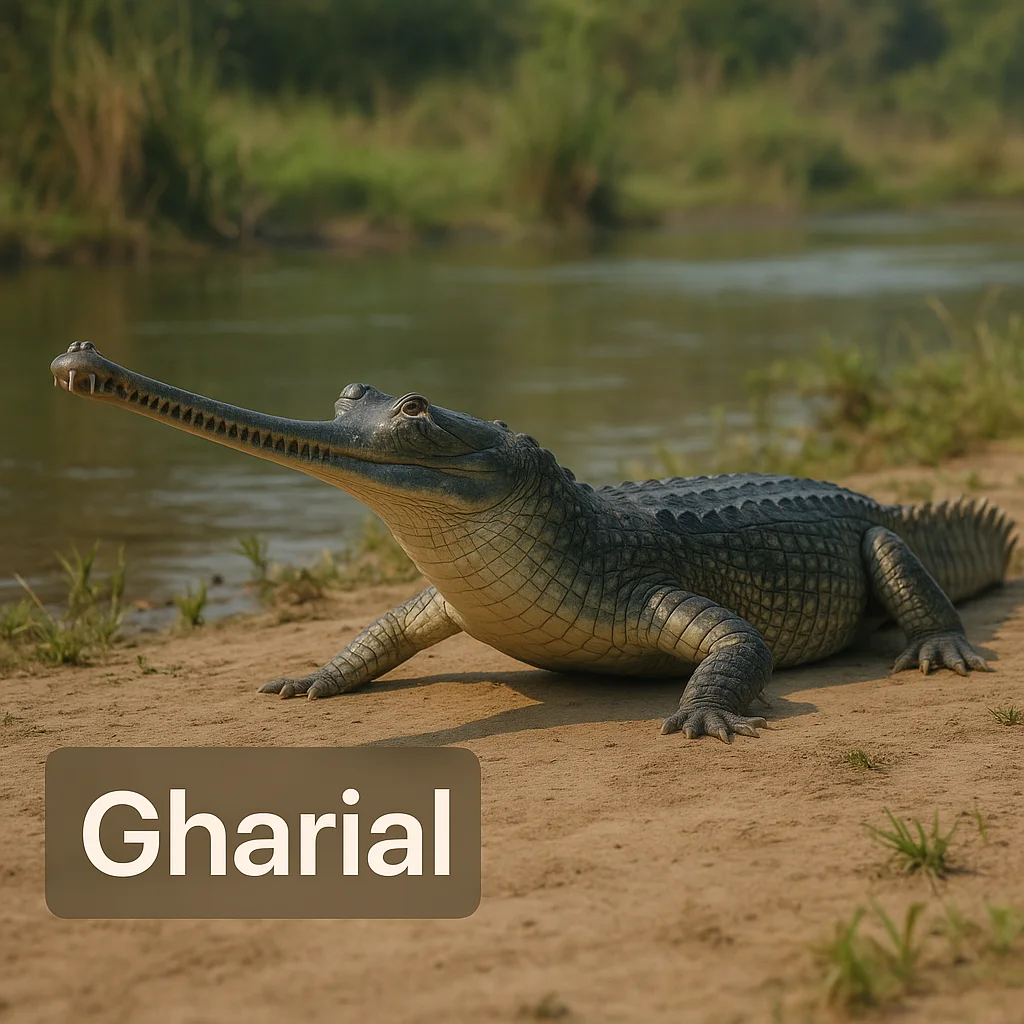
- Common Name(s): Gharial, Fish-eating Crocodile
- Scientific Name: Gavialis gangeticus
- Animal Type: Reptile
- Typical Adult Size: 4.5 to 6 meters long; males larger than females
- Typical Lifespan: 40 to 60 years
- Diet Type: Carnivore, primarily fish
- Activity Pattern: Diurnal
- Social Structure: Solitary, can be found in groups during basking
- Speed/Movement Highlights: Fast swimmers; swim gracefully with their slender bodies
- Intelligence/Learning: Limited problem-solving but adept at hunting
- Primary Habitats: Rivers, freshwater ecosystems
- Geographic Range: India and Nepal
- Predators/Threats: Humans, habitat loss, entanglement in fishing nets
- Conservation Status: Critically Endangered
🔍 Identification & Appearance
Gharials are recognized by their long, narrow snouts, adorned with sharp, interlocking teeth designed for catching fish. Their bodies are covered in dark olive scales, with juveniles possessing light banding that fades with age.
- Long, narrow snout; males have a bulbous growth called a 'ghara' at the tip
- Olive to dark grey coloration; juveniles have lighter crossbands
- Sharp, interlocking teeth visible even with a closed mouth
- Body is streamlined, optimized for swimming
- Scat appears as long, narrow droppings typical to crocodilians
- Often mistaken for crocodiles, but distinguishable by snout shape
- Look for their elongated, slim snouts
- Spot the 'ghara' bulge on mature males
- Observe their sharp, aligned teeth
- Notice their olive-grey coloring
- Watch for basking behaviors on riverbanks
- Distinguish them from crocodiles by snout shape
🧱 Body Structure & Physical Adaptations
The gharial's physical adaptations make it an efficient aquatic predator. Its streamlined body allows for agile swimming, while the snout shape aids in reducing water resistance.
- Slender, streamlined build with a long tail for powerful swimming
- Teeth are needle-like and interlock for catching slippery prey
- Strong limbs are shorter and less robust compared to other crocodilians
- Excellent vision adapted to underwater hunting
- Less adept on land due to limb positioning and body shape
- Snout serves as a hydrodynamic tool in fishing
- Streamlined body for swimming
- Sharp teeth for gripping fish
- Long tail for propelling quickly in water
- Strong underwater vision for detecting prey
- Snout specialized for reducing drag
🌍 Range & Distribution
Gharials historically inhabited the river systems across the northern Indian subcontinent. Today, they are mainly restricted to confined areas within India and Nepal's major river basins.
- Indian subcontinent: Mainly in India and Nepal
- Primarily found in the Chambal, Ghaghara, Gandak, and Rapti rivers
- Prefer warm freshwater rivers with sandy banks
- Low altitude riverine habitats
- Generally non-migratory, but males may roam for mating
- Chambal River, India
- Ghaghara River, Nepal
- Gandak River border regions
- Rapti River banks
- Sandy-beached river systems
🏞️ Habitat & Shelter
Gharials thrive in riverine environments with deep waters and sandy banks. They prefer habitats with a strong current, which provides an abundance of fish. Seasonal changes, such as monsoons, might alter river currents, impacting their behavior and distribution.
Understanding their habitat is crucial for conservation as disruptions can severely affect their survival.
🧭 Behavior & Ecology
Gharials are largely diurnal, spending much of their day basking on sandbanks and fishing during peak daylight hours. They rely heavily on sight to capture their prey, and their sleek bodies make them adept at chasing fish underwater.
- Primarily diurnal; active during daylight
- Relies on sight for hunting
- Skin darkens to assist in camouflaged ambush
- Basking helps in thermoregulation
- Males defend territories during the breeding season
- Vital role as an apex predator in river ecosystems
👥 Social Life & Group Dynamics
Gharials are mostly solitary but are seen in groups, particularly when basking on riverbanks. Males display territorial behaviors during the breeding season but show little evidence of forming distinct social hierarchies.
- Solitary life predominates
- Aggregations noted during basking sessions
- Dominant males oversee territories
- No evident cooperative hunting
- Mild conflict resolution via displays
🍽️ Diet, Prey & Predators
The gharial's diet consists almost exclusively of fish, utilizing its sharp teeth and long snout to catch its slippery prey. Gharials have few natural predators, with human activities posing the most significant threat to their survival.
- Primarily consumes fish, occasional crustaceans
- Efficient ambush predator
- Proficient at catching small, fast-moving fish
- Threatened by habitat destruction and human encroachment
- Fish net entanglement a common danger
🦌 Hunting, Foraging & Movement
Gharials are accomplished swimmers, using their tails for propulsion. Their elongated snouts are an adaptation for hydrodynamic efficiency. They are diurnal hunters, often lying in wait for fish to swim by.
- Expert swimmers with streamlined bodies
- Utilizes its tail for quick, agile swimming
- Primarily hunts during day in shallow waters
- Relies on ambush tactics for catching fish
- Limited terrestrial movement; cumbersome on land
🧠 Intelligence & Senses
The gharial exhibits a typical reptilian behavioral pattern with limited problem-solving abilities. However, its sensory adaptations, particularly its vision, make it an effective hunter.
- Adept vision for detecting prey underwater
- Utilizes vibration sensitivity to detect movement
- Basic problem-solving skills primarily for hunting
- Limited social intelligence
- Research on cognitive abilities is limited
🪺 Reproduction, Pregnancy & Parenting
Gharials typically breed during the cool season when males establish territories and engage in courtship displays. Females lay their eggs in sandy riverbanks, with the incubation period lasting about 55-80 days. Unlike some other crocodilians, male gharials do not participate in parental care beyond territory defense.
- Breeds during cooler months
- Polygynous mating system; dominant males mate with multiple females
- Incubation varies between 55-80 days
- Clutch sizes range from 20-95 eggs
- Females guard nests but provide minimal post-hatch care
♀️♂️ Male vs Female Differences
Male gharials are generally larger with more pronounced snouts. The distinct 'ghara' is exclusive to mature males and serves a role in sexual display and territory defense.
- Males typically larger and heavier
- Males have a bulbous nasal growth (ghara)
- Females lack the nasal 'ghara'
- Gender-based behavior is primarily during breeding
- Subtle size overlap can occur with young males and adult females
🧬 Subspecies & Variation
There are no recognized subspecies of the gharial, though local populations might exhibit minor variations due to habitat differences and isolated geographic distribution.
- No recognized subspecies
- Possible variations in coloration by region
- Minor genetic variation due to isolated populations
- Some phenotypic plasticity based on habitat
- Isolated populations may display slight morphological differences
⚠️ Threats, Conservation & Human Interaction
The gharial is critically endangered, primarily due to habitat destruction, pollution, and human encroachment. Conservation efforts focus on habitat restoration and minimizing human-wildlife conflict.
- Critically endangered due to habitat destruction
- Human encroachment and poaching are significant threats
- Conservation focuses on habitat protection and restoration
- Strict regulation of fishing and riverine activities required
- Efforts made in increasing public awareness about its role
✨ Fun Facts & Unique Traits
- The name 'gharial' comes from the Hindi word 'ghara,' referencing the nasal boss of the male.
- Gharials have more than 100 sharp teeth, perfectly designed for fish hunting.
- Males may use their unique 'ghara' to produce buzzing calls during the mating season.
- Despite their fearsome appearance, gharials are generally harmless to humans.
- They play a crucial ecological role by maintaining fish populations.
- The gharial's streamlined body allows it to execute quick turns while swimming.
- Gharials are part of the Gavialidae family, named after their scientific moniker.
📌 Summary
- Long, narrow snout distinguishes the gharial from other crocodilians
- Primarily inhabits freshwater river systems in India and Nepal
- Carnivorous, diet consists mainly of fish
- Critically endangered due to human activity and habitat loss
- Gharials exhibit minimal social behavior, mostly solitary
- Breeding occurs during cooler months with unique courtship displays from males
- Ecologically significant by regulating fish populations
- Unique physical features include the male's 'ghara'
- Gharials show little interaction with humans, though they are affected by human activities
- Their conservation is vital for riverine ecosystem health