🦁 Green Iguana
🧾 Quick Facts
The Green Iguana, commonly found in Central and South America, is one of the most recognizable large lizards due to its striking appearance and widespread distribution. Known for its laid-back demeanor, the Green Iguana thrives in tropical environments and is a popular sight both in the wild and as a pet.
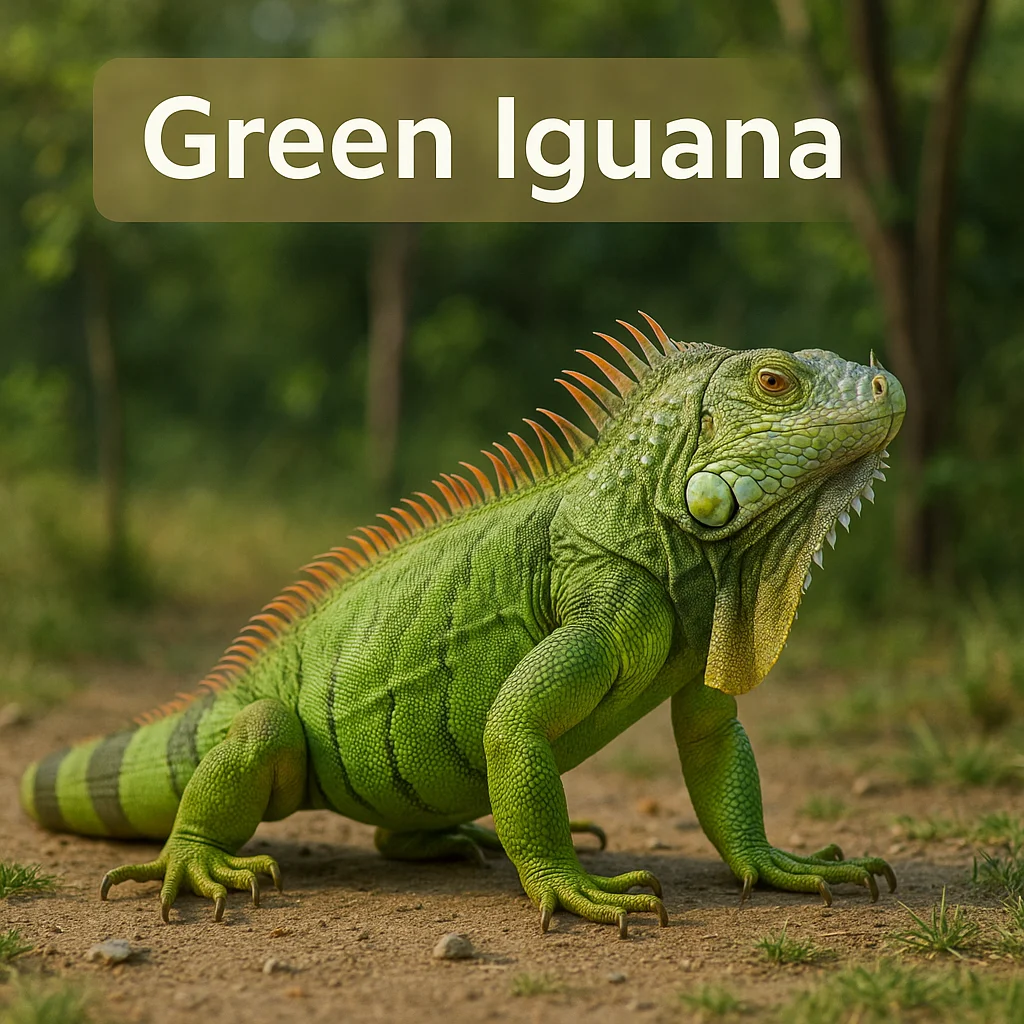
- Common name(s): Green Iguana
- Scientific name: Iguana iguana
- Animal type: Reptile
- Typical adult size: 4 to 6 feet (1.2 to 1.8 meters) including the tail
- Typical lifespan: 10 to 20 years in the wild, up to 30 years in captivity
- Diet type: Herbivore, primarily eating leaves, flowers, and fruit
- Activity pattern: Diurnal (active during the day)
- Social structure: Solitary, except during courtship or basking in groups
- Speed: Capable of brief sprints, primarily excellent climbers and swimmers
- Intelligence/learning: Capable of learning through trial and error; recognized for their visual communication
- Primary habitats: Tropical rainforests, riversides, and occasionally suburban settings
- Geographic range: Central and South America, Caribbean islands
- Predators/threats: Birds of prey, snakes, and humans (for pet trade and food)
- Conservation status: Varies by region, common in areas, and threatened in others due to habitat destruction and exploitation
🔍 Identification & Appearance
Recognizing a Green Iguana involves noting its elongated body, long tail, and distinct spikes running down its back. Their vibrant green coloration can vary, exhibiting darker tones or spots with age. A dewlap, or flap of skin under the chin, and pronounced cheeks are also key characteristics.
- Body shape: Long and slightly flattened with a tail that accounts for half their length
- Key colors/patterns: Bright green in juveniles, with potential browner tones in adults
- Distinctive features: Long tail, dewlap, large jowls, and dorsal spines
- Tracks: Typically not distinct, but claw marks may be noticeable along trees or sand
- Common look-alikes: Lesser Antillean Iguana; distinguishable by their lack of a prominent dewlap
- Top ID Tips
- Look for the long, spiky ridge along their back
- Notice the significant dewlap underneath the chin
- Count the number of visible limbs and body appendages
- Check for the presence of a robust array of cheek jowls
- Observe the vibrant green that can turn darker with age
- Significant tail length compared to body size
🧱 Body Structure & Physical Adaptations
The Green Iguana is built for life in the trees. With a slender, elongated form, a strong muscular tail that aids in swimming, and sharp claws for climbing, it's well-adapted to its environment. Its teeth are serrated, perfect for tearing plant material, while its keen vision aids in detecting predators.
- Build: Long and streamlined with a powerful tail, excellent for balance and swimming
- Teeth: Small, serrated for efficient plant tearing
- Claws: Sharp and well-developed for climbing
- Sensory strengths: Exceptionally sharp vision, particularly in detecting movement
- Key Adaptations
- Muscular tail for defense and swimming
- Serrated teeth for plant consumption
- Keen eyesight for predator detection
- Claws designed for gripping tree branches
- A dewlap used in communication displays
- Coloration providing camouflage in dense foliage
🌍 Range & Distribution
The Green Iguana is native to large parts of Central and South America, inhabiting rainforest canopies. Their range stretches across countries like Mexico, Brazil, and parts of the Caribbean, thriving in warm, humid climates close to water sources.
- Regions: Central America, South America, Caribbean
- Common countries: Mexico, Brazil, Colombia
- Preferred climate: Tropical; relies on warm, humid environments
- Prime habitats near water bodies for ease of escape and abundant food
- Mostly resident with little seasonal movement
- Where You Might Find It
- Dense rainforest canopies
- Around riverbanks
- Suburban and urban areas (escaped pets)
- Along streams and water edges
- Climbing in trees or basking in open areas
🏞️ Habitat & Shelter
Green Iguanas prefer habitats that offer plenty of sunlight and foliage for basking and hiding. They thrive in rainforest environments, heavily forested areas, and near water bodies. During adverse weather, these iguanas often take shelter high in trees or in dense undergrowth.
Their reliance on the right habitat is crucial for their survival, needing trees for shelter, water for cooling, and vegetation for sustenance. Seasonal rains can lead to increased vegetation access while offering cooler climates for thermoregulation.
🧭 Behavior & Ecology
Green Iguanas are primarily solitary creatures with a penchant for lounging in the sun, crucial for regulating their body temperature. They display various forms of communication, including head bobs and posture displays utilizing their dewlap. Their life is arboreal, but they will descend to drink.
- Daily routine: Basking, foraging, and climbing
- Communication: Visual displays with the dewlap and body movements
- Interaction: Limited aside from territorial disputes during mating
- Role: Important herbivores, aiding in seed dispersal
- Behavior Highlights
- Solitary but bask in groups occasionally
- Visual signaling for mate attraction and territory
- Passive interaction within shared territories
- Seed dispersers aiding forest regeneration
- Collectors of sunlight through basking
👥 Social Life & Group Dynamics
Typically solitary, Green Iguanas may congregate in favorable basking spots. Though not inherently social, during the breeding season, they become more territorial and can engage in displays of dominance. Males are often seen establishing and defending territories from rivals.
- Tendencies: Predominantly solitary
- Group types: Occasional loose aggregations around basking areas
- No significant cooperation beyond mating periods
- Dominance: Males dominate territory defense
- Social Structure Notes
- Males form territories in breeding season
- Females may share nesting areas with limited aggression
- Basking in groups reduces individual predator risk
- Timid and non-aggressive outside of mating disputes
🍽️ Diet, Prey & Predators
Herbivorous by nature, Green Iguanas primarily consume leaves, flowers, and fruits. Occasionally, they might ingest insects, though this is not a staple. Their main predators include birds of prey, snakes, and humans, with a primary defense strategy of fleeing into water or robust vegetative cover.
- What it eats: Leaves, fruits, flowers, minor insect consumption
- Main predators: Birds of prey, large snakes, and humans
- Defense: Escape into water or densely vegetated areas
- Feeding Notes
- Predominantly folivorous
- Selective in choosing nutrient-rich foliage
- Skilled at picking ripe fruits
- Avoids consuming too many fibrous plants
- Uses speed and agility to evade predation
🦌 Hunting, Foraging & Movement
Green Iguanas have adapted remarkably well to arboreal life. They excel at navigating tree branches and can also swim rapidly, an ability that aids in predator escape. Foraging is typically an inefficient traveler in search of food within its established range, mostly looking for plants.
- Locomotion: Climbers and swimmers
- Speed: Moderate on land, swift in water
- Foraging: Primarily around tree canopies and forest floor
- Movement & Strategy
- Adapted for tree-top navigation
- Alluring by heat from sunning areas
- Diversified diet through seasonal changes
- Rapid water escape as a survival tactic
🧠 Intelligence & Senses
Though not the most intelligent reptiles, Green Iguanas do exhibit problem-solving abilities, especially in regards to finding food and navigating complex environments. Their strong vision allows them to spot predators from a distance, aiding their survival in heavily forested habitats.
- Problem-solving and memory: Observed in food search adaptations
- Senses: Excellent vision, less sensitive smell and hearing
- State of research: Learning capabilities are noted, but detailed cognitive abilities remain understudied
- Notable Abilities
- Excellent color vision for identifying ripe foods
- Navigation skill in varied landscapes
- Effective communication using visual cues
- Capability to adjust behaviors to temperature changes
🪺 Reproduction, Pregnancy & Parenting
Green Iguanas are seasonal breeders, with mating typically occurring in the dry season. They exhibit a polygynous mating system where dominant males court multiple females. Female iguanas lay clutches varying from 20 to 70 eggs in nests dug within loose soil, practicing no parental care post-egg laying.
- Breeding season: Typically the dry months
- Mating system: Polygynous, with dominant males
- Clutch size: Between 20 and 70 eggs
- No post-nesting parental care, with hatching occurring independently
- Reproduction Snapshot
- Court multiple females
- Establish territories for exclusive breeding rights
- Guaranteeing nesting in safe underground sites
- Young iguanas are independent upon hatching
- Predation on eggs is common
♀️♂️ Male vs Female Differences
Differences between male and female Green Iguanas are noticeable, with males generally being larger and possessing more prominent features such as larger dewlaps and spinal crests. Males are also more brightly colored during the breeding season. Behavioral differences include males being more territorial and aggressive.
- Size differences: Males larger than females
- Coloration: Males possess brighter coloration during mating
- Behavioral roles: Males are territorial and aggressive, especially during the breeding season
- Sex Differences at a Glance
- Males have enlarged femoral pores
- Males have brighter colors for mate attraction
- Males are more aggressive in defending territories
- Females focus on nesting motivation
🧬 Subspecies & Variation
The Green Iguana is a highly variable species with recognized subspecies differing slightly in size and coloration. These adaptations allow them to thrive in diverse environments, from rainforests to urban suburbs. Ongoing taxonomic studies continue to refine these distinctions, with some disagreements in classifications.
- Known subspecies: Slight size and color differences
- Local adaptations: Varying responses to environments
- Taxonomic debates: Variation noted across different regions
- Variation Notes
- Differences in scale color and pattern by region
- Size variation related to resource availability
- Adaptation to urban environments with escaped pet populations
- Subspecies differentiation ongoing through research
⚠️ Threats, Conservation & Human Interaction
While Green Iguanas are adaptable, they face threats from habitat destruction, hunting, and the pet trade. Human expansion into natural areas reduces available habitat, while illegal pet trade exerts additional pressures. Ethical considerations stress the importance of sustainable practices and habitat protection.
- Natural challenges: Predation and habitat competition
- Human pressures: Habitat loss, illegal pet trade, poaching
- Coexistence: Importance of conserving natural habitats and responsible ownership
- Responsible Notes
- Habitat conservation initiatives are crucial
- Sustainable trade practices help curb population pressures
- Awareness campaigns highlight ethical pet ownership
- Efforts to rewild pet iguanas must manage biodiversity risks
✨ Fun Facts & Unique Traits
- Green Iguanas can hold their breath underwater for up to half an hour.
- They have a unique "third eye" on their head to detect light changes.
- Capable of tail autonomy, they can detach their tail to escape predators.
- Despite being predominantly vegetarian, juveniles occasionally consume insects for added protein.
- Very communicative through visual signals, including head bobs and displays.
- Their body's green color provides excellent camouflage among the treetops.
- Green Iguanas have been known to survive falls from great heights due to their tough skin and body structure.
📌 Summary
- Identification: Long-tailed lizard with bright green coloration and dorsal spines
- Habitat: Prefers tropical rainforests and proximity to water bodies
- Distribution: Central and South America, Caribbean
- Diet: Herbivorous, consuming leaves, fruits, and flowers
- Predators: Threats from birds of prey and humans
- Social life: Mostly solitary but gather in basking spots
- Reproduction: Polygynous, with males courting multiple females during the dry season
- Key adaptations: Excellent swimmers, climbers, and possess keen vision
- Unique traits: Ability to communicate visually and escape predators through tail autonomy