🦁 Green Sea Turtle
🧾 Quick Facts
The green sea turtle, also known as Chelonia mydas, is a large and charismatic marine reptile often seen gliding gracefully through the waters of tropical and subtropical oceans. Recognized for its distinctive greenish color, it is an important species contributing to marine ecosystems.
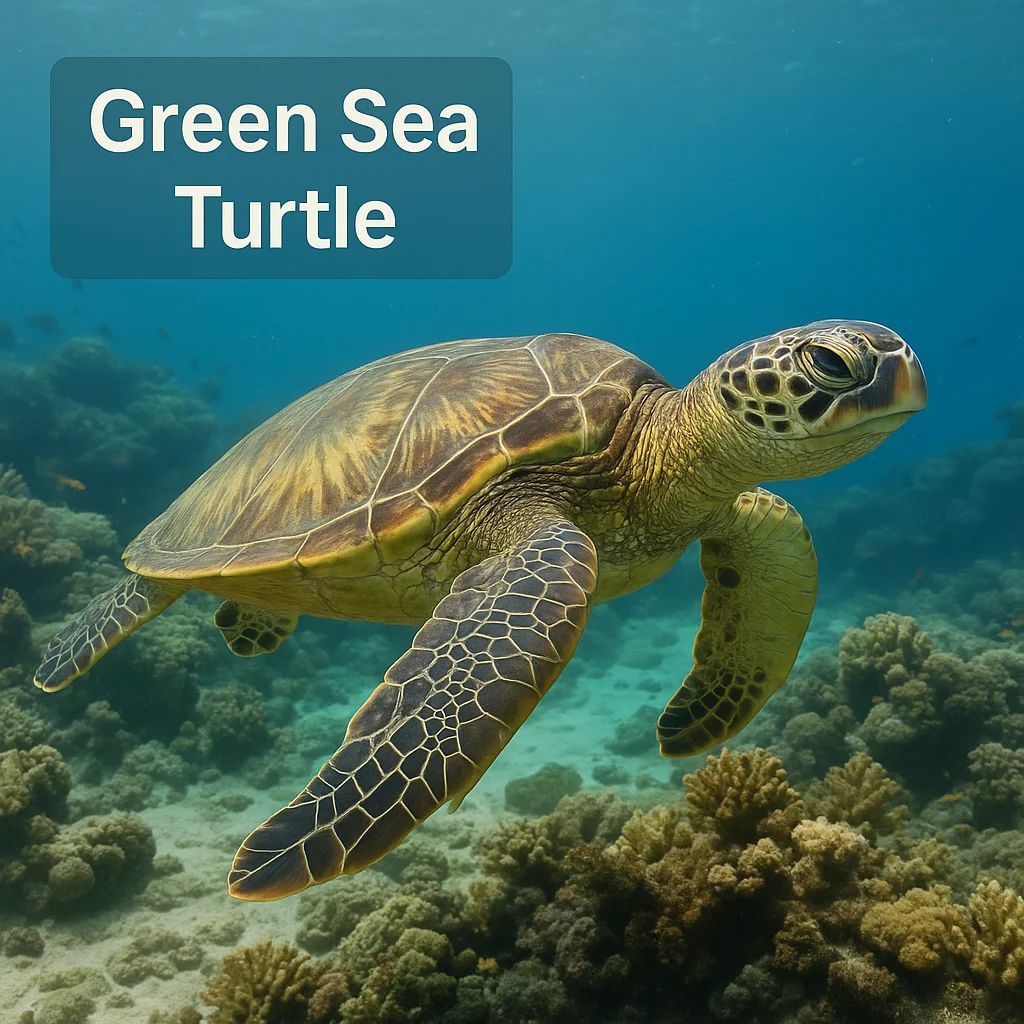
- Common name: Green Sea Turtle
- Scientific name: Chelonia mydas
- Animal type: Reptile
- Typical adult size: 1 to 1.5 meters (3 to 5 feet) in length, 150 to 200 kg (330 to 440 lbs) in weight
- Typical lifespan: 60 to 80 years in the wild
- Diet type: Herbivore; primarily sea grasses and algae
- Activity pattern: Mostly diurnal, active during daylight
- Social structure: Solitary; occasionally seen in groups when basking or feeding
- Speed / movement highlights: Capable of swimming up to 35 km/h (22 mph)
- Intelligence/learning: Known for excellent navigational skills and long-distance migration
- Primary habitats: Coastal areas, shallow bays, and coral reefs
- Geographic range: Tropical and subtropical regions of the Atlantic, Pacific, and Indian Oceans
- Predators/threats: Sharks, orcas, human activities (fishing, habitat disturbance)
- Conservation status: Endangered; varies by region
🔍 Identification & Appearance
The green sea turtle is easily recognized by its large body and heart-shaped carapace, which is distinctively smooth compared to other sea turtles. Their carapace color ranges from olive green to brown depending on their diet and habitat. Unlike many other turtles, they have paddle-like flippers well-adapted for swimming.
The skin of the green sea turtle is lighter in color, with a yellowish hue around the head. Juveniles can differ significantly in coloration, sometimes showing a mix of dark and light patterns.
- Top ID Tips:
- Look for a large, smooth, heart-shaped shell
- Notice the olive green to brown carapace color
- Identify by the single pair of scales in front of their eyes
- Observe the paddle-like flippers for swimming efficiency
- Check for a serrated lower jaw specialized for grazing
- Recognize by their relatively small head compared to body size
- Track marks on beaches resemble sand trails from large paddles
- Compare with similar species like the loggerhead; note size and shell shape
🧱 Body Structure & Physical Adaptations
Green sea turtles have a robust and hydrodynamic body structure. Their forelimbs have evolved into strong flippers that allow them to swim agilely in open waters and maneuver effectively in coastal habitats. Their lightweight, streamlined shell minimizes drag in the water, enhancing their swimming capabilities.
The turtles possess a serrated beak ideal for scraping sea grasses and algae. Their vision is adapted for underwater viewing, although they have limited capabilities on land. Unlike many terrestrial reptiles, green sea turtles rely on their strong sense of smell to locate food under the sea.
- Key Adaptations:
- Serrated lower jaw for grazing on vegetation
- Flippers adapted for swimming long distances
- Streamlined shell to reduce drag while swimming
- Improved underwater vision
- Strong sense of smell for locating underwater food sources
- Adjust body temperature through basking and swimming
🌍 Range & Distribution
Green sea turtles inhabit a broad area across the world's tropical and subtropical oceans. They are found in warm shallow waters, including bays, lagoons, and around coral reefs. Typically, they are residents of coastal areas but are known for their extensive migratory patterns, traveling thousands of kilometers between feeding and nesting sites.
- Where You Might Find It:
- Along the coastal lines of the Atlantic Ocean
- In the coral-rich waters of the Pacific Ocean
- Shallow bays and lagoons worldwide
- Around the Indian Ocean islands
- Near the coastal areas of South America
- The Mediterranean Sea
- Throughout the South Pacific islands
- Adjacent to Central American coasts
🏞️ Habitat & Shelter
Preferring warm, shallow waters, green sea turtles can be found in coastal regions where sea grasses and algae are abundant. They often occupy areas with access to coral reefs, which provide excellent feeding grounds. These turtles rely on various underwater structures for shelter, including seagrass beds and coral formations.
During nesting seasons, females return to the beaches where they were born, which highlights the importance of these coastal habitats. Weather and seasonal changes influence their migratory and reproductive behaviors, prompting movements to more favorable conditions.
🧭 Behavior & Ecology
Green sea turtles are primarily solitary creatures, with much of their day spent foraging. They are known to bask in the sun on beaches or float near the surface to regulate their body temperature. Communication among green sea turtles involves a range of visual signals and body language.
As a vital part of marine ecosystems, these turtles help maintain healthy seagrass beds and balance algal growth on coral reefs. They serve as prey for marine predators and pose minimal competition with other herbivores in their habitat.
- Behavior Highlights:
- Diurnal activity pattern with peaks at dawn and dusk
- Basking behavior unique among sea turtles
- Long-distance migration between nesting and feeding sites
- Minimal vocalizations; rely more on body language
- Key role in controlling seagrass and algae populations
- Supports coral reef health through feeding patterns
- Natural prey for top marine predators
👥 Social Life & Group Dynamics
Social interactions in green sea turtles are generally limited to mating and nesting periods. For most of their lives, they lead solitary existences, occasionally forming small groups in feeding areas. During nesting, females gather on beaches, where limited social interactions occur, mainly around nesting sites.
There is little evidence of cooperative behavior or social bonding outside these crucial activities. Male turtles may engage in some territorial displays during mating seasons, but conflicts are brief and largely non-aggressive.
- Social Structure Notes:
- Primarily solitary adults
- Nesting sites may gather multiple females
- Limited cooperation during feeding
- Minimal competition observed within feeding grounds
- Nesting females might share beaches
🍽️ Diet, Prey & Predators
The herbivorous diet of the green sea turtle primarily consists of various seagrasses and algae types. Their feeding habits greatly influence sea flora health, aiding in marine ecosystem balance. Juvenile green sea turtles are more omnivorous, consuming invertebrates before transitioning into predominantly plant-based diets.
These turtles face natural predation threats, particularly from predatory fish and seabirds during hatchling stages. Adult turtles' main threats include sharks and occasional killer whale attacks. Human activities, such as fishing and habitat destruction, pose significant dangers.
- Feeding Notes:
- Primary food sources: seagrass and algae
- Supports marine ecosystems through grazing activity
- Juveniles feed opportunistically on small invertebrates
- Predators include large fish, birds, and mammals
- Significant threats from fishing nets and pollution
- Contribute to nutrient cycling in marine habitats
🦌 Hunting, Foraging & Movement
Green sea turtles are adept swimmers capable of covering vast distances, supported by their powerful and streamlined fin structure. Their locomotion is primarily defined by smooth, graceful movements through the water, a process bolstered by their lightweight shell and large flippers.
Foraging happens during daylight hours, focusing heavily on seagrass and algal beds. These turtles stick to clear, shallow regions, where food is plentiful and easily accessible. Navigation relies heavily on memory and environmental cues gained through years of migratory travel.
- Movement & Strategy:
- Long-distance swimmers
- Flipper-driven propulsion for efficient travel
- Daylight foraging times maximize food access
- Home range influenced by water temperature and food availability
- Remarkable migratory navigational capabilities
- Rely on coastal landmarks for orientation during travel
🧠 Intelligence & Senses
Green sea turtles demonstrate notable navigational intelligence, often returning to the exact beaches where they were born for nesting. This is thought to involve a geomagnetic imprinting process, yet research continues. Memory aids them in locating food and safe routes during migrations.
Their sensory perceptions are highly adapted to marine environments. Their vision is better suited for underwater conditions, with a largely reduced sense of sight on land. Olfactory senses are keen, aiding in detecting food sources.
- Notable Abilities:
- Strong migratory navigational skills
- Good underwater vision adapted for marine life
- Memory utilization for long-term navigational routes
- Acute sense of smell for foraging
- Geomagnetic field detection for orientation
🪺 Reproduction, Pregnancy & Parenting
Green sea turtles engage in seasonal migrations to nesting beaches, often returning to their hatching sites. Mating typically occurs in the water just offshore. Once mated, females come ashore to dig nests with their hind flippers and lay clutches containing around 100 to 150 eggs.
The incubation period ranges from 45 to 75 days, influenced by environmental temperature. Hatchlings emerge and instinctively make their way to the sea. Parental involvement ceases after eggs are laid, as hatchlings are self-reliant from birth.
- Reproduction Snapshot:
- Nesting season triggered by specific temperature ranges
- Migratory return to birth beaches
- Clutch sizes vary from 80 to 200 eggs
- Incubation period of 45 to 75 days
- No parental involvement post-laying
- Temperature-dependent sex determination in hatchlings
♀️♂️ Male vs Female Differences
Green sea turtles exhibit subtle sexual dimorphism, primarily noticeable through size and tail length differences. Males typically have longer tails and concave plastrons, aiding in reproduction. Females are generally larger and have shorter tails.
Behavioral differences are most apparent during the breeding season, with males actively seeking mates and engaging in brief rivalries over females. Females exhibit unique nesting behaviors distinct from males.
- Sex Differences at a Glance:
- Males have longer tails
- Females generally larger overall
- Males possess concave plastron
- Mating behaviors in males are more active
- Nesting processes are female-exclusive
🧬 Subspecies & Variation
Although primarily considered a single species, green sea turtles exhibit variations influenced by geographic distribution, which leads to size and coloration differences. Some populations are noted for unique traits resulting from their specific environmental conditions.
Debate exists regarding the classification of certain populations as separate subspecies; however, significant genetic differences have not been clearly established. Island-specific forms and colder climate adaptations are noted but remain widely variable.
- Variation Notes:
- Geographic-based size variability
- Coloration differences tied to diet and habitat
- Potential regional adaptations
- Debate on the existence of distinct subspecies
⚠️ Threats, Conservation & Human Interaction
Green sea turtles face numerous challenges both natural and anthropogenic. Key threats include habitat degradation, climate change, bycatch in fisheries, and pollution. Conservation efforts focus on protecting nesting sites, reducing marine pollution, and legal protections.
Educating local communities about sustainable fishing practices and the ecological role of sea turtles is critical in aiding conservation. While green sea turtles are powerful cultural symbols worldwide, it is vital to approach interactions with consideration for their vulnerability.
- Responsible Notes:
- Endangered status requires careful conservation efforts
- Habitat preservation is crucial for survival
- Mitigation of bycatch through modified fishing techniques
- Climate change impact on nesting site availability
- Marine debris and pollution reduction initiatives
- Legal protection enforcement key to conservation success
✨ Fun Facts & Unique Traits
- Green sea turtles can hold their breath for several hours when resting.
- They are named not for their shell color, but the greenish hue of their fat.
- Green turtles can travel over 2,600 kilometers (1,600 miles) between feeding grounds and nesting sites.
- Their gentle grazing helps maintain healthy seagrass beds, crucial for marine life ecosystems.
- Temperature determines hatchling sex: warmer sands typically yield more female turtles.
- Despite being solitary, they often "raft" together when basking at the surface.
- Green sea turtles' navigational abilities are still being studied and are not entirely understood.
📌 Summary
- Green sea turtles are large reptiles found in tropical and subtropical oceans worldwide.
- They are primarily herbivorous and play an important role in maintaining marine ecosystems.
- Recognized by their greenish fat, smooth heart-shaped shell, and paddle-like flippers.
- Endangered due to threats such as habitat loss, pollution, and bycatch.
- Nesting behavior is seasonal, with significant migrations to birth beaches.
- Primarily solitary, although some group behavior is observed during specific activities.
- Conservation efforts focus on protected areas and sustainable practices.