🦁 Reticulated Python
🧾 Quick Facts
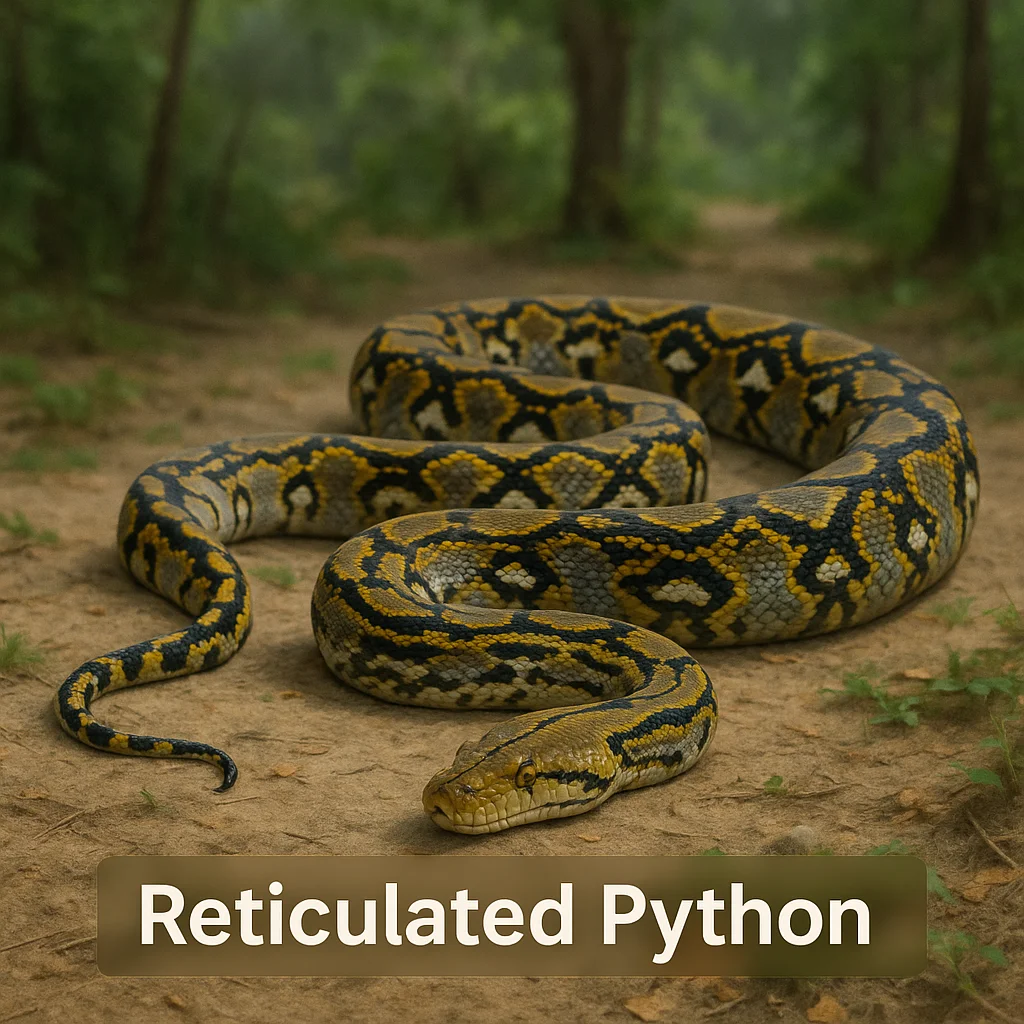
The reticulated python (scientific name: Python reticulatus) is renowned for being the longest snake species in the world. These large, nonvenomous pythons are found in the tropical rainforests of Southeast Asia. Known for their intricate, net-like pattern, they are a fascinating species with a wide array of adaptations that suit their arboreal and terrestrial lifestyles.
- Common name(s): Reticulated Python
- Scientific name: Python reticulatus
- Animal type: Reptile
- Typical adult size: 4.8 to 6.5 meters (15.7 to 21.3 feet) in length; some individuals exceeding 9 meters (29.5 feet)
- Typical lifespan: 15 to 20 years in the wild; up to 30 years in captivity
- Diet type: Carnivore, mainly feeding on mammals and birds
- Activity pattern: Primarily nocturnal
- Social structure: Solitary
- Speed / movement highlights: Slow-moving; capable of sudden bursts during ambush
- Intelligence/learning: Demonstrates problem-solving abilities
- Primary habitats: Tropical rainforests, woodlands, and grasslands
- Geographic range: Southeast Asia, including countries like Indonesia, Thailand, Malaysia, and the Philippines
- Predators/threats: Large birds, crocodiles; human activities like habitat degradation
- Conservation status: Varies by region; not currently threatened, but habitat loss poses risks
🔍 Identification & Appearance
The reticulated python is recognized for its elongated body and striking coloration. Its name derives from the intricate, geometric pattern of light and dark shapes, which provides excellent camouflage among foliage. The skin is predominantly light with a complex overlay of black, brown, and gold that can vary slightly in shade depending on the individual and its environment.
Distinctive features include a triangular head with a prominent jaw and a sleek body. Unlike other pythons, it does not change much in appearance seasonally or with age. Its eyes are rounded with vertical, slit-like pupils, ideal for its nocturnal lifestyle. Tracks and scat are seldom observed due to its arboreal habitat.
- 🔍 Body shape: Long and muscular, tapering to a slender tail
- 🔍 Key colors: Gold, black, brown with a net-like pattern
- 🔍 Distinctive features: Triangular head, prominent jaw structure
- 🔍 Field signs: Rarely leaves tracks due to tropical habitat
- 🔍 Look-alikes: Can be confused with other large pythons; distinguishable by its unique pattern
- 🔍 Pattern variation: Color intensity can vary slightly by individual
🧱 Body Structure & Physical Adaptations
Reticulated pythons are designed for life both in trees and on the ground. Their slender and flexible body enables them to navigate complex environments. The jaw is adapted to expand, allowing them to consume prey much larger than their head. Their teeth are curved and sharp, designed to grip prey securely.
Sensory adaptations include heat-sensing pits along their upper lip, allowing them to detect warm-blooded prey even in darkness. Their hearing is limited, relying more on vibrations, and their vision, while adapted to low light, is complemented by their acute sense of smell, which is vital during hunting.
- 🧱 Build: Slender yet extremely powerful, aiding in constriction
- 🧱 Jaw structure: Stretchable to accommodate large prey
- 🧱 Teeth: Backward-curved, specialized for holding prey
- 🧱 Sensory abilities: Heat-sensing pits for detecting prey
- 🧱 Vision: Adapted to low-light conditions
- 🧱 Smell: Highly developed for hunting
- 🧱 Locomotion: Muscular body aids in both climbing and swimming
🌍 Range & Distribution
The reticulated python's range spans across Southeast Asia, found in countries such as Indonesia, the Philippines, Thailand, Malaysia, and Vietnam. They thrive both at sea level and at elevations of up to 1,200 meters in tropical rainforests.
- 🌍 Region: Southeast Asia
- 🌍 Countries: Indonesia, Philippines, Thailand, Malaysia, Vietnam
- 🌍 Elevation: Sea level to 1,200 meters
- 🌍 Biomes: Tropical rainforests, woodlands, and grasslands
- 🌍 Residency: Generally non-migratory, occupying defined home ranges
🏞️ Habitat & Shelter
Reticulated pythons prefer warm, humid environments such as tropical rainforests, marshes, and grassy lowlands. They can also be found in agricultural areas close to water bodies. This adaptability allows them to exploit various shelter sites, including tree branches, hollow logs, and dense foliage. Seasonal weather changes can influence their movement, prompting migration towards areas with abundant prey.
Understanding the habitat preferences of the reticulated python is essential for appreciating their role in the ecosystem and the challenges they face due to habitat encroachment by humans.
🧭 Behavior & Ecology
Reticulated pythons are solitary creatures, typically coming together only during the breeding season. They are primarily nocturnal, using the cover of night to hunt and avoid the heat of the day. Their primary mode of communication is through chemical signals and body language, as vocalizations are not part of their repertoire.
In the ecosystem, they play a significant role as apex predators, regulating the populations of their prey. Occasionally, interactions with other species occur at shared water sites or when competing for food.
- 🧭 Activity pattern: Nocturnal hunter
- 🧭 Social interaction: Mostly solitary
- 🧭 Communication: Emphasizes chemical signaling
- 🧭 Role: Apex predator in its ecosystem
- 🧭 Symbiotic relationships: Occasionally competes or scavenges alongside other species
👥 Social Life & Group Dynamics
Solitary by nature, reticulated pythons do not form permanent groups or packs. These reptiles interact primarily for reproductive purposes. There is little to no cooperative behavior observed in hunting or territory defense, as individuals maintain their own space and resources.
Conflicts are typically avoided through size displays and brief physical confrontations. In general, their solitary lifestyle minimizes social hierarchy dynamics.
- 👥 Group tendency: Solitary
- 👥 Group formation: Temporary during mating
- 👥 Conflict resolution: Relies on size displays
- 👥 Cooperative behavior: Largely absent
- 👥 Social hierarchy: Minimal due to solitary nature
🍽️ Diet, Prey & Predators
The reticulated python's diet consists primarily of mammals and birds, with common prey including rodents, bats, and occasionally larger animals like pigs and deer. They employ ambush strategies, using their cryptic coloration as camouflage to surprise prey.
Human encroachment and natural predators like crocodiles and large birds pose threats to young pythons. Their main defense is their formidable size and constriction strength, allowing them to dispatch threats quickly.
- 🍽️ Diet: Carnivorous, mammals and birds
- 🍽️ Hunting strategy: Ambush predator
- 🍽️ Main prey: Rodents, bats, pigs, deer
- 🍽️ Natural predators: Large birds, crocodiles
- 🍽️ Anti-predator strategy: Constriction, camouflage
🦌 Hunting, Foraging & Movement
Reticulated pythons primarily utilize an ambush technique, lying in wait for unsuspecting prey to come within striking distance. Their locomotion is primarily characterized by slow, deliberate movements, yet they can strike rapidly when necessary. While adept climbers, most of their hunting occurs close to the ground or near water sources.
- 🦌 Locomotion style: Ambush predator, climber
- 🦌 Speed: Slow-moving, rapid strike
- 🦌 Hunting times: Predominantly nocturnal
- 🦌 Foraging habitat: Ground-based and low branches
- 🦌 Territory: Defined home range
🧠 Intelligence & Senses
Reticulated pythons demonstrate notable intelligence through problem-solving during complex environmental navigation and their ability to memorize specific prey-rich areas. While they don't use tools, their sensory abilities are refined, including excellent olfactory senses for tracking. Research on their cognitive abilities is ongoing, with variations observed across populations.
- 🧠 Problem-solving: Flexible environmental navigation
- 🧠 Senses: Keen olfactory abilities
- 🧠 Social learning: Limited due to solitary nature
- 🧠 Research status: Ongoing and varies by population
🪺 Reproduction, Pregnancy & Parenting
Breeding typically occurs during the cooler months, with males seeking out females through chemical cues. The pythons exhibit a polygynous mating system. Females lay clutches of eggs, generally between 15 to 80, which they incubate by coiling around them to provide warmth. Offspring are independent upon hatching, requiring no parental care.
- 🪺 Breeding season: Cooler months
- 🪺 Mating system: Polygynous
- 🪺 Egg-laying: 15 to 80 eggs per clutch
- 🪺 Incubation: Female-coiled eggs for warmth
- 🪺 Offspring: Independent at birth
♀️♂️ Male vs Female Differences
Males and females exhibit some differences, primarily in size, with females generally being larger and bulkier. Mating roles also differ, with males searching actively for mates while females invest in egg incubation. Behavioral differences in terms of aggression and territory defense are relatively subtle.
- ♀️♂️ Size: Females larger and bulkier
- ♀️♂️ Mating behavior: Males actively search for mates
- ♀️♂️ Parental roles: Female incubates eggs
- ♀️♂️ Behavioral differences: Subtle variations in aggression
🧬 Subspecies & Variation
Subspecies classification within reticulated pythons is a topic of scientific debate, with differences noted in size and coloration according to geographic locality. Variation is common, influenced by island gigantism or dwarfism, which results from isolated environments.
- 🧬 Subspecies: Debate exists over classification
- 🧬 Geographic variation: Island gigantism/dwarfism observed
- 🧬 Pattern/coloration: Varies by locality
- 🧬 Research status: Under continued study
⚠️ Threats, Conservation & Human Interaction
Reticulated pythons face both natural and human-induced challenges. Habitat loss due to deforestation remains a significant threat, along with hunting and the exotic pet trade. While they are not currently classified as endangered, local populations may be at risk. Conservation efforts that focus on habitat preservation are key.
For human interaction, understanding snake behavior is important for reducing conflict, and ethical handling practices are crucial in captivity to ensure their well-being.
- ⚠️ Key threats: Habitat loss, hunting, pet trade
- ⚠️ Conservation status: Variable based on local habitats
- ⚠️ Coexistence tips: Awareness and ethical interaction
- ⚠️ Captivity considerations: Requires specialized care
✨ Fun Facts & Unique Traits
- ✨ The reticulated python can grow longer than any other snake species in the world.
- ✨ They have a remarkable ability to constrict prey with immense force.
- ✨ Their intricate patterns provide excellent camouflage in their natural habitat.
- ✨ They possess heat-sensing pits, allowing them to detect warm-blooded prey easily.
- ✨ They can consume prey items significantly larger than their own head due to a hinged jaw.
- ✨ Despite their size, they are excellent climbers and swimmers.
- ✨ Their lifespan can reach 30 years in captivity with proper care.
📌 Summary
- 📌 Identification: Longest snake with net-like pattern and golden hues
- 📌 Habitat: Tropical rainforests, woodlands, grasslands
- 📌 Distribution: Southeast Asia, including Indonesia and the Philippines
- 📌 Diet: Carnivorous, hunting mammals and birds
- 📌 Predators: Large birds, crocodiles, human pressures
- 📌 Social life: Solitary, except during mating
- 📌 Reproduction: Female incubates eggs; offspring independent
- 📌 Key Adaptations: Heat-sensing pits, powerful constriction
- 📌 Distinctiveness: Apex predator role, remarkable length