🦈 Basking Shark
🧾 Quick Facts
The basking shark, scientifically known as Cetorhinus maximus, is the second largest fish in the world. Known for its gentle nature and impressive size, it is a filter-feeding shark that can be found in oceans around the world.
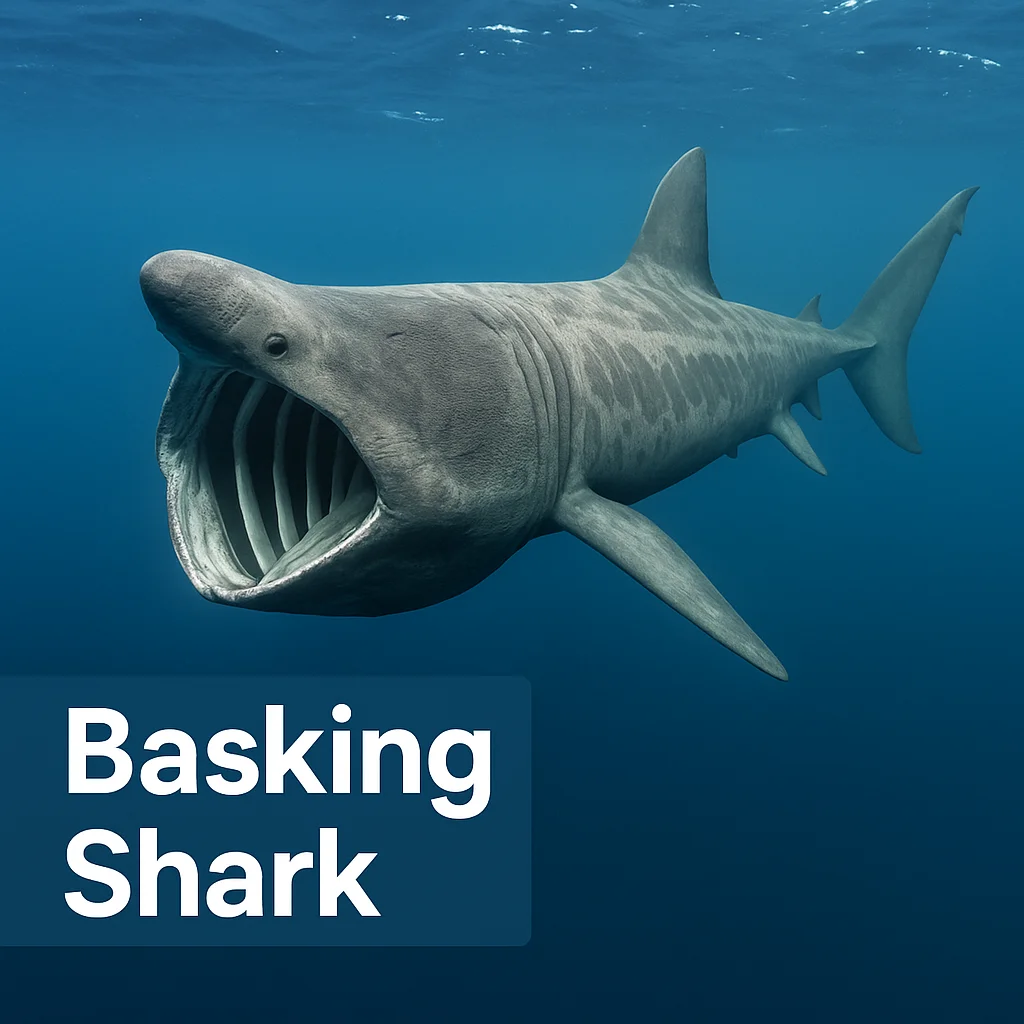
- Common name(s): Basking Shark
- Scientific name: Cetorhinus maximus
- Animal type: Fish
- Typical adult size: 20–26 feet in length, weighing up to 5 tons
- Typical lifespan: 20–30 years (in the wild)
- Diet type: Filter feeder, consuming mainly plankton
- Activity pattern: Diurnal
- Social structure: Mostly solitary or small groups
- Speed / movement highlights: Slow swimmer, around 2–4 mph
- Intelligence/learning: Limited learning; primarily follows instinctual behaviors
- Primary habitats: Coastal and open ocean
- Geographic range: Worldwide, temperate oceans
- Predators/threats: Orcas, large sharks, human activities
- Conservation status: Varies by region; often considered vulnerable
🔍 Identification & Appearance
Recognizable by its colossal size, the basking shark has a torpedo-shaped body and a distinctive conical snout. Its grayish-brown skin may appear mottled, especially across the back. The gills are long and extend nearly completely around its head. Its mouth is cavernous and can appear wide-open as it feeds, though it lacks teeth.
- Top ID Tips:
- Extremely large size, up to 26 feet
- Huge, open mouth when feeding
- Long gill slits nearly encircling its head
- Conical, rounded snout
- Mottled gray-brown skin
- Large dorsal fin, often visible above the water
- Sluggish swimming behavior
- Broad, powerful caudal (tail) fin
🧱 Body Structure & Physical Adaptations
The basking shark is well-adapted for filter feeding. Its wide mouth allows it to ingest vast amounts of water to filter out plankton using its gill rakers. It has a heterocercal tail fin that aids in propulsion through the water.
- Key Adaptations:
- Massive mouth for efficient filter-feeding
- Long gill rakers for filtering plankton
- Streamlined, torpedo-like body for stability in ocean currents
- Large, stiff dorsal fin for balance
- Sensitive lateral line for detecting water movements
- Gill slits for efficient oxygen extraction
🌍 Range & Distribution
The basking shark is found in temperate oceans worldwide. It tends to frequent continental shelf areas, preferring cooler waters. Seasonal migrations are common as they follow food sources like plankton blooms.
- Where You Might Find It:
- North Atlantic Ocean
- North Pacific Ocean
- Southern Hemisphere temperate waters
- Nearshore coastal regions
- Surface waters for feeding
- Off British coastlines during summer
- Along the western coast of the United States
🏞️ Habitat & Shelter
Basking sharks prefer coastal areas but can occasionally be found in the open ocean. They inhabit the epipelagic zone, staying near the surface where they can feed on plankton. Seasonal changes trigger migrations to follow food sources.
🧭 Behavior & Ecology
Basking sharks are known for their slow, deliberate swimming near the ocean's surface. They are non-territorial and generally solitary, though they can be found in loose groups during plankton blooms. Their role in the ecosystem is primarily as a filter-feeder.
- Behavior Highlights:
- Filter-feeding with mouth open, swimming slowly
- Non-aggressive nature
- Solitary or found in small, non-permanent groups
- Migration following plankton blooms
- Surface feeding in summer months
- Occasional breaching observed
👥 Social Life & Group Dynamics
Typically solitary, basking sharks can be observed in small aggregations during feeding seasons. There is no evidence of complex social structures or cooperative behaviors, and they do not form permanent groups.
- Social Structure Notes:
- Primarily solitary lifestyle
- Sometimes seen in groups of up to 100 during feeding
- No known territorial behavior
- No hierarchy within observed groups
- Non-aggressive towards other species
🍽️ Diet, Prey & Predators
The basking shark is a planktivore, feeding on small organisms such as copepods, larvaceans, and fish eggs. They are not active predators and have few natural predators due to their size, though orcas and larger sharks occasionally prey on young or sick individuals.
- Feeding Notes:
- Consumes vast quantities of plankton
- Filter feeds near surface
- Mouth kept open when feeding
- Uses gill rakers to trap food
- Migrates to follow plankton blooms
🦌 Hunting, Foraging & Movement
Basking sharks are slow swimmers, utilizing steady movement to filter feed. They can perform vertical migrations, coming to the surface to feed during the day and possibly resting in deep waters at night.
- Movement & Strategy:
- Slow, continuous swimming
- Filter feeding with open mouth
- Migrates according to plankton availability
- Rare episodes of breaching
- Follows currents rich with food
🧠 Intelligence & Senses
The basking shark has limited cognitive abilities, as it relies heavily on instinctual behaviors. Its sensory adaptations support its filter-feeding lifestyle, such as a sensitive lateral line for detecting changes in water movements.
- Notable Abilities:
- Strong lateral line sensitivity
- Sparse use of eyesight; relies more on water movement detection
- Basic problem-solving related to feeding efficiency
🪺 Reproduction, Pregnancy & Parenting
Basking sharks are thought to breed in the summer, though exact mating behaviors are not well-documented. They are ovoviviparous, giving birth to live young. Gestation periods are poorly documented, but it is believed to last between one and three years.
- Reproduction Snapshot:
- Uncertain breeding behaviors
- Gives birth to live young
- Poorly known gestation period
- Long intervals between breeding seasons
♀️♂️ Male vs Female Differences
Generally, female basking sharks tend to be larger than their male counterparts. However, without straightforward external differences or behavioral traits, any divergence in size is the primary distinguishing factor.
- Sex Differences at a Glance:
- Females typically larger than males
- No significant color or pattern differences
- Subtle differences in fin size documented
🧬 Subspecies & Variation
There are no widely recognized subspecies of the basking shark, although individual size can vary based on regional conditions and food availability. Some scientists discuss the potential for unrecognized genetic diversity across global populations.
- Variation Notes:
- No confirmed subspecies
- Possible undocumented regional differences
- Size varies with prey availability
⚠️ Threats, Conservation & Human Interaction
Basking sharks face threats from fisheries bycatch, marine pollution, and vessel strikes. They are also sometimes targeted for their fins and liver oil. Conservation measures focus on protecting important feeding and breeding grounds.
- Responsible Notes:
- Migratory routes vulnerable to human activities
- Protected under international conservation agreements
- Support policies for marine protected areas
- Avoid disrupting their feeding by maintaining a safe distance
✨ Fun Facts & Unique Traits
- Second largest fish in the world after the whale shark
- Can filter millions of liters of seawater daily
- Seasonal migrator, known for traveling great distances
- One of the few sharks capable of breaching (jumping out of the water)
- Historically misunderstood as a fearsome predator
- Has no teeth for eating prey, relying solely on plankton
📌 Summary
- Highly distinctive due to sheer size and open-mouthed feeding
- Prefers temperate ocean regions, often near coasts
- Feeds exclusively on plankton through filter-feeding
- Few predators, primarily safe from natural threats
- Mostly solitary with minimal social interaction
- Poorly understood reproduction with infrequent births
- Excellent adaptations for filter-feeding lifestyle
- Global distribution but sensitive to human impacts
- Role as a major consumer of plankton in marine ecosystems