🦁 Bluefin Tuna
🧾 Quick Facts
The Bluefin Tuna is often regarded as one of the most iconic species in the realm of oceanic fish, known for its remarkable speed and size. There are several species within the bluefin group, each with unique traits but sharing common characteristics that make bluefin tunas distinctive.
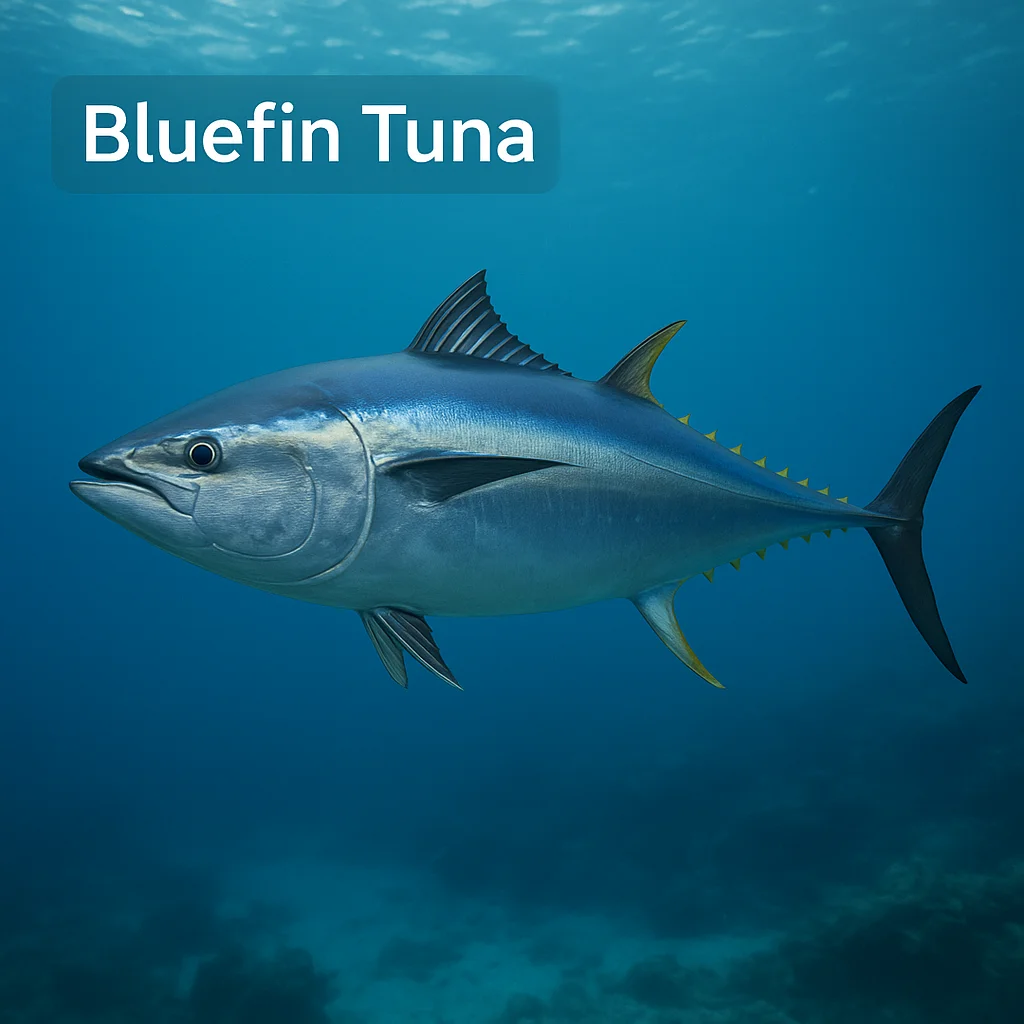
- Common name(s): Bluefin Tuna
- Scientific name: Varies (Thunnus thynnus, T. orientalis, T. maccoyii)
- Animal type: Fish
- Typical adult size: 2-3 meters in length; up to 500 kg in weight
- Typical lifespan: 15-30 years in the wild
- Diet type: Carnivore; feeds on fish, squid, crustaceans
- Activity pattern: Diurnal
- Social structure: Generally solitary but may form schools
- Speed / movement highlights: Capable of swimming at speeds over 60 km/h
- Intelligence/learning: Exhibits complex migratory and social behaviors
- Primary habitats: Open ocean
- Geographic range: Atlantic, Pacific, and Southern Oceans
- Predators/threats: Sharks, larger predatory fish, humans
- Conservation status: Varies by species; some endangered
🔍 Identification & Appearance
Bluefin Tuna are recognized by their smoothly rounded, torpedo-shaped bodies. These fish are a shimmering metallic blue on the top with a silvery white bottom, aiding in camouflage from both prey and predators. They possess long, narrow pectoral fins and distinctive crescent-shaped tails.
- Distinctive, robust body shape
- Metallic blue coloration with silvery belly
- Long pectoral fins
- Crescent-shaped tail
- Streamlined for speed
- Large, circular eyes
- Counter-shaded body aids in camouflage
- May have slight color variations by species
🧱 Body Structure & Physical Adaptations
Bluefin Tuna boast a muscular, hydrodynamic build designed for high-speed swimming and endurance. Their body structure is optimized for long-distance migrations. Strong jaws and sharp teeth allow them to catch quick-swimming prey. Their fins provide stability and maneuverability in open water.
- Torpedo-shaped, streamlined build
- Powerful tail propels fast swimming
- Sharp, conical teeth for gripping prey
- Highly developed gills for efficient oxygen exchange
- Robust muscular structure for sustained swimming
- Dense bones, unlike most fish, aiding buoyancy control
- Sensory cells lining the lateral line for detecting water movements
- Vision optimized for predatory lifestyle
🌍 Range & Distribution
Bluefin Tuna are distributed across the world’s oceans, with different species occupying distinct regions. The Atlantic Bluefin is found in the North Atlantic Ocean and adjacent seas, the Pacific Bluefin is located in the North Pacific Ocean, and the Southern Bluefin is primarily in the Southern Hemisphere.
- Found in temperate and tropical ocean areas
- Atlantic Bluefin: North Atlantic, Mediterranean
- Pacific Bluefin: Northwestern Pacific, spawning in the western Pacific
- Southern Bluefin: Southern Hemisphere, near Australia and New Zealand
- Prefers open ocean habitats
- Migratory, following prey and breeding patterns
- Can be found near coastlines during certain seasons
- Mainly pelagic, residing in deep waters
🏞️ Habitat & Shelter
Bluefin Tuna thrive in open ocean environments. Their preference for the pelagic zones allows them to access extensive feeding grounds. They are rarely associated with reefs or shallow waters, except when younger individuals may enter coastal zones to avoid larger open-water predators.
Seasonal shifts in temperature and food availability influence their migratory patterns. These migrations are crucial for their life cycle, particularly for breeding and accessing areas with abundant prey.
🧭 Behavior & Ecology
An apex predator, the Bluefin Tuna plays a critical role in marine ecosystems. They exhibit complex migratory behavior, travelling thousands of kilometers, which suggests an advanced ecological strategy for feeding and reproduction. Bluefin Tuna often form schools, especially when feeding on smaller fish.
In addition to their role as a top predator, they are important prey for larger species like sharks and humans.
- Form schools for social hunting
- Involved in long-distance migrations
- Diurnal feeding habits
- Use speed and agility to catch prey
- Part of a dynamic marine food web
- Highly migratory, spanning vast oceanic distances
- Predation pressure spurs their alertness and adaptation
- Utilize body language in group coordination
👥 Social Life & Group Dynamics
Bluefin Tuna exhibit both solitary and social behaviors. While they are often seen alone, they can form large schools during feeding or migration. These schools may consist of hundreds of individuals, providing benefits such as increased protection from predators and more efficient foraging.
Within these schools, there is cooperation to herd prey species into tight groups, which facilitates easier feeding.
- Social schooling behavior for feeding
- Dynamic group sizes, adapting to environmental conditions
- Utilize group dynamics for more effective hunting
- No distinct dominance hierarchies observed
- Schools can deter predators through numbers
- Cooperative interaction mainly during feeding and migrations
- Individual tuna display independence outside schools
- Sudden changes in group behavior when threats are perceived
🍽️ Diet, Prey & Predators
As powerful predators, Bluefin Tuna primarily consume a carnivorous diet, feeding on fish like herring and mackerel, as well as squid and crustaceans. Their hunting techniques include rapid bursts of speed to outpace prey and coordination during schooling to herd and capture smaller fish.
Natural threats include sharks and larger predatory fishes, while human fishing pressures represent a significant anthropogenic threat.
- Feeds on a variety of pelagic fish
- Squid and crustaceans are common prey items
- Utilizes speed to capture fast-moving prey
- Plays a key role in regulating prey populations
- Vulnerable to overfishing by humans
- Adaptive hunting strategies depending on prey type
- No scavenging behavior noted
- Preyed upon by large sharks when young or wounded
🦌 Hunting, Foraging & Movement
Bluefin Tuna are expert swimmers with the ability to travel enormous distances swiftly. They are known for their endurance, allowing them to chase prey over large areas. Their hunting takes place mainly at sunrise and sunset, when prey is active.
- Highly efficient swimmers, covering vast distances
- Hunt through cooperative schooling or solo pursuits
- Travel long distances during seasonal migrations
- Hunting and foraging strategies vary with prey availability
- Exceptional burst speed for effective prey capture
- Responsive to environmental changes during migration
- Follows migratory routes that align with prey movements
- Relies on powerful muscular build for endurance
🧠 Intelligence & Senses
Bluefin Tuna possess advanced sensory detectors, particularly in vision and lateral line systems, aiding in detecting prey and navigating the vast oceans. Although their problem-solving and learning are not well-documented, their successful long-distance migrations suggest a high level of navigational intelligence.
- Acute vision for detecting prey and predators
- Lateral line detects movements and pressure changes
- Reacts to environmental cues for migration
- Adaptability to different marine environments
- Limited research on cognitive abilities
- Capable of learning migration routes
- Sensory adaptations for predation efficiency
- Little evidence of tool use or problem-solving
🪺 Reproduction, Pregnancy & Parenting
Bluefin Tuna are broadcast spawners, releasing eggs and sperm into the ocean where fertilization occurs externally. Spawning is commonly seasonal, triggered by temperature changes. They exhibit ovaries or testes that can ripen synchronously to ensure high success rates in fertilization.
- Broadcast spawners with external fertilization
- Seasonal spawning usually in warm months
- Spawning often occurs in specific breeding grounds
- Females can produce millions of eggs
- No parental care post-spawning
- Ensures genetic diversity through broad dispersal
- Eggs and larvae are part of the planktonic community
- Juveniles migrate after development in nurseries
♀️♂️ Male vs Female Differences
In Bluefin Tuna, sexual dimorphism is relatively subtle, with males and females generally similar in appearance. Both genders can achieve significant size; however, there may be slight variations in reproductive organ structures.
- Males and females similar in size and coloration
- Internal reproductive structures for gender distinction
- Few visible differences in behavior or territoriality
- Both sexes contribute to spawning events
- Limited dimorphism compared to other fish species
- Slight variance in size possible within populations
- No dedicated nesting or parental roles
- Sexual maturity reached around the same age
🧬 Subspecies & Variation
Bluefin Tunas are divided into several key species with regional adaptations—the Atlantic, Pacific, and Southern Bluefin Tunas being the most recognized. Variation can occur in terms of size, range, and spawning grounds. Genetic studies sometimes debate the exact classification due to overlapping traits.
- Atlantic, Pacific, Southern species recognized
- Size differences among geographical populations
- Regional spawning grounds influence genetic flow
- Genetic overlap may complicate subspecies classification
- Adaptive traits linked to water temperature and food availability
- Similar appearance but different geographic ranges
- Seasonal variation in behavior and migration patterns
- Some regions show more pronounced size dimorphism
⚠️ Threats, Conservation & Human Interaction
Bluefin Tuna face significant challenges from overfishing, habitat changes, and climate impacts. Conservation efforts aim to regulate fishing quotas and establish marine protected areas. Human interaction primarily involves commercial fishing, which has historically impacted tuna populations.
- Facing overfishing and habitat degradation
- Climate change affects spawning and migration
- Conservation status varies; some are endangered
- Efforts focus on sustainable fishing practices
- Marine protected areas help safeguard populations
- Enhanced regulations on international fishing quotas
- Public awareness campaigns promote conservation
- Collaboration across countries for conservation initiatives
✨ Fun Facts & Unique Traits
- Bluefin Tunas are among the fastest fish in the ocean.
- They are warm-blooded, a rarity among fish, allowing them to adapt to various water temperatures.
- Their ability to travel long distances is key to their migratory patterns.
- Highly prized in sushi markets, their economic importance is significant.
- They can regulate their body temperature, which aids in efficient hunting in different climates.
- Bluefin Tuna are known for their spectacular leaping ability.
- They have been tracked traveling across entire ocean basins.
- Widely studied in marine biology for their unique adaptations.
- Bluefin Tuna populations are used to study the effects of climate change on marine life.
- Their diet and role as top ocean predators make them an essential species in marine food webs.
📌 Summary
- Recognizable by their large, streamlined bodies and distinctive coloration.
- Inhabit open ocean habitats and are highly migratory.
- Distributed in Atlantic, Pacific, and Southern Oceans.
- Carnivorous diet focusing on fast-swimming prey like fish and squid.
- Natural predators include larger fish and sharks, with significant human fishing threats.
- Complex social structures when schooling for feeding and migration.
- Reproduction is through widespread spawning, with no parental care.
- Key adaptations include speed, endurance, and thermal regulation.
- Serve an essential role in marine ecosystems as apex predators.